
This newsletter is free and goes out to over 24,000 subscribers, but it’s only able to sustain itself due to the support I receive from a small percentage of regular readers. Would you please consider becoming one of those supporters? You can subscribe via Patreon or the Subscribe button below! You can also make one-time donations through Venmo or PayPal.
The Southern Baptist Convention, the largest Protestant denomination in the country, lost another 390,312 members over the past year and hitting another 50-year low, according to the Annual Church Profile (ACP) compiled by Lifeway Christian Resources (an arm of the SBC).
The SBC is spinning this by saying baptisms are up and “the SBC has seen five consecutive years of increases in baptisms,” but that’s an imaginary metric that means very little outside their bubble.
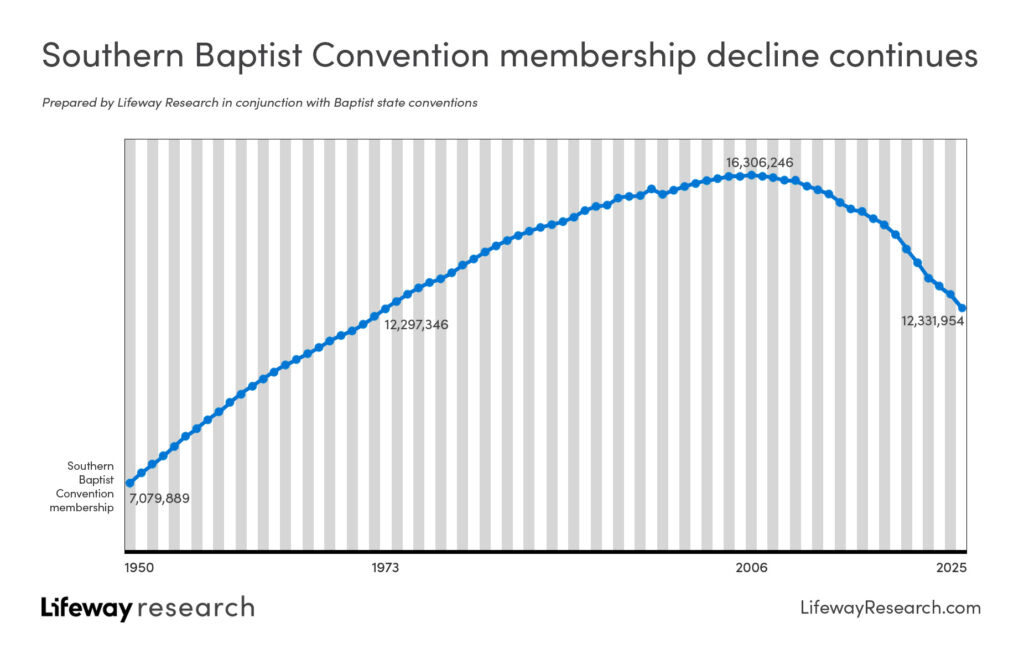
Here are the facts: Membership has declined for 19 straight years. And the decline is picking up steam. Given the record declines in previous years, this means things are continuing to get worse for the SBC.
Southern Baptist churches saw sustained growth in attendance and baptisms, but the two-decade membership decline continued in 2025.
Total Southern Baptist Convention (SBC) membership fell by more than 3% from 2024 to 2025, dipping to 12,331,954, according to the Annual Church Profile (ACP) compiled by Lifeway Research in cooperation with Baptist state conventions.
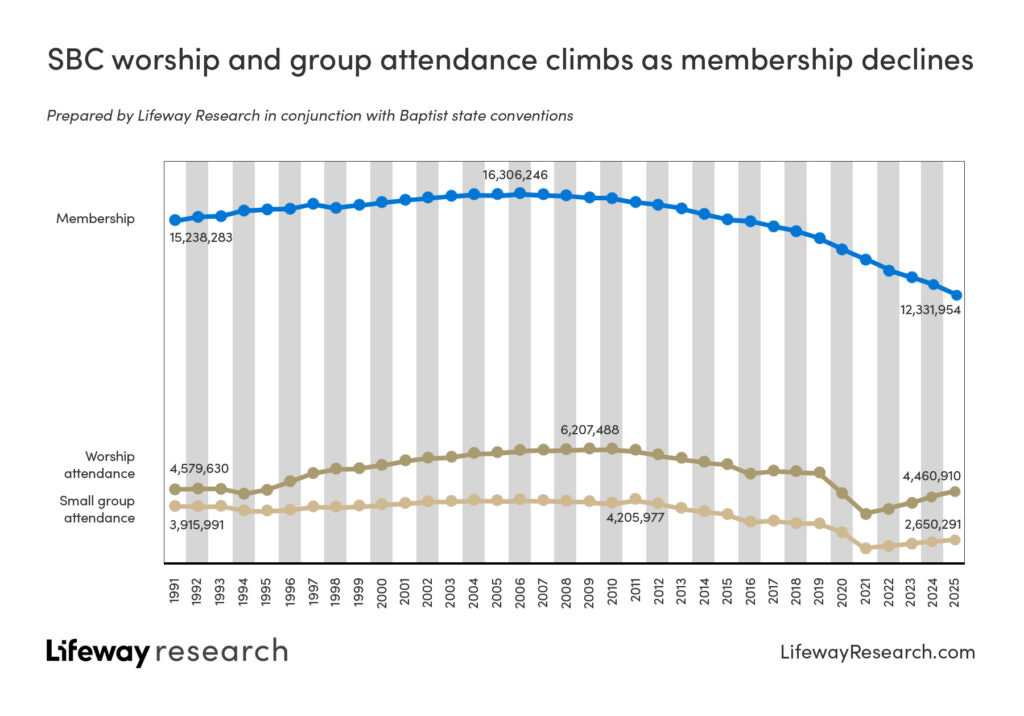
While fewer members belong to Southern Baptist congregations, more people are attending worship services and small groups and are being baptized.
It’s never good when you have to brag about how, sure, your popularity is still fading, but at least you dunked a few more people in water.
Couldn’t have happened to a more worthy organization.
Here are the numbers you want to hear:
In 2021, there were 13.68 million Southern Baptists.
In 2022, that number dropped to 13.2 million (a loss of 457,371 people).
In 2023, that number dropped to 12.99 million (a loss of 241,032 people).
In 2024, that number dropped to 12.72 million (a loss of 259,824 people).
In 2025, that number dropped to 12.33 million (a loss of 390,312 people).
That’s where we’re at today.
The last time the SBC saw membership at this level was in 1973—well over 50 years ago!—when the numbers were going in the other direction and Jimmy Carter would, in three years, be elected president.
It’s all a far cry from 2003, when the SBC had a record high 16.3 million members. While the number of baptisms and in-person attendance numbers have gone up in recent years, that doesn’t counteract the fact that fewer people want the taint of that Southern Baptist label.
It doesn’t matter how many people get baptized if the cup is still leaking faster than they can refill it.
Some of that decline can be blamed on the pandemic—and the recovery since then. It would explain why weekly church attendance and baptisms have been inching upward since 2021 despite a drop in overall membership.
Some of that can be blamed on older members dying and not getting replaced by younger Baptists.
But remember that in 2023, Scott McConnell, executive director of Lifeway Research, explained the steep declines by saying many churches were just “catching up” on their record keeping and cleaning up their membership rolls by getting rid of people “who stopped participating in an individual congregation years ago.” If those rolls were cleaned up, then why does membership continue to drop? Answer: Because the problem was never paperwork.
Not that that’s stopping him from still blaming the record keeping.
“Church closures and churches cleaning up their membership rolls to reflect those people God has currently entrusted to them have negative impacts on total membership numbers. Churches with more than four times as many members as their average attendance are either unhealthy or need to clean up their membership records,” said Scott McConnell, executive director of Lifeway Research.
Okay. But they’re still not making up for the ones who are leaving or dying.
Nowhere in the report does it say anything about how potential members may have been turned off by the SBC’s pathetic attempts at addressing its sex abuse crisis, or downplaying sexual misconduct among former leaders, or punishing churches with women pastors, or pushing out Black pastors, or losing prominent advocates, or all the anti-LGBTQ policies. (A 2024 survey found that “negative religious teachings or treatment of about gay and lesbian people” was one of the top reasons people gave for why they left the religion of their childhood.)
Nor does it say anything about how some of the largest and most influential SBC churches in the country have chosen to leave the denomination entirely.
Three key megachurches — Saddleback Church in Southern California, Elevation Church in North Carolina, and NewSpring Church in South Carolina — exited the convention since in 2023. NewSpring left just a few weeks ago. All three churches consistently rank as the top 100 largest U.S. churches, according to Outreach 100, a survey administered by the SBC-affiliated Lifeway.
The recent news of NewSpring’s departure revived discourse among Southern Baptists about whether it’s more important for the SBC to maintain its size — a key factor in how the denomination exerts wider influence across U.S. politics and culture — versus its commitment to certain theological tenets.
Those churches left because they believe women can hold certain positions of leadership in the church (if not the top one). And instead of addressing actual problems, the SBC’s members are focused on how to best rearrange deck chairs on the Titanic.
Their public outreach is pathetic, too.
Recall that when Bart Barber, the former president of the SBC, appeared on 60 Minutes in October of 2022 to defend the denomination and present a more compassionate side of the SBC, he still ended up saying he wanted to force children to have their rapists’ babies, regardless of circumstance, because he believes fetuses matter more than their mothers. It was a barbaric stance, void of any real compassion. He also promoted “conversion therapy” (which is dangerous and ineffective) while saying that someone in a same-sex marriage could not possibly be a “good Christian.” He also denied the existence of trans people. And then he said he voted for Donald Trump in 2020.
That’s not to say the SBC’s membership decline is Barber’s fault or even Clint Pressley, the current president. But when the chief representative of your religion—someone who was praised for his appearance on the show—explains how his faith teaches him that Jesus is homophobic, that his God wants to further traumatize child victims of sexual assault, and that the thrice-married racist who paid hush money to a porn star he was having an affair with when his current wife was pregnant with his fifth child and who remains a threat to democracy could still get his support, it’s no wonder that less media-savvy pastors aren’t keeping people—especially young people—in the pews. And as Trump’s popularity continues to dwindle, we can only hope he’s dragging conservative Christianity down with him.
That’s why it’s hard to feel any sympathy for the denomination. They may be losing members but we, as a society, aren’t losing anything of value. The faster those remaining members leave or die out, the closer we get to a nation where Southern Baptists don’t have political power.
Keep in mind that the SBC is still doing just fine. It’s like Elon Musk having a bad day in the stock market; no one should feel bad about it. The SBC took in $9,639,343,162 in 2025. That’s nearly $10 billion. It’s slightly more than they took in in 2024. They’ll survive.
Despite all these problems, the SBC is still powerful. 4.4% of Americans are Southern Baptist, making the SBC the largest Protestant denomination in the country. (Coming in at #2? United Methodists, at 2.7%.)
But if the numbers are part of a trend, then there’s reason to think Southern Baptists aren’t about to become more popular in the future. Have all the baptisms you want; it won’t change the writing on the wall. And why would it? People are starting to realize how damaging those beliefs are and they’re walking away. Maybe they’re not ditching the concept of God altogether, but they are discovering that their lives are perfectly fine without having to support churches that do more harm than good.
(Portions of this article were published earlier.)
Poor dears, I guess not everyone wants to be a homophobic, misogynistic racist supporting sexual abuse.
GOOD!
May it disappear from the face of the earth and take all other forms of Christianity with it.