
This newsletter is free and goes out to over 23,000 subscribers, but it’s only able to sustain itself due to the support I receive from a small percentage of regular readers. Would you please consider becoming one of those supporters? You can use the button below to subscribe or use my usual Patreon page!
Earlier this year, when the Pew Research Center released its “Religious Landscape Survey”—arguably the largest, most comprehensive look at religion in the country—the big takeaway was that the shift away from Christianity had finally leveled off.
After years of people ditching the Christian label and becoming some form of non-religious, that trend had basically come to a halt and even showed hints of reversing.

Because that decades-long drop for Christians corresponded with a rise of the religiously unaffiliated (atheist, agnostic, or “nothing in particular”), that meant the number of “Nones” also appeared to hit a plateau at just under 30%.
I speculated at the time that this wasn’t telling the whole story. After all, new generations are less religious than older ones, and the only way Americans would become more religious as a whole was if younger people somehow drifted back to organized religion in the future as older (more religious) Americans died.
Furthermore, within each generation, surveys showed that people became less religious as they got older.
On top of that, so many of those Christians were in conservative denominations that were linked to the current Republican administration. The more unpopular Trump became, the more people would want to abandon his party and the religion most closely associated with him. (I would argue that’s one reason Christian affiliation began taking a nosedive after the administration of George W. Bush in the 2000s.)
Christian Nationalism may have far too much power right now, but the backlash was inevitable. It was only a matter of time.

You wouldn’t know that from the headlines, though.
There have been stories about how young people are becoming more religious, citing everything from the raising sales of Bibles to the death of Charlie Kirk .


This week, the Pew Research Center confirmed some of my speculation: They said that there are no signs of a “religious revival” in the country. At best, the key indicators of religiosity are stable for now, but long term trends suggest we’ll see a further drop in religiosity in the future.
… what is happening with religion among young adults today? Some media reports have suggested there may be a religious revival taking place among young adults, especially young men, in the U.S. But our recent polls, along with other high-quality surveys we have analyzed, show no clear evidence that this kind of nationwide religious resurgence is underway.
How do we know that’s happening? Besides the lack of evidence that there’s a national “religious resurgence,” all the trend lines are going in the direction you’d expect even if the decline isn’t as steep as it used to be.
The youngest generation is the least likely to identify with a religion (57%), pray daily (32%), or say religion is important in their lives (33%). There’s a slight blip when it comes to church attendance but it’s hardly anything for churches to celebrate given that only 31% of people under 30 say they attend a service at least once a month.
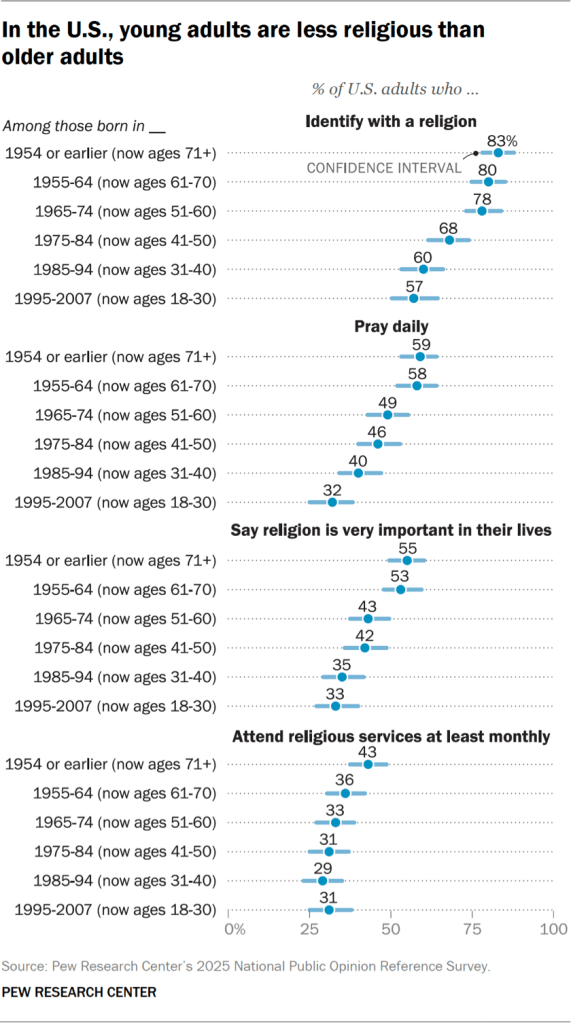
On average, young adults remain much less religious than older Americans. Today’s young adults also are less religious than young people were a decade ago. And there is no indication that young men are converting to Christianity in large numbers.
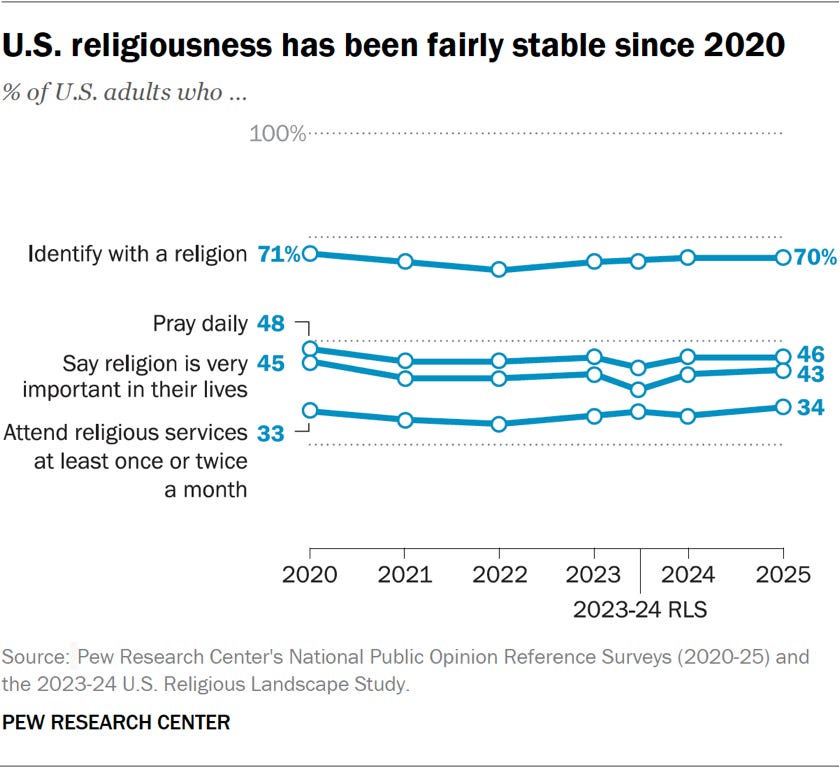
When looking at American adults overall, the best anyone can say is that religiosity has held steady over the past five years:
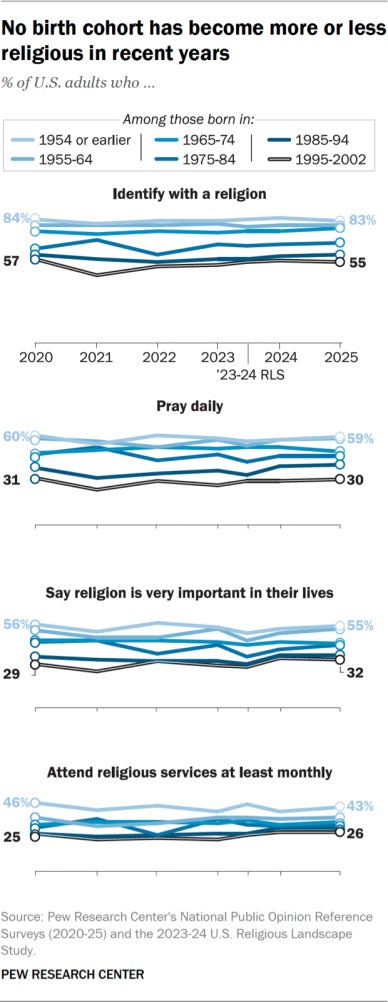
Even when you break those numbers down by generation, the steadiness is the story, but the overall trend shows that younger people remain less religious than older ones.
If someone is hoping to see a religious revival, stability over the past five years is horrible news. After all, given all the power that conservative Christians have right now, if they’re unable to capitalize on their popularity at the moment, what do Christian leaders think will happen when the political and social pushback—against the Republican administration’s cruelty, and against the Supreme Court’s preferential treatment toward Christians, and against the resurgence of viral diseases due to faith-based delusions about vaccinations, and the right’s overall religious-freedom-for-me-but-not-for-thee mentality—finally hits its peak?
Their bigotry isn’t going to age well and religion is rightfully going to be seen as part of the problem rather than the solution. If you want to see moral courage in America right now, you wouldn’t go to a megachurch. You would go to where the protesters are and look to political candidates who aren’t afraid to admit that “bipartisanship” is toxic when one side wants to destroy the country. You don’t look to the people trying to ban books and deny science and support a fascist and racist president who maintains support largely due to his conservative Christian base. (To be clear, there are plenty of religious people who are fighting back as well, and they are heroes in every sense of that word. The inevitable backlash against religion shouldn’t be seen as a backlash against them.)
For what it’s worth, this lack of a religious revival has also been noted by people like analyst Ryan Burge, who said we shouldn’t be surprised by the steadiness because “Most change happens through simple generational replacement, which is a very methodical process.”
The bottom line is that we’re not witnessing a religious comeback story. If there’s a Christian resurrection underway, we’re not seeing it in the data. So for all the breathless claims about Bible sales, (fake) conversions, or the supposed spiritual awakening of disaffected young men, there is no evidence of a nationwide return to faith.
Instead of a reversal, we’re really seeing more of a maturing. Generational turnover—which is slow, predictable, and relentless—continues to push the country toward lower levels of religious identification, practice, and belief. The stability of the past five years isn’t a reprieve for religion. It’s just a temporary pause before the next downward shift.
That says a lot about the problems with conservative Christianity. If they can’t gain new converts at a time when they have disproportionate political power, unprecedented legal favoritism, and unbroken cultural visibility, then they have no hope. We know Americans can be duped into voting against their best interests, but the culture war bullshit eventually wears thin. And the longer conservative Christians align with cruelty, exclusion, and authoritarianism, the harder they’ll have to work to convince anyone they’re part of a club worth joining.
The reality appears to be that the future will be shaped less by churches than by the millions of Americans—religious and nonreligious—who refuse to cede their values to dogmatic leaders who would freely give it up for access to power. We will continue becoming more religiously diverse, more secular, and less tolerant of institutions and individuals who believe their religion should replace our democracy.
As 64 year old former Catholic I was not contacted to participate in this survey.
I began drifting away from my strict Catholic upbringing in young adulthood. The final nail in the proverbial coffin was when I attended my very religious nieces church wedding about 10 years ago. In the wedding program on the inside was a statement that said something like, "If you are not in a state of grace with God please do not join in the communion procession."
That was that. I only set foot in a church two more times since, for two other weddings. I never left my seat except to leave.
Now, my only connection to religion is observing my ridiculously hypocritical family members supporting the hateful and deadly trump regime. Sheer insanity.
You know who could stop the downward trend? An omnipotent god.