
This newsletter is free and goes out to over 23,000 subscribers, but it’s only able to sustain itself due to the support I receive from a small percentage of regular readers. Would you please consider becoming one of those supporters? You can use the button below to subscribe or use my usual Patreon page!
In April of 2025, the UK-based Bible Society released a bombshell report saying that young people in England and Wales were returning to church, reversing a downward trend we’d been seeing for decades.
Paul Williams, the Bible Society’s CEO, held nothing back when talking about what a big deal this was:
Where once we saw aging congregations and a steady decline in attendance, we see dramatic growth, led by the young. Where once we saw apathy or even hostility to Christianity and the Bible we see increased openness, again among the young. You may have heard the rumblings and rumours emerging over the past few years, you may even have noticed it in your own community, or it might have passed you by entirely – but this data shows that it is real. This is the Quiet Revival.
… Challenges remain for the Church and civic society in responding to this Quiet Revival, but its reality can no longer be denied.
While other research organizations had published data suggesting a possible reversal in how people saw organized religion, it was hardly proof that Christianity was making a comeback. This “quiet revival” went much further than that. They even said they had data backing it up!
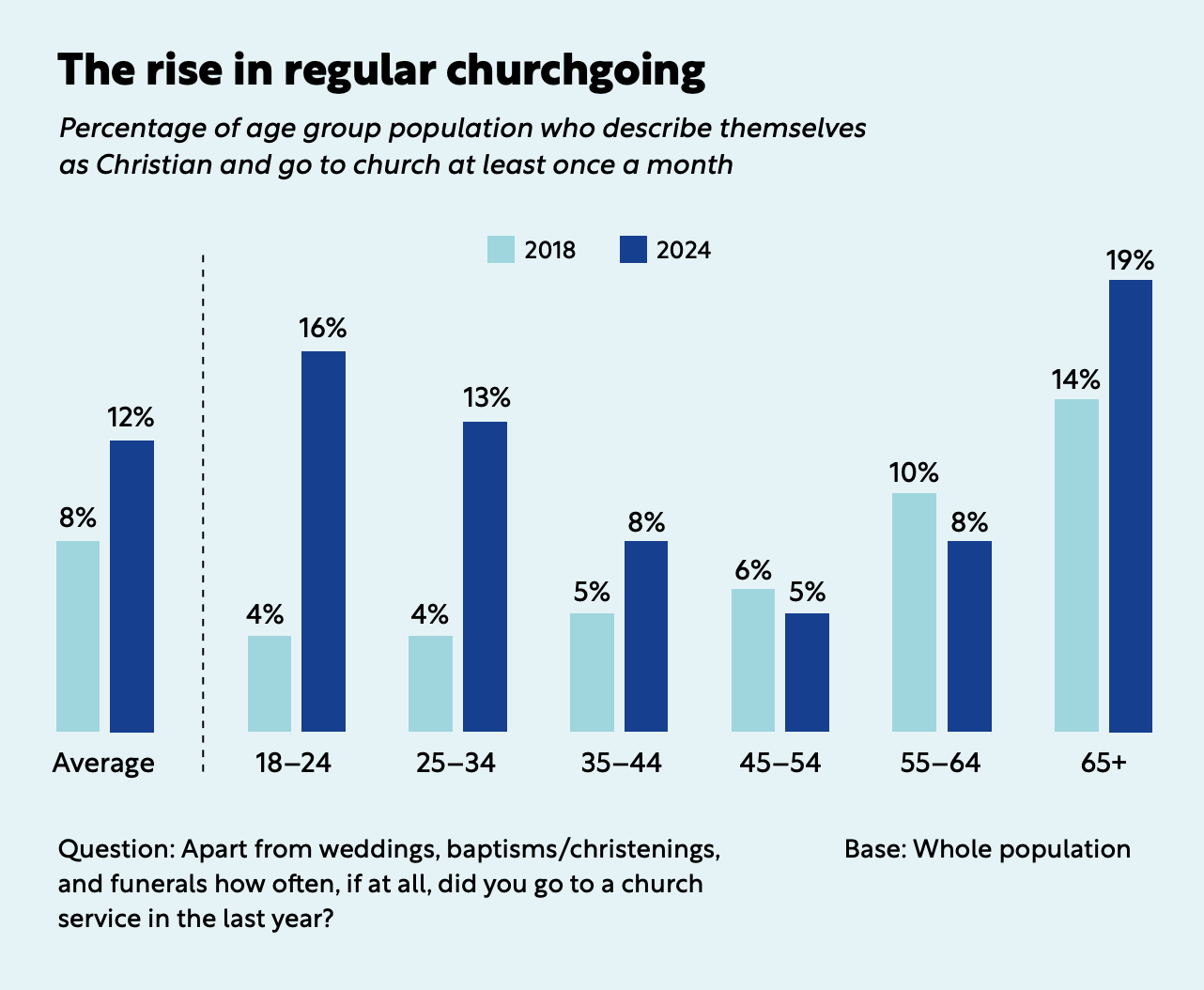
What was the data?! A couple of charts really told the whole story. Like this one showing that the percentage of people 18-24 who called themselves Christian and attended church at least once a month had jumped from 4% to 16% since 2018. A similar jump occurred for the 25-34 age group.
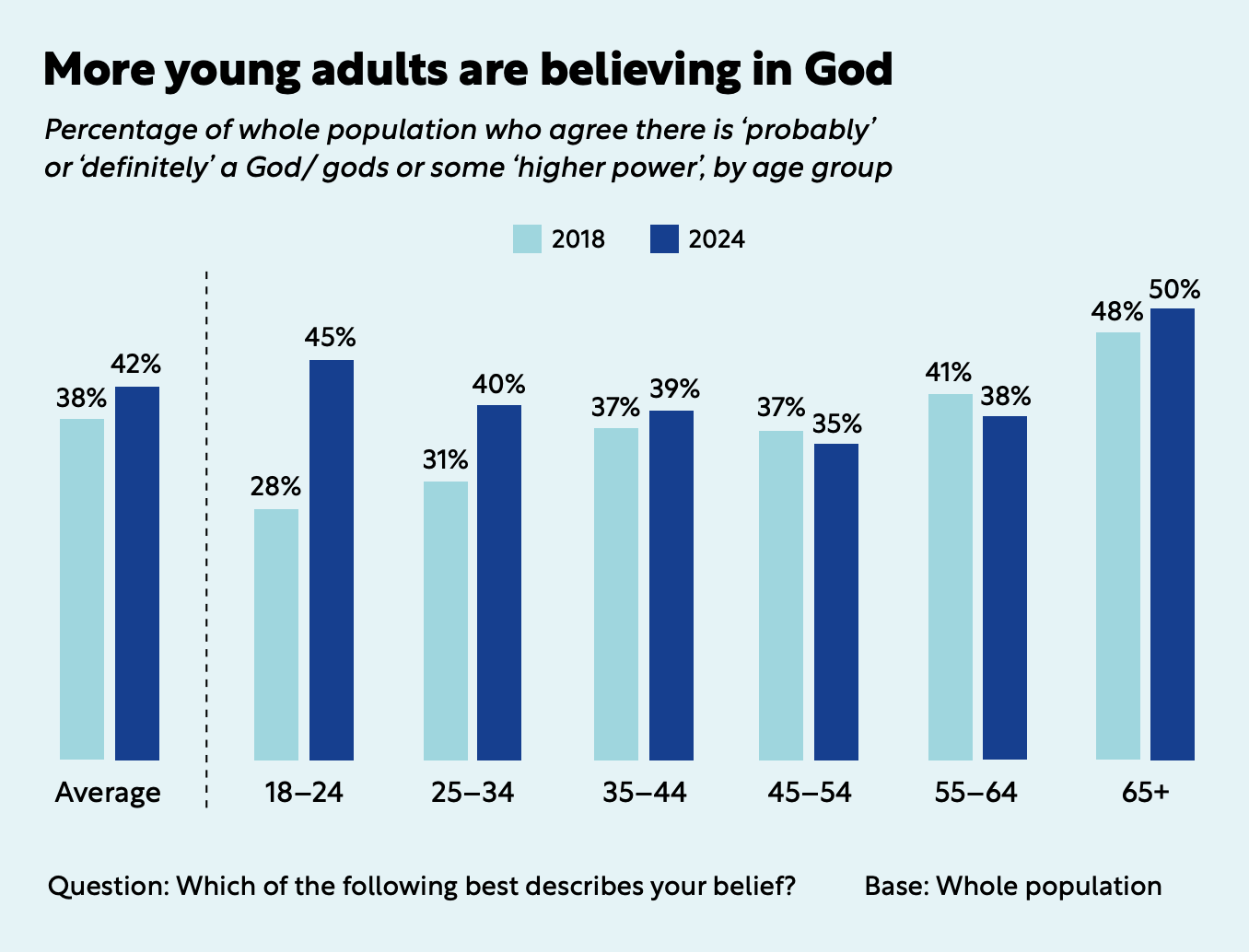
When it came to belief in God more generally, 45% of the youngest cohort now believed in God compared to only 28% in 2018. What a jump!
The report attributed this massive jump to two main factors: (1) Young people were rethinking how they saw Christianity; instead of the “New Atheism” hostility towards it, they were now more open to it thanks to celebrities and athletes and “intellectual figures” advocating for the faith. And (2) Young people wanted a deeper sense of “meaning, order and belonging.” As the proverbial “anxious” generation grew up, they wanted community and meaning. Religion provided that.
What made the survey so damning for atheists is that it wasn’t just some internal data from a biased Christian group. The 2018 and 2024 surveys were both conducted by YouGov, a reputable organization. The research may have been commissioned by the Bible Society, but the numbers were the numbers. You can spin the results however you’d like, but surveys don’t lie!
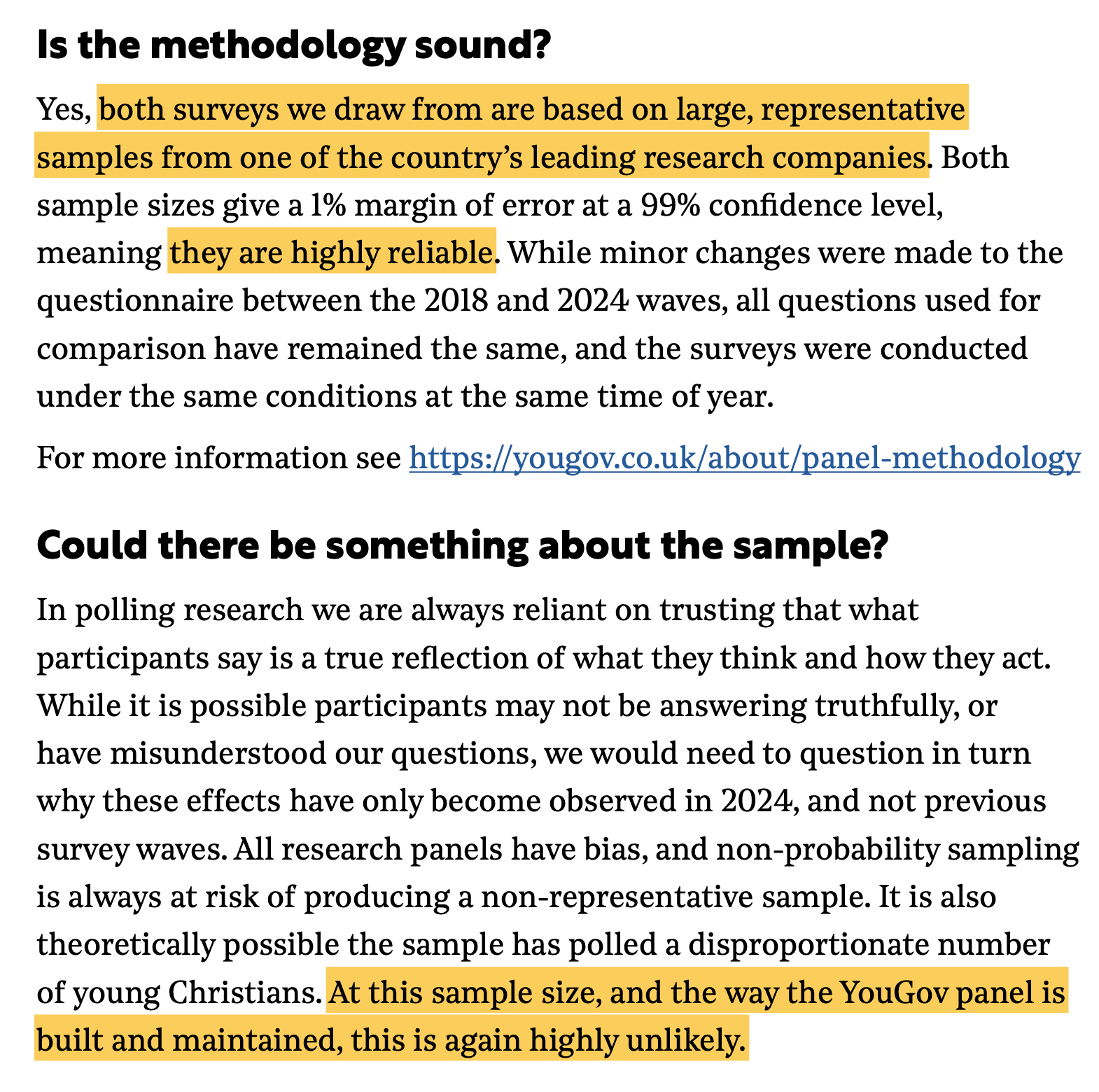
At the very end of the report. the Bible Society even included an FAQ in which they pre-butted anyone trying to say the data might be unsound (highlights are mine). They said the surveys were conducted by “one of the country’s leading research companies” and were “highly reliable.” Furthermore, while all surveys are at risk of using a non-representative sample of the population, the Bible Society insisted “At this sample size, and the way the YouGov panel is built and maintained, this is again highly unlikely.”
The report took off like a rocket. If the Bible Society hoped to draw attention to their work because of this report, the plan worked.
The Gospel Coalition called the report “understandably good news for Christians in the United Kingdom who feel beleaguered in a secular and post-Christian culture.”

Premier Christianity said “It’s an exciting time to be a Christian in the UK.”
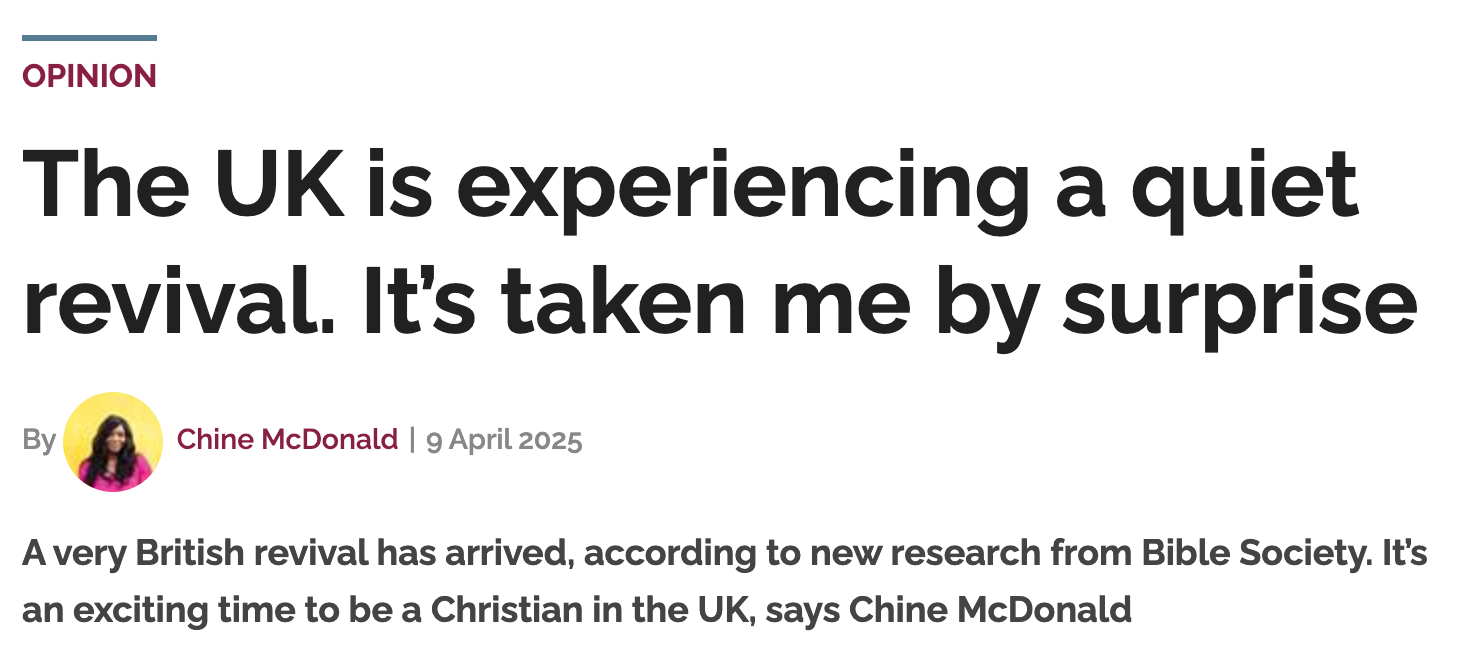
A month later, Premier Christianity published a follow-up piece explaining why they were confident this data was accurate. In addition to anecdotal confirmation, they said “YouGov is renowned for its accuracy and reliability.”
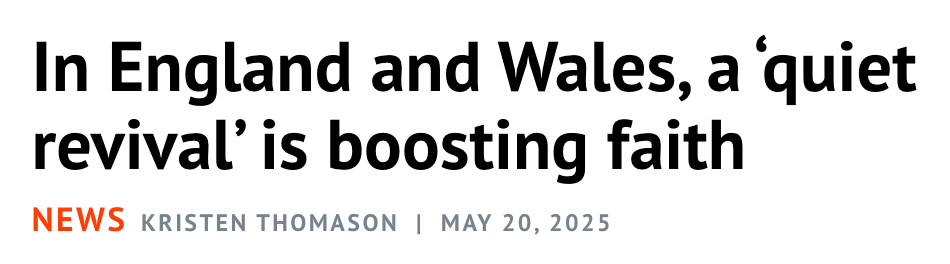
Baptist News Global said this revival was “boosting faith”:
And the conservative Christian outlet First Things noted that these results showed how “the notion that Christianity is doomed to age-out in Europe is false.” That article closed like this, and I dare you to read it without laughing:
God’s ways are not our ways. We wring our hands over the damage that polarization is doing to our societies. We fight against the excesses of woke ideology. We’re not wrong to do so. Yet it seems that the Almighty in his providence has been preparing the ground to be sown anew. The progressive assault on our natural loves is becoming unbearable. The West is being convulsed by an agony born of utopian ambitions for liberation that have curdled into ignoble and debasing failures. But the Greek root for crisis also means decision. A growing minority—especially men—are searching for the solid foundations on which to build a new and very different future.
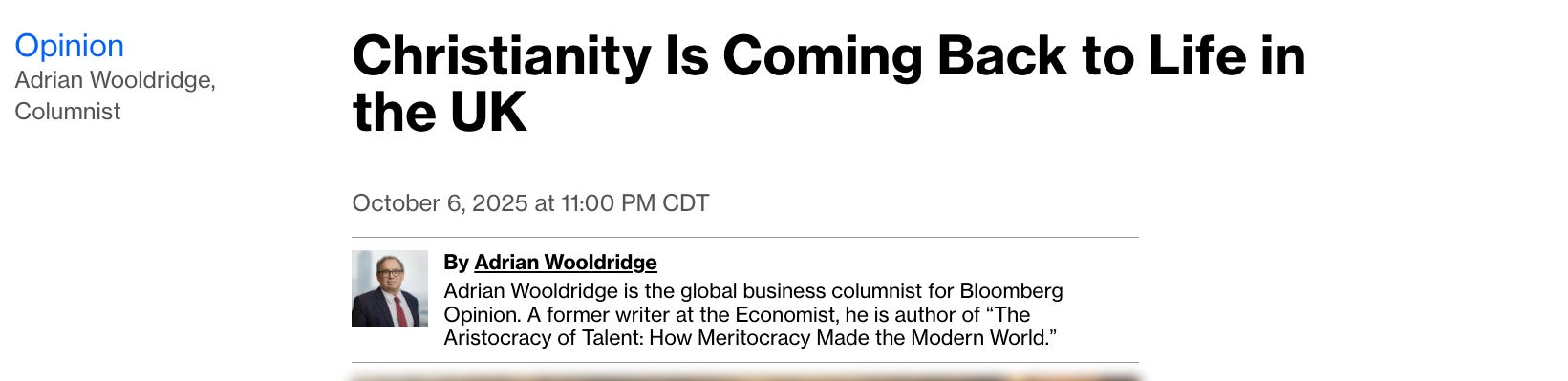
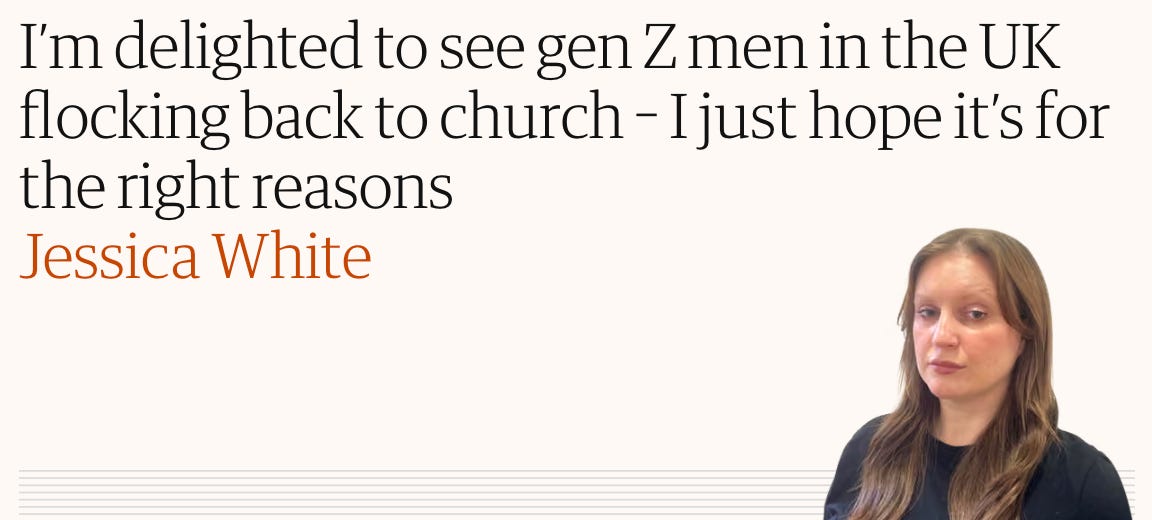
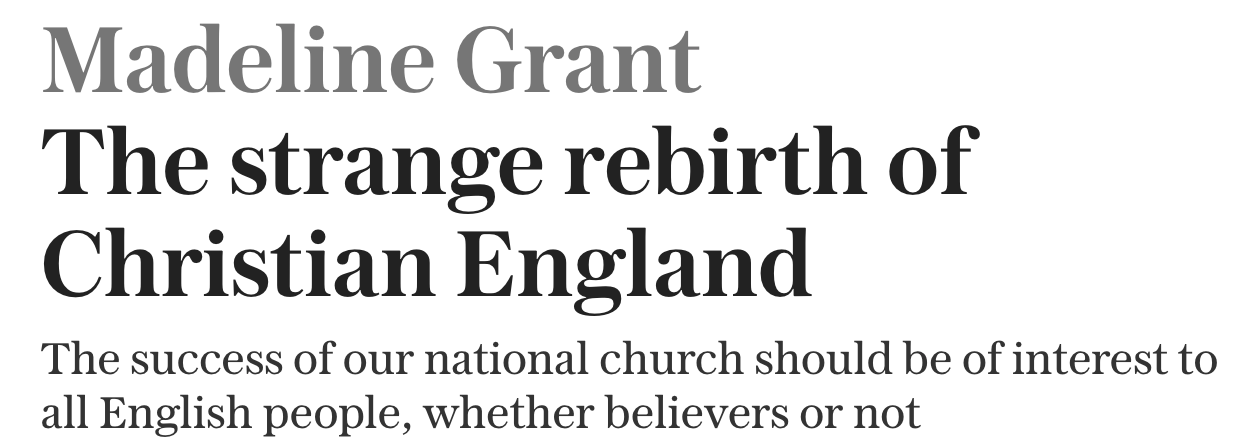
There was coverage in more mainstream secular publications too:
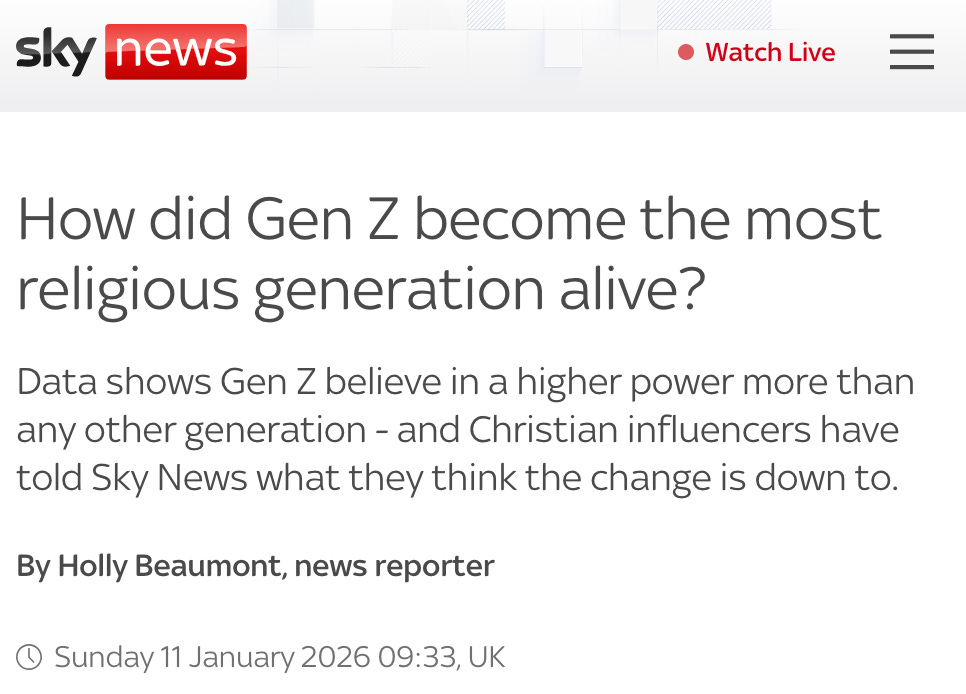
But while Christians were cheering on this report, there were critics who suggested early on that this didn’t pass the smell test.
Humanists UK issued a statement saying the YouGov results were “at odds with other (arguably more reliable) data sets.” They pointed out that it was possible the 2024 survey included a rise in “online church attendance” driven by the pandemic, but that’s not quite the same as in-person gatherings. (“How much are people paying attention versus doing other things? How long are they staying tuned in?”) Furthermore, the self-reported YouGov data didn’t seem to align with objectively reported attendance figures from the Church of England or the Catholic Church.
They weren’t crying “fake news.” But they were trying to suggest explanations for what appeared to be a huge anomaly and they called for more research to be done to clarify the situation: “More research is needed to disaggregate how different young people claim to be attending church and who they are, and recorded attendance by age demographics, in order to tell what is going on.”
Earlier this year, Humanists UK also pointed to a different data set showing that “Gen Z churchgoing is actually still declining.”
There were also social scientists who expressed their skepticism about the Bible Society’s report because it was so inconsistent with everything else we knew about young people and their relationship with organized religion. Hell, even the Pew Research Center said their own data didn’t suggest any kind of religious revival, quiet or otherwise.
Well, well, well.
Looks like the critics were right to be skeptical.
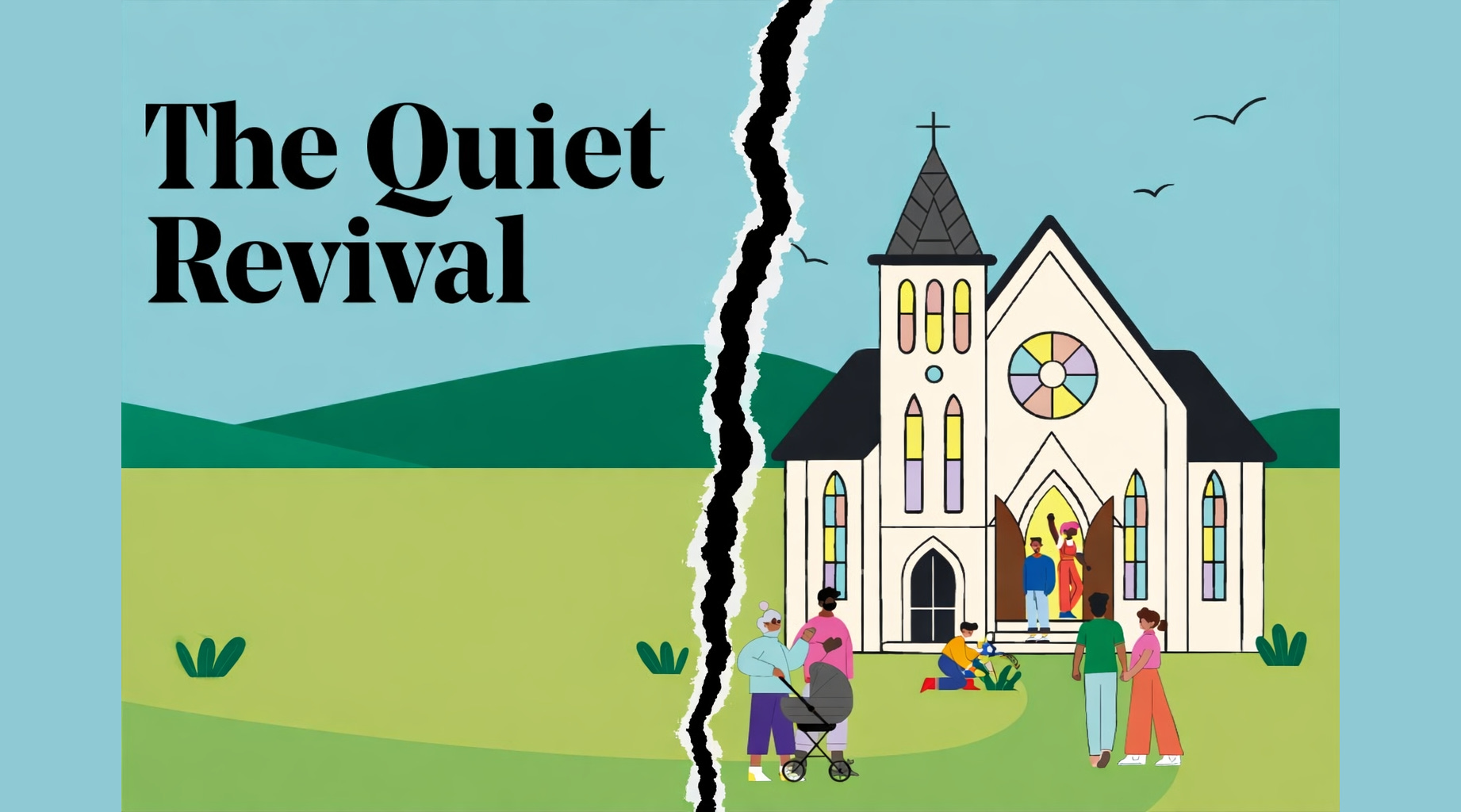
After a year of overwhelmingly positive, hopeful coverage about the revival of religion in the UK, the Bible Society issued a bombshell of its own on Thursday: The survey conducted by YouGov was “faulty” and could “no longer be regarded as a reliable source of information about the spiritual landscape in Britain.”
We recognise that this news may feel discouraging and we share that sense of disappointment.
Over a 15-month period, Bible Society repeatedly sought and received assurances from YouGov, regarding both the robustness of the methodology and the reliability of the report’s conclusions. It was only at the beginning of March that YouGov confirmed that it failed to activate key quality control technologies that protect the sample from a wide range of errors and this undermines the reliability of the results.
We are therefore deeply disappointed that YouGov not only made an error but also that it only discovered this so recently.
The Bible Society insists they were just working with the data they had—they even quote the CEO of YouGov as saying the “Bible Society has at all times accurately and responsibly reported the data we supplied to them.” But the Bible Society can definitely be blamed for not including more caveats in its report. It’s not like they went out of their way to remind people these numbers were out of step with all the other available research.
So what the hell just happened?
Well, that’s the subject of a brand new report from the Bible Society in which the group pretends their conclusions are still true even if the data backing it up is no longer reliable.
In short, they explain that YouGov’s poll was supposed to exclude people who aren’t living in the UK, and who complete the survey more than once, and who give “random answers to questions.” But those quality control measures weren’t in place when the survey was conducted. That means the 2024 numbers are effectively worthless. (The Bible Society says they plan to work with YouGov again this year to get more accurate numbers.)
Could they have spotted this error before releasing their report? Not a chance, they claim.
… We exercised exceptional care when it came to this research. We delayed publication of The Quiet Revival for three months while we investigated YouGov's data thoroughly. Because we have an academically trained research team, we were able to interrogate the data rigorously – asking questions about weighting, the possibility of sampling error, panel drift, drop out, response bias and questionnaire effect. However, as a client we weren't able to access the systems YouGov uses to detect ineligible respondents and had to rely on their assurances that these had been properly applied. This turned out not to be the case. YouGov has confirmed that it was impossible for us, as their client, to have been aware of the error.
It’s a bizarre statement to make because experts who understand survey data and religious trends had no problem interrogating the data rigorously and finding good reason to doubt the results. Why weren’t any of those people consulted? Maybe an organization built on spreading unverifiable beliefs shouldn’t be relying on its own “research team” to dive into facts. The people who know how to separate fact from fiction probably wouldn’t be working for the Bible Society in the first place.
But what about the results the Bible Society drew from the faulty data? Can those be trusted? Somehow, the group insists those conclusions are still solid.
… our conclusion is that the core themes and messages arising from The Quiet Revival report are substantially true. However, we cannot provide the same level of confidence about the scale of the trends as would have been the case had the error not been made by YouGov.
… The drama of the error in the 2024 YouGov survey should not be allowed to obscure the real story of the actual changes taking place in the spiritual and religious landscape of Britain.
How’s that for spin? The data is garbage… but we still want to believe there’s a religious revival, so let’s just pretend it’s true!
The rest of the 43-page report is devoted to anecdotal information—and tons of very, very large pictures to pad the report—suggesting a religious revival that isn’t borne out by the data. At one point, they say “even Richard Dawkins is describing himself as a ‘cultural Christian’”—a statement that he’s been saying for decades now and still doesn’t mean there’s any validity to supernatural beliefs.
Humanists UK took a well-deserved victory lap in response to the retraction. Chief Executive Andrew Copson released this statement:
This is both validation and vindication. We need to be absolutely clear: there is no revival of Christianity in Britain. For almost a year, Humanists UK has taken a rational, evidence-based approach, repeatedly and rigorously explaining why the Bible Society’s claims do not stand up. They chose not to engage with that evidence.
Much of the damage has already been done. Global media reports have too often and wrongly jumped on the bandwagon of a supposed Christian revival in the UK. That must stop. At a time when truth in these social questions has never been more politically important, everyone has the obligation to be rigorous in their presentation of data in the public realm and the claims they make for it.
The UK is not a Christian country, and our politics must reflect that. If we fail to recognise the plural and mainly non-religious nature of our society, not only will we be living a lie as a country, we will be undermining our ability to work for peace and cohesion in our diverse society.’
The bottom line is there’s no “quiet revival” of religion in the UK.
Or, you could argue, it’s so quiet that it simply doesn’t exist.
This whole situation really isn’t just about some methodological blunder. It reveals a larger failure by religious advocacy groups that don’t understand how to contextualize and interpret evidence—and by gullible media outlets that are eager to amplify their conclusions.
This narrative about a religious revival blew up long before the underlying data was properly vetted. Pro-Christian outlets treated it like some sort of divine vindication and critics were treated as if they were just unwilling to deal with facts that contradicted their preferred narrative. It was actually the complete reverse of that.
The lie about a religious revival has been spreading for nearly a year. The admission of potentially misleading data will barely make a blip in the same publications that boasted the initial report.
That’s why the admission the Bible Society and YouGov are offering now fall so dramatically short of the mark. If the Bible Society wants to demonstrate integrity, it needs to do a hell of a lot more than blame YouGov for its errors while clinging to the same conclusions. It should concede that their central claims remain unproven, that their critics had a good point, that they overhyped the story they wanted to hear, and people shouldn’t automatically believe anything else they say either—about survey results or the Bible. And whenever their next YouGov report comes out, they should make sure to share it with skeptics and outside analysts—people whose allegiance isn’t to Christianity—before blasting it out.
The biggest problem with religion is that it teaches people to buy into a series of lies even when the evidence shows otherwise. In a way, the Bible Society fell victim to the same logical fallacy that makes them buy into the Bible in the first place.
𝑇ℎ𝑒 𝑠𝑢𝑟𝑣𝑒𝑦 𝑐𝑜𝑛𝑑𝑢𝑐𝑡𝑒𝑑 𝑏𝑦 𝑌𝑜𝑢𝐺𝑜𝑣 𝑤𝑎𝑠 “𝑓𝑎𝑢𝑙𝑡𝑦” 𝑎𝑛𝑑 𝑐𝑜𝑢𝑙𝑑 “𝑛𝑜 𝑙𝑜𝑛𝑔𝑒𝑟 𝑏𝑒 𝑟𝑒𝑔𝑎𝑟𝑑𝑒𝑑 𝑎𝑠 𝑎 𝑟𝑒𝑙𝑖𝑎𝑏𝑙𝑒 𝑠𝑜𝑢𝑟𝑐𝑒 𝑜𝑓 𝑖𝑛𝑓𝑜𝑟𝑚𝑎𝑡𝑖𝑜𝑛 𝑎𝑏𝑜𝑢𝑡 𝑡ℎ𝑒 𝑠𝑝𝑖𝑟𝑖𝑡𝑢𝑎𝑙 𝑙𝑎𝑛𝑑𝑠𝑐𝑎𝑝𝑒 𝑖𝑛 𝐵𝑟𝑖𝑡𝑎𝑖𝑛.”
YouGov is an outfit that pays you to take surveys. That alone should be enough to not trust their data. Self selecting broke young adults who can lie on the internet cranking out surveys? That'll do it.
It looks like the Bible Society follows the same methods as Sensei. Finds a single, small data set and latch on to it for dear life because it says what they want to hear.
Who is surprised the truth is different from what Bible thumpers claim it is? Certainly not I.