
This newsletter is free and goes out to over 23,000 subscribers, but it’s only able to sustain itself due to the support I receive from a small percentage of regular readers. Would you please consider becoming one of those supporters? You can use the button below to subscribe or use my usual Patreon page!
In 1985, 67% of Americans felt clergy members were ethical and honest.
In 2001, shortly after 9/11, that number was still as high as 64%.
It’s basically been downhill ever since, and a recent Gallup poll revealed that only 27% of Americans now feel clergy members are trustworthy, a record low for a survey that’s been administered for fifty years.
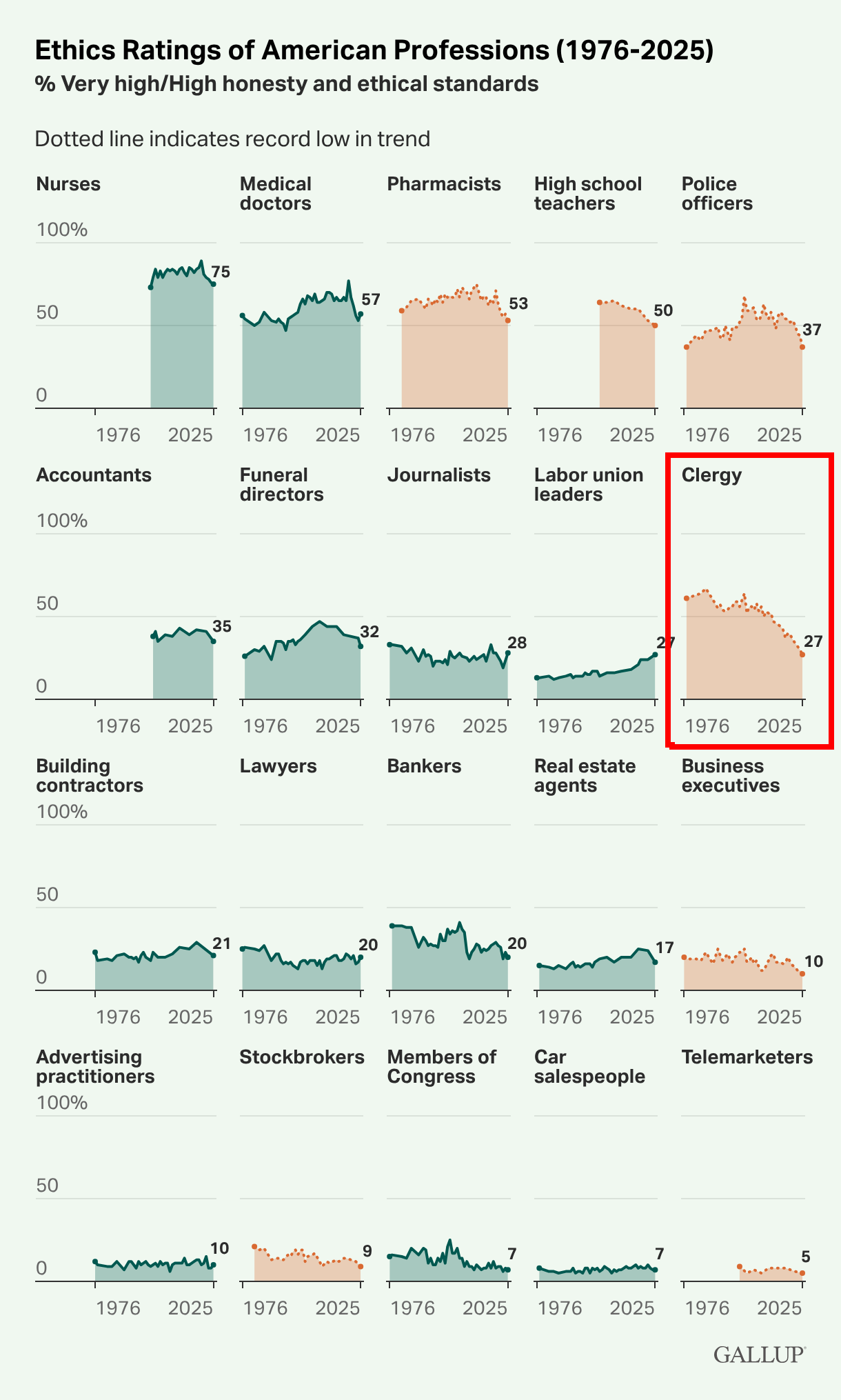
While trust in general has dropped for many professions over the past few years, no one’s seen a bigger fall from grace than religious leaders, who are no longer perceived as honest brokers. The last time more than half the country felt they were trustworthy was back in 2012. Even worse for clergy members? 18% of Americans now say they have low or very low ethics.
It’s not just clergy members, though. Politicians, police officers, and pharmacists also garner less trust than ever before. (Nurses continue to top the list at 75% because nurses are, by definition, awesome.)
But still: the clergy number has to sting. Those other professions aren’t founded on the idea that the people in them are moral leaders.
And incredibly, even Republicans don’t hold clergy members in high esteem, with only 36% of them saying religious leaders have high ethical standards. Clergy members are also among the more polarizing professions in this regard. The difference between Republicans and Democrats is 15%:
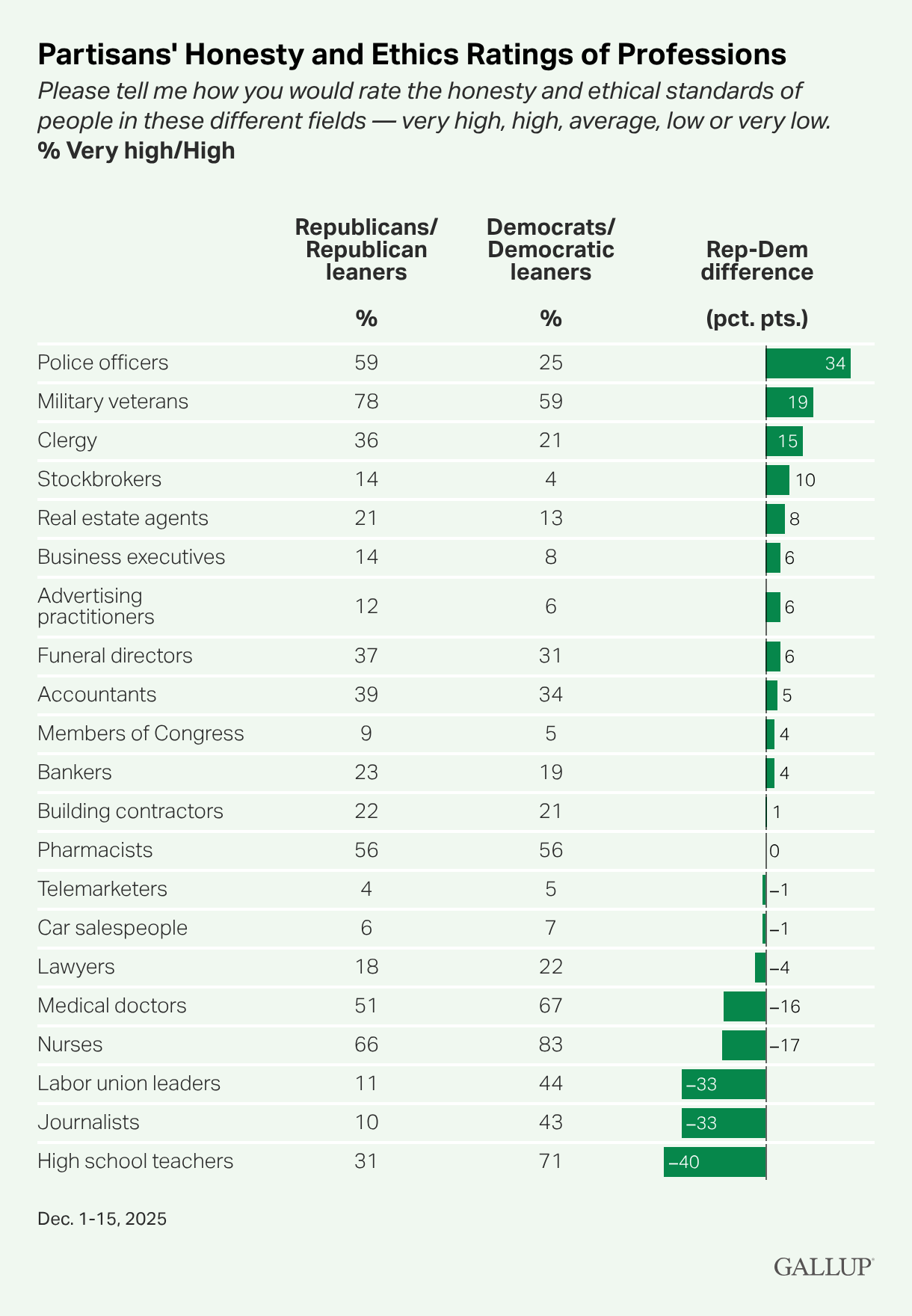
It’s morbidly funny that high school teachers and journalists sit at the bottom of that list because the takeaway is that Republicans don’t trust people whose job it is to educate children and report on facts. They’ve demonized these respectable professions because reality and education go against the propaganda they’re trying to spread.
But none of this should be surprising. There’s no shortage of news articles about Pastors Behaving Badly, and so many of the ones who’ve avoided scandal still hold beliefs that are untrue, harmful, and bigoted. The biggest denominations in America, Southern Baptists and Catholics, have failed to adequately deal with their sexual abuse problems. The ever-powerful white evangelical bloc continues to carry water for the most corrupt president in history while fully ignoring his dictatorial fantasies, blissful ignorance, and criminal charges. Meanwhile, Purity Culture and patriarchal thinking still dominate discussions among younger conservative Christians online.
If we’re supposed to judge people by their actions and not their words, there’s no reason to respect people who preach about values on Sunday morning while spending the rest of the week ignoring those values so they continue having access to power. Power that, in their minds, matters more than principles.
If you’re looking for ethics and morals, you’re not about to find them in a local church. Or at least that shouldn’t be anyone’s default starting point.
It’s not just that. Consider the rise in secular Americans throughout the country and the fact that we’re becoming more religiously diverse. People know their non-Christian neighbors are decent people, flying in the face of the religious rhetoric they’ve been force-fed since childhood. And when they see how church/state separation is under attack, it’s never been more important to stand on the side of American values in the face of religious extremism.
The sad thing is that there are plenty of decent, thoughtful pastors who agree with all this. But if they’re not willing to call out the bad apples in their profession, then they’re not reliable narrators either.
Can the profession do anything to regain trust? It’s hard to imagine how when the largest denominations’ core beliefs involve the same broken ideas that led so many people to walk away from organized religion in the first place. Without a full-scale rethinking of what it means to follow Jesus—something many religious leaders have shown no interest of doing—they’re not going to be seen as leaders worthy of respect by people who have far better ethics and morals than they do.
Moral authority doesn’t suddenly disappear overnight. It erodes through complicity, and that’s what so many pastors have offered. They actively participate in the destruction of their own profession or stand silently while others do it around them, because they fear it might cost them congregants, donations, or access.
Trust can’t be demanded. It has to be earned. And for millions of Americans, clergy members have made it abundantly clear that they’re not interested in earning that kind of respect.
(Portions of this article were published earlier)
Given the endless religious scandals and the fanatigelicals siding with Trump the Cancerous Lump, 27% is WAY too high.
𝐶𝑎𝑛 𝑡ℎ𝑒 𝑝𝑟𝑜𝑓𝑒𝑠𝑠𝑖𝑜𝑛 𝑑𝑜 𝑎𝑛𝑦𝑡ℎ𝑖𝑛𝑔 𝑡𝑜 𝑟𝑒𝑔𝑎𝑖𝑛 𝑡𝑟𝑢𝑠𝑡?
Every day, there is a story somewhere about a member of clergy doing horrible things to children. Every day there are other clergy covering up for those misdeeds.
The first step to regain trust? 𝗦𝘁𝗼𝗽 𝗮𝗯𝘂𝘀𝗶𝗻𝗴 𝗸𝗶𝗱𝘀. The second step? Turn in ALL of the abusers to secular authorities. In-house punishment is part of the cover-up.