
This newsletter is free and goes out to over 23,000 subscribers, but it’s only able to sustain itself due to the support I receive from a small percentage of regular readers. Would you please consider becoming one of those supporters? You can use the button below to subscribe or use my usual Patreon page!
We already know that roughly a third of Americans are religiously unaffiliated. (I recently posted about how a supposed “religious revival” isn’t seen in the data.) That raises another interesting question, though: Why are people leaving the religion in which they were raised?
When the research group PRRI looked into that question in early 2024, their answers boiled down to logic, anti-LGBTQ bigotry, clergy sex abuse scandals, and the toll it takes on their mental health.
PRRI found that 63% of “Nones” said they left their faith because they come to their senses and just stop believing all that nonsense. But there were other answers on their list as well:
47% of the Unaffiliated cited anti-LGBTQ teachings.
41% said their families were just never that religious to begin with.
32% said it was bad for their mental health.
31% mentioned clergy sex abuse scandals.
20% said their churches had become too political.

Among religiously unaffiliated Democrats in particular, the “I just don’t believe this shit anymore” (my words) reason was more popular than anything else (75%) while anti-LGBTQ teachings came in second (61%).
Among religiously unaffiliated younger Americans (ages 18-29), many more of them (60%) cited anti-LGBTQ bigotry than their oldest counterparts (35%), though the most popular response was still that they simply didn’t believe the religion’s teachings anymore (66%).

Given all that information, I was curious to see what the Pew Research Center found in their own analysis of the same questions, which they just released this week.
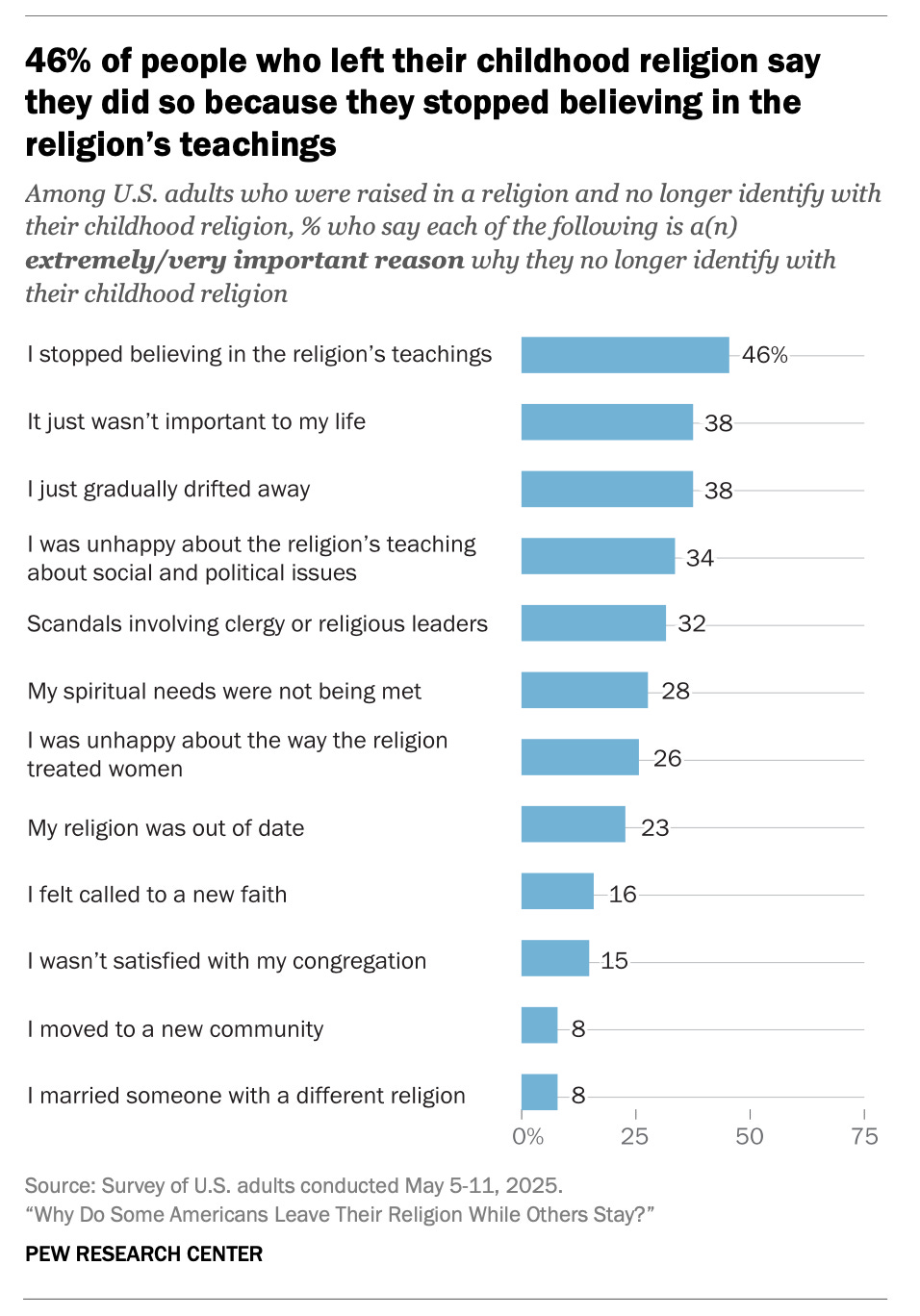
While many of the same reasons for ditching organized religion appear in their data, there are others in the mix as well. (The percentages are markedly different because Pew is only using the percentage of people who said these reasons were “extremely” or “very” important in their decision to leave.)
Among Americans who were raised in a religion but no longer identify with it, the most popular answer for why they left remains that they simply stopped believing (46%). The religion’s teachings regarding social and political issues also comes up as an important repellent (34%), as do the sex abuse crises (32%).
But they also named other reasons: It just wasn’t important to me anymore (38%), I just gradually drifted away (38%), I didn’t like my religion’s treatment of women (26%), it was too “out of date” (23%), and I married someone with a different religion (8%).
Former Catholics were more likely to say clergy sex abuse scandals played a role in them leaving the faith, with 39% of ex-Catholics saying the scandals were a “extremely” or “very” important reason they left. 37% of ex-Catholics cited the political/social stances playing a key role, too.
All of that tells us why they left. But why are they now non-religious? We have those answers too. They know they can be good without a god (78%), they question religious teachings (64%), and they don’t trust religious leaders (49%) all make appearances on the list:

The survey also found that people who had a positive religious experience growing up were far more likely to remain in it (though that’s hardly foolproof).
While this may seem intuitive, the survey also found that most people who switched religions did so before the age of 30, with 85% of religious switchers saying they made the leap before that age.

The bottom line remains that a lot of people are walking away from organized religion and they’re not trying to replace it with a different form of superstition.
The explanations for why they’re leaving should make conservative religious leaders think carefully about whether they really want to follow the path of hate that the Republican Party and MAGA extremists are taking them down. In a few years, will complicity with ICE terrorism make this list? What about fealty to Donald Trump instead of the Jesus who delivered the Sermon on the Mount?
We already know white evangelicals and the Catholic Church have no real interest in shifting their positions on even their least popular and most extreme forms of bigotry, which will only push out more people who care about decency over dogma. As those groups continue to push back against democracy, civil rights, science, and social justice, I suspect more Americans will realize that moral authority lies from fighting the church rather than being a part of one—despite the best efforts of progressive religious groups.
What will religious institutions do to keep people in the fold? There are very few pages left in their playbooks. At some point, especially as more ex-believers go public about their experiences on social media and popular docu-series, all the bells and whistles churches tend to pull out to attract new members become subjects of parody. People are aware of their tactics. They know what to look out for. No amount of Youth Pastor Voice, for example, is going to override the harm of Purity Culture. The overreach of high school football coaches and government officials who treat their secular positions as platforms to evangelize is more of a turn-off than ever before. As more kids distance themselves from faith, the pressure on their friends to convert to fit in also diminishes.
It can’t happen quickly enough.
(Portions of this article were published earlier)
I have maintained for some time that organized religion is going to have a very hard time surviving the internet with its influence intact. There is just too much good information out there and it's easy to access. I think the internet allowed people from all across the free-thought spectrum to realize, often for the first time, they were not nearly as alone as they once thought. Organized religion still exercises far too much influence over domestic politics, but that influence continues to erode year by year and I see no way that trend will be reversed.
A belief system premised on rib women, magic apples and talking snakes and donkeys can only appeal to those too young to have critical thinking skills or those adults that glorify willful ignorance.