
This newsletter is free and goes out to over 23,000 subscribers, but it’s only able to sustain itself due to the support I receive from a small percentage of regular readers. Would you please consider becoming one of those supporters? You can use the button below to subscribe or use my usual Patreon page!
Aaron Renn is one of those philosophers who sounds really smart to people who don’t know anything. For everyone else, his most well-known ideas don’t make any sense because they’re grounded entirely in fantasy. Like his theory that Christians are currently more persecuted than ever before.

Renn is most famous for arguing that for the past decade, Christians have been living in a “Negative World” where people see Christianity as a bad thing, “particularly in the elite domains of society.” In practice, that means prominent evangelicals who may have had influence in the culture are now often deemed bigots and “canceled.” I’ve written more about why that belief is garbage here.
On Friday, Renn published a similar essay in (where else?) the Washington Post, arguing that there’s a lack of evangelical Christians in the nation’s “most prestigious institutions”—like the Supreme Court—and this needs to be fixed immediately.
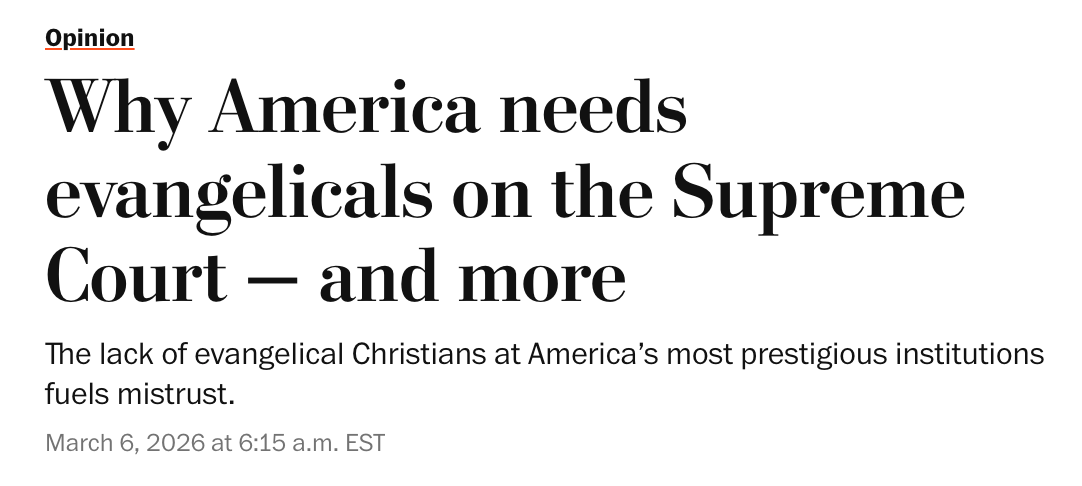
By the way, the much-worse original headline for the story, caught by Word&Way editor Brian Kaylor, was “Evangelicals are missing from the halls of power. That’s a problem.”
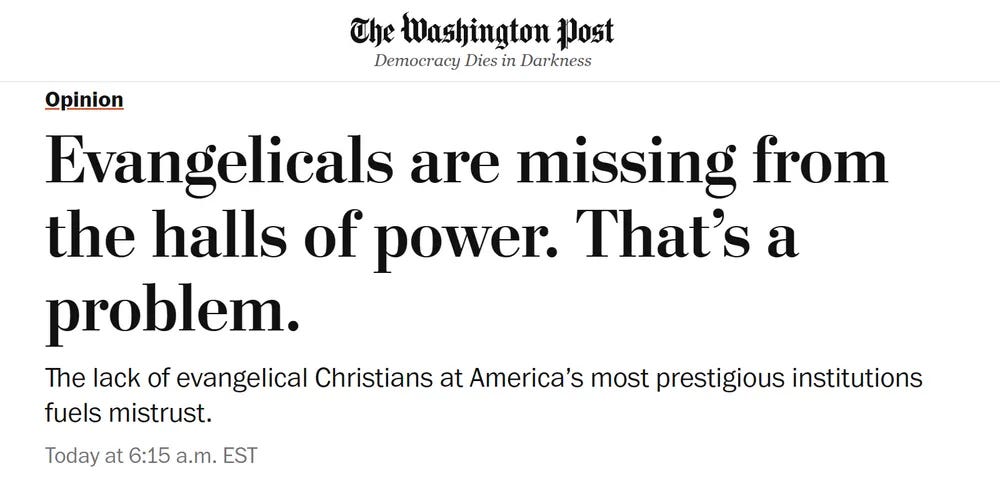
In either case, Renn opens his piece like this:
Evangelicals are 23 percent of U.S. adults and one of the most loyal Republican voting blocs, with 81 percent backing Donald Trump in 2024. Yet despite six of the nine Supreme Court justices being appointed by Republican presidents, there are no evangelicals on the Supreme Court.
This is just one of the many elite institutions in which evangelicals are absent or underrepresented. Evangelicals have excelled in politics, producing figures such as Sen. Josh Hawley (R-Missouri) and House Speaker Mike Johnson (R-Louisiana). They are also prominent in well-run and profitable businesses with relatively low cultural impact, such as food processing (Tyson Foods) and retail (Hobby Lobby). But they are all but absent from the leadership of prestigious universities, major foundations, Big Tech companies, leading financial firms and large media companies.
…
A stronger evangelical presence in elite institutions could strengthen them while addressing polarization and public mistrust. The lack of evangelicals in the halls of power contributes to anti-institutional public sentiment. It also deprives those institutions of an important pool of talent.
…
… Increasing the evangelical presence in boardrooms, elite universities and high courts would not only give those institutions access to a large pool of talent. It would also help restore trust in American institutions and ensure that they really do represent America in all its diversity.
This… is just plain dumb. The simple fact is that evangelical Christians have more institutional power in the places that matter, and when they don’t, it’s largely because they spend their time trashing those very institutions. This is like when conservatives complain about right-wing professors being underrepresented on college campuses while constantly raging about how higher education (and lower education for that matter) is evil, spreading conspiracy theories that contradict what scholars in those fields say, and calling on the government to withhold funding for public schools. It never occurs to them that the field doesn’t have parity because their side openly and proudly opposes what the field stands for.
Consider the Supreme Court, with its current 6-3 conservative super-majority. Even if there are no evangelicals on the bench, the conservatives go out of their way—laughably so in many cases—to give evangelicals whatever results they want.
The ability for coaches to hold performative prayers at midfield after a high school football game? Sure!
Overturning the right of women to control their own bodies? Absolutely.
Rewarding an evangelical website designer who refused to make a website for a same-sex wedding even though literally no one asked her to do that? Why not.
It doesn’t matter if there are no evangelicals on a nine-member Court if the majority of them rule as if all nine were evangelical anyway. The Rule of Law be damned.
Maybe Renn would understand this if he could imagine himself in virtually anyone else’s shoes. There are no atheists on the Supreme Court either, but most atheists, I suspect, are perfectly fine with religious people on the bench as long as they care about the Constitution and take church/state separation seriously.
The same thing is true in Congress, where 87% of all members are Christian, 98% of Republicans are Christian, and there is just one (1) openly Humanist representative. While it would be wonderful to have a more demographically representative Congress, it wouldn’t be as big of a deal if those religious members took their roles are representatives for all their constituents seriously. (I’ve voted for Christians in every election—sometimes gleefully so—and I will undoubtedly do it again in the future. I’m genuinely excited about the candidacy of James Talarico in Texas even though his religious beliefs are extremely far away from my own.)
Why are evangelicals so dominant in politics, by the way? Renn has an answer for that: He says evangelicals have succeeded largely due to “their ability to respond to the concerns of non-college-educated Americans.” That’s bullshit, of course. Republicans have succeeded because their party has figured out how to weaponize hate in a way that’s appealing to a broad base of ignorant Americans. They’re not winning races because of their goddamn economic policies. They’re winning because they gave the worst people you know something to rally around so they could feel better about themselves.
Meanwhile, you know who responded to the concerns of the people better than anyone in recent memory? Zohran Mamdani, whom Renn doesn’t mention at all.
Republicans have also won due to gerrymandering, and a friendly media ecosystem, and a Democratic Party that can never seem to get its act together, and flat-out lying about what they’re actually doing to help Americans. Whatever the reason, addressing the “concerns of non-college-educated Americans” isn’t on the list.
The problem with politics right now is that the people in power are already giving evangelicals whatever the hell they want—and the country is worse off because of it. And the institutions that don’t have an evangelical proportion equal to the country’s demographics tend to be areas that evangelicals don’t want to be in anyway.
Renn’s examples of areas that lack evangelical participation include the “leadership of prestigious universities”… even though evangelicals have their own damn colleges and believe in dogma over facts, counter to how academia actually works. (By the way, he offers no proof that university presidents are overwhelmingly non-Christian. I suspect many of them are religious, but they may not wear their faith on their sleeve, which is why Renn may not count them as True Christians™.)
The people who reject sex education, and comprehensive American history, and evolution, and climate change, and reading books that might challenge your preexisting beliefs are probably not going to succeed in academia. That’s not an academia problem; that’s an Aaron Renn problem.
He also cites “large media companies” even though those large media companies are in the business of entertaining as many people as possible. But when shows like White Lotus and Heated Rivalry and Bridgerton are what so many cultural arbiters are talking about, it’s no wonder that Purity Culture enthusiasts, and anti-LGBTQ zealots, and patriarchy supporters, and the people who constantly avoid reality because they can’t handle it (e.g. God’s Not Dead) aren’t typically great at figuring out what America wants. Meanwhile, there are alternative Christian media companies, like Great American Pure Flix, made just for that group. They’d rather silo themselves than participate in a shared culture.
Renn kind of acknowledges that when he says evangelicals could help themselves by “productively collaborating with people who have different beliefs—a necessity in a pluralistic country.” Great idea. Someone let me know when white evangelicals are willing to collaborate with—and not talk down to—LGBTQ people, and Muslims, and atheists, and all the people their pastors routinely denigrate from the pulpit.
Maybe the most damning giveaway that Renn has no argument here is when he calls himself a “minority”:
As a minority in a country that has become post-Christian in many respects, evangelicals can’t and shouldn’t seek to dominate national leadership roles. A diverse society will draw its talent from all quarters. But for that very reason, it can’t be healthy when nearly one-quarter of the national population is failing to contribute its fair share.
Let’s all shed a single tear for the plight of being a white Christian male in America. It must be so difficult for his people. I don’t recall the federal government launching terrorist attacks in his Indiana hometown based entirely on lies, like Republicans did in Minneapolis using racist attacks against Somalis, but maybe I missed it.
If Christians have it so bad, Renn should at least tell us which group he wishes he could trade spots with. You can’t pretend there’s a zero-sum game that you’re losing without telling us who’s winning. But he never does that. There’s his tribe… and everyone else. And everyone else, in his mind, is, by definition, anti-Christian.
But let’s suppose he’s right. If evangelicals had a stronger presence in these institutions, why would there be less distrust? We currently have a government that’s stocked with white evangelicals and distrust has never been higher because those white evangelicals are also liars and racists and thieves and (at the very least) pedophile-adjacent. Roughly 80% of white evangelicals backed Trump in each of the last three elections; no one should be looking to evangelicals for advice on good judgment.
Or consider vaccines, which shouldn’t be controversial at all. Because we put science-deniers—including evangelicals—in positions of power, measles and mumps are now making a comeback. The next “COVID” is going to be much deadlier than it otherwise could have been because evangelicals entered a field that their churches actively oppose
Renn doesn’t actually care if evangelicals are in those positions, anyway, unless they’re actively pushing his personal beliefs. That’s what he wants more than anything. He wants respect for this views, even though those views are not respectable.
Renn says that this exclusion of evangelicals deprives us of “an important pool of talent.” (That’s the same argument, by the way, made by supporters of DEI, which white evangelicals overwhelmingly oppose.) But he offers no evidence that they’re excluded from those pools because of their faith. That’s because there’s no systemic effort to shun Christians from these areas. If it happens, it’s probably because of what they’re bringing (or not bringing) to the table.
I said this before, but it’s worth repeating: If people see Christianity as a negative trait these days, it’s because that animosity has been earned. We don’t see Christianity as a bad thing for no reason—it’s because we’re constantly surrounded by evidence of how powerful Christians use their faith to hurt others. We’re not mad about Jesus. No one’s condemning the faith-based food pantries. We’re mad about misogyny and homophobia and hypocrisy and ignorance and incompetence. The instigators of the Culture Wars are acting like they were always just minding their own business when, in reality, they’re launching grenades all around them. They’re mad because their shitty beliefs lead to not being invited to Thanksgiving dinner, getting mocked and criticized by celebrities with larger platforms, and being the people the rest of us talk shit about when they’re not in the vicinity.
They feel they’re owed respect despite doing absolutely nothing to deserve it.
Meanwhile, even if Renn thinks evangelicals are missing from the “halls of power,” the people in those halls never got the memo. Just yesterday, while Trump was continuing his unnecessary war of choice against Iran that has already resulted in the deaths of approximately 150 people at a girls’ school, this is what was happening in the Oval Office:
Can anyone tell me how I can have as little power as evangelicals, because they seem to be doing just fine. What’s Renn’s next article going to be? Decrying how little power Muslims have in Iran?
Ultimately, Renn’s whole argument collapses under the weight of its own premise. The reason evangelicals aren’t prominent in certain “elite institutions” isn’t due to some anti-Christian blacklist. It’s because so many of those institutions depend on the very things large segments of evangelical culture openly reject: Evidence, a commitment to pluralism, intellectual humility, a willingness to acknowledge privilege, etc.
That’s what Renn—and the Washington Post editors who thought his argument deserved a platform—refuses to confront. Evangelicals aren’t missing from power. They dominate American politics, shape judicial outcomes, and have enormous cultural influence. But whenever they want to enter fields that value facts and collaboration with different worldviews, all the habits that serve them well in partisan politics—including ideological purity tests, and moral panics, and conspiratorial thinking—become liabilities. You want more representation in those spaces? Then the solution isn’t demanding a seat at the table simply due to demographics. It’s showing that other people can work with you even if they don’t agree with you, and proving that you can operate within the boundaries that make those institutions work.
That’s why Renn’s prescription is completely backwards.
The problem isn’t that elite institutions lack evangelicals; it’s that evangelical leaders have spent decades convincing their followers that those institutions are corrupt enemies of Christianity.
You can’t wage a culture war against universities, journalists, scientists, and educators, and then whine when those same institutions don’t treat people in your movement as trusted partners. That’s why no one needs to take Renn’s advice. The last thing our institutions need right now is more ideological pressure from people who already have disproportionate influence in our current state of affairs.
On the bright side, if any of you have ever wanted to get published in the Washington Post, now’s the time to make your pitches to their editors. Apparently they’re saying yes to everything.
"Evangelicals have excelled in politics, producing figures such as Sen. Josh Hawley (R-Missouri) and House Speaker Mike Johnson (R-Louisiana)."
Those two shitstains are your best argument? Try again, this time with a brain.
No, Renn. It is Christians that do the persecuting and have since 380 CE.
This is recorded history, not fantasy.