The Mormon Church is trying to sue a critic into silence. Now he's fighting back.
John Dehlin’s latest court filing argues the LDS Church’s trademark lawsuit is little more than an attempt to punish dissent
This newsletter is free and goes out to over 24,000 subscribers, but it’s only able to sustain itself due to the support I receive from a small percentage of regular readers. Would you please consider becoming one of those supporters? You can subscribe via Patreon or the Subscribe button below! You can also make one-time donations through Venmo or PayPal.
Two months ago, the Church of Jesus Christ of Latter-Day Saints sued one of its most prominent critics, podcast host John Dehlin, on grounds of trademark and copyright infringement… as if listeners to his show might be confused between the podcast and the Mormon Church itself.
Dehlin is now fighting back in court.
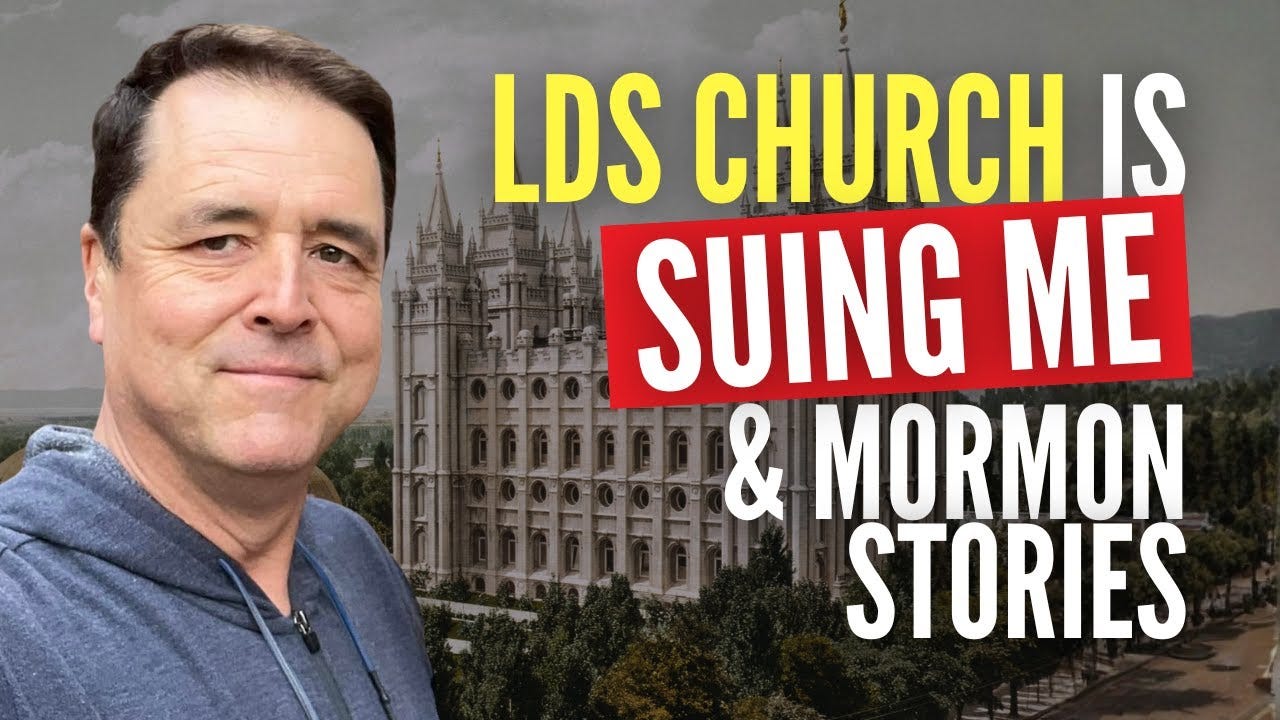
John Dehlin in a thumbnail from his podcast
A quick recap: Dehlin began the Mormon Stories Podcast in 2005 when he was questioning whether or not to leave the LDS Church. It soon became a haven for other critics and former Mormons—and a landing space for listeners who harbored the same doubts but knew the Mormon Church wasn’t a safe place to get their questions answered in a meaningful way.
In 2015, Dehlin was officially kicked out of the Church for the “crime” of apostasy—he was accused of leading people away from the Church—though Dehlin argued the real reason was because he openly and proudly supported same-sex marriage and the ordination of female priests.
The podcast has become popular enough that it spurred the creation of a non-profit group—the Open Stories Foundation—in 2010 to oversee the show and go beyond it. In 2024, the group generated over $1.12 million in revenue.
That’s nothing, of course, compared to the tens of billions of dollars hoarded by the LDS Church. You would think, given all the very legitimate criticism of Mormons from all over the place, the smart move would be to simply ignore what one podcaster is doing, even if he’s popular, in order to avoid the Streisand effect.
But the Mormon Church took the opposite approach. In April, after months of conversations between the two sides, the Mormon Church sued Dehlin, arguing he had no right to use the word “Mormon” or any of their materials.
As Defendants are well aware, the public associates the term MORMON with The Church of Jesus Christ of Latter-day Saints, which has used the mark MORMON and other names and marks incorporating the term MORMON since its founding nearly 200 years ago. Defendants’ use of Church trademarks and copyrighted materials has caused and will continue to cause individuals to be confused and access Defendants’ content mistakenly believing it comes from or is affiliated with or endorsed by the Church. This is not by accident. Defendants adopted a blue MORMON STORIES logo with a light-rays design prominently used by the Church, showing Defendants’ intent to capitalize on and increase confusion. Defendants’ logo was calculated to imitate the Church’s logos by using confusingly similar color, font, and other design elements, as shown below.
As I said at the time, in absolutely no world was anyone listening to Dehlin’s podcast and confusing it with Official Church Propaganda. Perhaps there was a case where someone searching for information about Mormonism stumbled across the podcast, but even if that happened, that person would quickly realize it’s not advertising for the LDS Church. After all, why would the banner for the show include Dehlin’s picture—an apostate!—instead of Mormon leaders?
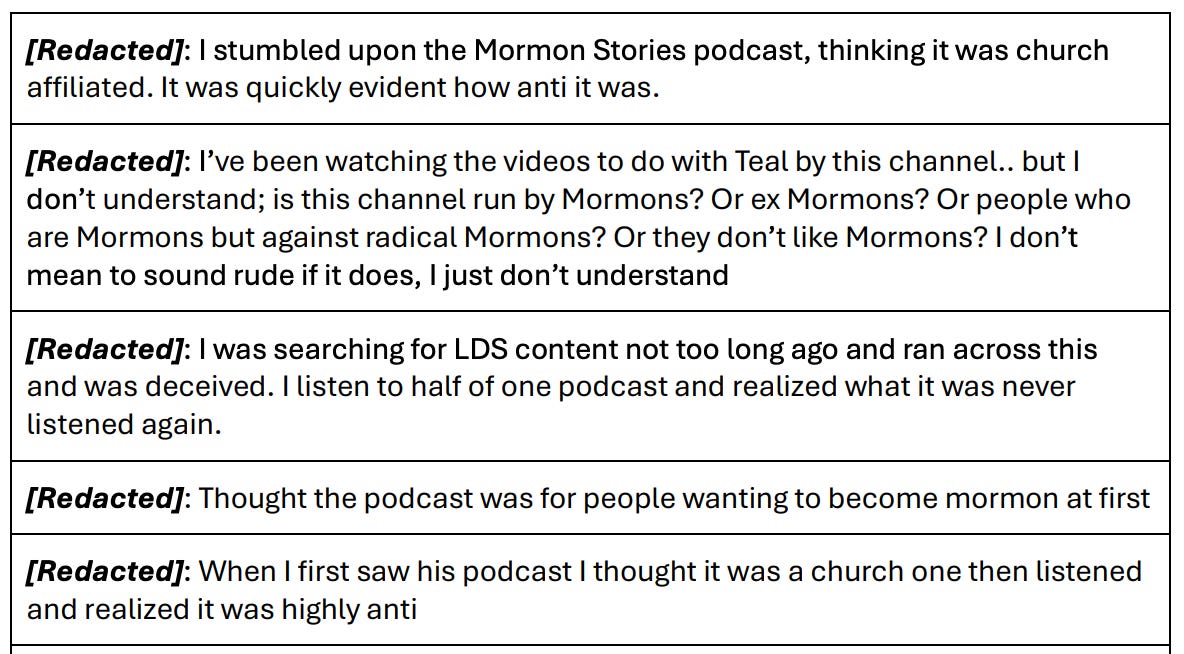
Nevertheless, the Mormon Church insisted there was confusion. To make that argument, the lawsuit included examples, cherry-picked from the podcast’s social media pages, of people who came across it because they believed it was pro-Mormon… only to realize that wasn’t the case. Here’s just a sampling:
There were more comments where those came from, but to me, they all seemed to prove the opposite point. People found Mormon Stories because they had questions about Mormonism… and then realized it wasn’t promoting the LDS Church.
At no point in any of the comments included in the lawsuit did those people say they genuinely confused Dehlin’s words (or his guest’s words) for Church policy. The fact that some of those commenters said they stopped listening immediately after their realization were points in Dehlin’s favor!
(Also, for a podcast this popular, it was deeply unfair for the Church to go searching for comments suggesting confusion was afoot because you’re bound to find anything you want. That’s the nature of popular comment threads. Anyone who spends any time on social knows you can’t always blame the owner of an account for what people say under that account, especially when the owner isn’t baiting it.)
To avoid confusion, the LDS Church demanded that Dehlin include a disclaimer everywhere saying that his podcast wasn’t an official product of the religious sect. But that, too, was beyond parody. No one should have to open their show by explaining which groups they’re not affiliated with.
Making matters worse for the Church, there are pro-Mormon podcasts that use the “M” word in their titles, too, yet there was no indication the LDS Church ever went after any of them for trademark violations even though those podcasts were not official products of the Church either.
This past February, the two sides met in person to discuss their positions.
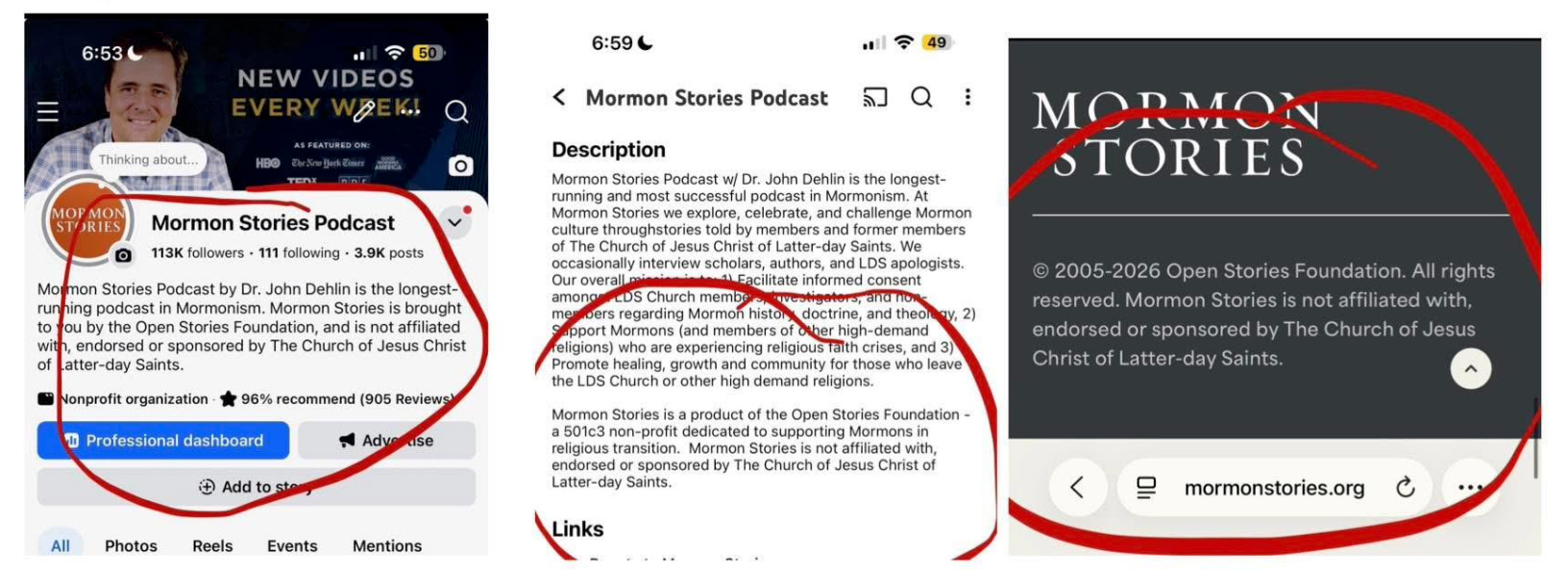
Dehlin agreed to remove any copyrighted images from his website and social media pages. (The LDS Church says he broke that agreement by later using an image of a temple to advertise an episode.) He changed the logo’s color from Mormon blue to non-Mormon orange. He even added the disclaimer to podcast descriptions on every platform.
What Dehlin refused to do was issue a disclaimer at the beginning of every show “acknowledging that Mormon Stories is not affiliated with the Church.”
That’s why the Church decided to go to court. I felt their case was weak.
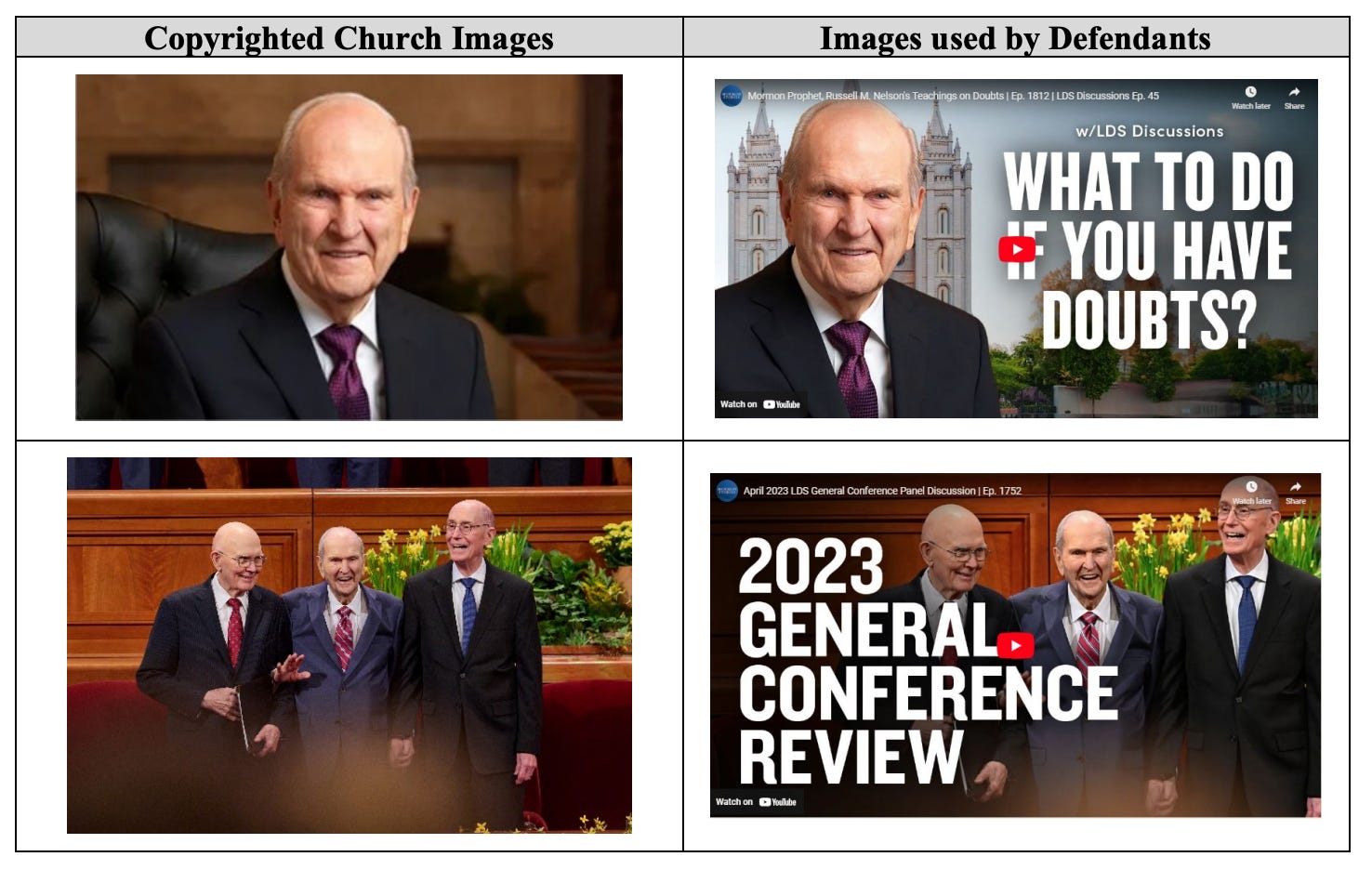
Just consider the copyright issues. The lawsuit included examples of official photos released by the Church that were later used in the thumbnails for Dehlin’s podcast videos:
Those seemed like perfectly normal cases of “fair use.”
The Church was also mad that Dehlin used the word “Mormon” at all... which was wildly ironic given that the LDS Church itself urged people to stop using the word because they didn’t want to be known that way to the point that even the famous Mormon Tabernacle Choir had been renamed the Tabernacle Choir at Temple Square.) And yet here they were telling the court that it was their word and not anyone else’s… and they had the paperwork from the U.S. Patent and Trademark Office to back it up.
This is all, they said, deeply damaging to the billion-dollar religious organization:
Unless these acts of Mormon Stories are restrained by this Court, they will continue, and they will continue to cause irreparable injury to Plaintiffs and to the public, for which there is no adequate remedy at law.
May we all strive to have that kind of influence. The Mormon Church was seriously arguing that Dehlin’s perfectly defensible use of their language and imagery might topple the entire damn religion. As if one man could destroy all of Salt Lake City through the power of… a podcast.
The lawsuit asked the court to stop Dehlin from using any logos or imagery that was “confusingly similar” to the LDS Church’s, and they wanted a jury trial.
Dehlin issued some informal responses to all this at the time, saying that he’s “been using the Mormon Stories name for my podcast for more than 20 years without any objection from the Church” and that he made plenty of changes at the request of LDS Church lawyers. But he added that it was “unreasonable” to demand anything beyond that:
… We didn’t feel any disclaimer was required, but in the spirit of cooperation we adopted one in our podcast description. The Church wanted us to make the disclaimer more prominent so it was essentially the primary thing anyone sees in our branding which we believe is unreasonable. We don’t want our primary message to be about what we are NOT. We have operated for a long time promoting who and what we are…
He said he was surprised by the lawsuit “given how cooperative we have been.” (There is a fund for supporters who want to contribute to the podcast’s legal defense.)
The LDS Church insisted it wasn’t going after Dehlin for what he says, only for the way he’s marketing his show, but there’s just no jury on Earth who would buy that excuse. They argued:
People are free to express support for or criticism of the Church and its teachings. This case does not concern the content of the podcast.
Uh-huh. Sure it doesn’t….
There’s a far stronger case that the Broadway musical “The Book of Mormon” might confuse outsiders who don’t know any better, but the Church didn’t fight that battle in court. If anything, they used it to their advantage. Did the Church sue Hulu over “The Secret Lives of Mormon Wives”? Not a chance. Even though that suggested a window into, well, the secret lives of Mormon wives.
In my mind, it was truly amazing this is how the LDS Church was wasting its time and money. Pope Leo is fighting fascism while the Mormon Church is fighting a podcaster.
And now, Dehlin’s team has filed its official response in court, calling on the judge to dismiss the entire case. While many of the arguments are ones I’ve written about above, it’s worth noting how Dehlin defends himself.
When it comes to the use of the word “Mormon” and whether it constitutes trademark infringement, the LDS Church has to show there’s no artistic/editorial relevance and that Dehlin is trying to mislead people.
It’s not hard to rebut any of that:
… the word “Mormon” has a strong cultural significance far beyond any alleged source-identifying function claimed by the Church; it is used as a ubiquitous and descriptive reference to Mormonism writ large, including the history, traditions, culture, and people within Mormonism beyond just the Church itself… Indeed, the Church itself has publicly declared that “Mormon” is only a “nickname” for members of the Church and is “correctly used in proper names” or “when used as an adjective.”
…
Defendants’ MORMON STORIES podcast series uses the term “Mormon” in the title to signal the subject matter of the series—stories about Mormonism, Mormon culture, Mormon history, and Mormon experiences. There is nothing in the title of the podcast that is overtly misleading or deceptive—indeed, it accurately and creatively describes the content that the listener can anticipate engaging with.
Dehlin also points out the LDS Church waited 20 years before filing this lawsuit—suggesting they waited until the podcast became incredibly popular to try to silence it rather than go after it the moment they found out about its name. It’s not like they only learned about the podcast this year! In fact, he says, it’s “impossible for the Church to claim it was not aware of Defendants’ use of MORMON STORIES for more than a decade before filing the present action.”
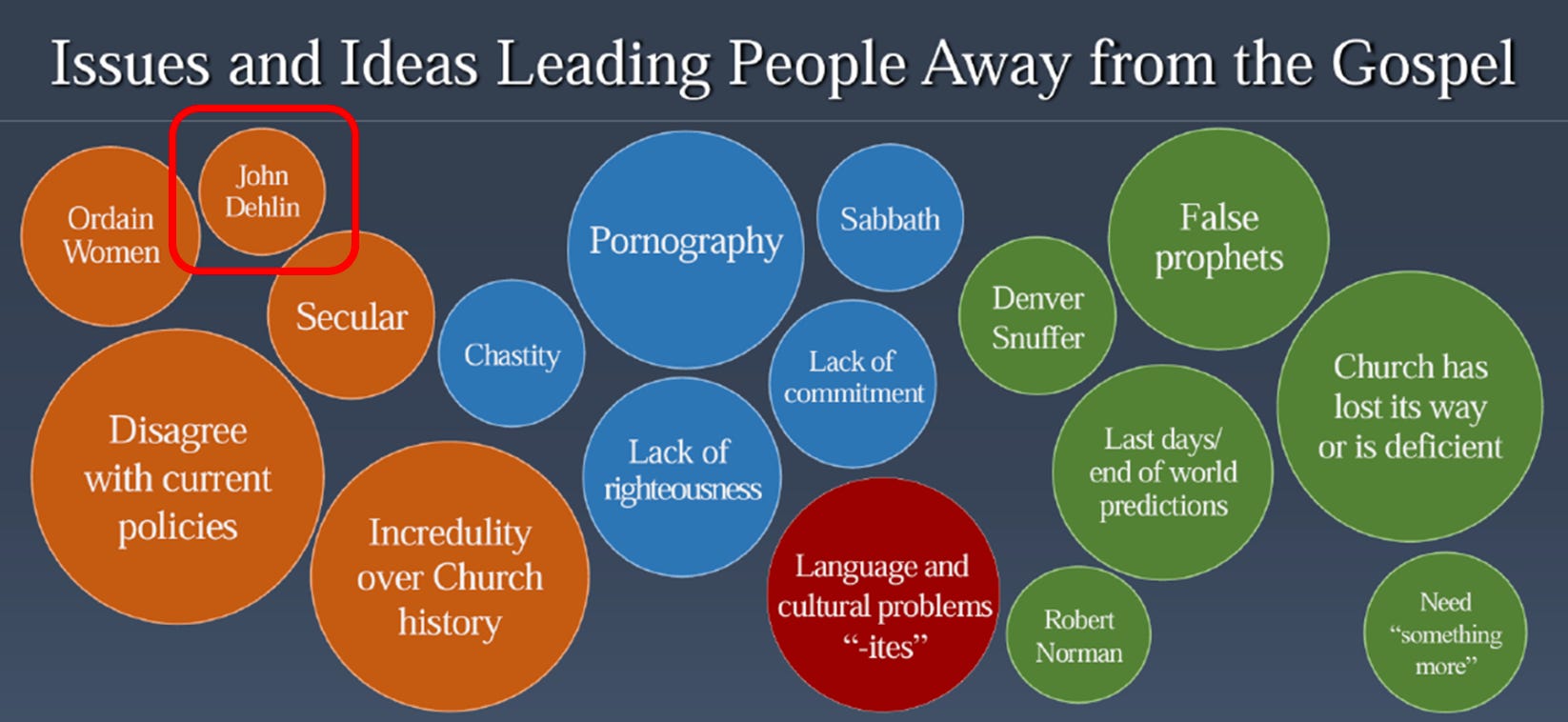
In a separate filing, responding to the LDS Church’s lawsuit line by line, Dehlin goes into more depth about the podcast and his own history with the Mormon Church. My favorite bit there may be the inclusion of a chart from December of 2015 in which the Church’s Quorum of the Twelve Apostles—a second-tier group of leaders—held a meeting to discuss why people were leaving the LDS Church… and included Dehlin as a reason for that.
Dehlin says that chart alone is “effectively an admission that his MORMON STORIES podcast did not create confusion about the podcast being affiliated with or sponsored by the Church.”
Not only that, but in 2010, the LDS Church trademarked its own “Book of Mormon Stories” podcast and told the United States Patent & Trademark Office that no other podcasts with similar names “would create a likelihood of confusion with the Church’s podcast name.”
Elsewhere in the response, he argues the LDS Church has no ownership of the blue color or a generic “light rays” design.
Dehlin adds in a press release that he made changes to appease the LDS Church, but they made no compromises for him, and the lawsuit came as a shock:
According to today’s filing, Mormon Stories Podcast and the Open Stories Foundation have included disclaimers indicating its clear independence from The LDS Church since its founding. Mormon Stories’ use of the color blue and “rays” in its branding began well over a decade ago, and did not begin around 2022 as suggested by the Church’s claims. But, to avoid expensive litigation, Mormon Stories and the Open Stories Foundation engaged in months of mediation after first being contacted by The Church in late 2025, and agreed to numerous changes requested by Church representatives, including modifications to branding, disclaimers, logos, and imagery.
“We made substantial changes in good faith because we believed reasonable compromise could resolve this matter,” Dehlin said. “We were surprised to learn that despite accepting most of The Church’s requested changes, litigation would proceed. It feels like we were the only ones making compromises, and The Church took an all-or-nothing, one-sided approach to mediation, which included unreasonable demands. It is also very disappointing that The Church chose to publicly mischaracterize what happened in mediation.”
While the court will eventually have to weigh in, none of this is a good look for the Mormon Church. They’re not really trying to protect their “brand” at all. They’re just trying to put obstacles in the path of someone who has helped countless people leave the Church. Rather than addressing the criticisms people on Dehlin’s show make, they’d rather turn off the microphone by forcing Dehlin to fight an expensive legal battle.
Dehlin is fighting back by making several points:
The Church’s own documents—noting they’ve known about him for a long time—undermine their argument that their only concern is trademark violations.
The 20-year delay suggests there was never really any confusion about what Dehlin was up to.
The idea that the Church needs to protect the word “Mormon” is ridiculous given that Church leaders have openly distanced themselves from the word.
The word “Mormon” is a generic word that’s bigger than just the religious institution. You can’t copyright it any more than a church can copyright “Christian.”
He has a First Amendment right to criticize the Church.
Overall, though, this is how you know his show makes a positive difference in people’s lives. It shows them their lives can be fulfilling and wonderful and guilt-free outside the bubble of Mormonism.
If this is how the LDS Church treats a former insider who asks questions and builds community, imagine what it signals to current members who are quietly doubting. If you become too effective at articulating those doubts, the institution won’t just argue with you; it’ll try to silence you.
By picking this fight, the Mormon Church is only confirming the criticisms they’re so desperate to suppress.
(Portions of this article were published earlier)
Please share this post on Reddit, Facebook, or the godawful X/Bird app.
If the LDS-church has the word "Mormon" trade marked, they admit it is used for trade. They sell false hope into a good afterlife for big money to customers who can't complain afterwards when they don't get what was promised. The conclusion is that the LDS-church is a for profit commercial organisation that must be taxed.


Dum(b) dum(b) dum(b) dum(b) duuum(b)
They don't like Dehlin using the word "Mormon?" Fine. He should switch to Mor(m)on." Let's see the LDS claim copyright infringement on THAT.
If the LDS-church has the word "Mormon" trade marked, they admit it is used for trade. They sell false hope into a good afterlife for big money to customers who can't complain afterwards when they don't get what was promised. The conclusion is that the LDS-church is a for profit commercial organisation that must be taxed.