
This newsletter is free and goes out to over 23,000 subscribers, but it’s only able to sustain itself due to the support I receive from a small percentage of regular readers. Would you please consider becoming one of those supporters? You can use the button below to subscribe or use my usual Patreon page!
Somehow, four years after its launch, one of the largest religious ad campaigns in American history is still failing to get a positive reception.
You may have the latest 60-second “He Gets Us” ad during the Super Bowl yesterday. At an estimated cost of $16 million, the ad conveyed the message that overconsumption is bad and that “there’s more to life than more,” before bizarrely suggesting that Jesus makes everything better.
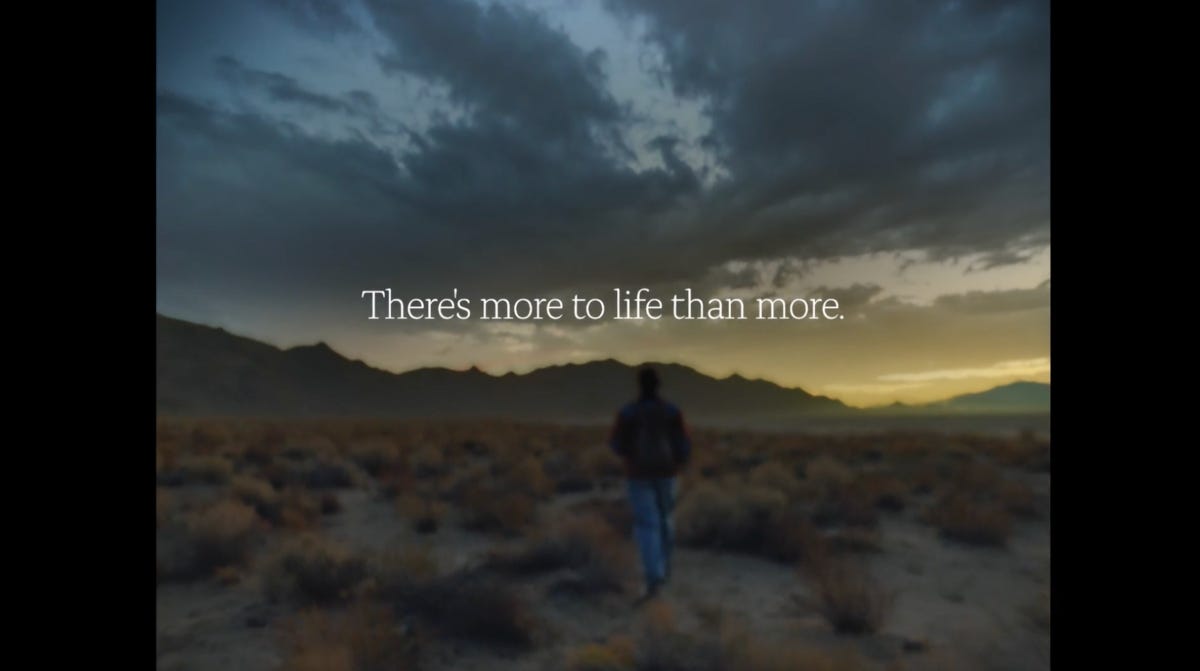

The irony is that being in nature— quiet, away from people, without modern technology, no money needed— doesn’t require Jesus at all. It’s also telling that there were no images from inside megachurches.
Several other ads that are part of the same $700 million (and counting) campaign have already aired on New Year’s Eve and during the Winter Olympics opening ceremony. Other ads will appear during the World Cup. One of them has already received over 68 million views on YouTube since it was released on December 19.
When the campaign first launched in 2022, all we knew was that a group of Christians, funded by anonymous donors, said they planned to spend over $100 million—who could have guessed that was a complete underestimate?—to shove Jesus in as many faces as humanly possible by way of TV spots, billboards, and online ads telling viewers one message about Jesus: “He Gets Us.”
See? Jesus is just like you. He understands you. He’s been there. (Now worship Him or else you’ll burn in Hell for all eternity.) Very catchy stuff.
These weren’t ads for a particular church or denomination. It was meant to be a catch-all campaign meant to sell the idea of Jesus in the hopes that people would eventually want to connect with a church. But even if they didn’t, the hope was that they would at least be “saved.”
Christianity Today explained the origin story of this marketing blitz at the time:
The $100 million for He Gets Us comes from The Servant Christian Foundation, a nonprofit backed by a Christian donor-advised fund called The Signatry. (Both declined to name the donors who helped envision and pay for He Gets Us, who want to remain anonymous.)
...
Last year, The Servant Christian Foundation approached Bill McKendry, founder and chief creative officer at Haven, concerned that too many young Americans are leaving Christianity and that more people were growing hostile toward faith. Their idea: a national media blitz for Jesus at a scale that no single church could afford.
McKendry said approaching American Christianity’s image problem with business savvy is what Jesus would have done. “[Jesus] crafted his language and his storytelling to resonate with people,” he said. “He told agricultural stories to farmers. He told fish stories to fishermen. … This culture is immersed in media, and we’re using media to reach them for Christ.”
The campaign organizers weren’t trying to convert atheists. They were aiming for what they called the “movable middle”—the people open to Christianity but who, for whatever reason, were not currently Christian.
Over the past few years, the ads have dealt with anxiety and loving your enemies.
Nowhere in that article or any of the group’s press statements, though, did anyone talk about the biggest and most obvious flaw with this plan. And nearly four years later, they’re still pretending it doesn’t exist.
To understand the issue, consider another kind of Super Bowl ad from a few years ago, advertising cryptocurrency. There was a viral tweet sent after the 2022 game that read, “One reason I still have trouble believing crypto currency is money is that there aren’t commercials for money.”
It made sense. A good product that already has widespread usage shouldn’t need a marketing campaign at all.
That was the problem here.
Marketing Jesus comes with an inherent flaw: Most of the people using the product aren’t worth admiring. Between televangelists, megachurch leaders, Republican politicians, campus evangelists, hate-preachers, lazy apologists, everyone who runs the National Prayer Breakfast, and Franklin Graham, the amount of harm caused by the most fervent Jesus followers can’t be understated.
Why would you ever want to join a club that includes those people as members?
And why wouldn’t you at least acknowledge that the biggest obstacle to selling Jesus are the people who’ve already purchased the product?
That idea already seems to be having an effect in an unintentional way. The original ads for the campaign included slogans like “Jesus confronted racism with love.” There was no mention of how white evangelicals are more likely than non-religious white people to reject the idea of structural racism.

Another photo said “Jesus was a refugee.” There was no mention of how the most powerful Christians in the first Trump administration opposed refugees entering our country. And there still is no mention of how the second Trump administration has waged an all-out war against people they claim are not real Americans.

Another photo said “Jesus fought systems of oppression.” There was no mention of how Christians were responsible for the anti-LGBTQ laws passing in state legislatures across the country.

Another photo asked: “Have you ever been bullied?“ The implication was that Jesus was bullied too. But there was no mention of how Christians are routinely the ones causing harm to others no matter how often they claim to be persecuted.

The whole campaign has always been like this. They elevate a form of Christianity that simply doesn’t exist in the real world—at least not among the people in positions of real power.
We know that because those people in power are the first to complain about the ads. In 2023, after the campaign aired a Super Bowl ad in which people washed the feet of those they would normally be against, Charlie Kirk called the entire campaign “one of the worst services to Christianity in the modern era” because it was led by “woke tricksters.”
Obviously, conservative Christians and white evangelicals don’t represent the full breadth of Christian thinking, and it would be unfair to pretend otherwise, but the United States, right now, is not in a better place because of Jesus followers. Many Americans are suffering as a direct result of their faith-based cruelty. So much of our politics right now, at least for liberals, involves fighting against Christian Nationalism and Jesus-inspired bigotry.
These campaign organizers want to market Jesus, but they don’t give a shit about the consequences. In that sense, they’re a lot like the Sackler family, eager to sell opioids to the masses while distancing themselves from all the harm caused by their products. As if the two things aren’t intertwined.
The “He Gets Us” campaign purposely avoids hot-button issues. They won’t say what Jesus stood for on matters of abortion, LGBTQ rights, immigration, etc. because they know taking a position on anything will alienate people. Unfortunately, they’re so afraid of alienating bigots that they won’t spend their money to make Jesus actually look good. They never define Jesus. Instead, they say Jesus is just like us. But they never say who “us” is.

A better campaign for Jesus wouldn’t be so damn afraid to say cruelty and bigotry and theocracy are wrong. To paraphrase an idea that’s floated around online, if people refuse to tell you whether they’re liberal or conservative, it’s because they’re conservative.
Turns out that’s not just speculation. According to Christianity Today, Haven, the “Michigan-based marketing agency” that created the first batch of ads for this campaign, previously worked for Focus on the Family and Alliance Defending Freedom, two groups that actively fight against civil rights, marriage equality, and pandemic safety. Haven was hired to promote those groups. They were hired to change the image of those groups in a positive way. They clearly weren’t bothered by the fact that their work was used to spread more hate in the name of Jesus.
Naturally, then, they ignored the worst aspects of their product in this marketing campaign too.
What about now?
According to Adweek:
He Gets Us was created in 2021, initially funded by The Signatry. It’s now backed by nonprofit group Come Near, which formed in 2023 to oversee a new chapter of the campaign with former Domino’s CMO Ken Calwell as CEO. The nonprofit has about 30 total staff, Armour said.
Come Near’s board of directors, as listed on its website, include Rob Hoskins, president of Christian ministry OneHope; Nicole Martin, president and CEO of Christianity Today; John Kim, investor and Christian pastor; Mart Green, founder and CEO of Christian retailer Mardel and son of Hobby Lobby CEO David Green; Joey Sager, managing director of Venturi Private Wealth; and Gary Nelson, chairman of Christian ministry Every Tribe Every Nation.
So… the Hobby Lobby family, a ministry (OneHope) that’s funded by Hobby Lobby, and several people who aren’t bothered by Hobby Lobby’s anti-LGBTQ, pro-Christian Nationalism history.
That’s why these people can’t separate Jesus from Jesus’ followers, no matter how hard they try. The reason so many people want nothing to do with Christianity is largely because the kind of people willing to blow $700,000,000 on a marketing campaign for Jesus either don’t care about or actively support the worst Christians in the country.
Even if this campaign “succeeds,” by whatever metrics they want to use, who really wins? Learning about Jesus is useless without considering the applications of those teachings. And when the people behind the campaign refuse to take a clear stand against moral monsters, it’s obvious where their loyalties lie.
There was a Christian preacher years ago who formed a ministry dedicated to helping Christians build bridges with LGBTQ people. Nice idea, right? But the preacher refused to answer questions about whether he thought homosexuality was immoral or whether same-sex marriage was okay. Whatever he thought personally, he felt any formal response would alienate one side or the other so he took the coward’s way out. His ministry no longer exists.
This marketing campaign is destined to end up in that same grave. If Christians aren’t willing to denounce fellow believers in positions of power, despite the glaring link that ties them all together, their religion isn’t worth adopting. And when Christians with hundreds of millions of dollars in pocket change want to pretend that Jesus (as a concept) rises above the worst Christians’ interpretations of biblical teachings, you’re better off avoiding anything they put in front of your face.
Of all the ways that money could’ve been used to show the world why Christianity is worth following, this has been the biggest waste imaginable.
Let’s hope that utter lack of self-awareness is obvious to the audience they’re hoping to reach. In the real world, Jesus isn’t the solution. Jesus is the problem. And refusing to acknowledge that only makes everything worse.
(Portions of this article were published earlier.)
𝐼𝑛𝑠𝑡𝑒𝑎𝑑, 𝑡ℎ𝑒𝑦 𝑠𝑎𝑦 𝐽𝑒𝑠𝑢𝑠 𝑖𝑠 𝑗𝑢𝑠𝑡 𝑙𝑖𝑘𝑒 𝑢𝑠. 𝐵𝑢𝑡 𝑡ℎ𝑒𝑦 𝑛𝑒𝑣𝑒𝑟 𝑠𝑎𝑦 𝑤ℎ𝑜 “𝑢𝑠” 𝑖𝑠.
We know. Their idea of Jesus is just like them. A vengeful bigot who hates everyone who doesn't fit into their narrow little boxes. It is not surprising that this ad campaign is funded by Hobby Lobby money. The only surprising thing is that Dan Cathy of Bigot Bird isn't on the list.
Jesus confronted racism with love. Jesus was a refugee. Jesus fought off systems of oppression.
And Jesus threatens all of us with HELL. Ain't he just a swell fella.
The whole "he gets us" crap amounts to very little more than a phenomenal waste of money. The $100 million that The Servant Christian Foundation is spending could have been used to feed and clothe people who need either or both, or perhaps provide housing for the homeless ... but nope. They'd rather thumb their nose at Matthew 6:5-6 and tell everyone how neat their supposed savior is.
And the message apparently isn't selling well. Whoda thunk it? 😝