
This newsletter is free and goes out to over 26,000 subscribers, but it’s only able to sustain itself due to the support I receive from a small percentage of regular readers. Would you please consider becoming one of those supporters? You can subscribe via Patreon or the Subscribe button below! You can also make one-time donations through Venmo, CashApp, or PayPal.
I’m still processing everything that happened during Tuesday’s Blue Tsunami, at least through a church/state separation lens, but I wanted to get a few thoughts down here while people are still happy and optimistic.

We Saw Serious Blowback Against Christian Nationalism
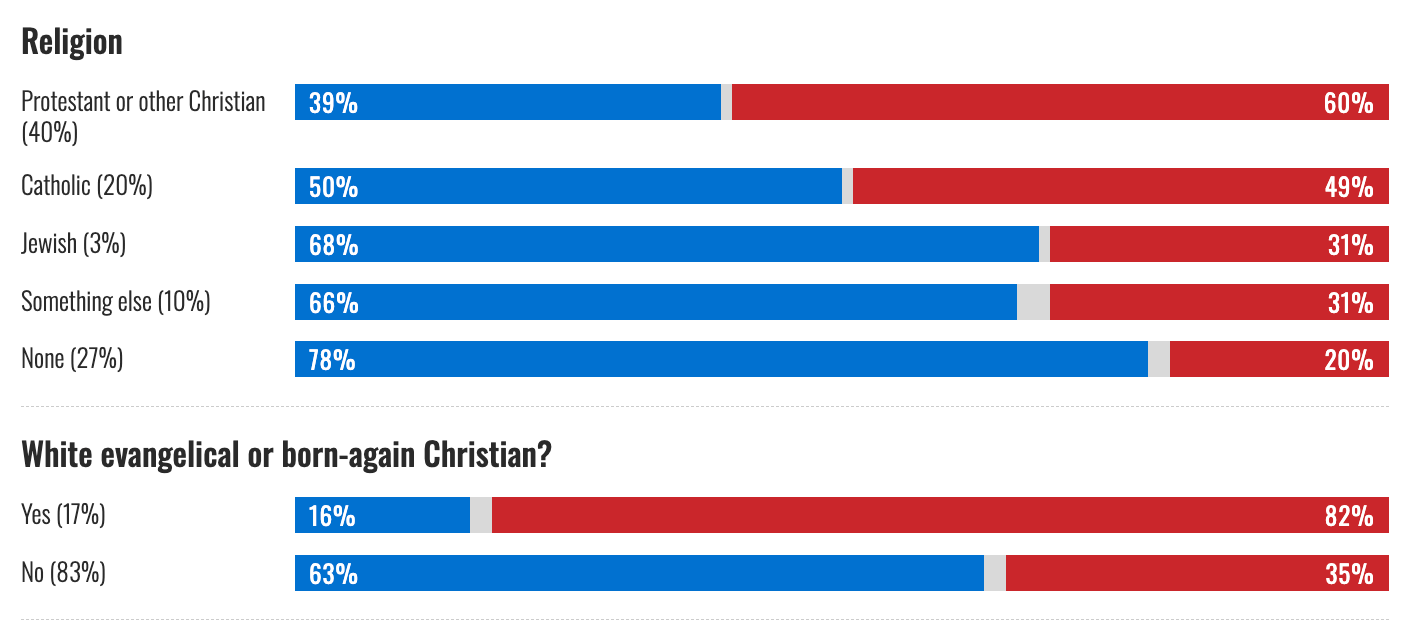
According to preliminary exit polling that breaks down results by religion, from NBC News, the share of “Nones” who voted rose from 24% in 2024 to 27% in 2026. We are a growing segment of American voters—and we’re reliably liberal. 78% of the Nones supported Democrats. That’s a shift of roughly 6 points to the left compared to two years ago.
Meanwhile, 82% of white evangelical voters continued to support Republicans—roughly on par with previous elections—showing yet again how they’re willing to overlook all kinds of cruelty and corruption in the name of partisan politics. (Christians who are not white evangelical or born-again, like Black Protestants, favored Democrats over Republicans.)
There’s a very good chance that Defense Secretary Pete Hegseth, one of Donald Trump’s more loyal allies and advocate for Christian Nationalism, will be fired in the days to come as Trump looks for someone to blame for his debacle in Iran. If not, then Democrats have said they will work to impeach him. Given all the ways Hegseth has infuse conservative Christianity into the military, his defeat would put at least a temporary stop to his theocratic fantasies.
House Speaker Mike Johnson has already announced he will no longer serve in that role when the new Congress is sworn in, removing himself from the presidential line of succession that put him two heartbeats away from the presidency. This was a man who promoted “covenant marriage.” He used Christian software to spy on his son’s internet viewing history. He attended a “Purity Ball.” He called for a “biblically sanctioned government” and explicitly said we are a “Christian Nation.” Johnson was the attorney for Creationist Ken Ham when he wanted to use taxpayer funds to build Ark Encounter in Kentucky—they later received massive tax breaks from the state. Not only did Johnson want to ban abortion, he also wanted to get rid of access to contraception. He has tried to ban abortion clinics, called abortion a “holocaust,” and longed for a return to “18th-century values.”
He’ll still be in Congress, but after years of power in which he served as a spineless yes-man to advance Trump’s cruelty, the highest profile white evangelical Christian in government oversaw a shellacking of his party. He wasted a golden opportunity to show the world that conservative Christians could make the country a better place. For all his talk about the importance of faith-based moral values, he constantly defended the most immoral man we’ve ever elected.
We also saw a thrashing of Christian Nationalists in Texas, where Gov. Greg Abbott, Lt. Gov. Dan Patrick, Senate candidate and current Attorney General Ken Paxton, Attorney General-wannabe Mayes Middleton, and white nationalist Bo French all lost their statewide races to Democrats. These are the people who forced Ten Commandments posters into public school classrooms, pushed chaplains into schools (in lieu of trained social workers and counselors), and rewrote school curricula so that it included the Bible.
The Texas Board of Education, where Republicans held an 11-4 edge, is also on the verge of flipping in favor of Democrats. (There’s currently a 7-7 split, with the Democrat on the verge of winning the last seat.) As the Texas Tribune notes, the Republicans have controlled that board since 1994 and their recent actions pushed all kinds of “culture war” narratives:
Earlier this year, members in the Republican majority approved the anti-Islamic rewrite of social studies lessons alongside the mandatory reading list for public school students that included Bible passages…
Members have also fielded complaints about the Texas Education Agency’s error-riddled learning materials, which incorporate Bible teachings into elementary reading lessons. They have debated the merits of a Native Studies course, with some in the GOP majority calling it “junk.” Years before that, they rejected science textbooks over messaging on climate change and walked back opposition to vouchers, which allows families to use taxpayer dollars to fund their children’s private school education.
We also saw Senate wins for Kansas’ Adam Hamilton, pastor of the largest United Methodist church in the country, and Texas’ James Talarico, a seminarian. Like fellow Sen. Raphael Warnock of Georgia, their faith was a huge part of their campaigns though they pledged their support for church/state separation. For so many years, Democrats have been accused of being hostile to faith; they prove that the party doesn’t have a problem with Christianity. We just have a problem with conservative Christian politicians who want to legislate their beliefs. They are a direct response to the right-wing brand of Christianity that’s overtaken the GOP.
The fact that Michigan’s Abdul El-Sayed, a Muslim who also supports church/state separation, will join them in the Senate just shows how the Democrats are a big-tent party that welcomes people of varying views on religion. Given that 98% of Republicans in Congress are some form of Christian, it’s clear to the ever-growing number of non-Christian Americans that only one political party welcomes their religious and non-religious diversity.
The Supreme Court Won’t Get Any Worse
With Trump in power for another two years, a Republican Senate majority could have created an opportunity for 78-year-old Clarence Thomas and 76-year-old Samuel Alito to retire, knowing their replacements would likely be ultra-conservatives in their 30s or 40s. This is a Supreme Court that has already eroded church/state separation in so many ways—and will continue to do so given the chance.
But with Democrats about to control the Senate, Trump shouldn’t be able to get any of his future SCOTUS nominees through. If either of those men retires or dies, Democrats can simply let the seats stay vacated until they have the ability to choose the replacements. (Mitch McConnell would be proud, I’m sure.) And if Thomas and Alito pull a Ruth Bader Ginsburg and misplay their own mortality, Democrats could theoretically flip the Court in a few years—or expand it entirely.
Even if either man announces his retirement in the days to come—something Alito says he will not be doing—what Republicans will vote for a right-wing MAGA cultist to replace him after seeing the price Sen. Susan Collins paid for her support of Brett Kavanaugh? Will Thom Tillis want to do that on his way out the door? How about Lisa Murkowski? Collins (again)?! What about any of the Republicans up for re-election in 2028 who won’t want that albatross around their necks?
Furthermore, unless Republican senators find a sudden urge to confirm lower court judges, Trump won’t be able to further hijack the federal judiciary after the new Congress is sworn in. (Republicans are already moving at a slower pace for judicial confirmations than he did during his first term.)
Openly Non-Religious Candidates Broke Records
With the help of a spreadsheet compiled by myself and the Center for Freethought Equality PAC (the political action committee affiliated with the Center for Freethought Equality, which is the political and advocacy arm of the American Humanist Association), we knew there were 38 “Nones” running for their respective State Senates and 123 running for State Houses—both roughly on par with 2024. Another 12 were running for U.S. Congress (a record). And 31 members of the Congressional Freethought Caucus (who are mostly all religious allies) were also on the ballot. Not a single one of them ran as a Republican.
These candidates use a variety of non-religious labels to describe themselves, but none of them subscribe to organized religion.
Did they succeed? Did their non-theism hurt their chances? What can we learn from their races?
Here’s what I can tell you so far:
All 31 returning members of the Congressional Freethought Caucus won their re-election bids.
Fred Wellman, a non-religious first-time candidate from Missouri, won a congressional race in a district that was specifically gerrymandered to make that harder for him.
Chris Rabb of Pennsylvania is about to become the first person elected to Congress while being openly atheist. (Rep. Jared Huffman came out as a Humanist after he had served a few terms.)
Jon Rosenthal, who’s agnostic, is about to become one of three Texas railroad commissioners, helping regulate oil and gas production. He was part of the Blue wave that won every statewide race and defeated one of the most bigoted politicians along the way.
And right now, there will be at least 75 non-theistic politicians in state houses and another 24 in state senates—with several races left to call. Both numbers are already records. Several of those winners are first-time candidates.
As the Center for Freethought Equality PAC put it:
Before this cycle, CFE knew of 81 state legislators in 33 states who openly identify with the Humanist, atheist and nonreligious community. After Tuesday, that number tops 100 legislator-elects spread across at least 38 states. Humanists, atheists and agnostics now have representation in the Georgia, Idaho, Illinois, Ohio and West Virginia statehouses for the first time, and South Carolina could be next once final results are in.
But if you really want to see the impact of the Nones, consider the case of Kristi Burke, an atheist YouTuber from the eastern part of Tennessee who jumped into the race against Congresswoman Diana Harshbarger.
In 2024, Harshbarger won with 78% of the votes, so this was always an uphill climb. But that also gave Kristi leeway to be herself. She never shied away from her atheism or her progressive values. She ran the kind of campaign that almost makes El-Sayed seem centrist. She gave voters a real choice; instead of Democrats settling for a generic opponent to Harshbarger, they could proudly support Kristi.
Kristi didn’t win on Tuesday. But here’s the thing: Harshbarger only received 67% of the vote this time around—a massive drop from two years ago.
Just look at this map of how the counties that make up Tennessee’s 1st Congressional District shifted from 2024:
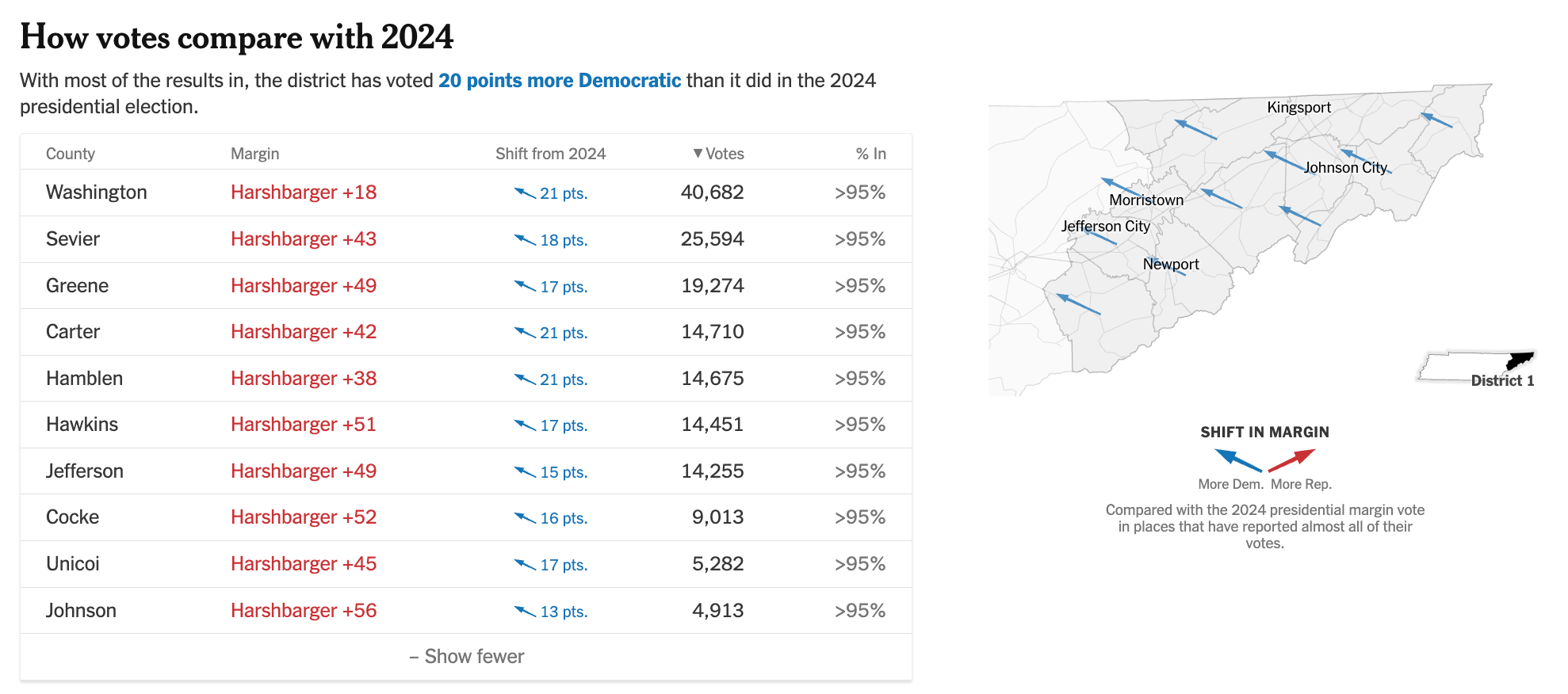
My jaw dropped staring at that image.
Kristi managed to pull every single county in her direction by double-digits. That’s not just part of a national trend; that’s a mark of a great candidate who can also get more votes for the Democratic ticket as a whole. Even if we don’t see seats flip this year, that’s the sort of thing that pays dividends in the future. (Hell, we’re only now seeing the fruits of the 2018 Beto O’Rourke Senate campaign in Texas and Stacey Abrams’ gubernatorial campaign in Georgia.)
Tennessee can flip in the future, and when it does, it will be because of people like Kristi and Justin Pearson and candidates who fight like hell for progressive values and energize voters in the process.
What Does All of This Mean?
Tuesday was a release of so much pent-up frustration. And it reminded me of the last time I experienced something like this.
In 2008, I was in Grant Park in Chicago with a massive crowd to watch Barack Obama win. It was incredible. We were in shock even though we knew it might happen. That night, you could feel everyone in the crowd realizing we were part of something amazing, with the hope that things might finally change.
What I remember more than anything, though, was how that night was really about one candidate, even though it was a wave election. Joe Biden’s win in 2020 was a little more subdued due to COVID but that election, too, was about him more than everyone else.
On Tuesday, we saw victories from so many different candidates, in so many huge races. Good news flowed in for hours on end from every conceivable direction—and we’re not done yet.
Now it’s time to use those victories to advance policies that help as many people as possible. Because the conservative Christians in the Republican Party will never do that.
I think the so-called Christian Nationalists tend to live in a bubble where they constantly reinforce one another. They are oblivious to the fact the overwhelming majority of Americans want no part of what they advocate for the country and delude themselves into believing people will passively submit to their rule if they can just attain power. If you want to see what genuine persecution looks like . . . hand power to the preachers.
A major victory, but not an end.
They will temporarily retreat, lick their wounds, and come back.
The arc of history only bends towards justice if good men and women stand up and make it bend that way against the neverending forces of those who wish to perpetuate injustice.