
This newsletter is free and goes out to over 24,000 subscribers, but it’s only able to sustain itself due to the support I receive from a small percentage of regular readers. Would you please consider becoming one of those supporters? You can subscribe via Patreon or the Subscribe button below! You can also make one-time donations through Venmo or PayPal.
Texas has, as expected, green-lit a plan to force kids to read the Bible in public school.
On Friday, the State Board of Education voted 9-5 to give preliminary approval to a list of books that will be forced upon public school students beginning in 2030. An earlier version of the list was much longer and received well-deserved criticism—which is why the Board delayed any vote on it until this week—but this pared-down list is hardly any better.
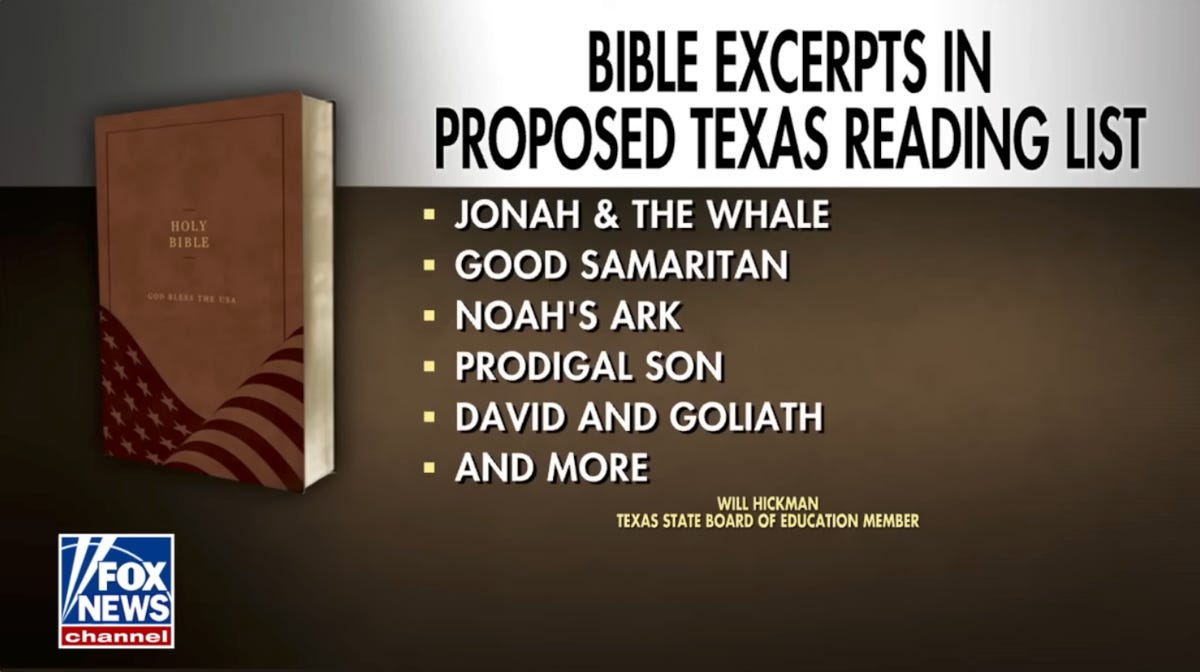
It’s all part of a proposal to institute an official Texas literary canon at each grade level. Rather than having school districts and teachers decide which books would be best for their students to read, the proposal would require certain texts to be assigned from kindergarten onward.
Plenty of the items made sense: Under the initial proposal, for example, Kindergarten teachers would read aloud books like “The Cat in the Hat” and various nursery rhymes. Sixth graders would read the play “The Miracle Worker” (about Helen Keller) and S.E. Hinton’s “The Outsiders,” among other works. The high school curriculum would include books like “The Great Gatsby” and “The Scarlet Letter.”
But included in the mix were Bible passages:
Also included are three Bible-infused readings drawn from the state’s controversial Bluebonnet Learning curriculum: “The Golden Rule” in kindergarten, “The Parable of the Prodigal Son” in first grade, and “The Road to Damascus” in third grade.
The readings got more specific as students got older. Seventh graders would have to read “The Shepherd’s Psalm (Book of Psalms, Chapter 23)” from the Old Testament along with “The Definition of Love” from 1 Corinthians 13. High schoolers would be reading Genesis 11:1-9 about the Tower of Babel, Lamentations 3, and the story of David and Goliath as told in 1 Samuel 17.

There’s an argument to be made that there are secular benefits to teaching kids about Christianity. There are also certain Bible stories that any culturally literate person would know. Many of the passages in the original proposal, after all, were tied to other (secular) books that make references to them.
But what made the initial proposal so damning was that the Bible was the only religious book included in the required readings, and even the more secular stories were infused with more direct religious messages. (That’s on top of the state-sanctioned curriculum itself, which is already Bible-heavy.)
Consider the Golden Rule. That’s a pretty universal message, right? Of course we want to teach kindergartners to treat others the way they want to be treated. That’s not a Jesus Original™ by any means, but it’s a fine moral message.
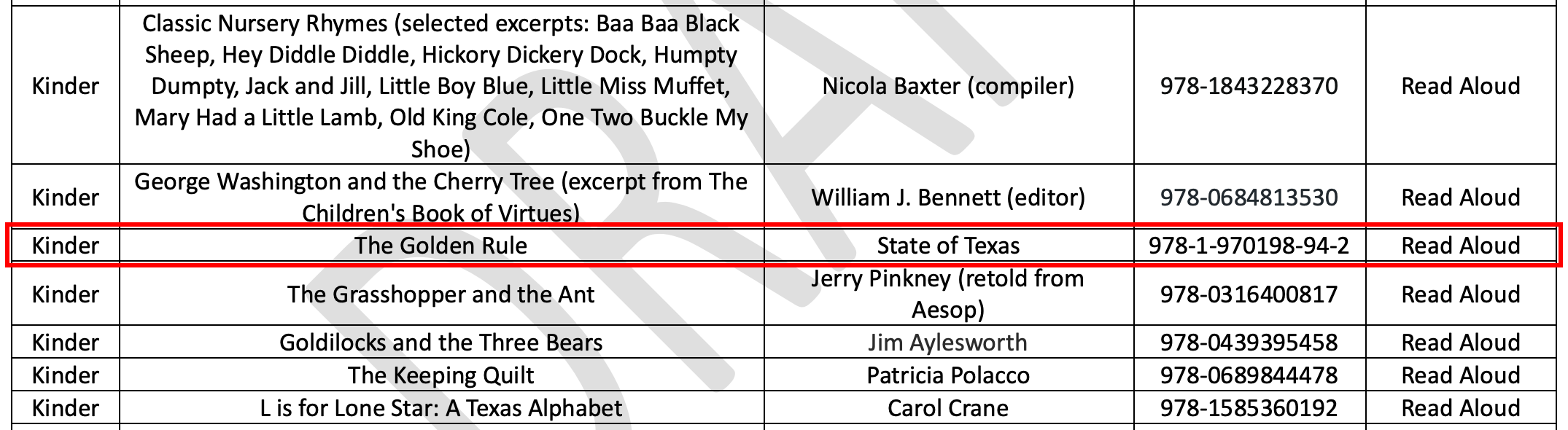
But if you go to the actual lesson that the Texas Board of Education has released, as part of the overly Christian Bluebonnet curriculum, you can see that the message is really part of a larger attempt to teach kids that the Bible is amazing.
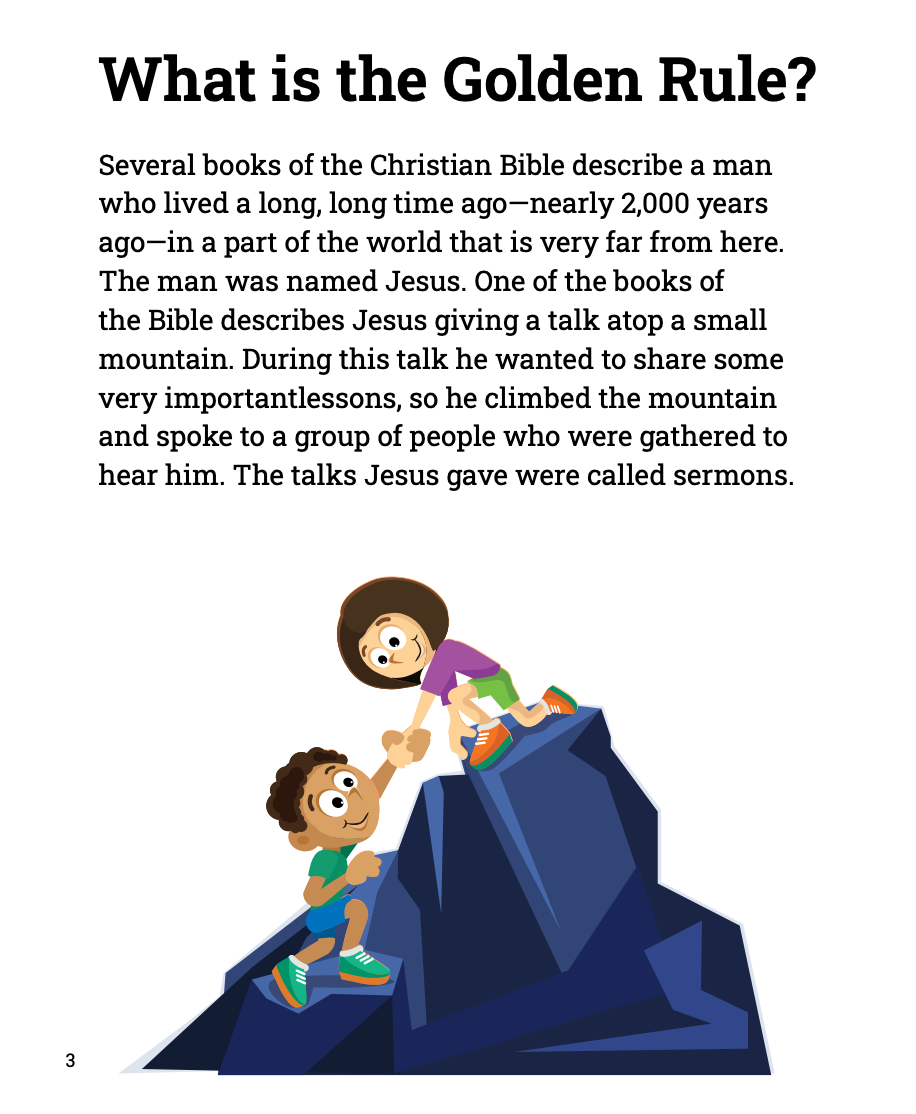
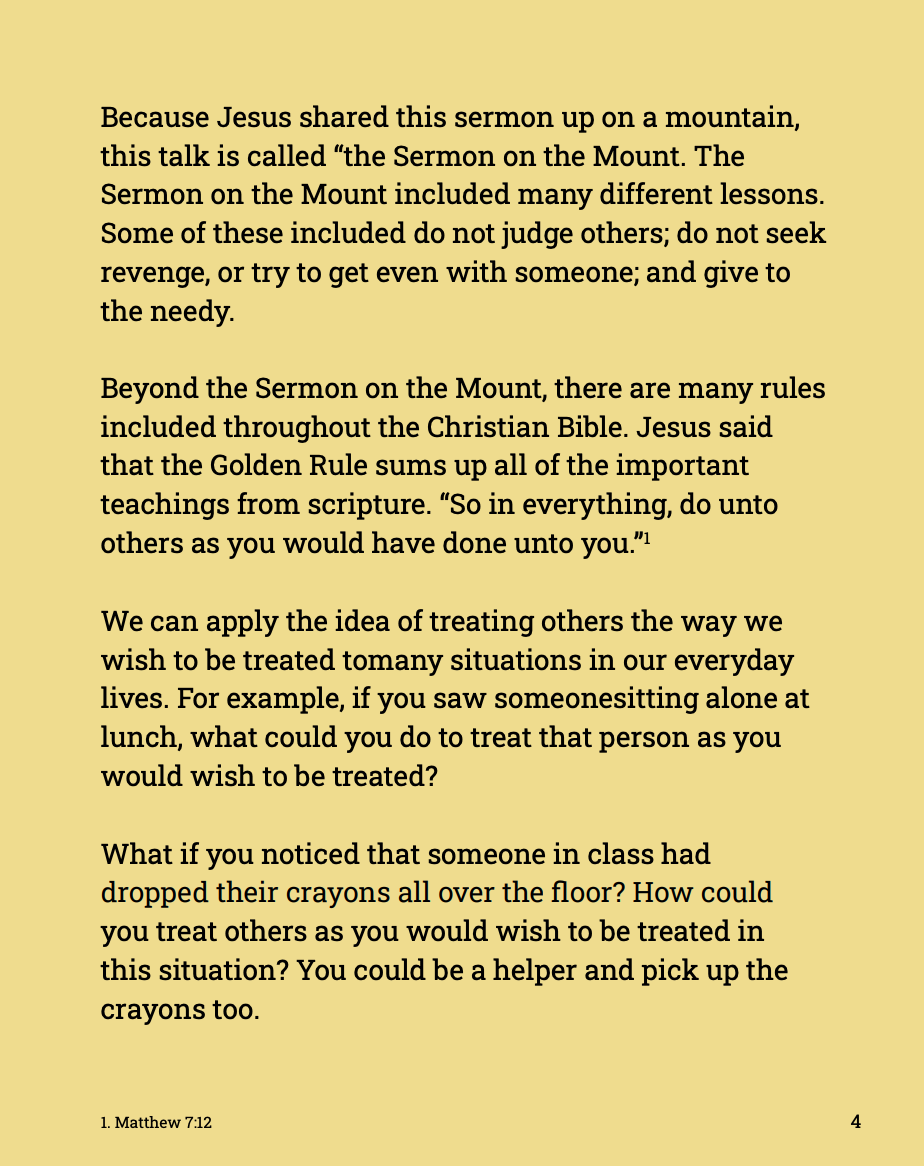
What is the Golden Rule?
Several books of the Christian Bible describe a man who lived a long, long time ago—nearly 2,000 years ago—in a part of the world that is very far from here. The man was named Jesus. One of the books of the Bible describes Jesus giving a talk atop a small mountain. During this talk he wanted to share some very important lessons, so he climbed the mountain and spoke to a group of people who were gathered to hear him. The talks Jesus gave were called sermons.
Because Jesus shared this sermon up on a mountain, this talk is called “the Sermon on the Mount.[”] The Sermon on the Mount included many different lessons. Some of these included do not judge others; do not seek revenge, or try to get even with someone; and give to the needy.
Beyond the Sermon on the Mount, there are many rules included throughout the Christian Bible. Jesus said that the Golden Rule sums up all of the important teachings from scripture. “So in everything, do unto others as you would have done unto you.”
We can apply the idea of treating others the way we wish to be treated to many situations in our everyday lives. For example, if you saw someone sitting alone at lunch, what could you do to treat that person as you would wish to be treated?…
Why is all that context about Jesus necessary to teach children that they should follow the Golden Rule? It’s not. But this is how an otherwise innocuous lesson is being used as a Trojan horse for more direct proselytizing. (It’s not until the very end of that lesson that the text mentions how other religions “including Hinduism and Islam” also follow some version of the Golden Rule, but the implication is that those religions got the idea from Christianity.)
The Houston Chronicle said there were “Ten excerpts from the Old and New Testaments… dispersed throughout” the proposal. And while the law allowed parents to remove their children from religious lessons, the way this program is structured, that created problems for the students:
Though parents would likely be able to opt their children out of reading religious texts, the reading list will become part of Texas’ English standards and therefore used to write standardized tests, which could make the readings unavoidable, critics said.
“This list represents another step by the state toward turning public schools into Sunday schools that undermine the right of parents to direct the religious education of their own children,” said Carisa Lopez, deputy director of the advocacy group Texas Freedom Network, in a statement Wednesday.
At least one member of the Board made very clear that this proposal was really about getting the Bible in front of kids, not getting secular lessons that may appear in the Bible in front of them. Brandon Hall, one of the Board members, wrote this on Facebook just before the January meeting:

Today, the Texas State Board of Education will vote on a proposal to add Bible passages to a required reading list for K–12 students across the state. This would bring the Word of God back into schools in a meaningful way for the first time in decades. We need prayer warriors to intercede for this vote.
Oops. He said the quiet part out loud.
(Side note: The “Word of God” was never taken out of public schools and therefore doesn’t need to be brought back into them.)
The revised version of the reading list, which is what the Board voted on, removed about 100 readings from the 300 that were first proposed… but those cuts didn’t include the Bible references. Those are very much still in place. (It’s unclear to me which draft list they voted on, but this is one version.)
The revised list, proposed by Republican member Keven Ellis of Lufkin, cut about 100 readings — including Mary Shelley’s Frankenstein and Frederick Douglass’ What to the Slave Is the Fourth of July? — though it still includes Bible texts.
…
Supporters of the list have said they believe the biblical material will help students better grasp the influence of Christianity in U.S. history. Meanwhile, at least one critic called the original list and its biblical material “a lawsuit waiting to happen,” while many stressed the importance of students needing to see themselves reflected in the books they read.
It was even pointed out that the revised list is still “mathematically impossible” to get through in the limited time teachers have with their students. But that’s what happens when you keep teachers out of the decision-making process, as the State Board of Education did in this case.
The new list can still be (and must be) reduced even further before the final vote in June. But there’s no indication the Bible passages will be left on the cutting room floor.
In the meantime, enjoy this brief-but-powerful testimony delivered to the Board during the public comments by Matilda Miller (a.k.a. MamaMephistopheles):
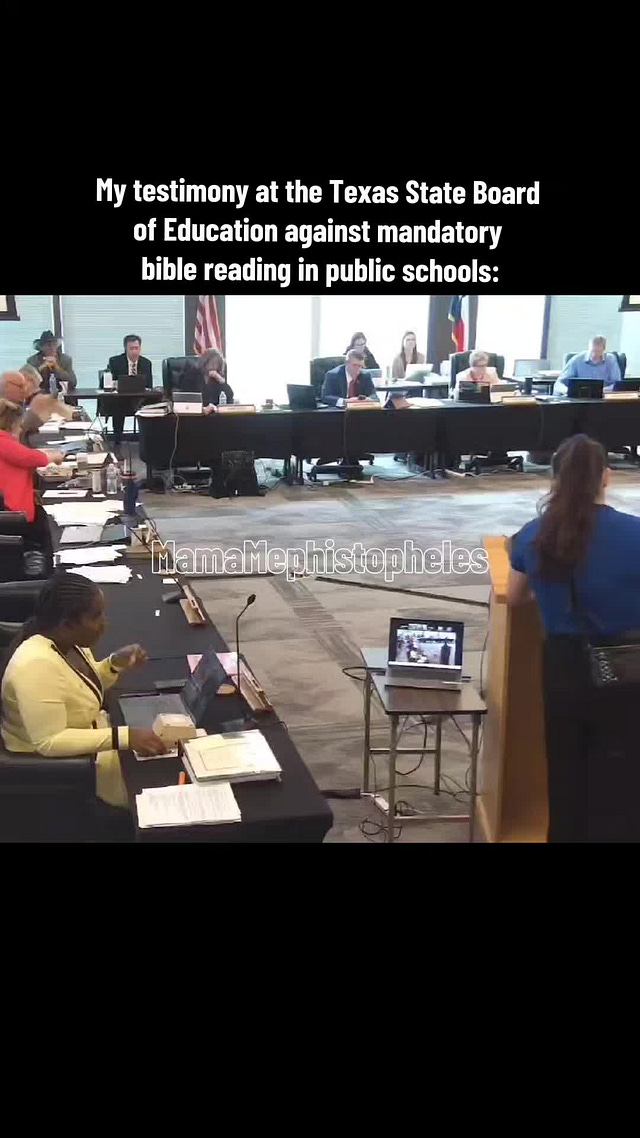
 Tiktok failed to load.
Enable 3rd party cookies or use another browser
Miller told me yesterday that she’s received “mostly positive” feedback from her statement and the viral video. While other speakers focused on the unconstitutionality of the list or the logistical impossibility of getting through the list in a school year, she wanted to focus on the Christian Nationalism of it all.
“I wanted to use my time to address what I saw as the elephant in the room,” she told me, referring to the “irrationality of the religious zealotry fueling the list from the beginning.”
She doesn’t expect the board members will change their minds on the issue, but she hopes she can get more people to understand why the proposal is wrong from this angle. And, she hoped, maybe she can inspire others to “feel comfortable speaking out the way I did at the meeting.”
As I’ve said before, the Texas Board of Education is shoving explicitly Christian narratives into a mandatory, state-sanctioned reading list and pretending it’s objective when it comes to religion. They want to privilege one (and only one) religion at the expense of all others, treating biblical stories as if they’re foundational truths and the default moral framework for everyone, regardless of their families’ beliefs.
That’s why people in Texas should object loudly to what’s happening. Once these readings are baked into the state standards, it’s so much harder to opt out of them. What the Board is doing should alarm anyone who believes in actual religious freedom—and the right of local school districts to have some control (beyond minimum, sensible state standards) of what students should learn.
If the new list is approved as is, textbook publishers and standardized test makers would have a few years to incorporate the reading list into their materials.
(Portions of this article were published earlier)
It just never ends, and it needs to. It is NEVER the job of our secular government to backstop anyone’s religion. The people pushing his measure would go out of their tiny little minds at the mere suggestion of school children being required to read from the Koran. Do these fools realize this is an open admission the churches have failed to get their message out? The people who approved this measure need to be held personally liable for the costs of defending it in court.
Texass xtians grooming kids. Child molesters, the lot.
And bravo for that viral vid by Matilda Miller.