
This newsletter is free and goes out to over 23,000 subscribers, but it’s only able to sustain itself due to the support I receive from a small percentage of regular readers. Would you please consider becoming one of those supporters? You can use the button below to subscribe or use my usual Patreon page!
For some reason, South Carolina is considering a bill that would force public schools to post a copy of the Ten Commandments in every classroom. Even though nearly identical laws in Louisiana, Texas, and Arkansas have all been struck down in federal courts as unconstitutional, and even though an appellate court is currently weighing a challenge to that, and even though this could end up before the U.S. Supreme Court before long.
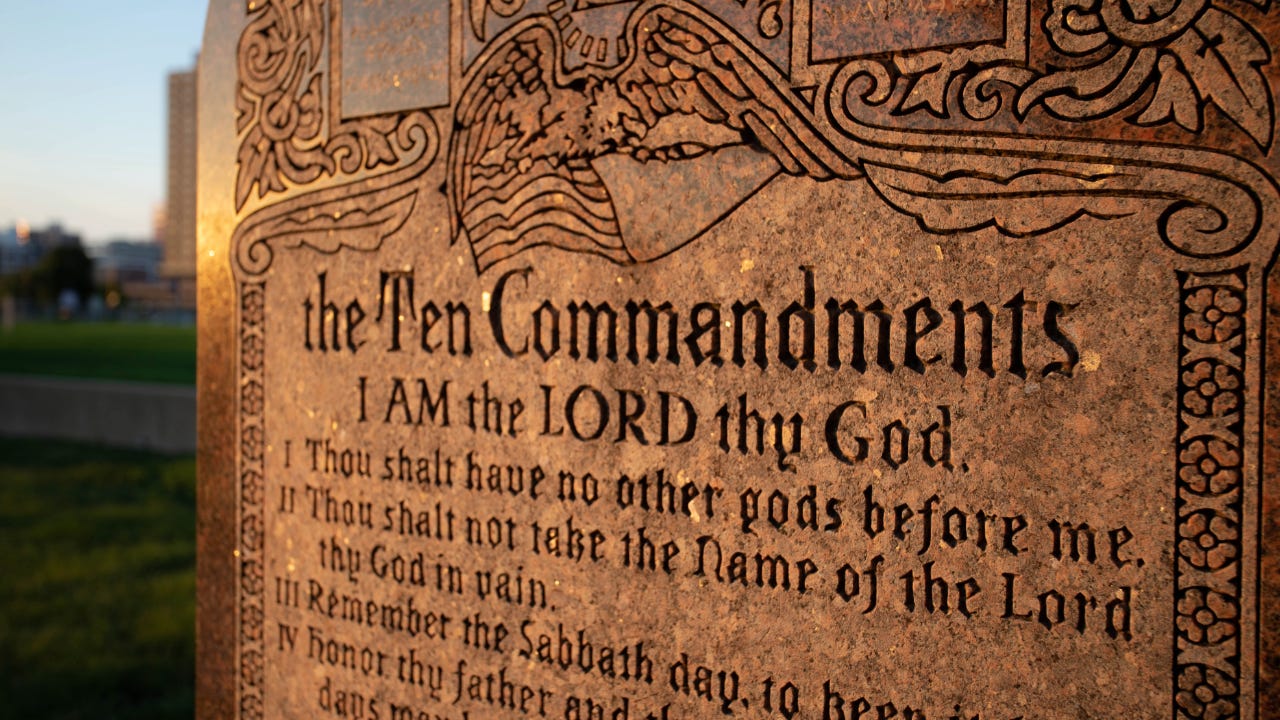
H 4762 actually has two parts. The first would allow volunteer chaplains in public schools—a move that would open the door for Satanic and Humanist chaplains to make themselves available to students. The second would require the Decalogue to be put up in every classroom, on a poster that’s at least 11” by 14”, using the lie that the Ten Commandments are “part of our state and national history, culture, and tradition.”
The Ten Commandments
I AM the Lord thy God.
Thou shalt have no other gods before me.
Thou shalt not make to thyself any graven images.
Thou shalt not take the Name of the Lord thy God in vain.
Remember the Sabbath day, to keep it holy.
Honor thy father and thy mother, that thy days may be long upon the land which the Lord thy God giveth thee.
Thou shalt not kill.
Thou shalt not commit adultery.
Thou shalt not steal.
Thou shalt not bear false witness against thy neighbor.
Thou shalt not covet thy neighbor’s house.
Thou shalt not covet thy neighbor’s wife, nor his manservant, nor his maidservant, nor his cattle, nor anything that is thy neighbor’s.
The way that’s written, it looks like there are more than 10 commandments on that list, a fact that Republicans failed to note.
The bill also includes a defense of what they’re doing from none other than James Madison:
History records that James Madison, the fourth President of the United States of America, stated that “(w)e have staked the whole future of our new nation… upon the capacity of each of ourselves to govern ourselves according to the moral principles of the Ten Commandments.”
Just one problem: Madison never said that. So Republicans are using a fake quotation to prop up an illegal action.
The bill would also require the following disclaimer to be included next to any poster:
The History of the Ten Commandments in American Public Education
The Ten Commandments were a prominent part of American public education for almost three centuries. Around the year 1688, The New England Primer became the first published American textbook and was the equivalent of a first grade reader. The New England Primer was used in public schools throughout the United States for more than one hundred fifty years to teach Americans to read and contained more than forty questions about the Ten Commandments.
The Ten Commandments were also included in public school textbooks published by educator William McGuffey, a noted university president and professor. A version of his famous McGuffey Readers was written in the early 1800s and became one of the most popular textbooks in the history of American education, selling more than one hundred million copies. Copies of the McGuffey Readers are still available today.
The Ten Commandments also appeared in textbooks published by Noah Webster in which were widely used in American public schools along with America’s first comprehensive dictionary that Webster also published. His textbook, The American Spelling Book, contained the Ten Commandments and sold more than one hundred million copies for use by public school children all across the nation and was still available for use in American public schools in the year 1975.
Finally, the bill would allow—but, importantly, not require—schools to put up posters of the Mayflower Compact, the Declaration of Independence, and parts of the Northwest Ordinance.
I’ve said this before, but it’s genuinely bizarre that the same people who don’t want high schoolers learning about sex, systemic racism, or LGBTQ people seem to have very specific things they want kindergartners to know about about adultery and their neighbor’s maidservants.
The list also wouldn’t solve any real problems; no potential school shooter has ever plotted out a path of destruction only to reconsider after realizing the Ten Commandments say “Thou shalt NOT kill.” If students need a sign to remind them not to murder others, they have bigger issues.
And, of course, several of the Commandments are flat-out useless since they forbid believing in false gods, making “graven images,” taking God’s name in vain, and not keeping the Sabbath day holy.
What about the other commandments? “Thou shalt not kill” ought to be pretty straightforward, but South Carolina permits state-sanctioned murders and is tied (with Utah) for the most executions via firing squad.
The list simply has no purpose. What exactly is the educational benefit of telling children they can’t have other gods before the One True Christian God™? Or that they can’t make false idols? Or they can’t take God’s name in vain? Or that they have to rest on Sunday? Or that they can’t have sex with people they’re not married to? Or they can’t want what their neighbors have?
Do kindergartners really need to be told not to commit adultery? (If that line were in a library book, you know these same Christians would try to get it banned.)
And which teachers are clamoring for the government to give them this distraction?Which teachers are lobbying the legislature for the ability to tell children they’ll burn in Hell for all of eternity if they don’t follow a set of mostly arbitrary rules?
There is no secular purpose for any of this.
There’s no history of it, either, contrary to what Republicans here are claiming.
What about the argument that they were used in the New England Primer, McGuffey Readers, and textbooks by Noah Webster? The New England Primer was used almost exclusively in religious schools long before the rise of public education. And while some McGuffey Readers include a story about the Ten Commandments, others don’t. There are all kinds of reasons all of these texts went out of style over the past century.
When lawyers on the side of church/state separation argued against the law in Louisiana, they said “there is no evidence of a longstanding, let alone unbroken, historical acceptance and practice of widespread, permanent displays of the Ten Commandments in public schools.”
The reason the law cites some old textbooks used before America became more religiously diverse, before we adopted public education, and before we even knew how evolution worked, is because that’s the only “history” they can cite in their defense. And even then, those textbooks didn’t call for posting the Ten Commandments in the classrooms. The Ten Commandments weren’t even significant texts in those books.
They weren’t “prominent.” They weren’t in public schools. They weren’t on the walls. That’s why these disclaimers prove absolutely nothing.
What about the argument that the Ten Commandments posters would be part of a broader display of historical documents? That would at least attempt to get the Commandments in line with the law, but again, this bill makes these other documents optional. Schools “may” display them. They don’t have to. That word choice alone negates the entire section. If you’re forced to put up the Christian text, while merely having the option of putting up secular documents that still make references to God (because they didn’t know any better at the time), then you’ve got a bill promoting Christianity.
It’s telling that the bill attempts to prove it’s legal by saying the text is “identical to the text of the Ten Commandments monument that was upheld by the Supreme Court of the United States in Van Orden v. Perry.” But in that case, involving a display outside the Texas Capitol, the monument was only deemed legal because it was part of a broader display of historical monuments.
That distinction doesn’t apply here.
Finally, the bill says no school has to pay for any of this. They can always use “donated funds” or “donated displays” that meet the requirements. But that, too, creates a problem since school officials would be in the position of having to approve or reject various donated posters, which could lead to legal problems. The bill says nothing about who would pay for the lawsuits once this law goes into effect.
For now, this bill was approved by the State House Judiciary committee on an 18-3 vote. (Some pathetic Democrats voted in favor of advancing the bill despite raising objections to it.) It’ll now go to the full State House. But it’s hard to imagine any of the legal or ethical concerns will prevent Republicans from passing it. Those things have never stopped them before; why start now?
That’s why opponents have called this bill a “waste of time”:
The Rev. Gary Linsky, director of the Basilica of St. Peter in Columbia, said he supports bringing faith into the public square but questions how much impact a mandated classroom display would have.
“I’m not convinced that a bill bringing the Ten Commandments into our schools is necessarily going to change the underlying fabric of belief,” Linsky said.
Opponents, however, argue the proposal violates the First Amendment and would marginalize students of different faiths or no faith at all. The American Civil Liberties Union of South Carolina has strongly criticized the bill.
“Our public schools shouldn’t be places where one religion is prioritized over another,” said Courtney Thomas, the organization’s advocacy director. “Our schools are meant for education, not indoctrination.”
Thomas said she believes the measure is likely to face the same legal obstacles seen in other states, calling it “a waste of time.”
Incidentally, this past week, a website went up that offers well-designed Ten Commandments posters that meet all the requirements of this bill (and ones in other states) that also allow for malicious compliance.
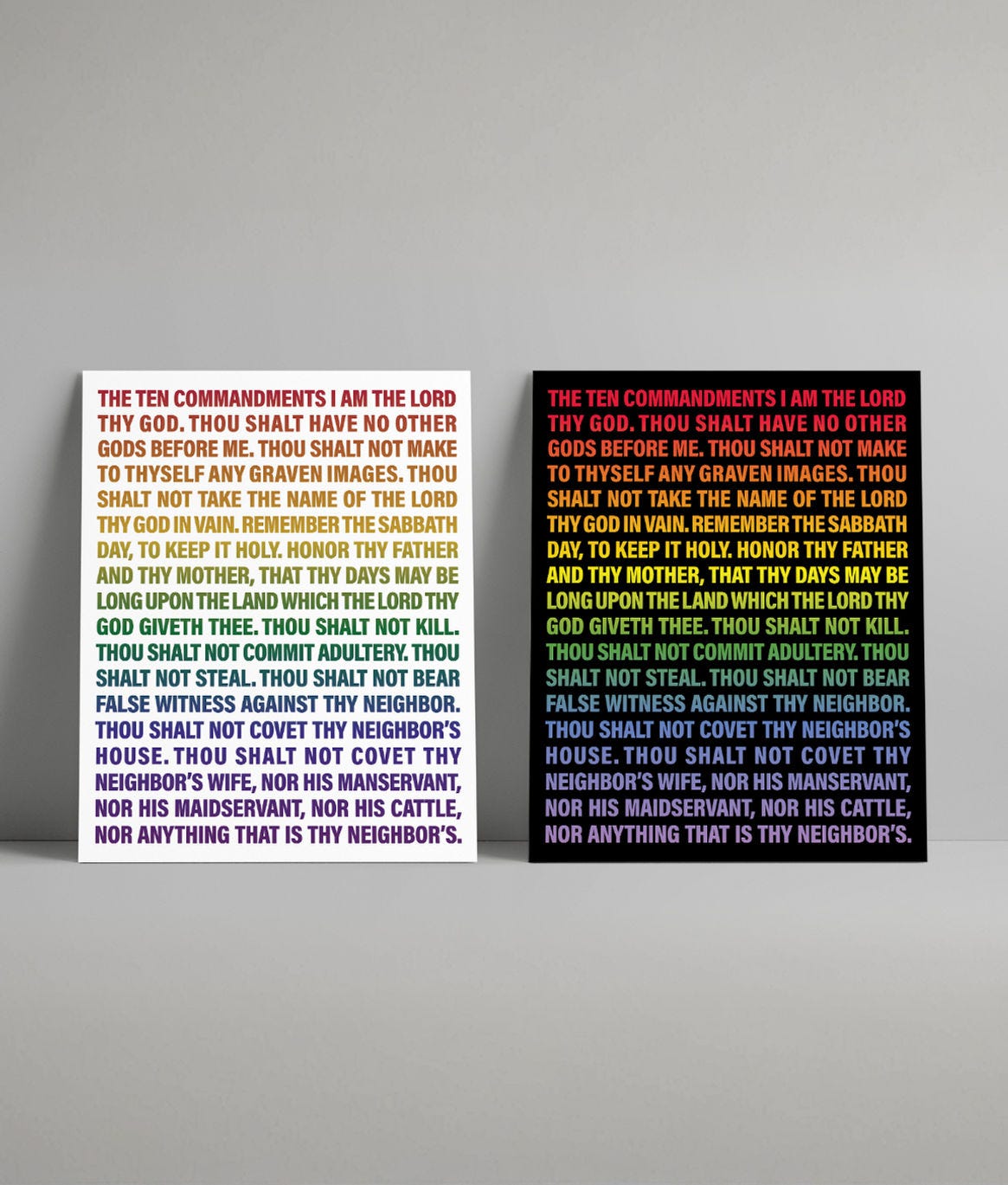
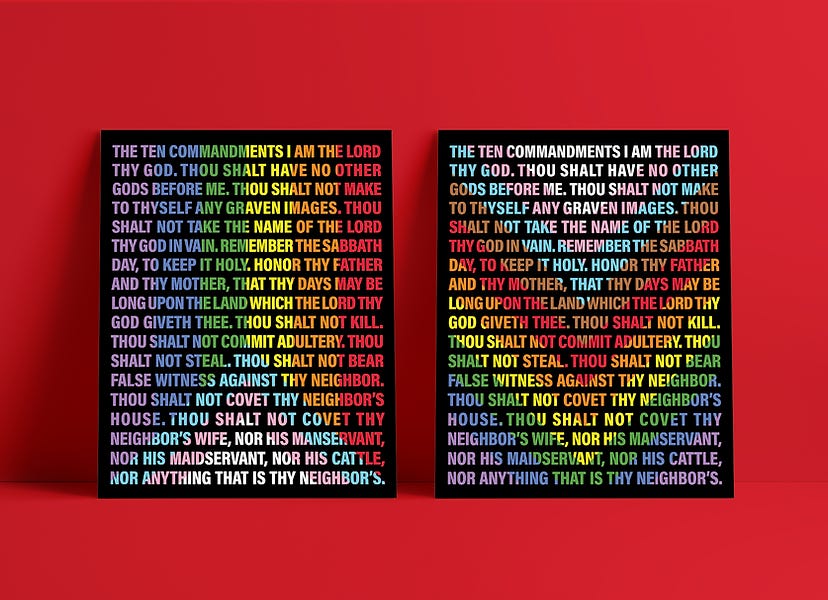
It’s something teachers and administrators may want to keep on their radar.
(Portions of this article were published earlier)
They couldn’t cite a single example where posting the Commandments in public school classrooms ever made a bit of difference. These things are always a win-win for the religious right. They either get to force their religion into the public schools paid for by everyone, or they get to play the poor, persecuted victims of the Godless left. It’s that second option that keeps the money rolling in. The law makers who vote to enact this should be held personally liable for the legal costs of defending it in court, as the legal history is quite clear on this issue.
No matter how many times believers in power are told NO! they persist. Once again, I liken xtians to date rapists.