
This newsletter is free and goes out to over 23,000 subscribers, but it’s only able to sustain itself due to the support I receive from a small percentage of regular readers. Would you please consider becoming one of those supporters? You can use the button below to subscribe or use my usual Patreon page!
Back in October, the Republican-majority Ohio Senate passed a bill (on a 24-9 vote) requiring public school districts to teach middle and high school students that there’s a proper order for a successful life. The bill now sits in a Republican-led Ohio House Education Committee.
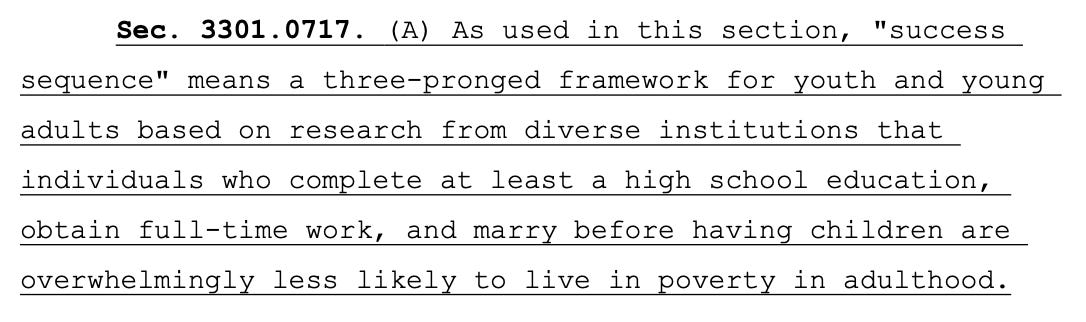
Senate Bill 156 says kids must be taught that “Success Sequence” involves doing three specific things: Complete “at least a high school education,” “obtain full-time work,” and “marry before having children.”
If you do that, the bill says, you’re “overwhelmingly less likely to live in poverty in adulthood.”
The implication is that not doing these things, or doing them out of order, is some kind of problem that sets you up for failure.
As I mentioned earlier this year when another state passed a similar bill, “Success Sequence” legislation was drafted by the Heritage Foundation, the group behind Project 2025. The Ohio version was sponsored by Sen. Al Cutrona, a Republican whose other priorities include creating “Charlie Kirk Memorial Day” and banning books.

The problem with this bill is that the three prongs are not keys to success. They are ingredients that might help, but obviously, plenty of people skip or re-order multiple steps and do just great in life, and plenty of people do exactly these things in exactly this order and have miserable lives.
That’s why this is so misguided. It’s not that going to college, getting married, and having children are bad. It’s that not doing those things doesn’t necessarily explain why you might not make as much money (or be as healthy). The root causes are completely ignored here.
For example, someone who graduates high school, gets an apprenticeship, marries his high school girlfriend, then impregnates her when they’re both 19 are following the formula perfectly. But they may not have much life experience, barely know themselves, don’t have money saved up in case of emergencies, don’t know if the jobs they have now are the ones they’ll want down the road, etc.
Someone who stays single and focuses on her career, spends her twenties dating and having sex and traveling and saving money, then gets married to someone with a child from a previous marriage is arguably better positioned to have a successful future because some of the biggest concerns in life (money, health, self-awareness) are satisfied.
There are obviously exceptions in all directions. A lot of this depends on how much support you have from your extended family, what the job market is like, and what hopes and dreams you have for the future. But that’s the point! There isn’t a pathway to success. There are multiple pathways to success. Yet this bill suggests there’s one best way to go through life… and it happens to coincide with the Purity Culture-like nonsense that conservative Christian churches tend to push on children.
Along the way, the text of the bill ignores the underlying reasons someone may or may not be successful. (If you grow up in a wealthier family and don’t have medical issues, you’ll probably avoid poverty regardless of whether you go to college or get married.)
The irony is that the legislation says it relies on the “best research methods available, describing the positive personal and societal outcomes associated with the success sequence.”

But if the evidence says the success sequence itself is misguided, then what? The bill doesn’t say the policy will be discarded if that happens.
The evidence didn’t sway Republicans during committee hearings either:
State Sen. Kent Smith, a Euclid Democrat, read from a separate study that poked holes in the Success Sequence research. He noted that not everyone graduates from good schools. Many people face racism and other structural issues in life. And it overstates the importance of marriage.
He said since the 1960s, marriage has been a weaker component in the fight against child poverty, and work has become more important in getting out of poverty.
“The success sequence misrepresents values among low-income individuals,” Smith said. “Research and surveys show that poor Americans generally value work, education and marriage just as much as those in the middle class. Their behavior is not a rejection of these ideals, but a reflection of their limited availability to act on them due to systematic barriers.”
As another opponent of the bill noted, “Ohio remains the only state in the nation without statewide health curriculum standards.” So instead of addressing actual problems, they’re trying to institute this patchwork approach that’s full of holes.
In other states where this kind of legislation has passed, the justification for the bill has been more specific—and a perfect example of faulty logic. Just consider Tennessee. That state’s “Success Sequence” bill said couples who marry then have children “have higher family incomes and lower poverty rates than their unmarried counterparts.” It also said kids in “stable, married-parent families are more likely to excel in school.” All of that ignored how people with stability in their lives in other ways have the luxury of getting married when they’re emotionally ready for it, having kids only when they’re prepared to take care of them, and providing an environment for those kids where they can focus on school rather than taking care of other problems.
Similarly, the bill said kids who weren’t raised in a home with married parents were “twice as likely to end up in jail or prison before reaching thirty years of age.” That again points to stability. Living in a home where married parents argue constantly, or have to work multiple jobs to make ends meet, is far worse for kids than living in a home with a single parent with a great 9 to 5 job who’s available for them in the evenings.
But instead of creating conditions for all children to have the best chance of success—however they define it—later in life, these Republicans are merely passing a checklist for kids to follow. They’re patting themselves on the back for doing the bare minimum while ignoring all the conditions that put people in harm’s way. If you’re not successful, they’re basically saying, it’s because you didn’t follow the list, not because they failed to create an environment where you could thrive. It’s your fault, not theirs.
They don’t want people to know that the simplest path to guaranteed financial success later in life is to be born into a wealthy family.
(Policy analyst Matt Bruenig had a very comprehensive takedown of this mindless “success” formula over here. It’s worth your time to read.)
You know what would help all people be more successful in life? Having access to free health care and child care. Having access to birth control. Having a guaranteed income. But Republicans don’t want any of that because they’re not actually interested in your success. They passed this bill because it makes them feel better, not because it’ll improve kids’ lives.
In Tennessee, Democratic State Rep. Aftyn Behn actually tried to amend her state’s bill to address these concerns. It wouldn’t have eliminated the four-step sequence, but it would have addressed many of these concerns by substituting more honest language:
WHEREAS, millennial women have come of age in an era marked by wage stagnation, skyrocketing student debt, unaffordable housing, and the rising costs of child care and health care, all of which make marriage and family formation increasingly out of reach; and
WHEREAS, over the past forty-five years, the decline in children living with married parents reflects not a rejection of family values, but the growing economic instability that delays or deters marriage and childbearing; and
WHEREAS, nearly a quarter of children today are raised outside of marriage, a statistic driven less by personal choice and more by structural barriers that make partnership and parenting financially precarious; and
WHEREAS, while children raised in stable, well-supported families tend to thrive, our focus must be on creating conditions where all families, regardless of marital status, have access to opportunity, security, and community support; and
WHEREAS, millennial women understand that marriage alone does not guarantee economic stability, especially in a landscape of wage inequality, rising medical costs, and inadequate family leave policies; and
WHEREAS, millennial women face a workforce that too often punishes caregiving and undervalues women’s labor, making the prospect of balancing work, marriage, and parenting an overwhelming challenge; and
WHEREAS, millennials carry more student loan debt than any previous generation, delaying milestones like homeownership, marriage, and childbearing well into their thirties and beyond; and
WHEREAS, the high cost of child care, lack of affordable health care, and insufficient parental support policies have led many women to delay or forgo having children entirely; and
WHEREAS, despite narratives that tie personal success to marriage and childbearing, millennial women are redefining what it means to flourish, prioritizing financial independence, community connection, and personal fulfillment; and
WHEREAS, building a society where family formation is a real choice, not an economic gamble, requires addressing the root causes of inequality, investing in paid leave, child care, health care, and housing, and creating fair economic conditions for all; now, therefore,
That sensible realistic preamble was defeated 72-22. Not surprising but further proof that Republicans don’t want to fix the real problems. They just want to redefine them and act like they have simple solutions to everything.
Maybe the most surprising thing about this Ohio bill is that the “Success Sequence” doesn’t include a line about how you have to go to church. After all, plenty of conservatives have promoted studies that say people who attend church tend to make more money and suffer fewer health problems. Those studies suffer from the same ignorance as this bill: They act like “job + marriage + kids = success” when it’s more about having stability and a social safety net. Going to church isn’t the reason you’re successful. Marriage isn’t the reason you’re successful. Having kids isn’t the reason you’re successful. But if you’re healthy and educated and have the luxury of time, you might be interested in those things. (Some people never learn that famous lesson from statistics class.)
This is all just an attempt to micromanage educational decisions. Instead of allowing experts in subject areas to decide what kids should learn, Republican lawmakers have decided they know best. All while passing a different law forcing districts to let kids ditch school to attend church during the day.
It shouldn’t be lost on anyone that the leader of the Republican Party is a person who allegedly paid someone to take his SATs for him, is currently on his third marriage, and ignored his children when they were younger. That’s the family man the Republican Party props up as the model of success.
(Large portions of this article were published earlier)
"It shouldn’t be lost on anyone that the leader of the Republican Party is a person who allegedly paid someone to take his SATs for him, is currently on his third marriage, and ignored his children when they were younger."
And those are his better qualities. 😉
There are a great many people who, through no fault of their own, have been dealt terrible hands in life. People who have had the deck stacked against them from birth. This measure smacks of the old, worn-out idea that a person's lack of success is their own fault, and a clear sign they do not have God's favor. If this was a good program for children the Heritage Foundation wouldn't be supporting it. Their goal is the creation of a permanent American underclass, forever under the boot-heels of those who were born to rule.