
This newsletter is free and goes out to over 25,000 subscribers, but it’s only able to sustain itself due to the support I receive from a small percentage of regular readers. Would you please consider becoming one of those supporters? You can subscribe via Patreon or the Subscribe button below! You can also make one-time donations through Venmo, CashApp, or PayPal.
Mormons have long been devout and conservative, keeping Utah a reliably red state, but a new analysis by Jonathan Evans and Rebecca Leppert of the Pew Research Center finds that there are changes occurring within the religion that challenge those stereotypes.
One of the most interesting changes is that people who were raised in Mormon families are now more likely to leave the faith than ever before. In 2007, 14% of Americans raised as Mormons no longer identified with any religion in adulthood. The more recent survey, from 2023–24, shows that figure has doubled to 28%.
The share of people raised Mormon who remain in the Church of Jesus Christ of Latter-day Saints has also dropped in that same time period from 70% to 54%.
To put that in academic terms, the religion’s “retention rate” is falling.
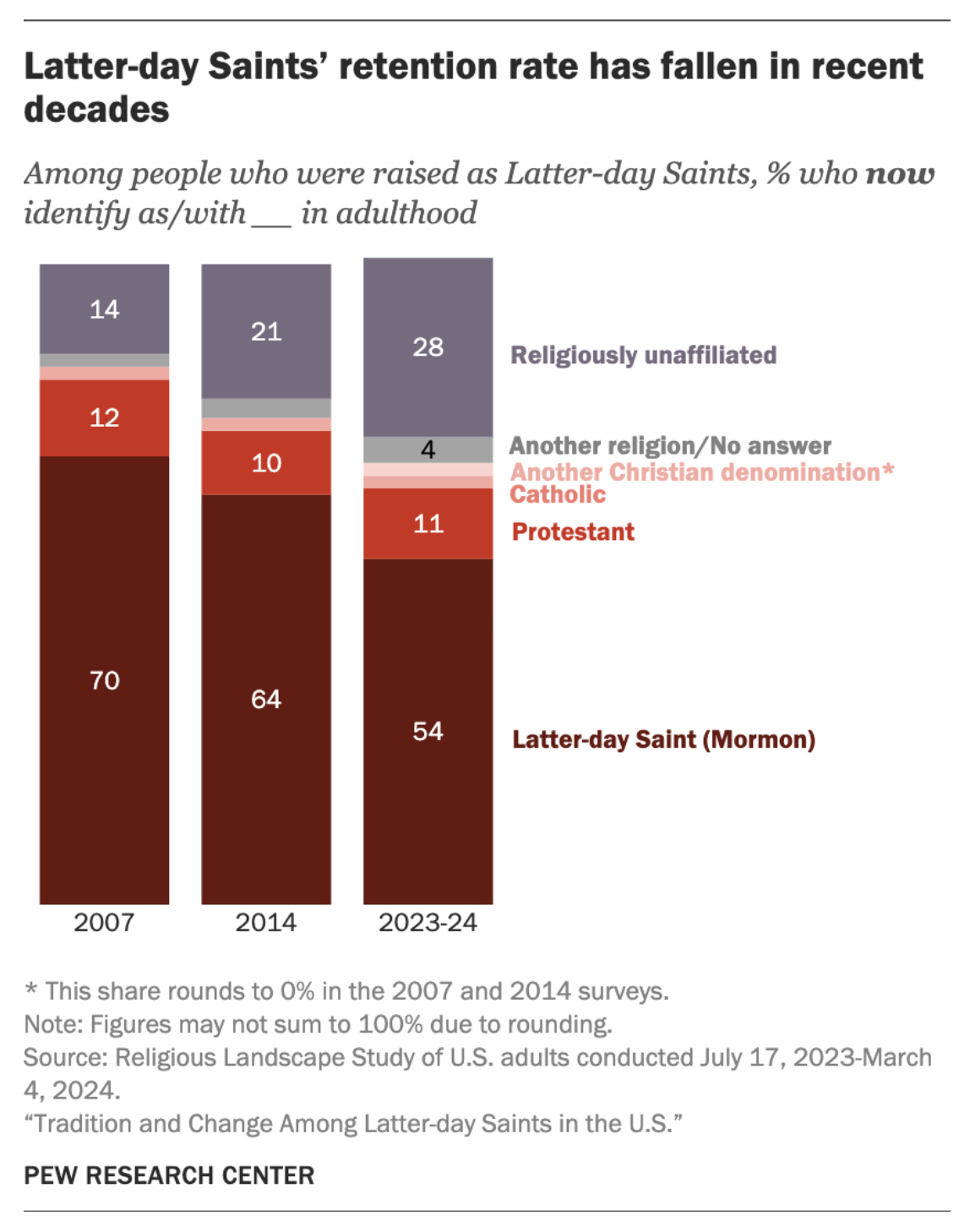
That 54% retention rate isn’t just lower than it used to be. Pew says it’s now among the lowest of all the religious groups large enough to analyze. People raised without religion are substantially more likely to remain unaffiliated than people raised Mormon are to remain Mormon.
The number of Americans who have left the religion is also much larger than those who have joined it. While 0.4% of all U.S. adults converted to the LDS Church after being raised in another religion—or no religion—1.0% were raised Mormon but have since left.
The clearest generational divide involves women. Only 49% of women ages 18-49 who were raised in the Church still identify with it, compared to 66% of women 50 and older.
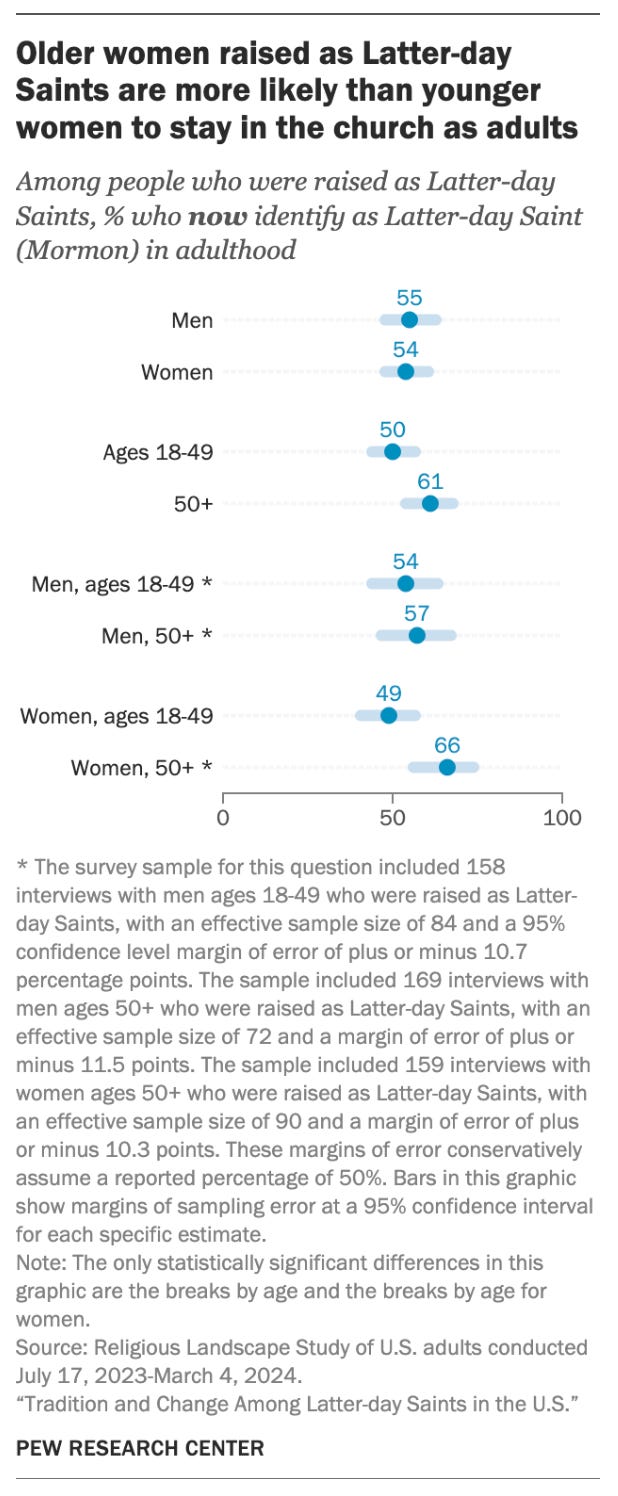
While Pew doesn’t get into why that’s happening, the Church’s positions on gender inequality, purity culture, and abortion rights may play a role. (It’s worth noting that the margin of error for each of those subgroups is fairly large.)
The demographics of the religion are shifting, too, making the religion more racially and ethnically diverse. While Mormons were approximately 85% white in 2007, that’s down to 72% in 2023-2024. Hispanic and Black Mormons have jumped to 12% and 6%, respectively, compared to 6% and 2% nearly two decades ago.
It’s also interesting to see that the people in the faith are less intensely religious than in 2007.
Absolute certainty in their belief in “God or a universal spirit” dropped from 90% to 76% since 2007 while those who say religion is “very important in their lives” fell from 83% to 72%.
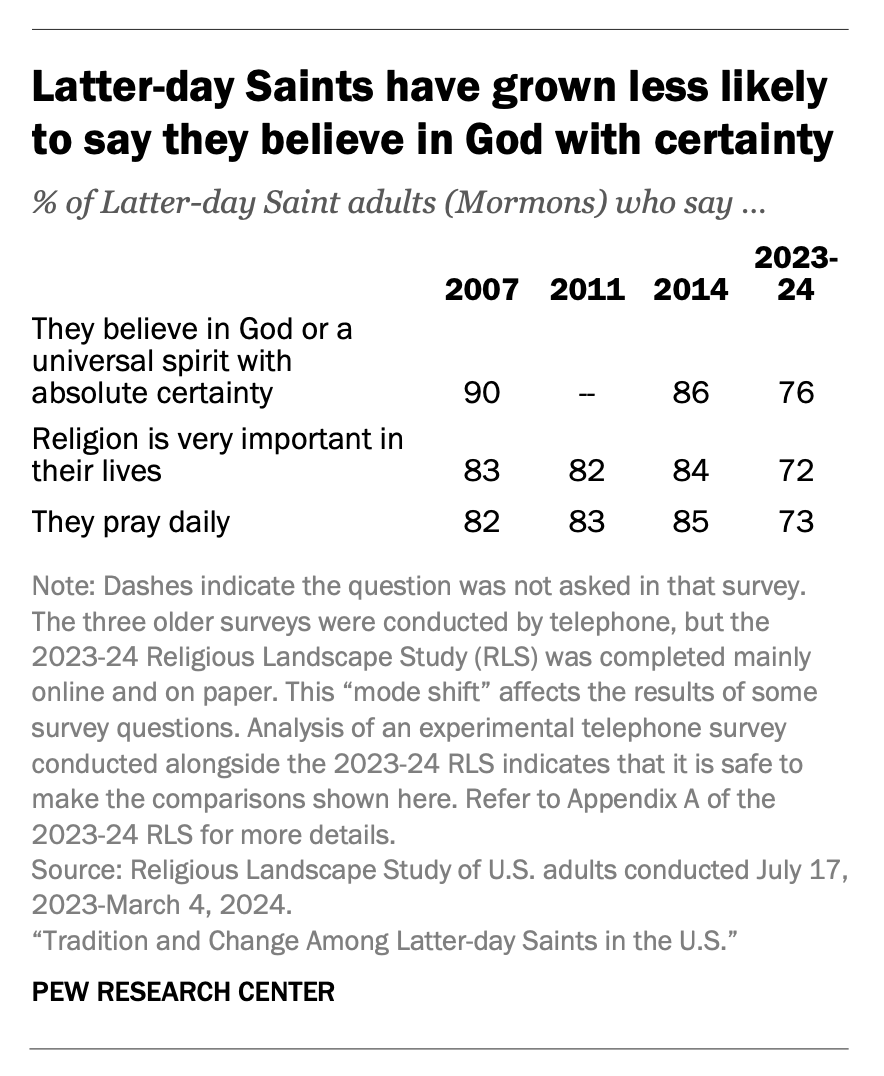
So even among those Mormons who remain in the faith, religious conviction is less deep than it was in 2007. (It’s not clear if or how that change is connected to the church’s falling retention rate.)
Their views on hot-button issues have shifted in predictable ways, too. Homosexuality was deeply unpopular in those circles in 2007, with only 24% saying it should be accepted by society, but that has since risen to 46%.
61% of Mormons also say it’s good to see more women in the workforce, a jump from 49% in 2014.
There’s so much more in the full report, which you can read here.
I would add that there are some other big controversies within LDS circles over the past several years that could have led to people wanting nothing to do with the religion. The church has become more of an investment company with holdings worth well into the billions, and they’ve committed financial shenanigans to hide their assets. They’ve sued a prominent critic in a trademark and copyright dispute. Investigations and lawsuits have accused church officials and their attorneys of keeping certain abuse reports from law enforcement and prioritizing institutional confidentiality.
They’ve also historically been on the wrong side of women’s rights, civil rights, racial equality, and LGBTQ rights—positions which are magnified under this administration. They’ve restricted the participation of transgender Mormons in the church, a move that was condemned by LGBTQ members and allies. They’ve even played politics, urging members to vote against an abortion rights ballot measure in Idaho. (Of course, they famously got involved with Prop 8 in California in 2008.)
That’s why it’s hard to ignore the political divide between those who remain Mormon and those who leave. Among people raised Mormon, 77% of lifelong members say they’re Republican (or lean Republican), compared with 50% of former members. Lifelong members are also more than twice as likely to call themselves conservative. The survey doesn’t establish if people leave the Church because they reject its conservative politics, or if they just become more liberal after leaving it, but the two things appear to be closely related. That overlap makes the Church’s cultural conservatism increasingly difficult to separate from Republican politics.
Similarly, it’s also revealing that while just 2% of lifelong Mormons identify as gay, lesbian or bisexual, that figure jumps to 24% among former members. We can’t tell from the survey if LGBTQ people left the Church because of their identities, if they just became more comfortable acknowledging their identities after leaving, or both. But the gap is staggering.
To be sure, none of those controversies proves why retention has fallen. Pew didn’t ask former members why they left, and the most recent survey predates the 2024 election. Still, the larger pattern is unmistakable. Mormon identity has become less durable, with an especially large generational divide among women. Former members are also far more likely to hold dramatically different views on abortion, LGBTQ acceptance, conservative politics, and teacher-led Christian prayers in public schools.
The Church itself remains overwhelmingly religious and conservative, even as the attitudes of many of its members have moderated. I suspect the retention problem will only get worse in the coming years as Donald Trump sets the standard for what it means to be a religious conservative.
No booze. No caffeine. people are noping out of that shit.
Churches tend to be businesses, none more so than the LDS church. They value nothing so much as acquiring vast wealth. The Mormon church was founded by a convicted con artist, and the church expects people to accept what he said without questioning any of it. There is no independent corroboration for any of what Joseph Smith dreamed up, and the Mormon church does not begin to stand up against critical historical analysis.