
This newsletter is free and goes out to over 23,000 subscribers, but it’s only able to sustain itself due to the support I receive from a small percentage of regular readers. Would you please consider becoming one of those supporters? You can use the button below to subscribe or use my usual Patreon page!
The Kansas House just passed a bill that will make clergy members mandated reporters. If the bill becomes a law, priests who learn about abuse against children—physical, mental, emotional, sexual—will have to report it to law enforcement authorities.
… But there’s a key exception to that rule.
If they learn about the abuse through the act of Confession, they can keep the secret to themselves. That exception removes the teeth from the bill, creating a loophole for abusers. Still, it’s a step forward in a state where priests currently don’t have to report anything to law enforcement.
HB 2352 advanced in the House forward with a 111-5 vote on Thursday. It makes two specific changes to existing law: First, it adds “duly ordained minister of religion” to the list of people who are mandated reporters.
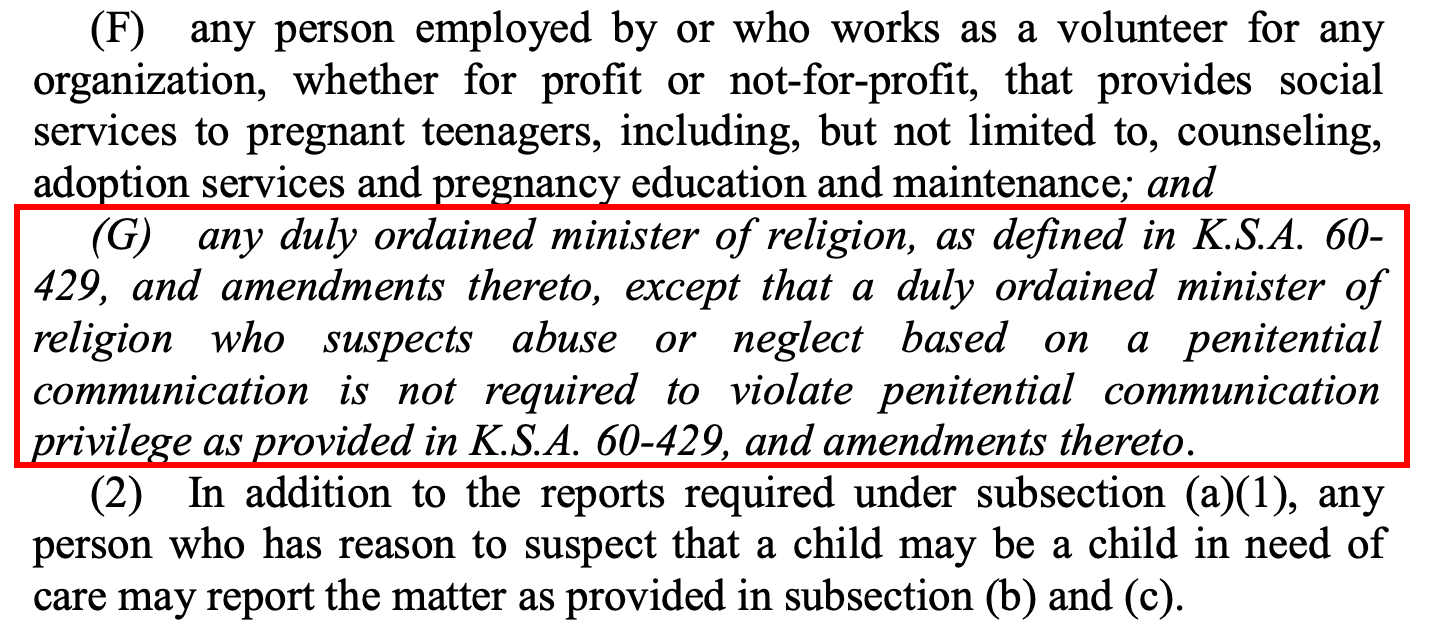
Second, it requires all mandated reporters to go through a state-approved training session offered through the Kansas Department for Children and Families.
None of this should be controversial, which is why the bill sailed smoothly through the Republican-led House. With “privileged” communication, like Confession, protected under this bill, there’s really no reason for conservatives to oppose it, so they didn’t even try. Even the Kansas Catholic Conference supports the bill, saying they already do everything contained in it.
In a letter submitted as proponent testimony, Chuck Weber, executive director of the Kansas Catholic Conference, said Kansas Catholic churches already have the reporting requirements in place outlined in the bill.
“The Church’s child protection policies have been highly successful in preventing and responding to misconduct, and thus the church supports the adoption of similar policies that may help prevent misconduct in other organizations statewide,” Weber said.
That’s how you know this bill is merely symbolic. It’s not requiring priests to do anything more than they’re already doing to protect children. Which means it’s not nearly as powerful as it could be.
That’s why the fact that privileged communication is exempted from this bill is absurd. In no rational world is a priest getting excommunicated—the punishment for revealing confidential information learned through Confession—more damning than letting a child continue to suffer sexual abuse. If you would rather protect priests than kids, then your organization should just admit the safety of children isn’t a top priority.
In fact, one Lutheran priest told a local news station that he worried this bill would prevent potential abusers from talking to priests. He said he has spoken to abusers-in-waiting through Confession and urged them to get therapy. What he didn’t do was report them to anyone. He feared that this bill would be a slippery slope to ending the sanctity of Confession and added that opponents were “legislating a vendetta.”
To accuse supporters of trying to use this bill to target religion says more about the problems with religion than the motives of the supporters. The “vendetta” in question involves protecting children. It takes faith-based hubris to fight against that. In any case, this bill doesn’t touch the privacy of Confession.
That’s likely because bills that didn’t include those exemptions have failed. Just last year, the state of Washington agreed to a settlement to exempt Confession from a mandatory reporting bill that purposely didn’t include it after facing a lawsuit backed by the Trump administration.
But the goal in Kansas wasn’t a perfect bill. It was simply catching up to other states. This is the fourth year a similar bill has been introduced in Kansas, but this time, it’s actually getting some traction.
Last month, when the Judiciary Committee held a hearing on the bill, the personal statements were devastating. One of them came from Joe Cheray, who told the lawmakers her grandfather was a church leader who abused her from the ages of 10 to 15. During that time, she told a priest about what was happening… but he didn’t take any meaningful action to stop the abuse.
I tried going to our priest a few times during that time and nothing happened. Why should it? He wasn’t a mandated reporter of abuse in the state of Kansas at the time. Had I known this I wouldn’t have gone to him, but I didn’t know this. Had I known this I would have gone to DCF. Later after I got out and was in a foster home I called him and he said I should go home and pray that things get better.
Kansas is one of ten states and territories in the United States that clergy are not listed as mandatory reporters of abuse. Neighboring states around us all have some statute for clergy with respect to mandatory reporting. The DCF website lists 13 professions that are mandated to report abuse. Clergy are absent from this list.
It’s too late for me to have been able to benefit from the help this legislation would have afforded me at the time of my abuse, but it’s not too late for others going forward. I urge everyone on this committee to please pass this favorably out of committee. Help current and future victims of abuse have one more safety net in place to help them escape their abuse.
The courage to make a statement like that is truly incredible.
All of this is happening shortly after a local news station reported on a case of an abusive priest whose carnage could have been stopped if a mandated reporting law was in effect:
In the summer of 2025, KAKE aired four separate reports about the abuse suffered by over 20 children at Eastminster Presbyterian Church during the tenure of former youth pastor Bodie Weiss.
We broke the story online when Eastminster Presbyterian Church released a letter admitting to investigating and dismissing the abuse allegations years before.
KAKE then spoke directly with lawmakers like Representative Susan Humphries on mandatory reporting and eliminating the statute of limitations -- two things survivors at Eastminster set out to change, listing them in demands during a protest outside the church.
While the bill passed through the State House, the State Senate is where bills like this typically die. So that’s the big hurdle this time around. The bill has not yet been introduced in any committee there.
Even if this bill is symbolic in most ways, though, it’s still worthwhile. Mandated reporting isn’t radical. It’s not anti-religious. It is the bare minimum that we ought to require from adults who have any kind of authority over vulnerable people. When teachers, doctors, therapists, and social workers are all legally required to report abuse, exempting clergy sends a chilling message: that religious figures exist outside the same moral and legal framework that governs everyone else. That’s why including them on this list is still a big deal. It puts them on a level playing field with everyone else.
By having elected officials formally recognize clergy members as mandated reporters, they’re also reminding survivors that their abuse isn’t some private spiritual matter but a crime that must be stopped.
Kansas has allowed this loophole to exist and closing it—even partially—is an acknowledgment that protecting children is more important than preserving institutional privilege. There’s no good reason for the State Senate to ignore this.
Passing this bill won’t erase the harm already done. But failing to pass it would guarantee that the next victims will be left to fend for themselves because Republicans don’t care enough to protect them.
"Just last year, the state of Washington agreed to a settlement to exempt Confession from a mandatory reporting bill that purposely didn't include it after facing a lawsuit backed by the Trump administration."
The regime of child abusers protecting child abusers. How very unsurprising.
"Men will never be free until the last king is strangled with the entrails of the last priest." -- Denis Diderot