
This newsletter is free and goes out to over 24,000 subscribers, but it’s only able to sustain itself due to the support I receive from a small percentage of regular readers. Would you please consider becoming one of those supporters? You can subscribe via Patreon or the Subscribe button below! You can also make one-time donations through Venmo or PayPal.
Donald Trump’s “Religious Liberty Commission” was formed to “offer diverse perspectives on how the Federal Government can defend religious liberty for all Americans.” But during their seventh and final meeting on Monday, held at the Museum of the Bible, the group’s leader denounced the very idea of church/state separation, calling it a “lie.”
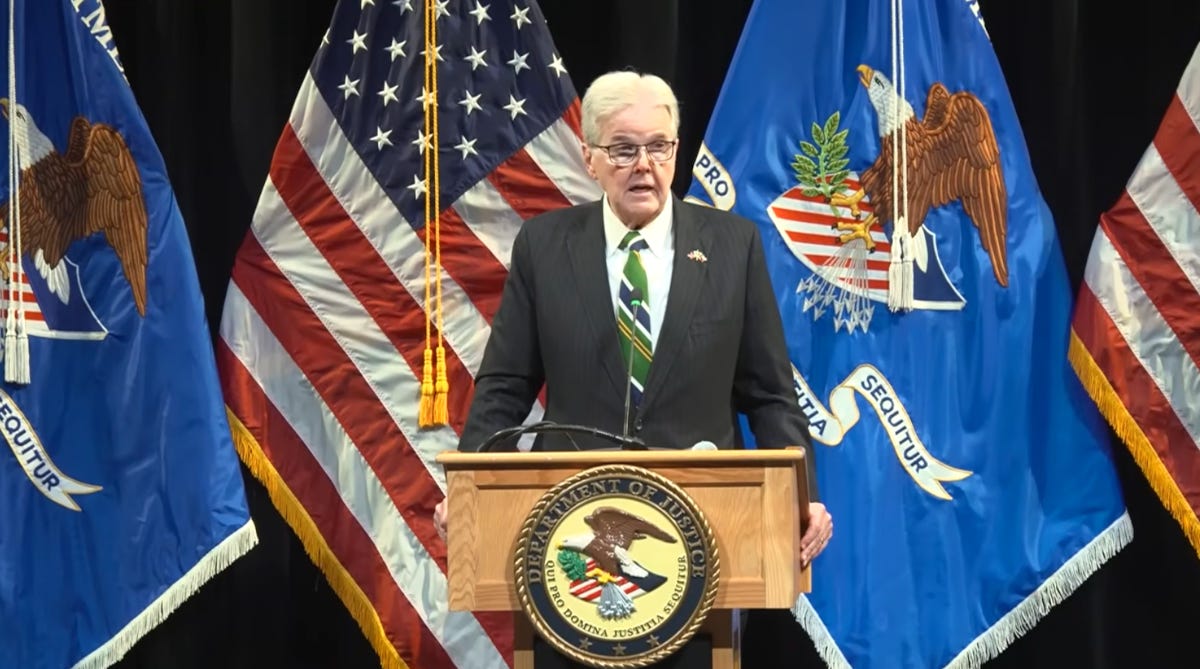
Chair Dan Patrick, also the Lt. Governor of Texas, asked the meeting’s featured speaker if public businesses and schools should be required to put up a poster, much like OSHA warning signs, reminding people that “the separation of church and state is the biggest lie that's been told in America since our founding.”
We have, in a typical building or a classroom, teacher’s room, wherever it may be, we have posters, all types of federal posters, up about OSHA regulations and various regulations you must follow. Your rights must be protected. Uh, we’ve talked about it a little bit on this Commission.
Would it not be a good recommendation that every school, every university, every business has to have that one sheet on the bulletin board about protecting people’s religious liberty, and that the separation of church and state is the biggest lie that’s been told in America since our founding?
The speaker, law professor Helen Alvaré of the right-wing Antonin Scalia Law School (which was hilariously once named the Antonin Scalia School of Law—you figure out the acronym) and a former staffer for the right-wing U.S. Conference of Catholic Bishops, responded by saying “it would be an appropriate time” to do just that.
Because of course she would. Tearing down the very idea of religious freedom—and the notion that the government shouldn’t take a position on religion—is why she was invited to speak in the first place.
Americans United for Separation of Church and State denounced the comments, calling them an “attack on our democracy.”
[Church/state separation] is an American original, something we should be proud of, fight for, and cherish.
“If this commission really cared about religious freedom, it would join Americans United in demanding a national recommitment to church-state separation as the best way to defend religious freedom for all.”
(AU is one of several groups suing the Commission over its obvious pro-Christian bias.)
At another point in the meeting, Commission member and First Liberty Institute CEO Kelly Shackelford made another suggestion: What if they asked Trump to get the IRS to issue a “small fine” to a church that endorses a candidate from the pulpit? By directly violating the Johnson Amendment and getting punished by the IRS—something the IRS, historically, has not done—Christian groups would have standing to file a lawsuit that could eliminate the Johnson Amendment once and for all.
… There’s a lot that [the Department of Justice] can do. And… I would add one more that I think is sort of an IRS and DOJ recommendation, is we just saw, just a few weeks ago, yet again, this whole idea of scaring churches from talking about political issues… There was a lawsuit that should have been decided. We had a judge find a way not to rule. Just happened a few weeks ago.
And there is a way to deal with this. And that is: If the president would ask the IRS to go ahead and issue a small fine against any church for talking about politics, and then make clear to the DOJ we want a decision on the constitutionality of this IRS regulation versus the First Amendment of the United States Constitution, then we can finally get a precedent that then will make clear to every church the freedom they have.
But until we get that, everybody’s gonna be scared. And this is something that the president can do.
Nobody is scared. Pastors routinely endorse candidates from the pulpit—and often brag about it—because they know damn well the Trump administration doesn’t get about justice or the law. But Shackelford’s point here is that the Commission should use its power to force the president’s (weirdly discolored) hand.
The reason all this matters is because this group only has two jobs: producing a report on the state of religious liberty in America and advising the White House (and connected agencies) on policies it should adopt.
We can now be assured that the report and advice will be built on the faulty assumption that church/state separation is unnecessary and that churches (by which they mean white evangelical ones) should be allowed to endorse Republicans from the pulpit, further contributing to the idea that this is a Christian Nation.
In some ways, this was already a foregone conclusion. This Committee and its meetings have always been just for show. If Republicans want to pass pro-Christian executive orders or resolutions, they already have the numbers to do it, whether or not their desires are legal. It’s not like GOP officials are sitting around reading white papers and thinking, “Wait a minute, maybe we should protect religious freedom for Muslims!” Hell, Dan Patrick didn’t even realize that Trump extended the life of this Commission through 2027; Patrick is treating this body as if it’s about to be disbanded while Trump wants to keep it going past the midterms for no apparent reason.
It raises an interesting question of whether the recommendations will even matter. Why write a report with suggestions when Trump sure as hell isn’t going to read it? And if Republicans don’t act on this Christian Nationalist fantasy list, will anyone on the Commission say anything about it? It’s doubtful. They rarely speak up in the face of injustice; why would they draw more attention to the fact that Trump ignores them too?
But until that happens, we should assume the worst. This Commission, with no real religious diversity at all, was selected with the understanding that they would support Christian Nationalist ideals. When one member, Carrie Prejean Boller, dared to question the group’s definition of antisemitism, she was kicked out by Patrick.
The final report won’t be about religious freedom at all. It’ll just be an extension of Project 2025. It’ll be a government-backed document attempting to rewrite history while also urging the adoption of policies that will elevate Christianity over other religions. It’ll be a report that aims to end the concept of religious liberty altogether in favor of pro-Christian policies. What else would you expect when the foundation of religious liberty—church/state separation—is being called a “lie”?
That’s the danger. It’s not that the comments or report will have a long-term effect on their own but that we’re normalizing the ideas underlying them. What used to be the deranged rants of fringe pastors are now conversations shaping how our government treats religious minorities. They want to end government neutrality on religion, require public schools to push their propaganda, and give their churches the ability to become funnels for dark money campaigns promoting their preferred conservative candidates.
If those barriers fall, we’re all screwed, because church/state separation is good for church and state. As history shows us, whenever one religion gains political power, freedom for everyone else disappears.
Dan Patrick was a Houston radio blowhard, and Rush Limbaugh wannabe. He is also a four-star religious nut case. That is 100% of what he brings to the table. The Constitution does not mention the words Bible, Jesus or God, and Article VI specifically bans religious tests for holding public office in the United States. Article VI is a very strange thing to include in the foundational document of a country whose founders did not want church-state separation. Article VI also predates the Bill of Rights which speaks to how the founders felt about the issue. Like every other evangelical fool, Patrick assumes it will be his tribe calling the shots for everyone else. He should be imagining the tribe he hates most having control over his life because that will definitely be someone’s reality. I will never understand why mere freedom of religion isn’t enough for these people.
The dumbest part about this has got to be the idea that a bunch of old, white males want to argue that they're being oppressed somehow.