
This newsletter is free and goes out to over 23,000 subscribers, but it’s only able to sustain itself due to the support I receive from a small percentage of regular readers. Would you please consider becoming one of those supporters? You can use the button below to subscribe or use my usual Patreon page!
If a medical school offered a course teaching future doctors how to cast healing spells on their patients, we would rightly condemn the university for wasting everyone’s time by pretending that magic had the same power as actual science-backed treatment.
And yet the University of the Pacific’s Thomas J. Long School of Pharmacy is effectively doing the exact same thing by pretending homeopathy is a valid treatment for patients. The school is actively promoting an “Introduction to Homeopathic Medicines” elective class for its students—first offered a year ago—with the goal of introducing “future pharmacists to a category of products that is growing in popularity.”
Just because they’re popular, however, doesn’t mean homeopathy is valid. It’s nothing more than astrology for people wearing white coats. You can pretend there’s something to it all you want—and people are free to waste their money on homeopathic products—but professionals are committing malpractice when they go along with it.

The only way any of that is on the “leading edge” is if we’re acknowledging those students are about to jump off a cliff…
Homeopathy is, of course, the sham treatment that takes a trace amount of actual medicine, then dilutes it with water thousands of times over until no actual medicine remains. The irrational thought behind this is that the more you dilute something, the more powerful it becomes. That resulting mixture of bullshit and nonsense is packaged and sold to customers who may not realize theyre being duped by nothing more than an expensive placebo. (Want to have some fun? Play Homeopathic Battleship, in which the ships are on a board so large, it’s virtually impossible to sink anything.)

It’s not just a waste of time and money. There have been times when homeopathic remedies meant for babies were found to harm them because the pills were manufactured improperly. The makers found a way to screw up doing nothing. (Back in 2021, when COVID vaccines were finally available, then-Green Bay Packers quarterback and armchair conspiracy theorist Aaron Rodgers said he had been vaccinated. Turns out he lied and took an “alternate, homeopathic treatment” that the NFL thankfully said didn’t count.)
Both the U.S. Food and Drug Administration and Federal Trade Commission—back when they were led by people who took their jobs seriously—have taken action against misleading homeopathic “remedies.” In fact, the Federal Trade Commission said in 2016 that all marketing for homeopathic products had to include disclaimers saying “1) there is no scientific evidence that the product works; and 2) the product’s claims are based only on theories of homeopathy from the 1700s that are not accepted by most modern medical experts.”
All of that is to say homeopathy is bullshit, and scientists know it’s bullshit. If people want to waste their money on fancy-looking homeopathic products, that’s their right, but no one should suggest there’s any value to them. Certainly not trained medical professionals.
So what the hell is going on at this pharmacy school?
“As future pharmacists, students should be competent in counseling patients on products that are sold in pharmacies, including homeopathic drug products,” [Professor of Pharmacy Practice Kate M.] O’Dell said. “Pharmacists who are knowledgeable about homeopathic medicines can provide a level of care that is not yet widely adopted in current practice.”
So far, that statement isn’t a problem. Because pharmacists should know how to counsel patients who are curious about homeopathic products.
I’ll save you some tuition dollars. Here’s how you counsel them: “Don’t take it. It’s not real. You’re wasting your money. Let me direct you to medicine that might actually help.”
That’s not what they’re teaching here:
“The homeopathy elective course was one of the most eye-opening experiences I have had during pharmacy school,” said Marry Ann Danial ’26, a PharmD student who took the course last year. “It pushed me to look beyond traditional treatment options and really think about how we, as pharmacists, approach patient care holistically. I appreciate how the course encouraged open discussion and curiosity while still grounding everything in scientific evidence.”
That’s a lie because there’s no “scientific evidence” that suggests this shit works. Why is an accredited pharmacy school telling future pharmacists that they should play along with their patients’ delusions?
It doesn’t take long before we get to the answer: The entire course is funded by a company that sells homeopathic products.
The elective was launched through a partnership with Boiron. Founded in 1932, Boiron is the largest global manufacturer of homeopathic drug products, with products distributed to 50 countries.
“We are grateful for the thoughtful engagement and leadership of Shane McCamey, director of training and business development at Boiron USA, for providing valuable support to launch the first, formalized 13-week structured curriculum in homeopathic medicines at a U.S. pharmacy school,” O’Dell said.
Ah. Now it makes sense. Can’t wait for the “Introduction to Opioids” course funded by Purdue Pharma and the Sackler family.
There might be value for this course if it solely focused on how to get patients to stop taking this nonsense seriously, but there’s none whatsoever if the goal is to further fuel misinformation. No pharmacy school that wants to be taken seriously should accept money to spread lies. If the end result of this course is that pharmacists are effectively endorsing these products and not steering patients away from them, the school is screwing over both their students and everyone who will ever work with them.
Incidentally, the same pharmacy school offers a free online class in “The Role of Homeopathy in Oncologic Palliative Care Course”—which suggests there’s a role for homeopathy when dealing with cancer. At no point are students told that “alternative medicine” isn’t real medicine or that patients should be told that they can take this stuff if it makes them feel better mentally, but it won’t actually help them in any tangible way. Instead, there’s an online quiz in which students are asked which kind of bullshit is appropriate to prescribe to patients who request it:
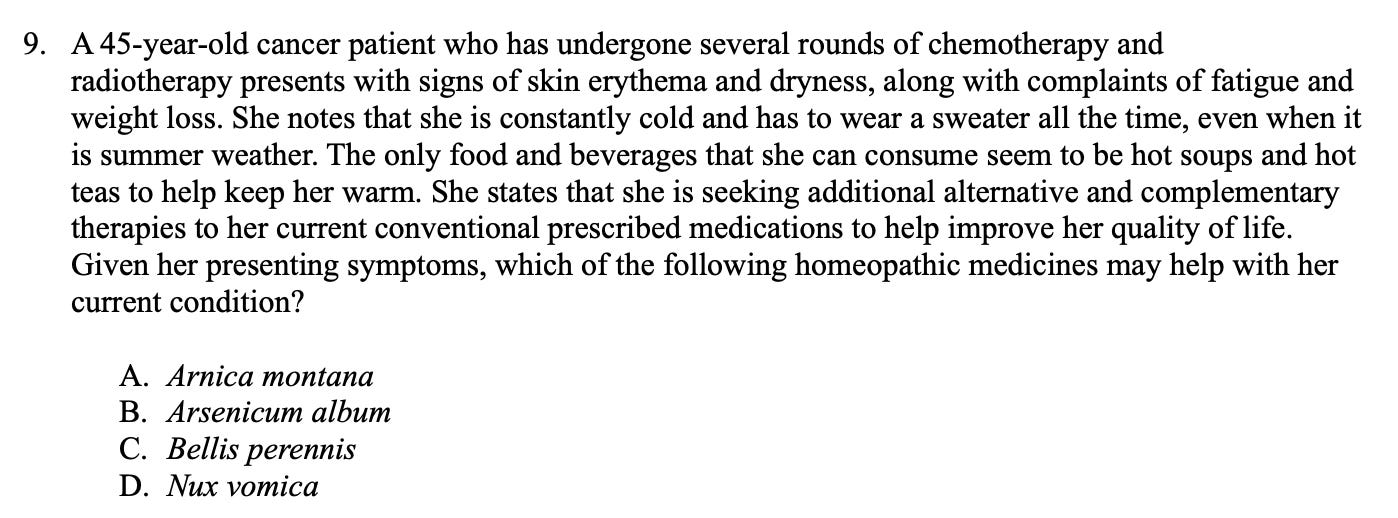
The correct answer, “none of the above,” isn’t an option.
What this school needs is a mandatory course in science literacy. But they’re clearly not interested in helping students learn actual medicine, so this is what they’re stuck with.
If there’s anything we can learn from this embarrassing situation, it’s how pseudoscience can launder itself through otherwise respectable institutions. Despite decades and decades of people exposing the lies of homeopathy, here it is again, not because it suddenly works, but because it sells because people wrongly think it works. It’s a professional’s job to cure people of that mistaken belief, not encourage more of it. It’s especially sad that a pharmacy school is abandoning its most basic obligation to science and public health in order to advance a company’s preferred brand of undiluted bullshit.
An institution that trains healthcare professionals shouldn’t be hiding behind vague language about holistic care in order to promote a course funded by industry money—certainly not an industry that exists purely to capitalize on people’s delusions. They shouldn’t be helping Boiron monetize the American public’s ignorance.
Everyone involved in this situation should be embarrassed. Homeopathy isn’t a big business because it works but because places like the University of the Pacific boost the idea that this stuff has merit. (And while we’re at it, let’s condemn stores that sell homeopathic products alongside actual medicine.)
If pharmacy schools won’t draw a hard line between medicine and magical thinking, what hope does the public have? This place doesn’t care if its reputation is degraded, much less if patients suffer in the long-term because no one has the heart to tell them their short-term solution isn’t a solution at all. What a shame.
Do you know what they call homeopathic medicine that actually WORKS?
𝗠𝗘𝗗𝗜𝗖𝗜𝗡𝗘.
Why this crap is being tolerated within the medical community is beyond me. Indeed, why aren't there double-blind studies to test things like St. John's Wort or echinacea for efficacy against depression or the common cold? Probably because if they did, the proverbial cat would be out of the bag. The homeopathy industry (and it IS an industry, have no doubt) can't have that.
And they resist every effort to actually demonstrate their claims. 😝
“future pharmacists to a category of products that is growing in popularity.”
At one time, mercury was used as a remedy for prolonging life. In 19th century, some mineral waters were touted for their arsenic level. Pharmacy schools should trach that too.
Boiron
This shit is sold here, their ads and commercials can be seen about everywhere 🙄