
This newsletter is free and goes out to over 24,000 subscribers, but it’s only able to sustain itself due to the support I receive from a small percentage of regular readers. Would you please consider becoming one of those supporters? You can use the button below to subscribe or use my usual Patreon page!
Article I, Section 3 of Florida’s Constitution is about as blunt as it can be when it comes to the issue of using taxpayer dollars to fund religion: It says you can’t.
There shall be no law respecting the establishment of religion or prohibiting or penalizing the free exercise thereof. Religious freedom shall not justify practices inconsistent with public morals, peace or safety. No revenue of the state or any political subdivision or agency thereof shall ever be taken from the public treasury directly or indirectly in aid of any church, sect, or religious denomination or in aid of any sectarian institution.
That passage is the state’s version of the “Blaine Amendment,” a reference to a failed amendment to the U.S. Constitution, first proposed in 1875, that would have banned federal money from going to religious schools. Even though it didn’t pass, 37 states have adopted their own versions of the law. Florida is obviously one of them.
But Attorney General James Uthmeier now says none of that can be enforced because the whole passage is unconstitutional. Sure, no other state has come to that conclusion, but he insists his interpretation is the right one. And as a result, his office is going to allow taxpayer dollars to flow to religious charter schools and to scholarships for religious schools.
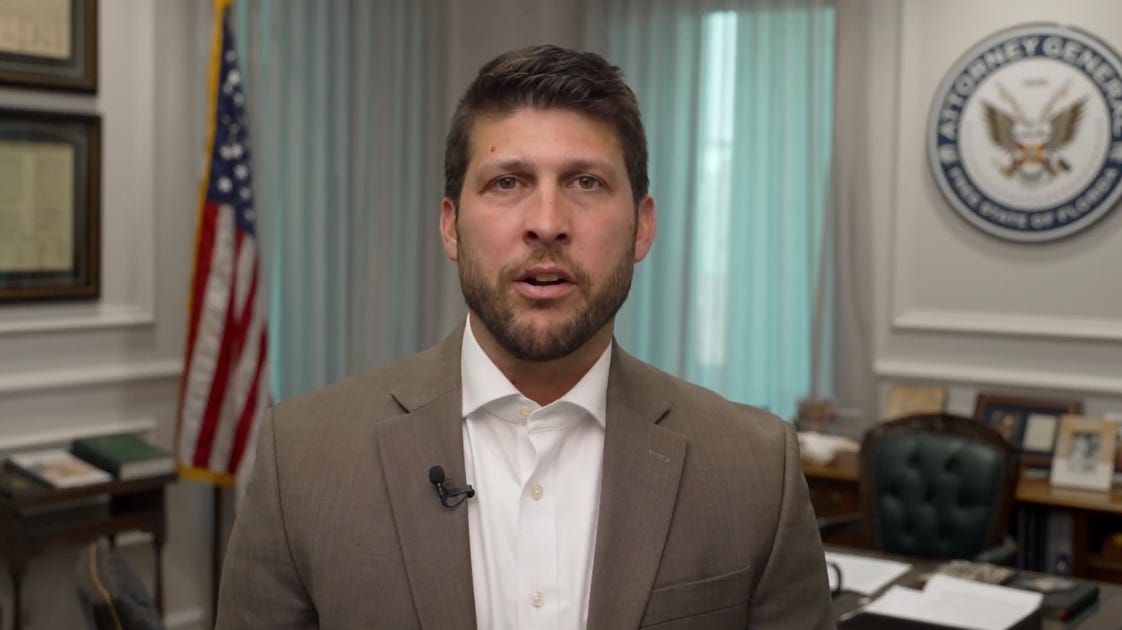
Uthmeier said all this in a nine-page memo that’s basically a love letter to Christian Nationalists everywhere. Just consider this passage about the problems with the First Amendment:
Establishment and encouragement are not the same, and no Framer would have conflated the two. The First Amendment prohibits the former (at the federal level), but not the latter. Government encouragement of religion acknowledges that “piety, religion, and morality are intimately connected with the well being of the state, and indispensable to the administration of civil justice. . . . It is indeed difficult to conceive how any civilized society can well exist without them”… Far from the overly pluralistic and religiously agnostic conception of the Clause commonly offered today, the Framers adopted it to safeguard “the right of private [religious] judgment,” “the freedom of public worship,” and the right to heed the “dictates of one’s conscience” against the dangers potentially posed by any particular Christian sect’s obtaining national ascendancy…
It is clear, then, that the First Amendment did not displace Christianity as the center of the nation’s religious identity. At the Framing, “the general, if not universal, sentiment in America was, that Christianity ought to receive encouragement from the State, so far as such encouragement was not incompatible with the private rights of conscience, and the freedom of religious worship. An attempt to level all religions, and to make it a matter of state policy to hold all in utter indifference, would have created universal disapprobation, if not universal indignation” (emphasis added)…
In that section, Uthmeier says church/state separation doesn’t apply to individual states, that Christianity remains the “center of the nation’s religious identity,” and that it’s fine for the government to encourage Christianity.
What about atheism? Of course the First Amendment’s Free Exercise Clause protects atheists, Uthmeier says, “but it does not privilege actions motivated by unbelief in the same way it privileges actions motivated by belief.” (He then cites multiple cases that say otherwise and dismisses them with a simple “Cases suggesting otherwise are incorrect.”)
But that’s not all he gets wrong. The Supreme Court has said that if a state offers benefits to everyone, it can’t exclude religious groups from having access to that money. So if a state offers vouchers for students to use at private schools, for example, they can’t ban religious private schools from receiving that money.
Uthmeier twists that around to say that logic means Florida must allow taxpayer dollars to go to religious charter schools:
Florida has broadly authorized any “individual, teachers, parents, a group of individuals, a municipality, or a legal entity” to apply to create a charter school... Yet it requires that any charter school “shall be nonsectarian in its programs, admission policies, employment practices, and operations”… This blanket exclusion of all religious entities also violates the First Amendment.
That makes no sense whatsoever. Taxpayer-funded charter schools are, by definition, public schools, not private ones. The door isn’t open to private schools, so it’s not open to private religious schools. That’s exactly what the Oklahoma Supreme Court said when it denied state funding for (you guessed it) a proposed religious charter school.
He may have more luck with the state’s “Effective Access to Student Education” grant, which currently prevents money from going to private religious schools but could be used toward private secular schools.
He closes his memo with what may as well be described as a prayer:
Florida’s Constitution rightly recognizes that “[w]e, the people of the State of Florida,” are “grateful to Almighty God for our constitutional liberty”… That constitutional liberty includes the right for religious people and entities to participate in pub-lic programs and benefits like everyone else. Any law, or any interpretation of the State Constitution, that violates this basic right will not—consistent with my oath—be enforced or defended by my office.
So what does all of this actually mean?
The immediate answer is… nothing. Uthmeier is urging religious groups to launch their own charter schools because he’s not going to get in the way of them, like the more courageous Attorney General Gentner Drummond of Oklahoma did. But that doesn’t mean those religious groups will automatically get away with it. Church/state separation groups can sue them for violating the state and federal constitutions even if Uthmeier’s office won’t.
To put it another way, Uthmeier is saying he won’t do his job of enforcing the law if religious groups—specifically Christian ones—are the ones breaking it. He’s abdicating his responsibility because he wants to see Florida creep closer to a theocracy. This comes months after Uthmeier argued that two Muslim schools shouldn’t be eligible for voucher money because they were “promot[ing] Sharia law.” (They were not. He’s just racist.)
But this is the sort of broken-brain thinking you get from an attorney general who’s in the same job once held by Pam Bondi. He was also previously chief of staff to Gov. Ron DeSantis, which is how he was appointed to his position a year ago. Substance has never been a prerequisite for any of his government jobs. All that matters is the ability to pretend anything that bothers conservatives is illegal so you can throw the full weight of your office against it, even if that has no basis in the law.
This fool should be held personally liable for the legal costs of defending his ruling, because there is no way he gets this past the courts. At least you’d hope so, but who knows these days. This country enjoys as much religious freedom as can be found on earth, and I don’t know why that isn’t enough for some people. They keep demanding government backstop their religion in spite of the fact the Constitution forbids it.
𝐸𝑠𝑡𝑎𝑏𝑙𝑖𝑠ℎ𝑚𝑒𝑛𝑡 𝑎𝑛𝑑 𝑒𝑛𝑐𝑜𝑢𝑟𝑎𝑔𝑒𝑚𝑒𝑛𝑡 𝑎𝑟𝑒 𝑛𝑜𝑡 𝑡ℎ𝑒 𝑠𝑎𝑚𝑒, 𝑎𝑛𝑑 𝑛𝑜 𝐹𝑟𝑎𝑚𝑒𝑟 𝑤𝑜𝑢𝑙𝑑 ℎ𝑎𝑣𝑒 𝑐𝑜𝑛𝑓𝑙𝑎𝑡𝑒𝑑 𝑡ℎ𝑒 𝑡𝑤𝑜. 𝑇ℎ𝑒 𝐹𝑖𝑟𝑠𝑡 𝐴𝑚𝑒𝑛𝑑𝑚𝑒𝑛𝑡 𝑝𝑟𝑜ℎ𝑖𝑏𝑖𝑡𝑠 𝑡ℎ𝑒 𝑓𝑜𝑟𝑚𝑒𝑟 (𝑎𝑡 𝑡ℎ𝑒 𝑓𝑒𝑑𝑒𝑟𝑎𝑙 𝑙𝑒𝑣𝑒𝑙), 𝑏𝑢𝑡 𝑛𝑜𝑡 𝑡ℎ𝑒 𝑙𝑎𝑡𝑡𝑒𝑟.
Are you sure about that, Uthmeier? If that were so, then the government could encourage The Satanic Temple. The government could encourage Islam. Or do you think the official position of the government, from federal down to township, should be that only Christianity counts as religion?
"An attempt to level all religions, and to make it a matter of state policy to hold all in utter indifference, would have created universal disapprobation, if not universal indignation”
Yes, it appears that that is your position. How, exactly, is the government to elevate Christianity above all other religions without establishing it?
Also, you have a fundamental misunderstanding of who the Establishment Clause applies to. It does not only apply to the federal government, but to all levels of government. That was codified by the 14th amendment, but it was a principle even before that. And the First Amendment's religion clauses served to clarify the rights of the people and the restrictions on the government already set forth in Article VI. "No religious test" means no religion required, no religion preferred, and no religion prohibited. Not just sects of Christianity.
It is a short step from the government encouraging Christianity to requiring Christianity, and from there, it isn't too far to mandate one particular sect. Do you want the Troubles? This is how you get the Troubles.