
This newsletter is free and goes out to over 23,000 subscribers, but it’s only able to sustain itself due to the support I receive from a small percentage of regular readers. Would you please consider becoming one of those supporters? You can use the button below to subscribe or use my usual Patreon page!
In a surprising but welcome ruling, a federal judge on Tuesday rejected a Trump-approved settlement that would have destroyed the Johnson Amendment and allowed pastors to endorse political candidates without jeopardizing their ministries’ tax-exempt statuses.
The coalition of Christian ministries including the National Religious Broadcasters, Intercessors for America, and two random Texas-based churches sued the IRS in 2024 (before the election) to challenge the Johnson Amendment.
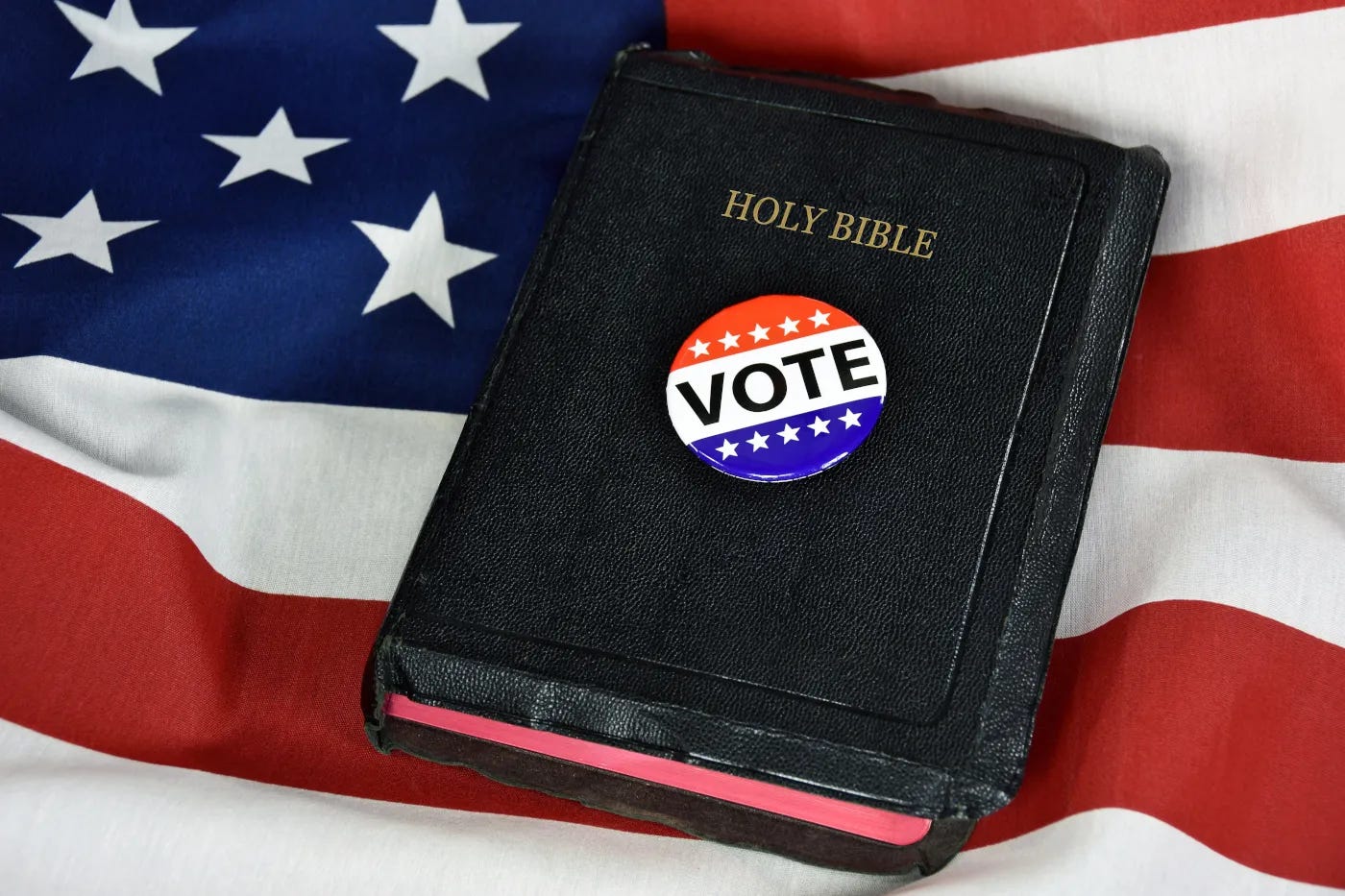
For the uninitiated, here’s what you need to know: Just about all non-profit groups (including charities, cause-based organizations, and churches) are considered by the IRS to be 501(c)(3)s. With that designation, the IRS is saying these groups are not looking to make a profit but rather serve a greater cause. As a way to encourage people to give money to those groups, contributions to them may be deducted on donors’ taxes. It’s theoretically a win-win for both sides.
To keep the 501(c)(3) designation, however, there are certain rules most of these groups must follow: For example, they have to fill out paperwork each year (a “Form 990”) detailing how much money they took in and how much is getting paid out and to whom. It’s a way for donors to keep tabs on the organizations and make sure they’re living up to their stated missions.
They also cannot endorse political candidates. They can always promote their partisan causes, and they can also issue “score cards” saying certain politicians uphold their values while others do not (wink wink), but they cannot explicitly tell members how to vote. That rule was proposed by then-Senator Lyndon B. Johnson in 1954, hence the name; it didn’t become an issue until decades later.
Houses of worship actually get an even sweeter deal. They are automatically granted a tax-exempt status (whereas secular charities have to fill out paperwork to earn the designation) and they don’t have to fill out the Form 990 at all. (Church/state separation groups have argued that the government’s preferential treatment for houses of worship in that regard is unconstitutional, but the courts haven’t agreed.)
Despite all that, plenty of conservative pastors still argue that these rules are too onerous and they’ve deliberately tried to goad the IRS into revoking their tax-exempt status just so they can file a lawsuit over it.
For several years during Barack Obama’s presidency, for example, hundreds of evangelical churches participated in “Pulpit Freedom Sunday” where they proudly endorsed Republican candidates and then, just to make sure their actions weren’t ignored, sent videos of those sermons directly to the IRS.
The IRS had every reason to take action and revoke the churches’ tax exemptions. But they never did.
In fact, over the past few decades, the IRS has only followed its own rules once. Just before the 1992 elections, a group called Branch Ministries ran full-page newspaper ads urging people not to vote for Bill Clinton. The IRS revoked the group’s tax exempt status. There was a lawsuit. The IRS won. (The Congressional Research Service, a government-backed public policy research institute, said another church also lost its tax exemption in 2012… but no further details are available.)
But that’s it. 70 years of the Johnson Amendment… and maybe two ministries that were punished by the IRS for violating it.
By the time Donald Trump was in office, the violations were even more egregious. There was no need for a concerted effort to endorse candidates because it was apparent to everyone that the IRS wasn’t going to punish pastors for telling church members how to vote. It didn’t help that Trump claimed he got rid of the Johnson Amendment… even though that was a lie. Churches have just been endorsing candidates ever since. While some churches have also endorsed Democrats, this is overwhelmingly a conservative/Republican issue. They’re the ones with the most to lose if the Johnson Amendment was ever enforced.
In 2022, ProPublica and The Texas Tribune published a damning piece attempting to get to the bottom of what the IRS was actually doing about these churches that violated the Johnson Amendment. What they discovered was that no one was minding the henhouse.
At least not publicly.
They found 18 churches over the previous two years explicitly violating the Johnson Amendment. (It’s almost certainly many, many more.) These were churches where the actions of the pastors weren’t at all ambiguous. If the IRS enforced its own rules, these churches would have instantly lost their tax exemptions. None of them did, and that’s because the IRS didn’t seem to care:
… The IRS has largely abdicated its enforcement responsibilities as churches have become more brazen. In fact, the number of apparent violations found by ProPublica and the Tribune, and confirmed by three nonprofit tax law experts, are greater than the total number of churches the federal agency has investigated for intervening in political campaigns over the past decade, according to records obtained by the news organizations.
In response to questions, an IRS spokesperson said that the agency “cannot comment on, neither confirm nor deny, investigations in progress, completed in the past nor contemplated.” Asked about enforcement efforts over the past decade, the IRS pointed the news organizations to annual reports that do not contain such information.
Why was the IRS acting like the CIA? No clue. They were saying they couldn’t confirm or deny investigations into churches that were openly and brazenly violating the law as if enforcing rules that were purposely broken amounted to some sort of national security issue.
It didn’t help that the IRS now needed a high-level official signing off on such investigations—and no one was employed in that position for a while, “leaving lower IRS employees to initiate church investigations.” Nor did it help that the IRS just stopped looking at churches’ political activity for several years during the Obama administration.
As Andrew Seidel of Americans United for Separation of Church and State said at the time, by giving churches enough leeway to endorse candidates, the IRS was “essentially creating super PACs that are black holes.”
Here’s how useless the IRS has been when it comes to prosecuting churches that violate their rules:
In response to a Freedom of Information Act request from ProPublica and the Tribune last year, the IRS produced a severely redacted spreadsheet indicating the agency had launched inquiries into 16 churches since 2011. IRS officials shielded the results of the probes, and they have declined to answer specific questions.
Just 16?! What is the point of reporting churches to the IRS if no one’s paying any attention to the complaints? And what does it even mean that they’ve “launched” inquiries? If hundreds of pastors are prodding the IRS to come after them by telling people how to vote, and the IRS is barely lifting a finger—and, even then, only against a few of those churches—what the hell are they doing?
Either the IRS needs to eliminate the Johnson Amendment and allow all non-profits to have the option of playing politics, or it must enforce the rules even if that means going after Christian churches.
The irony in all this is that the churches pushing to repeal the Johnson Amendment say they’re doing it because they don’t want to be beholden to the government. They say they want the freedom to preach whatever they want, including political endorsements, and they don’t want the government telling them what they can’t say. And yet, by opposing the Johnson Amendment and by demanding a right to promote candidates, they’re effectively becoming tools of the Republican Party.
So that’s where we were at when the lawsuit was filed. The Johnson Amendment is still on the books, but it’s almost never enforced. And yet this lawsuit pretended that the Johnson Amendment was hindering the supposed free speech rights of Christians.
The complaint argued that churches were forced into 501(c)(3) status and were therefore “automatically silenced” by the government. For example, they said the plaintiffs wanted to speak out about the candidates’ positions—which they’re already legally allowed to do!—but were too scared to do so because they feared the Johnson Amendment, as if their ignorance was a reason to strike down the rule. (They “have engaged in self-censorship,” they wrote while the tiniest violin played in the background.)
They also said many newspapers are non-profits, yet they’re able to endorse candidates—14 pages of the lawsuit were dedicated to providing examples of this.
The plaintiffs then spent pages documenting examples of churches openly endorsing Democratic candidates without penalty. Their conclusion?
The IRS operates in a manner that disfavors conservative organizations and conservative, religious organizations in its enforcement of § 501(c)(3). This is a denial of both religious freedom and equal protection.
Elsewhere, they claimed endorsements went “unchallenged by the IRS especially if the candidates in question are from the Democratic Party.”
The plaintiffs said they had to file this lawsuit because the only other option was to break the rule (by endorsing a candidate) and risk losing their tax exemption, which would stick if their lawsuit failed. So they were suing to avoid problems down the line.
This lawsuit should have failed for a number of reasons.
First of all, the people who want to see the Johnson Amendment enforced want it applied across the board, not to benefit one side or the other. It’s not like church/state separation groups are totally fine with it if a historically Black church endorses a Democratic candidate. We want it applied universally and think the IRS should be funded to the point where it can investigate all these allegations.
The cherry-picked examples of unenforced violations were also laughable. It’s true that there are examples of churches endorsing Democrats, but there are so many more examples of evangelical churches endorsing Republicans, and this lawsuit seemed unconcerned about that pesky little fact. How could anyone fail to call out right-wing churches for the same behavior, then, with a straight face, argue that the IRS was selectively enforcing its rule?
The closest they came to acknowledging that their side does this too is when they mentioned Cornerstone Chapel in Leesburg, Virginia. Weeks before the 2020 election, Pastor Gary Hamrick urged the congregation to vote for Donald Trump. He didn’t flat-out say that, but he implied it by saying (of Democrats): “I don’t know how, in good conscience, a Christian can vote for an agenda that is evil.”
According to the lawsuit:
Subsequently the IRS began an enforcement action against Cornerstone Chapel on the basis of implicit support or opposition of political candidates. The IRS levied and Cornerstone Chapel paid a tax penalty for violating the Johnson Amendment.
This was news to me. As far as I could tell, there weren’t any media reports about that alleged investigation, much less a fine, and I couldn’t find outside verification of those claims. (Intercessors for America, one of the groups involved in the lawsuit, promoted that sermon on its website.)
But let’s suppose that was true: It still meant that church, despite openly violating the Johnson Amendment, didn’t lose its tax-exempt status. They had to pay a fine of some unspecified amount (was it $1? $1,000?) and then the IRS went away.
If that was the worst example the plaintiffs could point to of the IRS coming after a Republican-supporting church, then why the hell were they suing? They have it pretty damn good!
What about the newspapers claim? If we’re talking about non-profit media outlets, then guess what? They’re not supposed to make political endorsements either! The IRS should absolutely go after them. The fact that so many outlets, many of which may have endorsed Democrats, have avoided such penalties doesn’t suggest bias by the IRS. It shows that the IRS is an institution that’s simply not concerned with enforcing its own rules.
That said, it wasn’t clear the Christian plaintiffs understood how some newspapers worked. They cited The Philadelphia Inquirer as a newspaper owned by a non-profit while also endorsing candidates. Hypocrisy, right? Not quite, as their CEO explained to Religion News Service:
“The Philadelphia Inquirer is owned by the nonprofit Lenfest Institute for Journalism, but the newspaper remains a for-profit public-benefit corporation,” Jim Friedlich, CEO of the Lenfest Institute for Journalism, told RNS in an email. “As a for-profit entity, The Philadelphia Inquirer is permitted to publish political endorsements, as it has for decades. It does so following thoughtful research on candidate policy positions, qualifications, integrity, and track record.”
In general, though, I want the IRS to go after non-profit media outlets and houses of worship if they’re endorsing candidates, regardless of which party they’re supporting.
Finally—and this was just a strategic issue—if the concern really was that the IRS is harming houses of worship, smarter lawyers would have brought together a variety of religious (and non-theistic!) organizations that felt muffled by the rule. By having four plaintiffs who espoused conservative Christianity, it sent the message that this was just a small group of whiners rather than a systemic issue that needed immediate fixing.
But even though this lawsuit should have failed, that didn’t mean it would. It was filed in the U.S. District Court for the Eastern District of Texas in Tyler… which happened to be a circuit where the only two judges who could hear the case, Jeremy D. Kernodle and J. Campbell Barker, were both Trump appointees. (The National Religious Broadcasters (NRB) association said the case was filed here because that’s where the two churches that are plaintiffs are located... but—let’s be honest here—those two churches were included in the lawsuit only because they’re located in the district. It’s not like the lawsuit pointed to any special reason they were involved in the case.)
So the game plan seemed pretty straight-forward. The Christians in this case wanted a Trump judge to strike down the Johnson Amendment. If there were appeals, they wanted this case to go all the way up to the Supreme Court, where the right-wing super-majority could declare the Johnson Amendment unconstitutional and turn churches across America into extensions of the Republican Party.
Last July, the New York Times broke the news that the IRS (now under Trump) was effectively ceding the case to the religious ministries. They said in a court filing that churches could freely endorse candidates without penalty because that was nothing more than a “family discussion concerning candidates” rather than politicking. (Seriously, that’s the phrasing they used.)
The IRS also said that their rules prohibit non-profits from participating or intervening in a campaign—which we all know means telling people how to vote. But the way the IRS was now defining those two words, participating meant taking part in the actual campaign, and intervening meant literally getting in the way of an election. Neither of those apply, the two sides said in their joint filing, when a pastor tells the congregation who to vote for.
More importantly, the IRS said this new definition only applied to houses of worship but not to non-profits in general. That meant a Southern Baptist church could tell its members to vote for a Republican candidate, but Planned Parenthood would still be prohibited from telling its members to vote for a Democratic one. That could have been grounds for a larger lawsuit.
All the IRS needed was for the federal judge to approve their new deal.
That’s why what happened on Tuesday was such a shocker.
The judge in question was Barker (a Trump appointee), and he tossed out the religious Plaintiffs’ case in a swift 9-page decision. In short, he said he had no authority to rule on the matter because the issue involved whether or not a group should be paying taxes and that’s not under his jurisdiction. That’s the IRS’ concern, not his, and people can’t generally sue because they don’t like paying taxes.
Then there was the fact that the supposed harms here were imposed by the ministries themselves. They chose this, Barker implied: “Put differently, if the plaintiffs here gave up their § 501(c)(3) tax-exempt status, none of the harms they allege could occur.”
Plus, he said, it’s not like the government is punishing people under the Johnson Amendment anyway: “… [I]t is not obvious that the government will ever assess an income tax against plaintiffs or impose any other tax consequence under the Johnson Amendment.”
But if they are ever taxed for this, and they feel it’s illegal, then they can definitely sue:
Under an 1867 law, [Barker] said, taxpayers cannot challenge a tax before they pay it. Because the plaintiffs in this case had not actually paid any tax penalties, Judge Barker said, the suit had to be dismissed.
“A refund suit could be brought if a tax were ultimately collected,” he wrote.
It’s everything critics were saying for years. No one is hampering the free speech of religious groups by enforcing the Johnson Amendment. No one is going after their religious freedom. If churches feel muzzled, they can just pay taxes. If they want the tax break, they have to play by the rules. It’s not that complicated.
It left the Christian Right reeling, given that they thought they had this one in the bag. Just look at how one right-wing lawyer tried to explain the ruling from one of their own:
Michael Farris, general counsel for the National Religious Broadcasters, said the plaintiffs were surprised by the ruling and planned to appeal the decision. He said the judge’s ruling would require the plaintiffs to violate the law to get their case heard.
“We think that is an error,” he said. “I think the judge was trying to do his very best as he understood the law. But I just disagree.”
They never say that about Sonia Sotomayor.
Meanwhile, Americans United for Separation of Church and State celebrated with good reason:
“We’re glad that the Johnson Amendment will remain a strong bulwark to stop religious extremists from exploiting houses of worship,” said Americans United President and CEO Rachel Laser. “Tax-free giving to charities should fund charitable work, not partisan politics. The proposed settlement agreement to exempt only houses of worship and not secular nonprofits would have been unfair and a violation of church-state separation. It also would have been unhealthy for our democracy because it would allow churches to become unaccountable political action committees. The court was right to reject the administration’s attempt to use the courts to rewrite our laws.”
While I share their joy here, keep in mind that part of the reason the victory occurred is because the Johnson Amendment isn’t being enforced, making everything moot. It’s hard to get excited about the Amendment remaining in place when it’s not being used at all, though this is a necessary step for it to be enforced in the future.
The appeal will go to the notoriously conservative Fifth Circuit, so who knows what happens after this. But the fact that this lawsuit took this long to achieve nothing is a victory in itself. When you have a Trump judge and a conservative legal system, anything that wastes this much time and get this sort of decision is a win for church/state separation.
(Portions of this article were published earlier)
Anyone who would take political advice from the clergy deserves every bad thing that happens to them as a result. The Christian right sees religion as the solution to all this country’s problems, without ever providing a single example to support their claims. The Bible-belt South has some of this country’s worst social metrics, but they dismiss things like that as the work-product of people who were not TRUE Christians. If Christianity is the solution, then why was the Civil Rights Act necessary?
Boarding in 10 minutes, I hope.
Even if churches were subject to taxes, it seems to me that most of them would owe little to no income tax. Deductible expenses would likely be close to revenue. Property taxes would be something else.
And the megachurches are likely a different story but, hey, they are rich and I’ve no problem taxing the rich.