
This newsletter is free and goes out to over 23,000 subscribers, but it’s only able to sustain itself due to the support I receive from a small percentage of regular readers. Would you please consider becoming one of those supporters? You can use the button below to subscribe or use my usual Patreon page!
Several months after Arkansas passed a law requiring every public school classroom to display a copy of the Ten Commandments, in April of 2025, a federal judge has finally blocked schools districts from following that law.
(It comes months after the same judge issued a temporary injunction in the same matter.)

Some quick background: This law required every public school classroom to display a copy of the Ten Commandments, and the posters didn’t even need a disclaimer explaining the supposed historical relevance of the Decalogue.
Similar laws have already been struck down by the courts and this was was even more egregious than the other ones, which is why a coalition of church/state separation groups filed a lawsuit against it.
When U.S. District Court Judge Timothy L. Brooks (an Obama appointee) finally weighed in back in August, he issued a preliminary injunction, putting the law on hold, at least in the districts attended by the students involved in this case.
After he issued his preliminary injunction, the groups that filed the lawsuit—Americans United for Separation of Church and State, the ACLU of Texas, the ACLU (national), and the Freedom From Religion Foundation—sent a letter to the other 233 school districts across the state. They explained that Brooks said the Ten Commandments law was “obviously unconstitutional” and that all school districts should take that seriously even if they weren’t directly involved in the case:
Even though your district is not a party to the ongoing lawsuit, all school districts have an independent obligation to respect students’ and families’ constitutional rights. Because the U.S. Constitution supersedes state law, public-school officials may not comply with Act 573.
…
In light of the court’s August 4 ruling that Act 573 is “plainly unconstitutional,” any school district that implements Act 573 will be violating the First Amendment and could be inviting additional litigation. We thus urge you to respect the First Amendment rights of Arkansas students and families by not implementing the statute.
It was the sort of letter that state officials should have sent to all the school districts, but in red-state Arkansas, that was never going to happen because Republicans don’t give a shit about the law if it interferes with their preferred religion. So this was more of a courtesy from the church/state groups, sternly warning these districts that they could also be sued if they dared to defy the judge’s orders.
But the Conway School District did it anyway. They posted the Ten Commandments in every classroom, forcing students to look at it the day they came back from summer break.
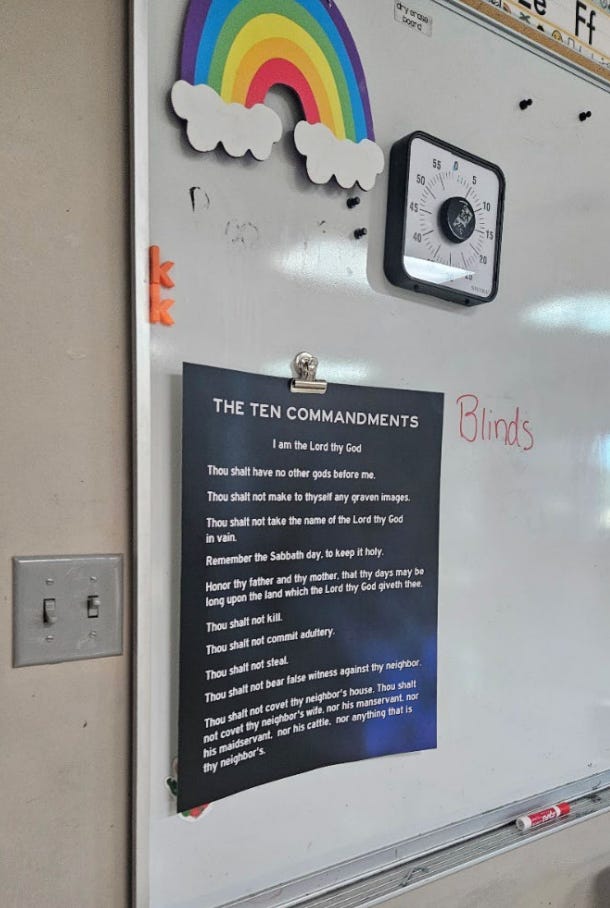

In an unusual move, Judge Brooks allowed those church/state groups to amend their original lawsuit to include that school district, too, and the judge immediately extended his injunction to that district. (A sixth district was later added to that list.)
It was the right move, but it made all this a giant game of whack-a-mole. What we needed was a permanent injunction that applied across the whole state.
And now we have it.
On Monday, Judge Brooks issued a 26-page ruling forbidding the named public school districts from going along with this law.
He said that the Plaintiffs had standing even though the posters had not yet gone up because the threat was real and imminent. There were “4,019 classrooms across the four school districts” initially prohibited from putting up the posters, and those districts had already received over 20,900 posters from donors. This was a problem waiting to happen.
To the argument that no one could know what the posters would look like before they went up—an argument that was recently used to favor a similar law in Louisiana—Judge Brooks acknowledged what everyone knew: “[N]o guesswork or speculation is required to determine exactly how Act 573 will be implemented by Arkansas school districts.”
For example, the Conway School District already put up some posters as seen in those photos above, and there’s no ambiguity about the religious intention of the text.
… The posters contain the Ten Commandments text and nothing more. There is no explanation as to why the Ten Commandments are displayed—which, again, is not a surprise, because Act 573 states no educational reason to display the Ten Commandments.
Further, the plain text of Act 573 does not suggest that other documents be posted alongside the Ten Commandments for educational reasons or mitigating context. That is because the Legislature intends the posters to hang in all classrooms without regard to the subject matter taught in class, the age of the students, or any other material consideration. Nothing could possibly justify hanging the Ten Commandments—with or without historical context—in a calculus, chemistry, French, or woodworking class, to name a few. And the words “curriculum,” “school board,” “teacher,” or “educate” don’t appear anywhere in Act 573. Accordingly, there is no need to strain our minds to imagine a constitutional display mandated by Act 573…
Finally, Judge Brooks noted that the Supreme Court already ruled in Stone v. Graham (1980) that putting the Ten Commandments on classroom walls was unconstitutional because it lacked a nonreligious, legislative purpose. With that still in place, this Arkansas law was dead on arrival. Furthermore, even the current Court’s more recent decisions haven’t reversed any of that.
In short, there is no reason to think the Supreme Court has thrown the baby out with the bathwater. Abandoning the Lemon test does not mean that public-school children’s religious liberties are now in a state of limbo and ripe for state exploitation.
…
[Arkansas’ law] is a coercive law that results in universal participation by students.
What about the argument that students could just ignore the posters if they didn’t want to look at them? Brooks said that was an impossible demand: “Children cannot similarly avoid reading the Ten Commandments posted in their classrooms for thirteen years of compulsory schooling.”
Finally, with regards to the fictional argument made by Christians that the Ten Commandments are historical, not religious, Judge Brooks was having none of it:
Given that Act 573 is coercive, the only thing left to consider is why it was enacted in the first place. The State’s lawyers claim at various points in their briefing that Act 573’s purpose is “to acknowledge the historical importance of the Ten Commandments”… This claim finds no support in the record. First, the word “historical”—or any form of that word—appears only twice in Act 573, and both times it is used to describe the ancient quality of the sacred text, not how the text will be used in schools.
He goes on to say the law doesn’t require teachers to explain the displays or anything like that, meaning even if they wanted to say the Commandments were historical, there’s nothing in the law making them do it.
In other words, the State admits there is no educational purpose in displaying the Ten Commandments—no teaching, no learning, and no curricular integration.
…
Act 573’s purpose is only to display a sacred, religious text in a prominent place in every public-school classroom. And the only reason to display a sacred, religious text in every classroom is to proselytize to children. The State has said the quiet part out loud.
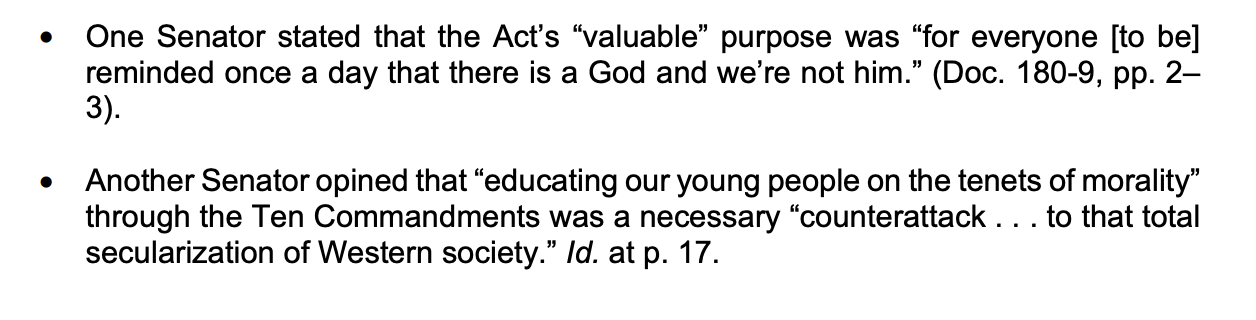
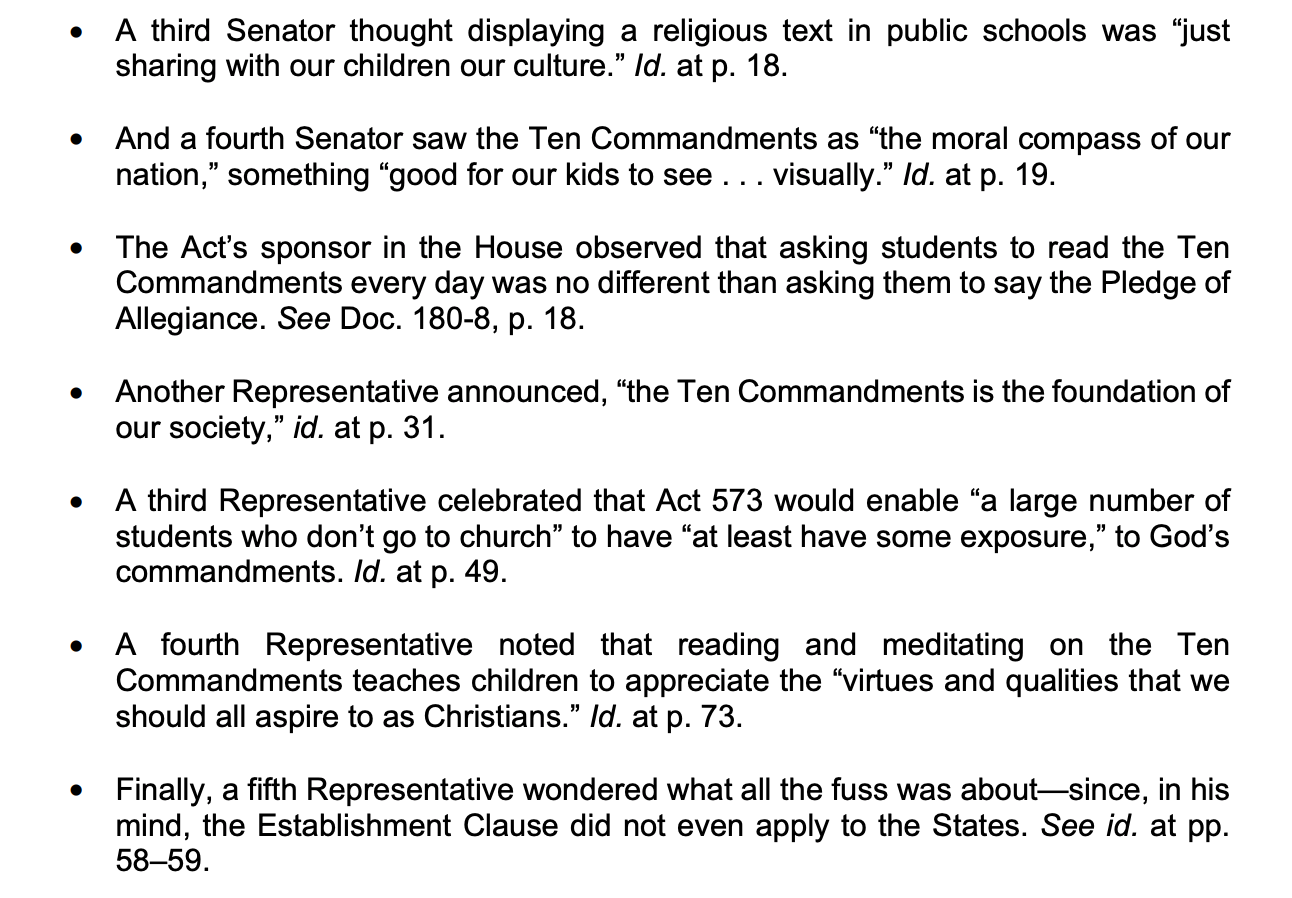
And then, as if to do a mic drop on that point, he quoted a number of lawmakers who pushed for this bill saying why it was important to indoctrinate kids with Christianity. Like one who said the purpose of the bill was to remind kids “there is a God” and another who said the Commandments were an important “counterattack . . . to that total secularization of Western society.”
Seriously, the judge used bulletpoints because there were so many examples.
Brooks also noted the expert witnesses for both sides. The church/state side had Dr. Steven K. Green, who had said in court that the Founding Fathers supported church/state separation, that our founding documents (like the Constitution and Declaration of Independence) weren’t based on the Ten Commandments, and that there’s no “longstanding historical practice” of putting the Ten Commandments in public schools.
Arkansas had Dr. Mark David Hall, a professor at the late Pat Robertson’s Regent University, who has repeatedly downplayed the threat of Christian Nationalism.
Both men, the judge said, admitted that there is “no longstanding, widespread history of permanently displaying the Ten Commandments in public-school classrooms.”
Discussing history is both unhelpful and irrelevant when the challenged law is coercive, applied universally in the public-school context, and has no educational, secular purpose. Even so, there are no historical practices and understandings to support the posting of the Ten Commandments in the public-school context.
(In one footnote, the judge mentions that even Dr. Hall admitted he would “find it hard to imagine” an educational purpose for having the Ten Commandments in a math or science classroom.)
Finally, the judge noted that this law violates the Free Exercise rights of the Plaintiffs by undermining the parents’ wishes when it comes to the religious upbringing of their children.
The bottom line? “Act 573 must be permanently enjoined.” (Meaning: It’s dead.)
Brooks says his ruling only applies to the six school districts named in the lawsuit. That doesn’t mean other districts are free to put up the posters, though, because if they do, they would then be subject to this ruling. So it’s a victory across the board.
“Today’s decision honors the Constitution’s promise of church-state separation and religious freedom,” said Rachel Laser, president and CEO of Americans United for Separation of Church and State. “It will ensure that Arkansas families – not politicians or public-school officials – get to decide how and when their children engage with religion.”
…
“We are delighted that reason and our secular Constitution have prevailed, and that children will be spared this unconstitutional proselytizing,” said Annie Laurie Gaylor, co-president of the Freedom From Religion Foundation. “Our public schools exist to educate, not to evangelize a captive audience.”
The celebration may be short-lived, though. Arkansas’ attorney general is already saying an appeal is on the way. Gov. Sarah Huckabee Sanders echoed that:
“In Arkansas, we do in fact believe that murder is wrong and stealing is bad,” Sanders said in a statement. “It is entirely appropriate to display the Ten Commandments – the basis of all Western law and morality – as a reminder to students, state employees, and every Arkansan who enters a government building, and I look forward to appealing this suit and defending our state’s values.”
The Ten Commandments aren’t the basis of anything in our law, which is exactly what the judge said. And the issue is never about murder and stealing. It’s about the other commandments which discuss worshiping other gods, making false idols, taking God’s name in vain, keeping the Sabbath day holy, etc. It’s revealing that Huckabee doesn’t mention any of those real concerns in her statement.
But that sort of faith-based lying is the basis of this entire charade—in Arkansas, Louisiana, and Texas. It’s always been about getting the Ten Commandments back in front of the Supreme Court in order to open the door to other forms of Christianity shoved back into public schools. Just last month, the Fifth Circuit Court of Appeals vacated an earlier ruling declaring the displays unconstitutional, but delayed a ruling on the substance of this obvious situation, suggesting that they’re going to eventually rule on the side of conservative Christian zealots. Whatever happens, this won’t end until the Supreme Court weighs in. An appeal in this particular case would go to the Eighth Circuit Court of Appeals, for what it’s worth.
Still, for now, The Ten Commandments proponents have lost every attempt at forcing their religion in public schools. That’s due to existing legal precedent and because there’s no history or tradition justifying the Decalogue from going up. That’s precisely why the current Supreme Court shouldn’t budge on this either.
"The judge said the law was coercive and lacked any historical precedent."
Shall we also mention that it would be in blatant violation of the Establishment Clause of the First Amendment? Seems as though I just did.
The religious right never stops trying to force their way into the public schools paid for with everyone's tax dollars. It's a win-win for them. They either get what they want or they get to play the poor, persecuted victims of the Godless left. That second bit keeps the money rolling in.