
This newsletter is free and goes out to over 23,000 subscribers, but it’s only able to sustain itself due to the support I receive from a small percentage of regular readers. Would you please consider becoming one of those supporters? You can use the button below to subscribe or use my usual Patreon page!
The Texas Board of Education voted 9-6 last week to approve thousands of fixes, large and small, to a state-approved reading and language arts curriculum for public schools that critics have long said is subpar for students and illegally infused with Christianity.
The decision to pay for those changes is proof that even the officials who supported the “Bluebonnet” curriculum now acknowledge it wasn’t ready to put in front of students.
To make sense of what’s happening, you have to go back to 2023, when Republican lawmakers passed HB 1605, a bill projected to cost the state more than $731 million over two years that directed the Texas Education Agency to develop instructional materials that aligned with state standards.
This would, in theory, be a huge benefit for cash-strapped districts because they wouldn’t have to purchase separate textbooks from outside companies anymore. While public schools wouldn’t be forced to use this material, they would at least have that option.
But the state also dangled a carrot in front of districts: We’ll give you up to $60 per student if you use our resources. It would be very hard for low-income districts to pass that up.
Whether or not this was a good use of state dollars was up for debate. Critics said the money would have been better spent on raising teachers’ salaries in order to attract better educators to the field. In any case, later that year, the State Board of Education posted drafts of the new material online—including the English Language Arts and Reading material for students in Kindergarten through Grade 5—so that the public could weigh in before the material was finalized.
One of the big takeaways? This material was riddled with Christianity.

According to The 74, an outlet that covers education, this was largely because right-wing groups played a significant role in developing the curriculum:
While largely hidden from public view, the redesign sparked behind-the-scenes debate long before its release. When a leading curriculum publisher balked at the state’s request to infuse its offerings with biblical content, Texas officials turned to other vendors. They include conservative Christian Hillsdale College in Michigan and the right-leaning Texas Public Policy Foundation, which supported an unsuccessful effort to require the 10 Commandments in every classroom, according to a list obtained by The 74.
So how bad did it all get?
Here were just two examples of how conservatives worked the Bible into the material in a way that allowed them to claim plausible deniability when accused of violating church/state separation.
The material for 5th graders included a unit on “Juneteenth and Beyond” where students were supposed to read Martin Luther King Jr.’s “Letter from Birmingham Jail.” King wrote the now-famous letter after he was arrested during a non-violent protest and after several white clergy members urged Black Americans to just be patient and fight racism through the courts.
King responded, “For years now I have heard the word ‘wait.’ It rings in the ear of every Negro with a piercing familiarity. This ‘wait’ has almost always meant ‘never.’” He also quoted the line, “justice too long delayed is justice denied.” In the middle of the letter, he said that his form of protest was hardly a new approach:
Of course, there is nothing new about this kind of civil disobedience. It was seen sublimely in the refusal of Shadrach, Meshach, and Abednego to obey the laws of Nebuchadnezzar because a higher moral law was involved. It was practiced superbly by the early Christians, who were willing to face hungry lions and the excruciating pain of chopping blocks before submitting to certain unjust laws of the Roman Empire. To a degree, academic freedom is a reality today because Socrates practiced civil disobedience.
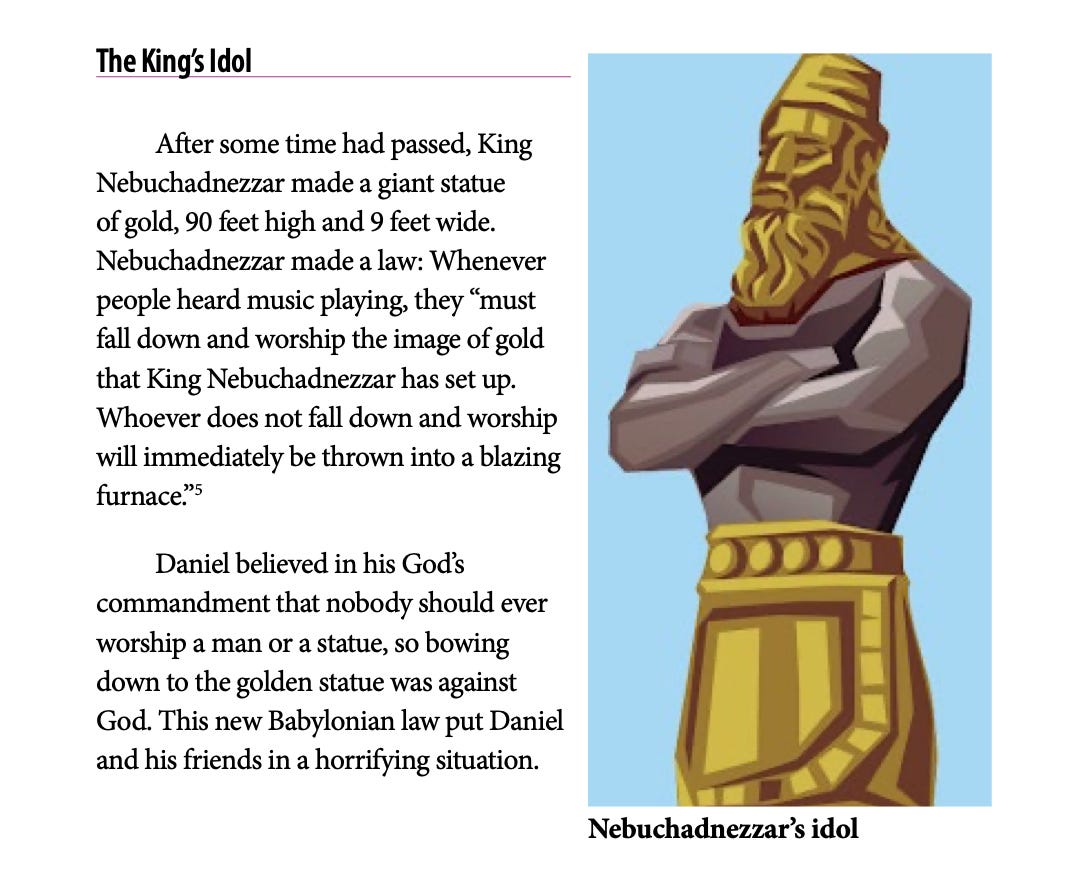
In the Book of Daniel, the characters Shadrach, Meshach, and Abednego were thrown into a furnace because they weren’t bowing down to an image of the King of Babylon, Nebuchadnezzar II. But when the king looked to see them burned up, he noticed four figures… one of whom appeared to be “like a son of God.” The three other men were unharmed.
How significant were those biblical references in the King letter? Not significant at all. They were just one of many, many allusions made throughout the piece. The Wikipedia article for the letter doesn’t even mention them once. When people talk about King’s letter, those biblical characters do not come up because the bigger picture of what King is saying is so much more important.
But not to the curriculum writers in Texas. They saw an opening.
In the student activity book accompanying this unit, kids are asked to write a short response to the question, “Why did Dr. Martin Luther King Jr. reference the story of Daniel in his ‘Letter from Birmingham Jail’?”

They could have asked any number of similar questions: Why did King reference Socrates and Aristotle? Why did King bring up Brown v. Board of Education? Why did King mention Thomas Jefferson and Abraham Lincoln? Instead, the big takeaway for the Christians writing this curriculum was to make sure kids understood the biblical reference.
Sure, understanding the Bible story helps make sense of what King is saying in that single sentence, but it’s hardly necessary. And yet Texas education Commissioner Mike Morath felt it was vital:
“If you don’t know who Nebuchadnezzar is, you don’t know what [King’s] talking about,” Morath said. “How do you make sure that you can unlock in the minds of our kids their ability to wrestle with … ideas that have surfaced in great works of literature?”
You could absolutely figure out what King was saying without knowing that Bible reference.
But you could see what they were doing here. They used a minor reference to the Bible and blew it up in order to centralize it within a discussion of King.
A separate document provided by state officials included a lengthy account of the Bible story in order to hammer home the point conservative Christians wanted kids to take away from this unit: “To understand King, one must also understand his religious references.”
It was nothing more than a Sunday School sermon wedged into a unit about King. What could have been explained in a single paragraph (as I did above) was expanded into six pages of Bible storytelling.
In addition to that, nothing in the entire unit, as far as I could tell, suggested that many racists were inspired by their Christian faith to maintain segregation. Instead, students were only told that “many leaders of the civil rights movement were motivated by their Christian faith.” That’s true, but it’s definitely not the entire story, and leaving out the other side ignores a very salient point.
That was just one example. Here’s another.
A 2nd Grade lesson about “Fighting for the Cause” introduced students to “ordinary people who stood up for what they believed in and who fought for a cause, even when faced with immeasurable odds.” That sounded wonderful! The leaders mentioned in the unit included Jackie Robinson, Dolores Huerta, Rosa Parks… and the biblical character Queen Esther.
The Bible said Esther saved the Jewish people by foiling a plot to eradicate them, which is why she was included in this unit… but unlike everyone else, there was no evidence she ever actually existed. Students were never told that. Her story was given the same treatment as the one of Rosa Parks refusing to give up her seat on a bus:

It didn’t stop there. In the packet of images meant to be used in the unit, there were actual pictures of freedom fighters like Dr. Héctor P. Garcia and Cesar Chavez. And there were paintings of historical figures William Penn and William Wilberforce. Esther, who didn’t actually exist, received a similar treatment. In fact, it was implied we know what she looked like because here she is:

The teacher’s notes never mentioned that this image, clipped from an 1878 painting by Edwin Long, was not the result of a portrait session but rather conjured up out of thin air because she wasn’t real. The notes went on to say the Bible described Esther as someone “who was chosen by the king of Persia to be queen”… as if her mention in the Bible proved it.

You get the idea. Throughout these lessons, Christianity was treated as fact. The Bible’s characters were not referred to as characters but rather as real people in history. And whenever the faith could be shoved into a lesson, it was.
There’s a very good argument that could be made for teaching children about the Bible in the name of cultural literacy. Without knowing the story of Adam and Eve and the Garden of Eden, for example, you may miss out on a lot of references made in literature, art, and pop culture. But if that’s the goal, then it’s imperative to tell students the Bible is a work of fiction—or at least to treat it objectively instead of as historical fact. It would also be important, then, to focus primarily on the biggest Bible stories and not B-plot characters just for the sake of telling their stories.
One professor who spoke to The 74 expressed that very concern:
“It is reasonable to devote some attention to [the Bible], and state education standards across the nation often require such attention,” said Mark Chancey, a religious studies professor at Southern Methodist University in Dallas. “The problem, of course, is that sometimes the legitimate reason of cultural literacy is used as a smokescreen to hide religious and ideological agendas.”
That’s what we were seeing here, over and over: a religious agenda masquerading as broad-based education. Hell, a poetry unit for fifth graders included poems by Robert Frost and William Carlos Williams and… The Book of Psalms. CNN reported, “No other texts from religious books would be included in the unit.”
This was also the result of complaints from conservative parents who, according to The 74, said the previous curriculum offered by the company Amplify emphasized mythology over Christianity. (The irony was apparently lost on them.)
State officials asked Amplify to provide a lesson on the story of Esther and suggested a unit on Exodus, said Alexandra Walsh, the company’s chief product officer.
While it had previously tweaked its curriculum for other states, Walsh said the company had never been asked to add biblical material. And when it suggested inserting content from other world religions, the state rejected the idea, said Amplify spokeswoman Kristine Frech.
“There was not much appetite for a variety of wisdom texts,” she said. “There was much more of an appetite for the tie to traditional Christian texts.”
So Texas ditched Amplify and began working with right-wing groups like the Texas Public Policy Foundation and Hillsdale. And this is what they developed.
Interestingly enough, The 74 pointed out that Texas was already offering high school students elective courses on the Bible. Those, too, would be legal as long as they were taught objectively (which they are not). But here’s the thing: Those classes were extremely unpopular. “Just over 1,200 of the state’s 1.7 million high school students took the course this year,” the article said.
Since that plan to indoctrinate students didn’t work, Texas lawmakers were looking for another way to do it, and this time, instead of waiting for high school students to choose a class on the Bible, they shoved the Bible into an entire elementary-level curriculum.
The new Bible-infused curriculum—known as the “Bluebonnet Learning“ curriculum—was eventually adopted. (It wasn’t a good sign that one of the companies contributing to the new material was founded by Mike Huckabee.)
And how popular was the new curriculum?
We already knew poorer districts would be compelled to use it to save money, and that’s indeed how it played out. According to the Texas Tribune, roughly 300 public and charter schools, representing about 25% of public school districts in the state, said they expected to use the Bluebonnet curriculum.
The Tribune obtained data through an open records request on the schools planning to use the [Texas Education Agency’s] new Bluebonnet curriculum, which includes the religion-infused reading lessons as well as phonics and math materials.
According to the data, about 595 districts and charters signed up as of late June to use at least some parts of the curriculum, and about 317 said they would use the reading lessons.
The silver lining here was that many of those school districts openly admitted they were doing this because of the financial perks, to align with state standards, and to avoid the most severe repercussions if their students didn’t perform as needed on standardized tests. They weren’t adopting the curriculum because of the infusion of Christianity. That said, we didn’t know how (or even if!) they would teach the lessons with religious messaging.
More than one district, however, said they would skip the reading sections in the Bluebonnet lessons because they just weren’t at the level they needed to be:
Sandy Denning, an associate superintendent who oversees curriculum for the Keene Independent School District, told the Tribune that Bluebonnet’s reading materials currently do not meet the level of rigor the district wants. She did not point to any specific parts but described the problem as “across the board.”
When you ask religious zealots to craft a reading curriculum, we shouldn’t be surprised that they dumb it down so much that veteran educators refuse to waste their students’ time with it.
It now turns out that the problems with the curriculum were far more extensive than anyone imagined: The number of corrections that need to be made amount to well over 4,000, though one spokesperson said it’s significantly fewer.
Board members said more than 4,000 corrections were needed. But Jake Kobersky, spokesperson for the Texas education agency, told the Associated Press that approximately 1,900 changes were made and that the figure includes duplicate corrections in the teacher guide, student workbook and other documents.
Kobersky said most changes were “proactive in response to teacher feedback or grammatical fixes, not a result of factual errors”.
(You can see discussion of the curriculum during the January meeting around the 2:20:00 mark. The vote to approve the changes occurred quickly during the following meeting on February 25.)
Some of the corrections involve punctuation, and formatting mistakes, and replacing images that never should have been included due to copyright and licensing issues. Some problems involved incorrect answer keys, and missing pages, and books that were falling apart due to shoddy material. You know what’s not going to be fixed? All the Christian references. Those will remain in place.
“What a waste of taxpayer dollars!” read one complaint to the Texas Education Agency. “This disaster has doubled the workload on my teachers, and as an administrator who saw the value in an aligned curriculum, I am embarrassed.”
The Board of Education is arguing that this sort of thing happens all the time. Relax, people, it’s just a few commas here and there.
Jake Kobersky, spokesperson for the Texas Education Agency, told The Associated Press that approximately 1,900 changes were made and that the figure includes duplicate corrections in the teacher guide, student workbook and other documents.
Kobersky said most changes were “proactive in response to teacher feedback or grammatical fixes, not a result of factual errors.”
Most changes were not factual errors. But that means some, apparently, were.
More importantly, a wrong answer in a key could steer kids in the wrong direction. Did anyone creating this curriculum bother to double check their work? When publishers submit their material for approval, they sign affidavits attesting that they have done that! Which, in this case, means they failed to notice the errors many times over!
The Texas Tribune offered another number just as a benchmark:
For comparison, four other publishers that submitted correction requests reported a combined 16 edits.
Oh. Turns out when you have professionals working on this sort of thing, errors are minimal. When you have religious zealots cosplaying as professionals, you get all the quality of a Christian movie: Their attempt to copy the real thing always results in a far inferior product.
That’s what one Democratic member of the board was worried about:
Democratic board member Tiffany Clark said the board and the education agency harmed students by allowing schools to teach flawed materials.
“If this is a product they’ve been using because they believe it was a high-quality instructional material, again, we have failed our students this school year,” Clark said.
It wouldn’t be the first time Texas ideologues have failed students.
What’s most disappointing about this is how predictable it all was. The Bluebonnet Learning curriculum was sold to districts as a cost-saving, standards-aligned solution for struggling districts. It has since become a taxpayer-funded experiment in Christian revisionism—one so poorly executed that it now requires thousands of corrections before it can have even basic functionality. That’s a sign of incompetence, not excusable human error.
And even when the corrections are made, bigger problems will remain. You can fix punctuation and swap out an image. What they can’t (and won’t) fix is the idea that public school reading lessons should normalize one religion as historical fact and cultural default. That remains the biggest scandal.
The Board’s vote to fix the mistakes amounts to an admission that the product they approved were rushed and unfit for classrooms. The biggest problems remain the ones they refuse to fix. And we still don’t know how much it’ll cost to fix all this.
Public education ought to require neutrality, competence, and intellectual honesty. This saga reveals a Republican-dominated board that’s willing to sacrifice all three in pursuit of a religious agenda, then act like it’s no big deal when everyone begins pointing out glaring mistakes. They’ve squandered the trust of millions of students and teachers. The longer this curriculum remains in effect, the more trust they’ll lose.
(Portions of this article were published earlier)
To focus only on the Christian’s magic book lends the impression nothing else was going on in the world, and that isn’t true by a long shot. Here are some unpleasant facts Christians brush aside as unimportant. There are no original copies of the gospels. No one knows who wrote them. Every single copy of the Bible for centuries to come were copied by hand and as Bart Ehrman points out, there are multiple discrepancies between them. There is little to no independent corroboration for the stories of the Old Testament. It cannot be objectively determined that the majority of the people mentioned there ever even existed, much less what they might have actually said. The religious right sees their book as the answer to everything in spite of the fact these people can’t even understand the questions.
There's stupid, then there's 𝑻𝒆𝒙𝒂𝒔 𝑺𝒕𝒖𝒑𝒊𝒅.¹
(¹ 𝑬𝒗𝒆𝒓𝒚𝒕𝒉𝒊𝒏𝒈'𝒔 𝒃𝒊𝒈𝒈𝒆𝒓 𝒊𝒏 𝑻𝒆𝒙𝒂𝒔.²)
(² Including the 𝑺𝒕𝒖𝒑𝒊𝒅.)