
This newsletter is free and goes out to over 23,000 subscribers, but it’s only able to sustain itself due to the support I receive from a small percentage of regular readers. Would you please consider becoming one of those supporters? You can use the button below to subscribe or use my usual Patreon page!
While Catholicism in Latin America remains a dominant force on paper, a new survey finds that people are ditching the faith faster than ever.
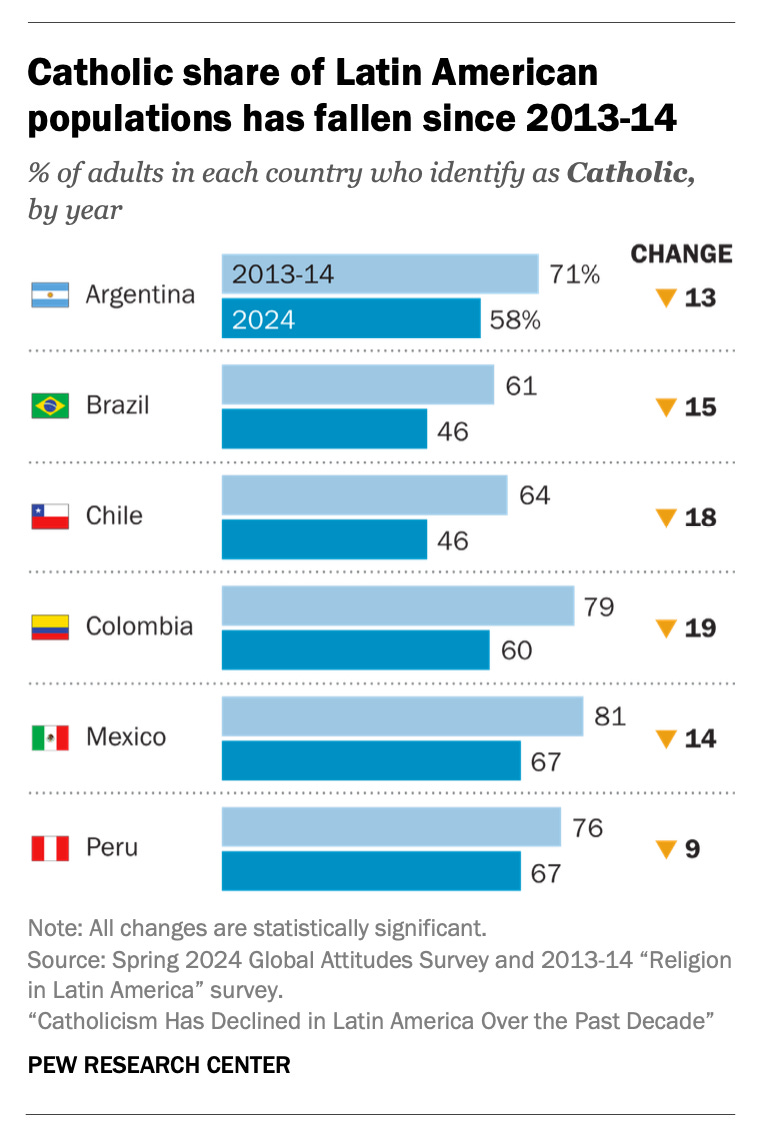
The Pew Research Center says the Catholic share of the most populous Latin American countries—Argentina, Brazil, Chile, Colombia, Mexico and Peru—has dropped by 9 points or more over the past decade, and there’s no indication the decline will end anytime soon.
Peru, for example, went from 76% Catholic in 2014 to 67% today… and that’s the best-case scenario. In Colombia, the numbers have dropped from 79% to 60% over the same time period.
Just about all of that decline can be connected to the rise in Religiously Unaffiliated people in those same nations. Peru saw an 8% increase of “Nones” over the past decade while Colombia jumped up 17%. How much of a change is this? “There are now more religiously unaffiliated adults than Protestants in Argentina, Chile, Colombia and Mexico,” say the researchers.
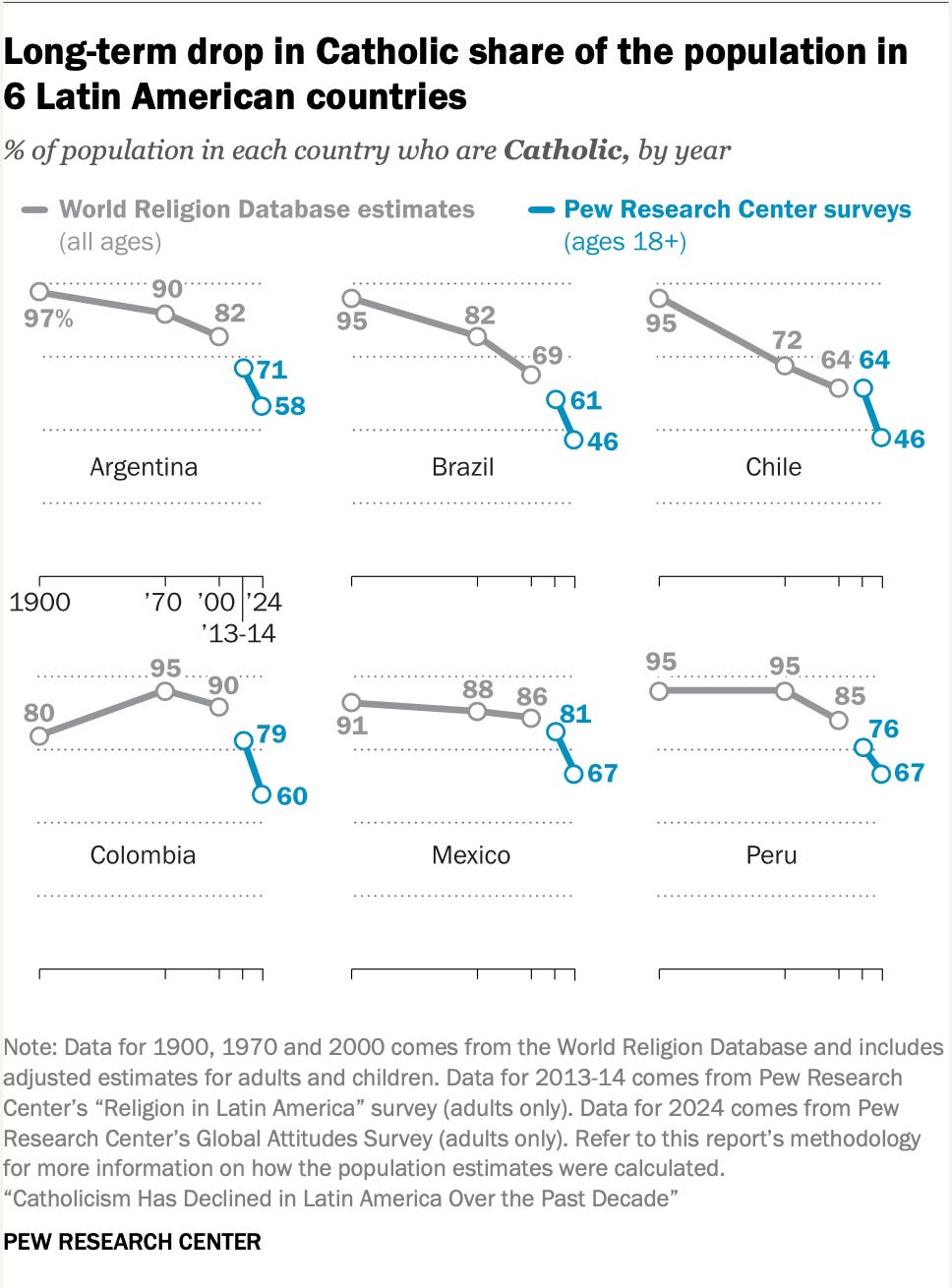
It’s all a far cry from estimates of the Catholic share from 1900 onward. Even if those earlier calculations weren’t as scientifically sound, the presumption that those countries were almost universally Catholic can no longer be made.
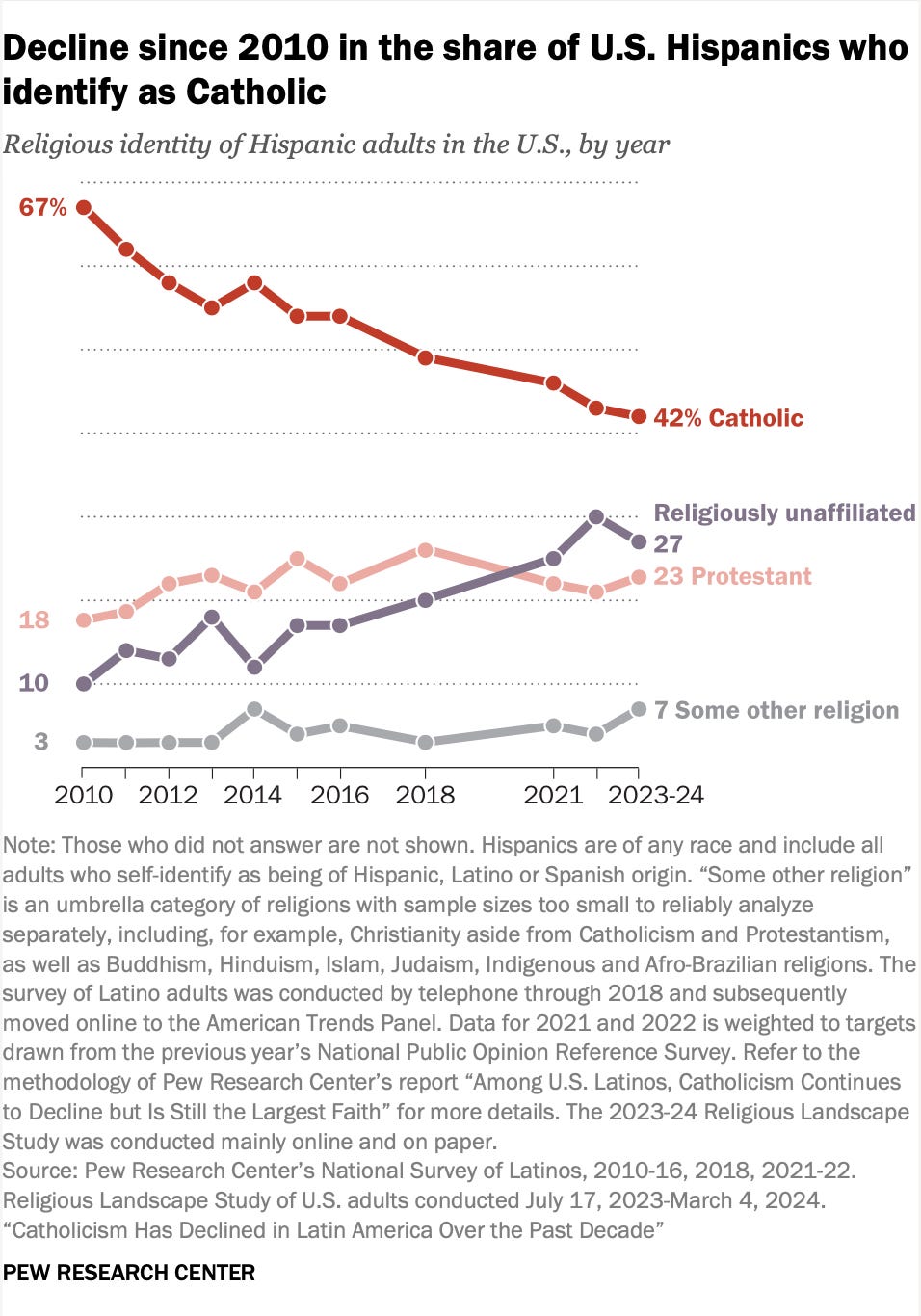
Incidentally, the decline of Catholicism in those countries has also seen parallels in the United States, where the Hispanic population has been steadily ditching Catholicism over the past decade while the Religiously Unaffiliated numbers have gone (mostly) up over the same period:
The obvious question then becomes: Why is this happening? While the answers are varied for why people might leave the religion of their childhood—sexual abuse scandals, coming to terms with reality, opposition to the Church’s anti-women and anti-LGBTQ and anti-birth control beliefs, etc.—what we can say is that the rise in Nones in Latin America is directly coming from people who are leaving Catholicism.
One reason for the decline of Catholicism and growth of religiously unaffiliated populations in Latin America is religious switching: a flow out of Catholicism by adults who were raised in the religion but no longer identify with it.
Across the six Latin American countries surveyed, around two-in-ten or more adults say they were raised Catholic but have since left Catholicism.
There is an important caveat to give here: Even though more people in these countries are becoming religiously unaffiliated, they’re not becoming atheists. In fact, the percentage of people who believe in God in those countries I mentioned earlier hover between 89% (Peru) and 98% (Brazil). They very much believe in the supernatural; they just don’t do it through the Catholic Church. That said, the survey found that the same people don’t pray regularly (76% do in Brazil but only 39% do in Argentina),
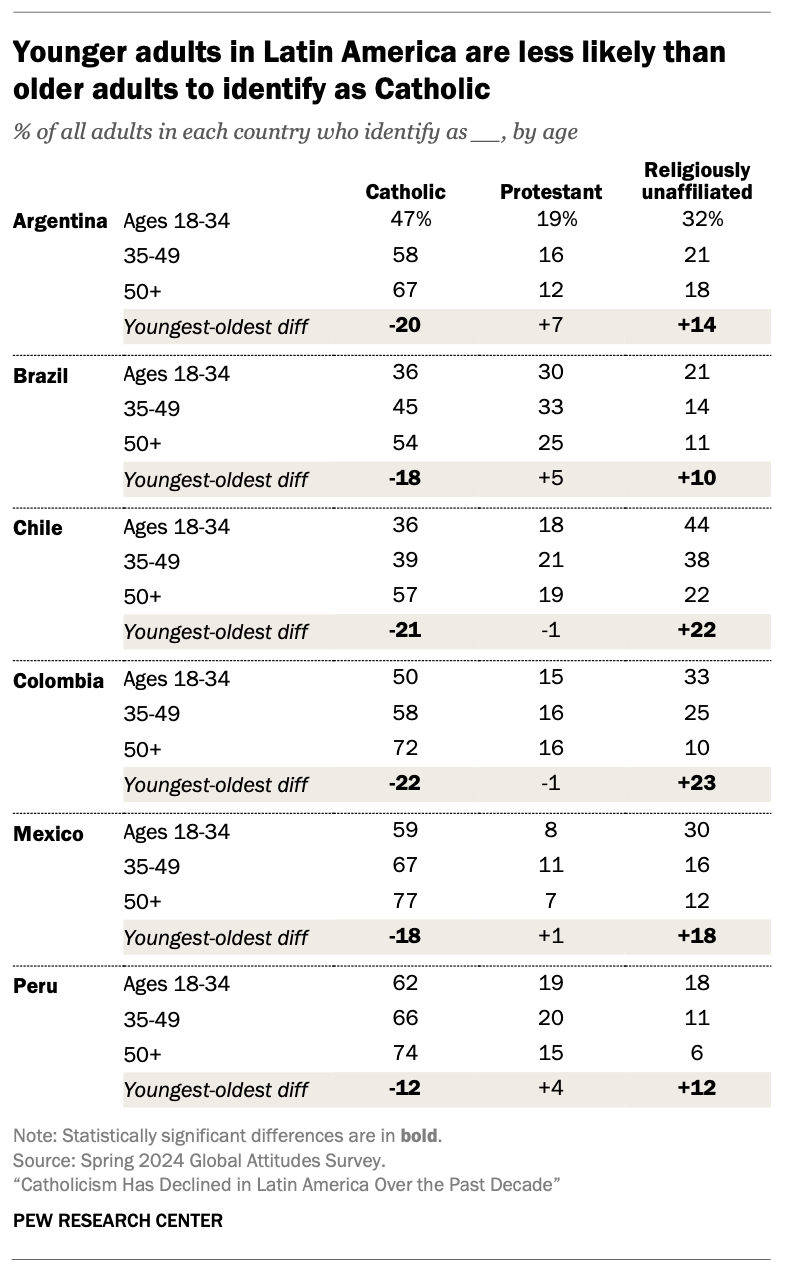
The reason I say these numbers will only decline further in coming years is because there’s a huge difference in religious affiliation when you separate the numbers by generation.
Consider Colombia: 72% of those ages 50+ are Catholic, but that number falls to 50% for adults under 35. Similarly, only 10% of people 50+ are Religiously Unaffiliated. That jumps to 33% for the youngest cohort. The trends for those who want to see Catholic dominance in those countries are only going to get worse.
None of this should be surprising especially at a time when conservative Christians in the United States have allied themselves with a Republican Party led by a demagogue who uses slurs to describe Mexican immigrants, brags about deportations, threatens to steal Venezuela’s oil, lays claim to the entire Western hemisphere, cuts USAID assistance to Latin American countries, imposes thoughtless tariffs, and bails out dictators. All of that, of course, is defended by Trump’s conservative Christian allies, all of whom seem perfectly willing to throw those nations under a bus if it means appeasing Trump and enriching themselves.
If a religion’s supposed moral clarity leads these powerful people to support someone like Trump, who’s a disaster for Latin America, then the religion is clearly broken.
In a way, these results show how a generation of Latin Americans raised under Catholicism have grown disillusioned about where it’s taken them. No wonder they don’t want to pay allegiance to it anymore. When you consider how millions of people raised in the Church are now walking away—overwhelmingly toward non-affiliation—it’s a sign of institutional failure.
If the Catholic Church refuses to do more when faced with the simplest moral questions of our time, they should only expect more people to leave them for good. These people might still believe in God, but they no longer have trust in the institutional that historically brings God to them. Hopefully that creates more room for evidence-based public policy and better human rights frameworks.
And even if nominal belief in God remains strong in those countries, the generational divide suggests the Church will keep losing its cultural relevance. Hallelujah. We can only hope the same occurs in the U.S. as religious conservatives help Republicans drag us further into a ditch.
To add some color to the statistics, a few years ago, I was speaking with a cab driver in Guatemala who confirmed that no one goes to the Catholic Church anymore because "they don't care about us". If a comment like that doesn't wake you up, nothing will.
The MAGAts worship Donald Trump. Therefore, the moral center of the Trumpetts is Donald Trump. Donald Trump, who said: "The only thing stopping me is my own morality". Since he has none, neither do any of his followers.