
This newsletter is free and goes out to over 25,000 subscribers, but it’s only able to sustain itself due to the support I receive from a small percentage of regular readers. Would you please consider becoming one of those supporters? You can subscribe via Patreon or the Subscribe button below! You can also make one-time donations through Venmo, CashApp, or PayPal.
For years now, Defense Secretary Pete Hegseth has tried to Christianize the American military, hosting Bible-based prayer services, shrinking the number of recognized religions, and tossing out the Army’s “Spiritual Fitness Guide,” which he deemed too woke.
It stands in stark contrast to our neighbors in Canada, where the military is now making sure religion doesn’t seep into any place it’s not needed.
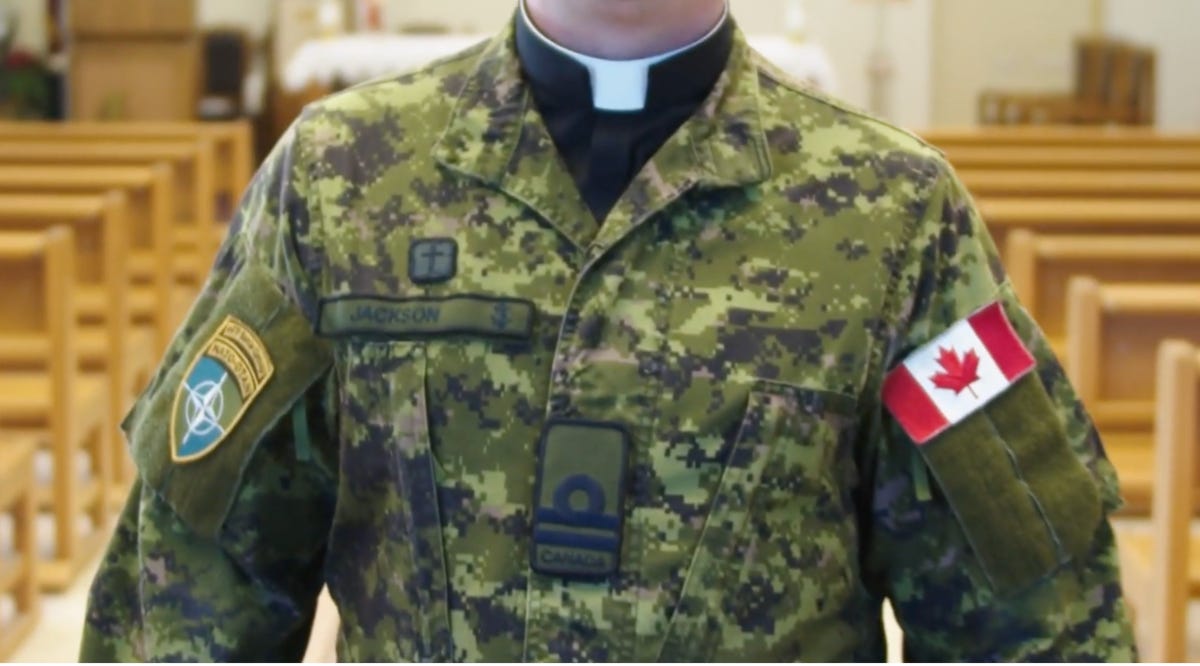
On July 29, the Canadian Armed Forces issued new guidance highlighting the importance of religious neutrality:
… The CAF recognizes the growing religious and spiritual diversity of its members, including those who do not have a specific religious belief or affiliation. The Chaplain General and chaplains are committed to care for all whether or not they have a spiritual or faith tradition (SFT).
… Under subsection 2(a) of the Charter of Rights and Freedoms (“Charter”), CAF members have freedom of religion. This includes the freedom to have no religious belief whatsoever. In addition, the CAF has a duty of religious neutrality. It cannot favour certain beliefs to the exclusion of others. The CAF must uphold and respect the Charter rights of our members and members of the public by maintaining religious and spiritual neutrality in the exercise of our public duties.
So what’s changing in order to uphold those values? In short, if any military member (including chaplains) speak at a public event in their official capacity, they may not use the opportunity to promote their personal religious/non-religious beliefs. Even at ceremonies and commemorative events, where prayers may have been requested, chaplains are now expected to only offer “a spiritual reflection” (without references to a God, for example) rather than a faith-specific prayer.
This doesn’t apply to funerals, which are supposed to honor the deceased (and their religious wishes) and are not considered “public” for the sake of these new rules. Same goes for worship gatherings, religious rites, one-on-one counseling, etc. No one’s asking chaplains to check their religion at the door. This is all about how they act when they’re outside a private setting.
Even if a military event includes Indigenous practices, those, too, must “maintain religious neutrality.”
The biggest takeaway here is that military chaplains are expected to serve everyone, not just people who share their religious views. So while they’re still able to offer specific religious care to individual service members, their public roles are meant to be universal. In those settings, “chaplains act as representatives of the [Canadian Armed Forces] rather than their own [spiritual or faith tradition],” and these updated policies are meant to allow them to “fulfill their broader mission: providing meaningful support to a diverse military community.”
The new policy supersedes a previous update from 2023. While the old policy isn’t all that different, it applied primarily to military chaplains while the new one applies to all CAF members. It also applies to all events where attendance may be expected rather than required. The older version also called for more inclusive reflections at public events while the newer policy explicitly forbids “religious specific language, including references to God.”
The whole point is that Canada is making clear that the military, just like the government, isn’t going to take a position on religion, and anyone acting as a representative of the government, like at military events. is expected to follow those rules. (Unlike the U.S. military, Canada’s military actually has a Humanist chaplain.)
When the new policy was announced, Humanist Canada and the British Columbia Humanist Association celebrated the move because it truly meant the government was looking out for everyone:
"The Canadian Armed Forces is made up of people from many spiritual/faith traditions and non-religious worldviews. This policy ensures that public military ceremonies allow every member to participate," said Janalee Morris, Executive Director, Humanist Canada. "These moves by the Canadian Armed Forces show the steps they are taking to reflect the diversity of Canadian service members."
…
"Canada is a diverse and secular country," said Ian Bushfield, Executive Director, BC Humanist Association. "The state's duty of religious neutrality is well established by the courts, and we appreciate institutions proactively taking steps to update their practices."
Naturally, conservative Christians are not happy about any of this, because they expect their religion to be treated as a default setting anywhere they go. Headlines about the change on conservative websites include phrases like “prayer ban” while some articles quote people who can’t understand the concept of acknowledging people outside their religious bubble.
“This policy goes beyond banning prayer and prohibits even the acknowledgment to those gathered that some may believe in the divine and others not,” said Bruce Clemenger, president emeritus of the Evangelical Fellowship of Canada (EFC) and a member of the Interfaith Committee for Canadian Military Chaplaincy. “This exclusion restricts the spiritual reflection of chaplains to a secularist and characteristically humanist expression.”
That’s bullshit, of course. No one’s banning prayer; the policy just asks that everyone (including chaplains) bears in mind that when they’re speaking at public events, there are people in the crowd who don’t share their views, and they’re expected to be inclusive of everyone. It’s not that hard to share your beliefs without invoking your specific mythology, and if you’re unable to do it, it’s because you’re bad at your job.
Conservative politician James Bezan also whined about the new policy, saying that inclusion was somehow anti-Christian:
… Instead of being inclusive, this Liberal government has excluded military members of faith and sent a message that they are no longer welcome in the Canadian Armed Forces.
This is yet another attack by the Liberals on freedom of religion and expression which are guaranteed under the Canadian Charter of Rights and Freedoms.
The Canadian Armed Forces should not be used as a testing ground for woke Liberal social experiments. Our military must remain an institution where every member, regardless of religious background, knows they are respected, valued, and welcome.
You know he has no argument because he tossed the word “woke” in there.
In any case, it takes a level of Christian arrogance to see a policy calling for neutrality and jump to the conclusion that it’s a personal attack on your faith. It’s the sort of broken brain thinking that says “My religion is the only one that matters, and if I don’t get to trash everyone else’s beliefs everywhere I go, it’s deeply unfair to me.”
It’s also worth remembering that Christian chaplains and service members are still allowed to express their faith in private settings without a problem. No one’s stopping them. There’s even a Bible verse about this. They’ll be okay if they don’t get to spew their religious rhetoric in public spaces.
None of these people are mourning the death of religious freedom because they’re not actually losing that. They’re whining about the loss of religious privilege. They’re so damn angry that Christianity is no longer being treated as the universal religion for the Canadian Armed Forced and that they can’t impose those beliefs on captive audiences.
The military is where these kinds of boundaries matter most. In a place where people are often ordered to be somewhere and expected to obey their superiors, there’s no easy way to escape unwanted Christian services—especially those inadvertently sanctioned by the government. It’s about time Canada recognized the coercive element of what was happening and moved to fix it.
Again: Christian service members (and chaplains!) can remain Christian. The same applies to Muslims, Jewish people, Sikhs, and atheists. When service members want to speak to someone from their faith, they can rest assured they’ll get help in that context, with their preferred language and rituals. The only change here is that religious zealots won’t get to use official government platforms to elevate their beliefs over everyone else’s.
Canada’s approach here should be the bare minimum for any modern, pluralistic military. When you ask people of all faiths and no religious faith to serve, the least you can do is make sure public events are welcoming to everyone. Chaplains who can’t speak to everyone are merely proving they don’t have the skills required to serve a diverse force.
If only the United States would follow Canada’s lead. Instead, Pete Hegseth is dragging our military in the opposite direction, treating it like a taxpayer-funded mission field for his version of batshit crazy, Doug Wilson-inspired Christianity. It’s a dangerous precedent for the country, especially when we claim to fight for religious freedom around the world.
OT: My bride and I are going on a cruise in a week or two through the Alaskan Inner Passage (fortuitous that our travel plans are a cruise given her broken foot and attendant knee scooter) and we end up in Vancouver where we will spend a couple of days. I’m going to wear my “Dear Canada We Hate Him Too” t-shirt.
𝐶𝐴𝐹 𝑚𝑒𝑚𝑏𝑒𝑟𝑠 ℎ𝑎𝑣𝑒 𝑓𝑟𝑒𝑒𝑑𝑜𝑚 𝑜𝑓 𝑟𝑒𝑙𝑖𝑔𝑖𝑜𝑛. 𝑇ℎ𝑖𝑠 𝑖𝑛𝑐𝑙𝑢𝑑𝑒𝑠 𝑡ℎ𝑒 𝑓𝑟𝑒𝑒𝑑𝑜𝑚 𝑡𝑜 ℎ𝑎𝑣𝑒 𝑛𝑜 𝑟𝑒𝑙𝑖𝑔𝑖𝑜𝑢𝑠 𝑏𝑒𝑙𝑖𝑒𝑓 𝑤ℎ𝑎𝑡𝑠𝑜𝑒𝑣𝑒𝑟. 𝐼𝑛 𝑎𝑑𝑑𝑖𝑡𝑖𝑜𝑛, 𝑡ℎ𝑒 𝐶𝐴𝐹 ℎ𝑎𝑠 𝑎 𝑑𝑢𝑡𝑦 𝑜𝑓 𝑟𝑒𝑙𝑖𝑔𝑖𝑜𝑢𝑠 𝑛𝑒𝑢𝑡𝑟𝑎𝑙𝑖𝑡𝑦. 𝐼𝑡 𝑐𝑎𝑛𝑛𝑜𝑡 𝑓𝑎𝑣𝑜𝑢𝑟 𝑐𝑒𝑟𝑡𝑎𝑖𝑛 𝑏𝑒𝑙𝑖𝑒𝑓𝑠 𝑡𝑜 𝑡ℎ𝑒 𝑒𝑥𝑐𝑙𝑢𝑠𝑖𝑜𝑛 𝑜𝑓 𝑜𝑡ℎ𝑒𝑟𝑠.
Hey MAGA! THIS is what religious freedom looks like. This is what separation of church and state means. This is what secular actually is. Secular does not mean atheist. It does not meam anti-Christian or anti-religion.
I am getting real tired of all these far right crazies screaming persecution when they are just being told that they have to follow the same rules as everyone else.