
This newsletter is free and goes out to over 23,000 subscribers, but it’s only able to sustain itself due to the support I receive from a small percentage of regular readers. Would you please consider becoming one of those supporters? You can use the button below to subscribe or use my usual Patreon page!
Two Florida Republicans have introduced a bill that would prevent public school teachers from punishing students for expressing their religious beliefs on an assignment.
You may as well call it the Samantha Fulnecky Act.
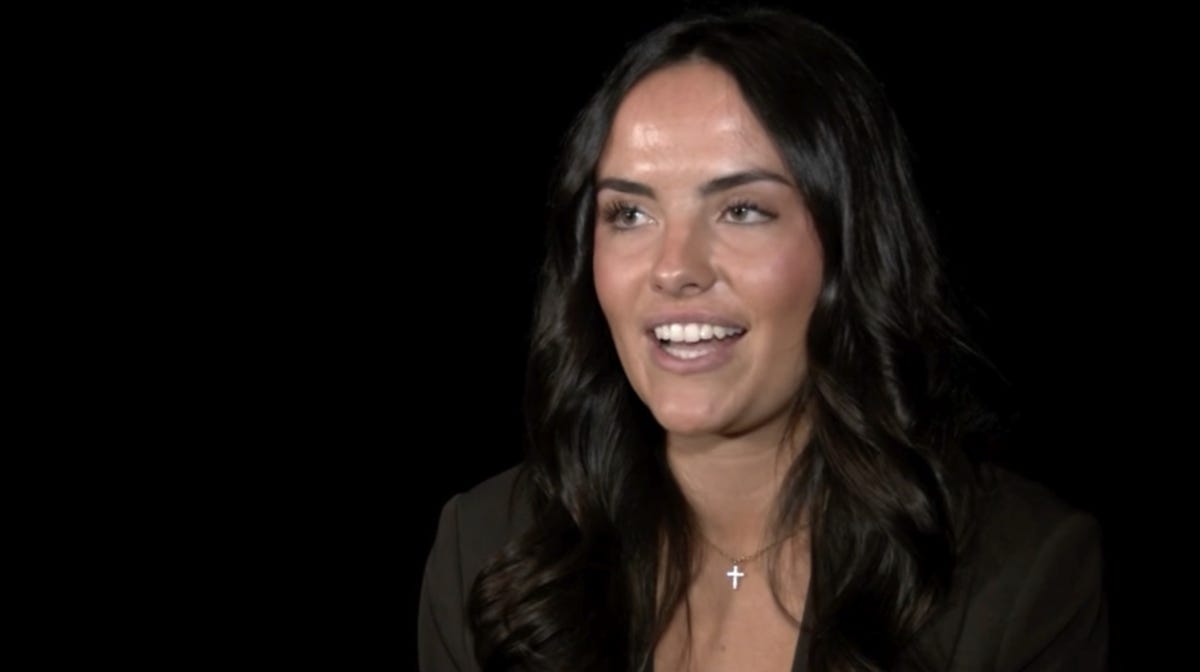
Over the past few weeks, conservatives have been up in arms over the fact that Fulnecky, a junior at the University of Oklahoma, received a 0% on an assignment in which she was supposed to write a response to a scholarly journal article. Instead of grappling with anything it said—the assignment’s rubric was loose enough that students could have talked about damn near anything connected to the article as long as they actually discussed what it said—Fulnecky turned in a four-page sermon that lashed out against transgender people, promoted traditional gender roles, and suggested that bullying kids was sometimes warranted.
The university has since responded by rescinding the bad grade from Fulnecky’s record and banning the graduate student who taught the class from teaching on campus. (I’ve discussed in depth why all of this is ridiculous.)
Now, these Florida lawmakers want to capitalize on the right-wing outrage with a bill that would guarantee that situation never happens in Florida… even though the bill does no such thing.
Florida currently has a law on the books involving “religious expression in public schools.” Among other things, it says school districts are prohibited from discriminating against students who express their religious views on assignments.
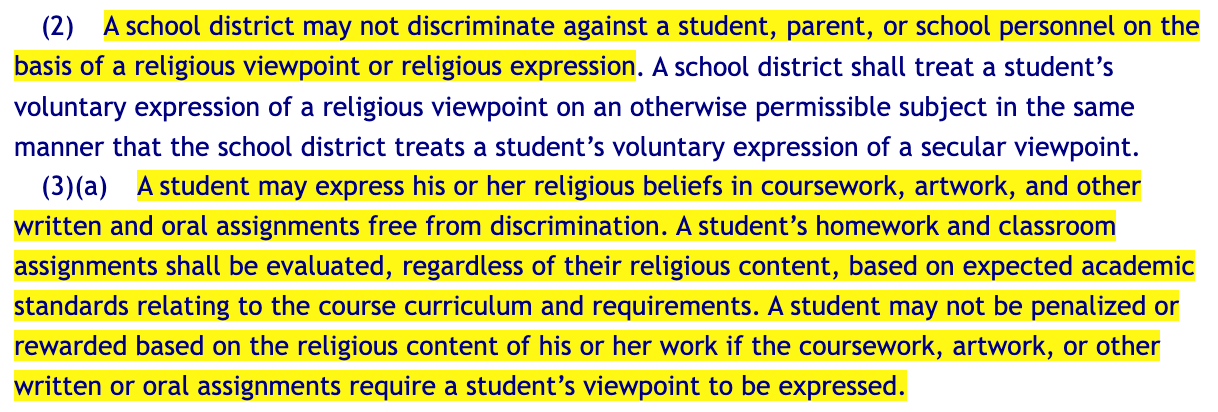
A school district may not discriminate against a student, parent, or school personnel on the basis of a religious viewpoint or religious expression. A school district shall treat a student’s voluntary expression of a religious viewpoint on an otherwise permissible subject in the same manner that the school district treats a student’s voluntary expression of a secular viewpoint.
A student may express his or her religious beliefs in coursework, artwork, and other written and oral assignments free from discrimination. A student’s homework and classroom assignments shall be evaluated, regardless of their religious content, based on expected academic standards relating to the course curriculum and requirements. A student may not be penalized or rewarded based on the religious content of his or her work if the coursework, artwork, or other written or oral assignments require a student’s viewpoint to be expressed.
All of that is a nothing-burger because no one was ever punishing students for expressing their views, religious or otherwise, on assignments where they were asked to talk about their views. But that’s the Republican Party for you: They always have solutions to problems that only exist in their imaginations.
But in recent weeks, State Sen. Clay Yarborough and State Rep. David Borrero have filed the “Florida Student and School Personnel First Amendment and Religious Liberties Act” (SB 1006 and HB 835, respectively) to modify that law to be even more specific about their persecution fantasies.
The relevant section of their bill would change the above law in the following ways (changes emphasized by me):
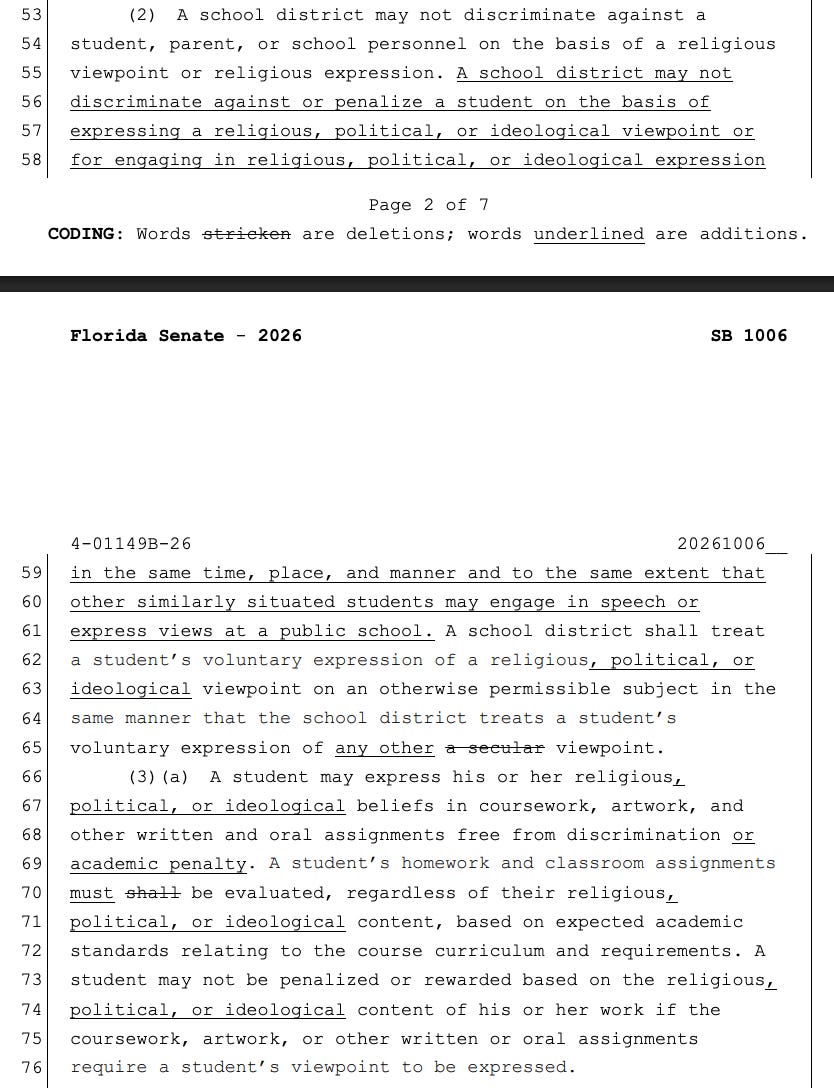
A school district may not discriminate against a student, parent, or school personnel on the basis of a religious viewpoint or religious expression. A school district may not discriminate against or penalize a student on the basis of expressing a religious, political, or ideological viewpoint or for engaging in religious, political, or ideological expression in the same time, place, and manner and to the same extent that other similarly situated students may engage in speech or express views at a public school. A school district shall treat a student’s voluntary expression of a religious, political, or ideological viewpoint on an otherwise permissible subject in the same manner that the school district treats a student’s voluntary expression of any other viewpoint.
A student may express his or her religious, political, or ideological beliefs in coursework, artwork, and other written and oral assignments free from discrimination or academic penalty. A student’s homework and classroom assignments must be evaluated, regardless of their religious, political, or ideological content, based on expected academic standards relating to the course curriculum and requirements. A student may not be penalized or rewarded based on the religious, political, or ideological content of his or her work if the coursework, artwork, or other written or oral assignments require a student’s viewpoint to be expressed.
In short, it extends the ban on religious discrimination to political and ideological discrimination—which is fine since that wasn’t happening either—while specifically saying expressing those views cannot lead to an “academic penalty.”
That’s the Fulnecky factor.
But if the goal was to prevent what happened to her from happening in Florida, this bill will fail since, as critics have been saying for weeks now, Fulnecky wasn’t punished for expressing her religious views.
She earned a 0% because she didn’t do the damn assignment.
Fulnecky showed no evidence of responding to anything written in the paper she was supposed to read. Even though her beliefs were odious, graduate student Mel Curth, a trans person who was teaching this course, told her the beliefs themselves played no role in her grade. Instead, her score was a 0% because the paper “does not answer the questions for this assignment, contradicts itself, heavily uses personal ideology over empirical evidence in a scientific class, and is at times offensive.”
Curth even said: “If you personally disagree with the findings, then by all means share your criticisms, but make sure to do so in a way that is appropriate and using the methodology of empirical psychology, as aligned with the learning goals in this class.”
You can argue Curth should have left “offensive” off the list of problems with the paper, but that wasn’t the basis for the grade. That was more like life advice. Fulnecky failed because she didn’t do the work. She even freely admitted she just whipped out a response in order to get it done so she could go out with her friends. She appeared to read the title of the journal article, figured she already had opinions about transgender people, and ran with it. That wasn’t the assignment.
So here’s the big question: If Fulnecky turned in the same paper in a Florida school, would this new bill prevent her from getting a 0%?
Not a chance. Because, again, the problem was that she didn’t do the assignment, not that she invoked her religious beliefs. I promise you conservative Christians are not being persecuted in states like Oklahoma and Florida. Fulnecky failed because she couldn’t handle the coursework, and then she un-failed because she’s a conservative Christian who knows how to manipulate right-wing propaganda networks.
This bill wouldn’t change a damn thing because ideological, political, and religious discrimination are still unacceptable in schools—and that’s how it should be. But leave it to Republicans to pretend they’re fixing a problem.
The bill also says students (like Fulnecky) who believe they’re harmed by a violation of this new law could file a lawsuit, and if they win, they would be guaranteed to receive statutory punitive damages worth anywhere from $15,000 to $25,000. Which means accusations of discrimination will fly all over the place regardless of substance.
It led the Freedom From Religion Foundation’s Action Fund to release this statement yesterday:
“This bill sends a dangerous message to teachers,” says FFRF Action Fund Regional Government Affairs Manager Mickey Dollens, who has worked as a public school teacher. “It implies that ordinary academic standards, such as relevance, accuracy and critical analysis, must take a back seat when a student invokes religion or ideology. That undermines educational integrity and opens the door to religious favoritism.”
For what it’s worth, I asked both Yarborough and Borrero a few days ago if they had examples of students being discriminated against in schools due to their ideology, and if this bill was meant to respond to Fulnecky’s situation. They didn’t respond to me.
But you can expect more bills like this in the future. Anything to protect conservative Christians from the consequences of their own incompetence.
This is what happens when one political party is dedicated to weaponizing grievance instead of governing responsibly. The bill is built on the lie that students are being punished for their beliefs when the record shows, plainly and repeatedly, that Fulnecky was penalized for refusing to meet basic academic standards. By recasting her failure to do the work as religious persecution, these legislators are just playing into her victimhood mentality. The Riley Gaines Disease is spreading.
I’m not worried that this bill will suddenly force teachers to give passing grades to bad work that has Jesus written all over it. Rather, the harm lies in the message it sends and the incentives it creates. It tells students that they can submit low-effort slop as long as they cloak their laziness in ideology. It tells educators that enforcing basic standards comes with a risk if a bad student decides to cry discrimination. It also tells the public that public schools and universities are hostile territory for conservative Christians, even though that’s not the case at all. Free expression in school was never under attack in any serious way. These Republicans just want to intimidate educators, erode trust in public education, and tell their conservative voter base that their persecution fantasies are legitimate.
It’s an invitation to bad-faith claims of discrimination that could make life harder for instructors while exhausting school districts into submission. If you flood the zone with enough noise and fear, teachers may hesitate before holding students accountable.
Fulnecky’s story was exaggerated because it had to be. The narrative collapses without her lies. And even if this particular bill accomplishes little in practice, it still advances the culture war battle against public schools. That’s what this is all about.
Just wait until a non-Christian/nonbelieveing student decides to pull a Fulnecky. Will Florida give them the same protections?
(Who am I kidding?)
This is all part of the Fake Victim narrative. If the student had completed the assignment, including reference to her view that transitioning is an abomination, I trust that that final remark would have been ignored, as irrelevant, and the remainder graded on its merits or lack of them.
However, I remain convinced that this whole thing was a planned setup, and that the choice of a trans instructor was premeditated