
This newsletter is free and goes out to over 24,000 subscribers, but it’s only able to sustain itself due to the support I receive from a small percentage of regular readers. Would you please consider becoming one of those supporters? You can subscribe via Patreon or the Subscribe button below! You can also make one-time donations through Venmo or PayPal.
Are young men turning to religion more than ever before? That’s what recent headlines suggest:


Fox News even put together this graphic to mark the news:
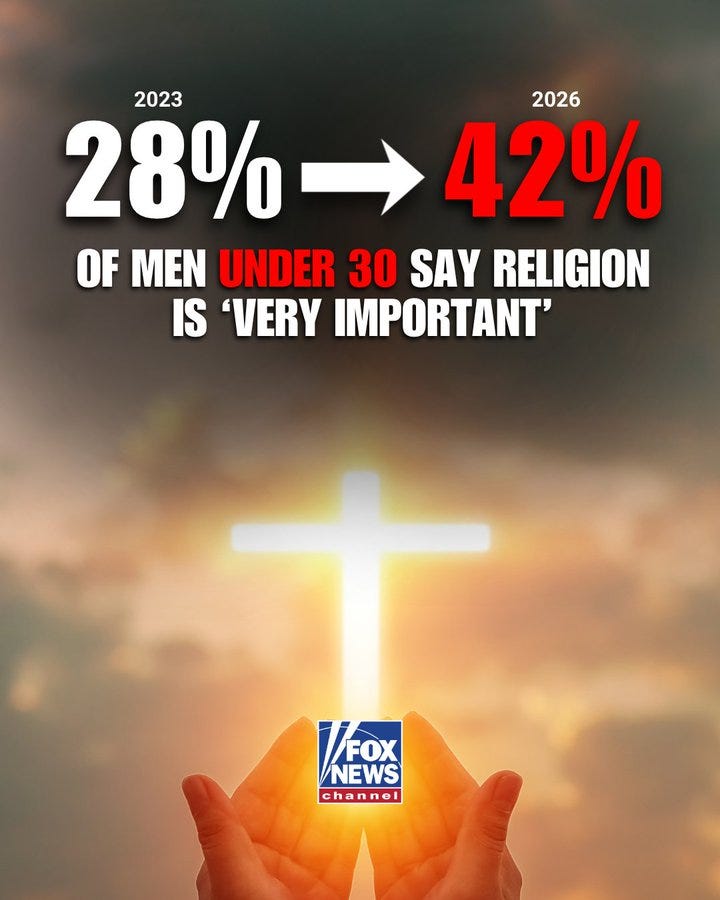
They’re basing those off of a recent Gallup poll that found men 18-29 are much more likely than before—and, surprisingly, much more likely than women—to say religion is important in their lives. This doesn’t just defy the overall trend of the past two decades, it defies numbers from the past two years:
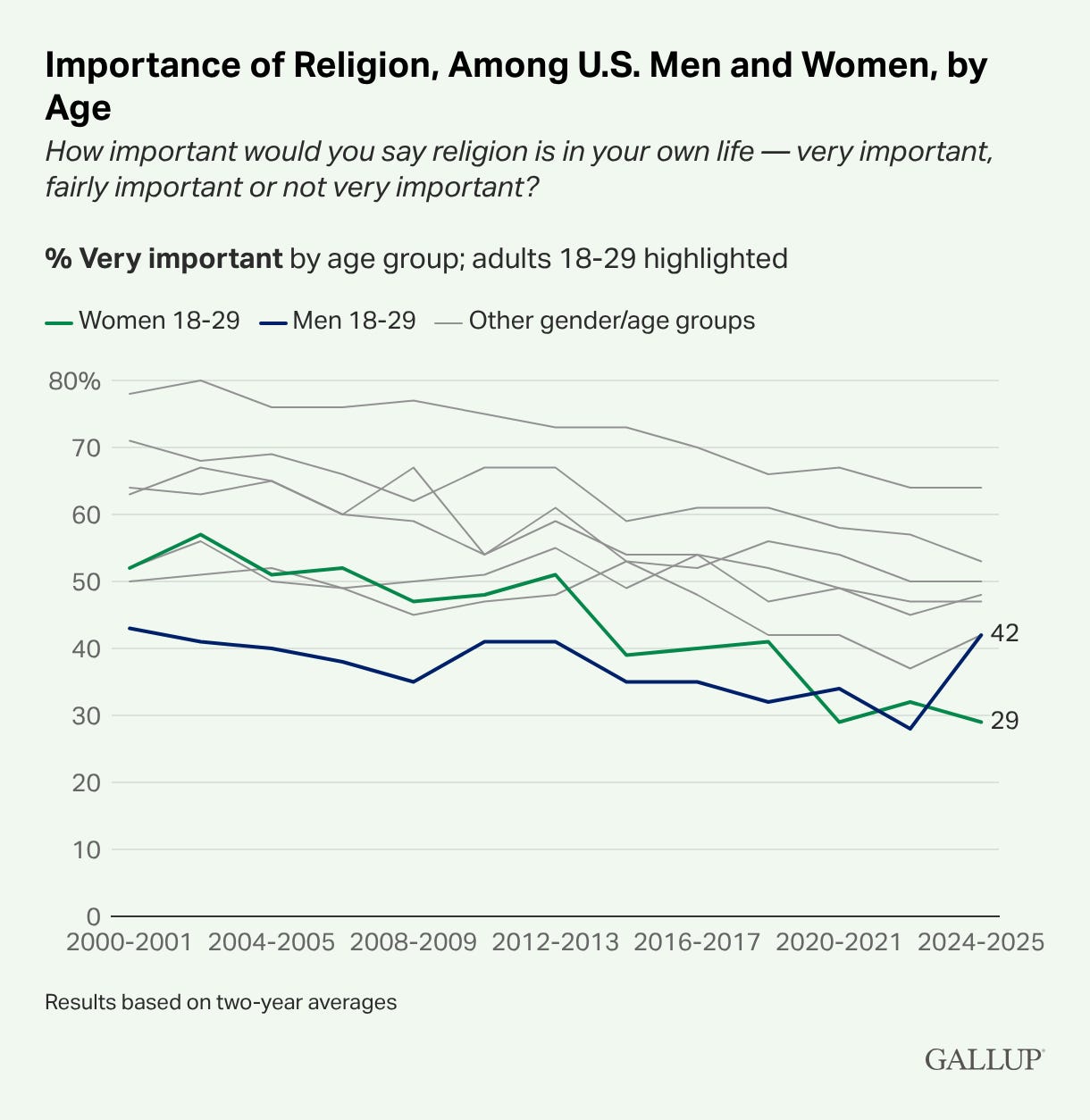
Driven by a recent increase, young men in the U.S. have now surpassed young women in saying religion is “very important” in their lives. Gallup’s latest data, from 2024-2025, show 42% of young men saying religion is very important to them, up sharply from 28% in 2022-2023. By contrast, during this period, young women’s attachment to religion has held steady at about 30%.
Although young men had previously tied young women on this key marker of religiosity, young men now lead by a statistically significant margin.
42% is a shockingly high number. We haven’t seen it among young men since the turn of the century. It suggests that the grip on young men we’ve seen by the Republican Party and conservative podcasters and the “manosphere” is now being shared by religious leaders too. It suggests young men are desperate to follow any older white guy who speaks with authority and tells them the secrets of how to control the women in their lives.
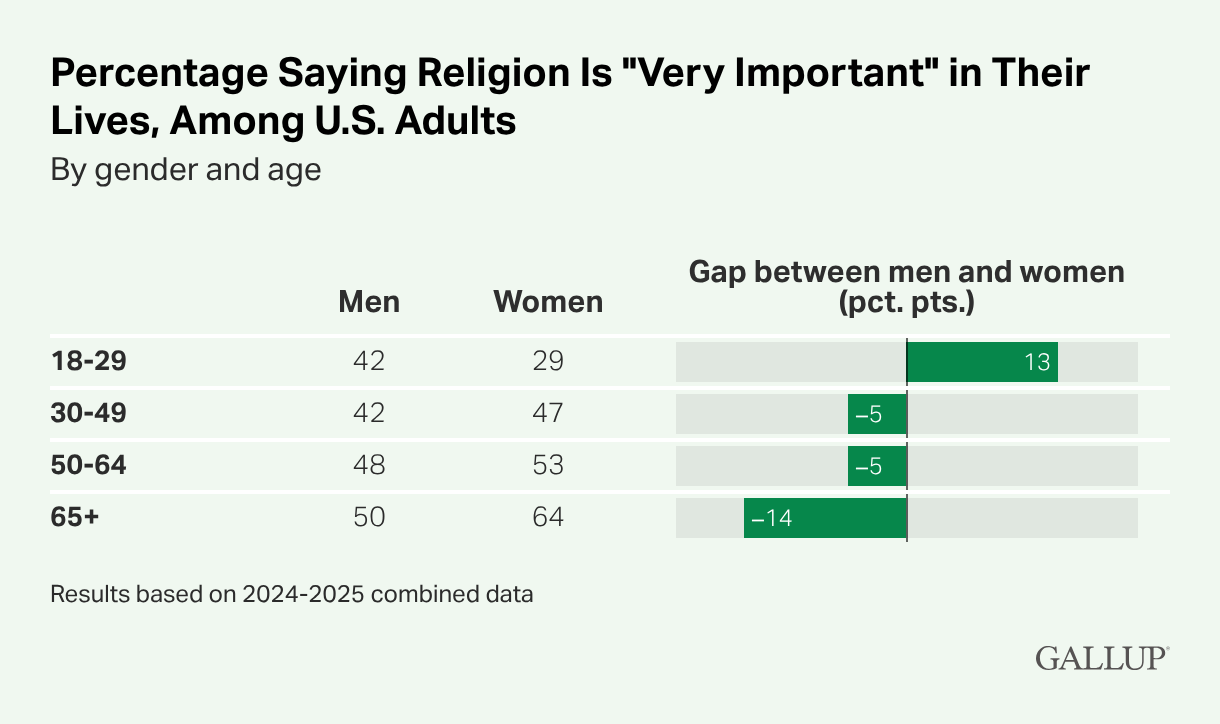
It’s all the more shocking when you realize the same number for women in that age group is pretty much as low as it’s ever been, at 29%.
That 13-point difference between young men and women is even more jarring when you realize there’s a 27-point swing among Americans 65 and older. In that group, women (64%) are far more likely than men (50%) to say religion is important in their lives.
The same article from Gallup says that religious attendance (at least once a month) among men and women ages 18-29 has also gone up in recent years to 40% for young men and 39% for young women—all while religious attendance numbers for older Americans continue going downward.
Here’s what’s not surprising: The rise in religious attendance is much higher among young Republicans than Democrats. That only affirms that the link between religion and politics on the right is as strong as ever.
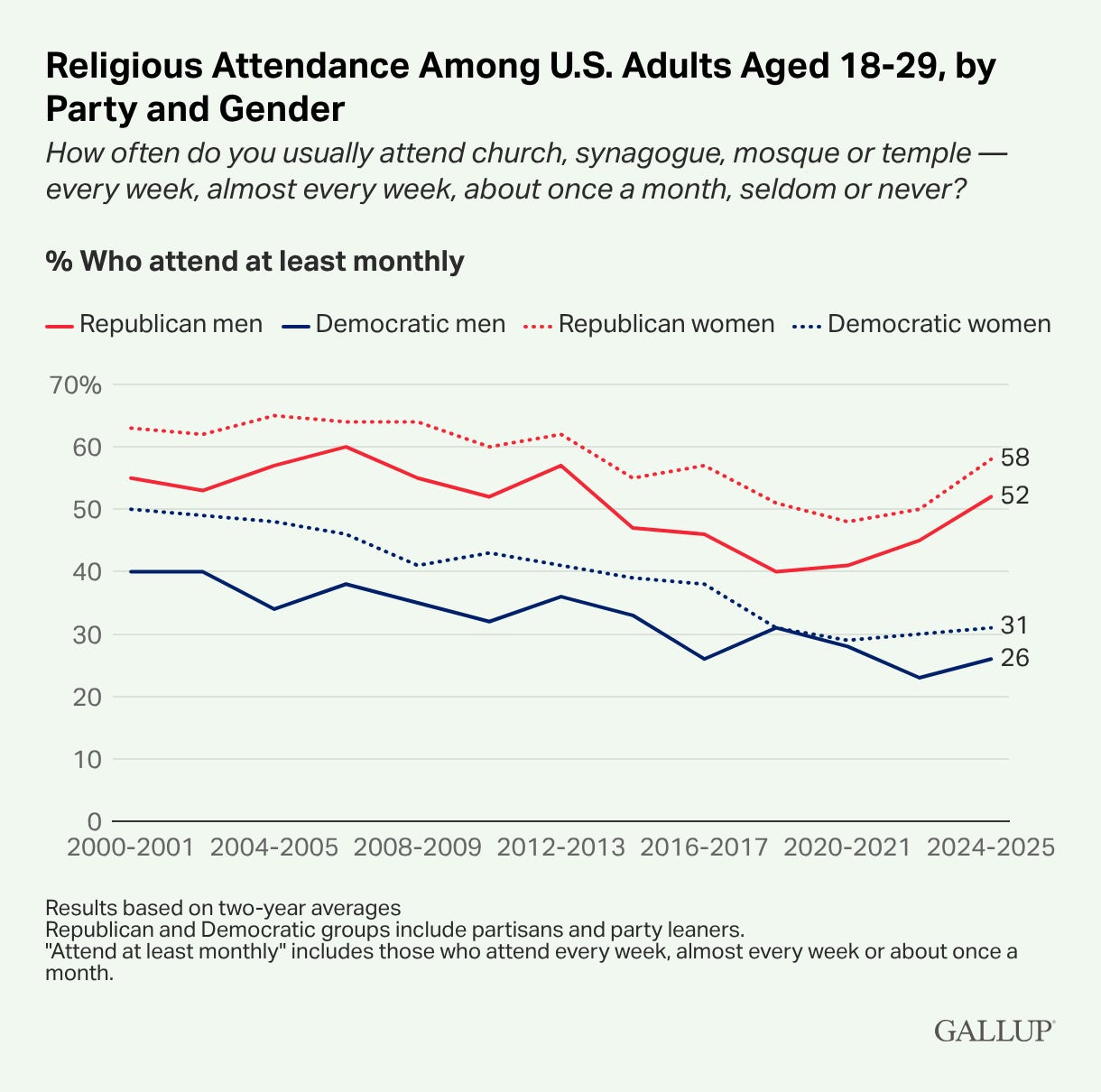
BUT. There are some big caveats to all of this.
The first involves the question about importance of religion. Gallup’s margins of error for young men and women are huge—7% and 10%, respectively. Simply put, they’re not getting those numbers from a large sample size, so take them with a huge grain of salt.
The 2024-2025 results for importance of religion are based on 4,015 U.S. adults, including 295 men aged 18-29 and 145 women aged 18-29. The margins of errors for these gender subgroups are ±7 and ±10 percentage points, respectively.
(By comparison, the error margins for the other questions are under 5%.)
Another concern is that other surveys haven’t seen the same results. As the Washington Post notes, “A December report by Pew Research Center found few shifts in church attendance or other measures of religiosity among young adults in recent years.”
PRRI, another polling group, hasn’t seen those results in their data, either. They say we’re focusing on the wrong takeaway entirely: The real story is that young women are leaving religion, not that young men are becoming religious.
“Looking at young adults, there is a shift happening, but it’s not among Gen Z men, as some suggest. Instead, young women’s declining religiosity has brought them on par with their male counterparts,” said Melissa Deckman, CEO of PRRI.
Unless and until we see the Gallup results replicated in other surveys, there’s no reason to run with their numbers just yet.
But let’s say you assume the numbers are accurate. If I were a church leader, I wouldn’t be celebrating the future just yet. If you believe that religion, politics, and overall cultural trends are all intertwined, and that’s why young men are becoming more religious, then what happens when those same men begin to turn away from Trump and the embarrassments in his orbit?
In 2024, young men (under 25) supported Trump over Kamala Harris by 5 points. That number has dropped by 25 points; his net approval is -19% among young men today. If they’re turning away from Trump, they’re likely to turn away from the people who support him as well as the institutions that prop him up despite all the evidence that Trump is a disaster for the country.
To put it another way, anyone getting excited about the rise of religion among young men should wait a year or two to see how these numbers look as Trumpism (hopefully) fades out.
And why would anyone get excited about the sort of young men who are supposedly being drawn to church these days due to conservative politics? If you’re drawn to faith because you believe in the tripe spread by Doug Wilson, Pete Hegseth, JD Vance, the ghost of Charlie Kirk, or any of the other wannabe alpha males who hog the spotlight, then the religion you’re allegedly attracted to isn’t one that makes the world a better place. It’s one that’s infested with misogyny, cruelty, and racism. It’s not like they’re joining church because they want to help the poor. And if women are leaving those same spaces, it won’t be long before those men follow.
Finally, consider the wording of the question: “How important would you say religion is in your own life”? Religion is extremely important in my own life because I fight against it. I’m not sure others would interpret it the same way, but the attendance numbers feel like a better proxy for what people are doing, not a question about the importance of faith, which sounds like something you should agree with.
In any case, this is why I think the merging of cultural religion and politics will eventually backfire on conservatives. Trump and his allies aren’t just pushing people away from the Republican Party right now; they’re dragging down everyone associated with them, including right-wing lobbying groups like AIPAC and right-wing churches whose pastors lack the courage to speak out against Republican-fueled atrocities.
I don’t say this often, but our society would be so much better off if young men were listening to the pope.
A jump from 28% to 42% in THREE YEARS? That should raise the suspicion of any statistician worth their salt. I would wonder both about the sample size AND the demographic being sampled.
Something is seriously rotten in those numbers, and further research and investigation is clearly warranted.
I am highly skeptical of this claim. Polling is notoriously unreliable and has been for some time.