
This newsletter is free and goes out to over 23,000 subscribers, but it’s only able to sustain itself due to the support I receive from a small percentage of regular readers. Would you please consider becoming one of those supporters? You can use the button below to subscribe or use my usual Patreon page!
The Congressional Freethought Caucus has added another two members: Rep. Ami Bera (D-CA) and Rep. Herb Conaway (D-NJ):
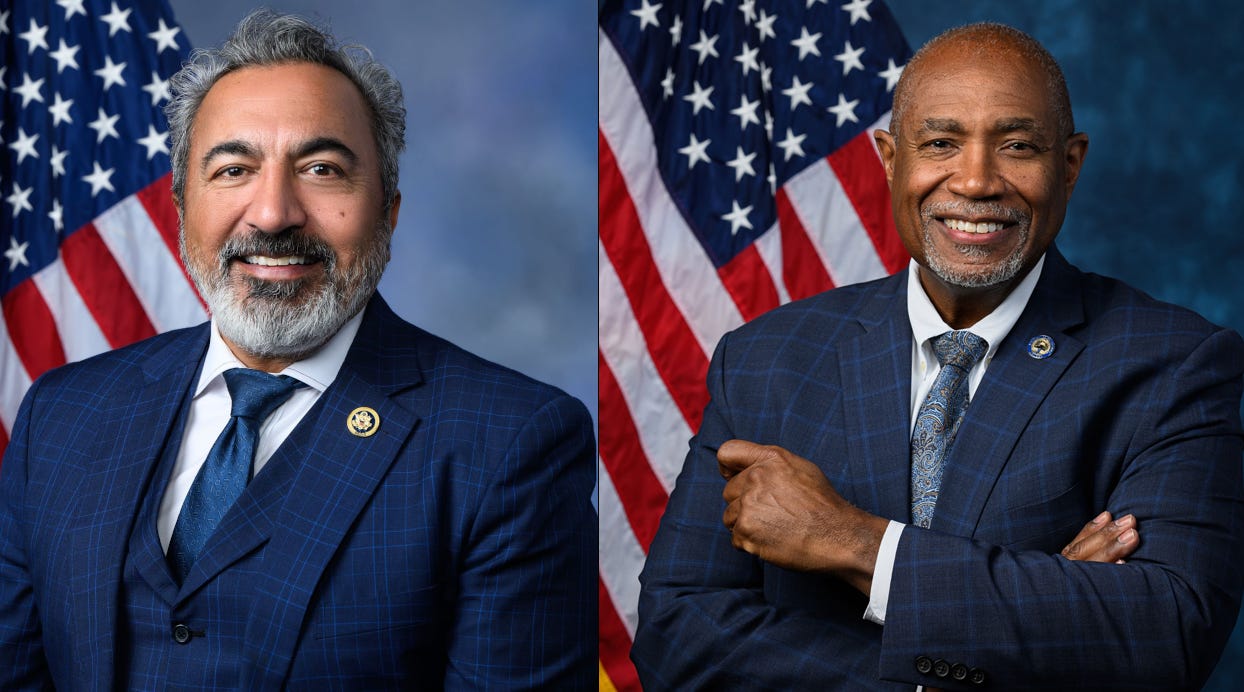
Bera is a physician who first entered Congress in 2013 as one of the few Indian-Americans on Capitol Hill without prior legislative experience. Conaway served in the New Jersey General Assembly from 1998 to 2025. He ran for Congress to replace Andy Kim, who had just become a senator. Conaway is the Vice Ranking Member on the Committee on Veterans' Affairs and the only member of Congress to graduate from both medical school and law school.
Like most of their colleagues in the CFC, Bera and Conaway are not explicitly non-religious. The Pew Research Center, in their 2025 roundup, listed Bera as a Unitarian Universalist, though Conaway responded to the religion question with “Don't know/refused.” Either way, they support church/state separation and pledge to protect freedom of religion for everyone (including the non-religious).
The caucus now includes 34 members, all of whom are Democrats. As of this writing, neither Bera nor Conaway has made any public announcements about their CFC affiliation. The American Humanist Association was first to break the news of their membership.
In case you need a refresher, the CFC was first announced in 2018 by Rep. Jared Huffman, currently the only openly Humanist member of Congress.
The 34 members now include:
Rep. Jared Huffman (D-CA) (Co-cha)
Rep. Jamie Raskin (D-MD) (Co-chair)
Rep. Mark Pocan (D-WI)
Rep. Rashida Tlaib (D-MI)
Rep. Pramila Jayapal (D-WA)
Rep. Steve Cohen (D-TN)
Rep. Hank Johnson (D-GA)
Rep. Zoe Lofgren (D-CA)
Rep. Sean Casten (D-IL)
Del. Eleanor Holmes Norton (D-D.C.)
Rep. Don Beyer (D-VA)
Rep. Jimmy Gomez (D-CA)
Rep. Julia Brownley (D-CA)
Rep. Kevin Mullin (D-CA)
Rep. Jan Schakowsky (D-IL)
Rep. Greg Casar (D-TX)
Rep. Robert Garcia (D-CA)
Rep. Maxwell Frost (D-FL)
Rep. Becca Balint (D-VT)
Rep. Eric Swalwell (D-CA)
Rep. Lizzie Fletcher (D-TX)
Rep. Laura Friedman (D-CA)
Rep. Andrea Salinas (D-OR)
Rep. Emily Randall (D-WA)
Rep. Yassamin Ansari (D-AZ)
Rep. Jerry Nadler (D-NY)
Rep. Judy Chu (D-CA)
Rep. Delia Ramirez (D-IL)
Rep. Suzanne Bonamici (D-OR)
Rep. Chris Deluzio (D-PA)
Rep. Kelly Morrison (D-MN)
Rep. Sarah McBride (D-DE)
Rep. Ami Bera (D-CA)
Rep. Herb Conaway (D-NJ)
To be clear, this isn’t an “atheist club” for Congress, as some critics have suggested. This is just a group of lawmakers dedicated to promoting reason-based public policy, keeping church and state separate, opposing discrimination against non-religious people, and championing freedom of thought around the world. There’s really no reason anyone should be against this. That’s why there’s nothing hypocritical about the fact that nearly every member of the Caucus is religious.
The hope is that the membership continues growing—making the Caucus more influential—while the stigma of being an atheist (or even being associated with non-religiosity) decreases across the country. Those two things are more closely linked than we might imagine. Keep in mind that the Congressional Prayer Caucus, which typically promotes a version of conservative Christianity, is much larger and has members from both major parties. By that metric, the Freethought Caucus has a long way to go.
As I’ve said before, perhaps the most shocking thing about the Caucus is that, based on the relative lack of media interest, people don’t seem to care who the members are… which is to say, no one—not even in right-wing media—thinks it’s a big deal for sitting House members to align with a group defending atheists.
That also means none of these lawmakers believes the Caucus will be a concern for them during the second Trump administration. That may come as a shock to anyone who remembers a time when aligning (even remotely) with atheism was considered one of the biggest taboos in politics.
(Portions of this article were published earlier)
As always, it's great news to hear that more Congresspeople are joining the Congressional Freethought Caucus, even if there isn't a single Republican who can see their way clear to endorsing the idea of the separation of State and Church. What I think we need to do now is mobilize the Caucus to start calling out Donald Trump and his Republican flunkies on their violation of that principle and frankly making a big noise about it.
Christian Nationalism is taking a foothold in the United States, and using the Caucus to bring attention to that and oppose it would be a good first step on the road to stopping it.
They don’t need to be atheists. They just need to be committed to the principle of keeping religion out of government and they’re okay by me.