
This newsletter is free and goes out to over 24,000 subscribers, but it’s only able to sustain itself due to the support I receive from a small percentage of regular readers. Would you please consider becoming one of those supporters? You can subscribe via Patreon or the Subscribe button below! You can also make one-time donations through Venmo or PayPal.
The Trump administration’s “Religious Liberty Commission” has now issued its final report documenting how the government can defend religious liberty for everyone and the main answer boils down to…
… eliminating church/state separation.
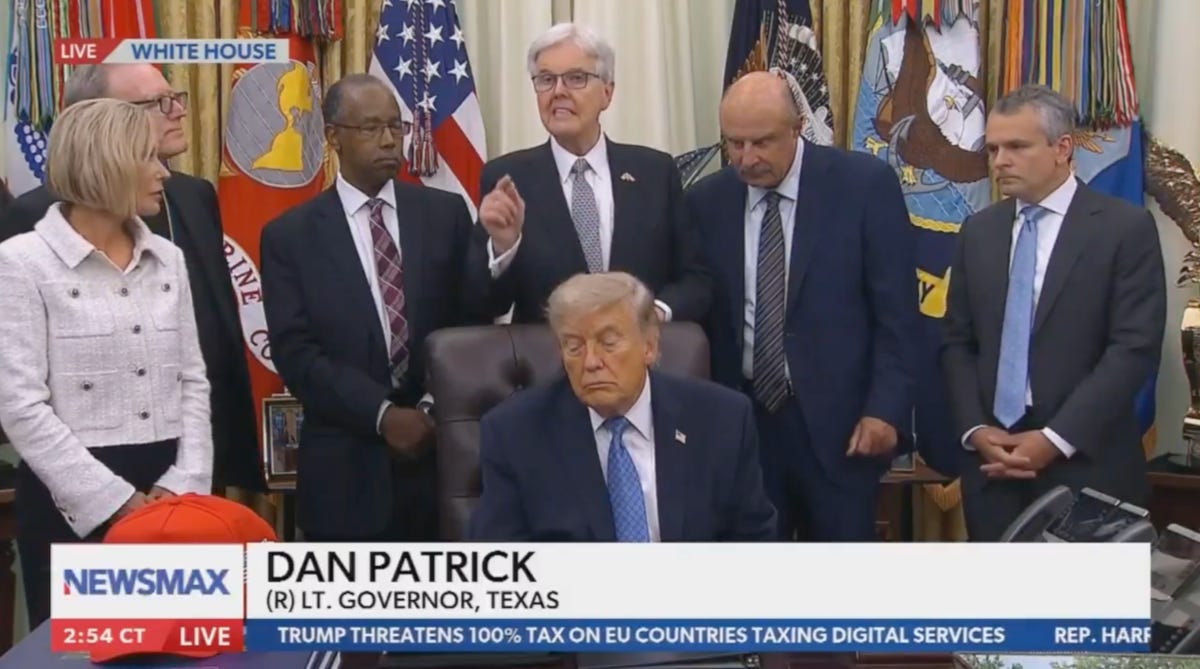
The chair of the group Dan Patrick, who’s also the Lt. Governor of Texas, said as much during an Oval Office meeting on Friday as Donald Trump struggled to stay awake.
… The separation of church and state is not in the Constitution. And from this day forward, if anyone says that to you, and they’re in public office or serving in any angecy in any capacity, they have to point out exactly where you have violated the Constitution, because you have not. And from this day forward, that phrase should have no power over the people of all faiths ever again in America.
He’s lying, of course. As the saying goes, the word “religion” appears in the Constitution twice, and both times, it’s preceded by the word “No.” No one ever said the phrase “separation of church and state” appears in the Constitution; rather, it’s that the First Amendment has long been interpreted to mean that the government cannot establish or endorse one religion over another—or religion over non-religion.
No matter what Dan Patrick and his Christian Nationalist colleagues say, and no matter how badly they wish their religion was the default faith for the country, church/state separation is very much alive.
So what the hell was he talking about?
Let’s back up a minute: On May 1 of 2025, the same day as the conservative Christian “National Day of Prayer,” Donald Trump signed an executive order establishing the “Religious Liberty Commission.” That group was formed to “offer diverse perspectives on how the Federal Government can defend religious liberty for all Americans” and they really only had two jobs: Produce a report about religious liberty (e.g. the foundations of it, the impact of it, the threats to it, how to protect it) and advise the White House on what policies to pursue to strengthen it.
It was all symbolic, but it could be useful if experts on the subject were coming together to offer the administration a guide on how to overcome serious obstacles to religious liberty.
That’s not what this was.
Instead, this was a gathering of conservative Christian zealots like evangelist Franklin Graham, conspiracy theorist Eric Metaxas, Dr. Phil (for some reason), Dr. Ben Carson, Pastor Paula White-Cain, along with a token orthodox Jew who supported Christian Nationalist ideals.
It was so skewed in terms of ideological makeup that a coalition of religious and non-religious groups sued over the lack of contrarian voices as required by law. (There’s been no resolution to that case.)
That’s why it was no surprise when, this past April, during their seventh and final meeting (held at the Museum of the Bible, naturally), Dan Patrick claimed “the separation of church and state is the biggest lie that's been told in America since our founding.” He even suggested every public school, university, and business ought to have a sign up somewhere reminding people that there’s no such thing as church/state separation.
At another point during that same meeting, commission member (and First Liberty Institute CEO) Kelly Shackelford urged the Trump administration to direct the IRS to issue a “small fine” to a church that endorsed a candidate from the pulpit. By directly violating the Johnson Amendment and getting punished by the IRS—something the IRS, historically, has not done—Christian groups would have standing to file a lawsuit that could eliminate the Johnson Amendment once and for all.
The point is: We all knew what the final report was going to look like because these Christian buffoons were broadcasting it from a mile away.
And now we have their draft writeup.
The Washington Post’s Michelle Boorstein summarizes the loooooong document:
The 224-page report recommended the Justice Department issue guidance to promote “an originalist understanding” of how the Constitution sees the relationship between religion and government. The founders had diverse views about the topic, but recent Supreme Court rulings have suggested a more narrow interpretation of what justices considered constraints on religious freedom.
Friday’s report also said faith-based groups working with the government shouldn’t have to accommodate civil rights laws or anything that conflicts with their religious beliefs; public schools should allow religious displays (it mentioned only the Ten Commandments); and soldiers who refused to be vaccinated and were punished should have their positions restored and be financially compensated. It called for the end to the Johnson Amendment, which bars nonprofits from making political endorsements.
The document also says religious liberty “acts as a bridge between church and state,” as if the two shall be merged, but the analogy fails as soon as you realize a bridge is meant to go in two directions while the report only ever calls for the government to make concessions to Christians.
Rev. Paul Raushenbush, head of the Interfaith Alliance and one of the people who sued over the commission’s one-sided makeup, called out the bullshit contained in the report:
The draft report, he wrote in a statement, “reflects the narrow, Christian nationalist worldview of the illegitimate commission. … A betrayal of the original intention of the promise of religious freedom guaranteed in the First Amendment, the report and the commission behind it fail to represent and uplift the importance of religious diversity and tolerance for all faiths in our country — not just a special, chosen few. The report is a wish list of divisive, unpopular ideas far-right religious groups have pushed for years.”
He also correctly pointed out that, for all the talk of religious liberty, the report contained nothing about Islamophobia or the need protect the religious freedom of people who weren’t Christians or Jews. They went above and beyond to talk about Christians who didn’t want to get vaccinated, or who (falsely) believe liberals want to “trans” their children, or who aren’t allowed to put up a crucifix on their classroom wall, but they somehow ignored all the actual instances of persecution against people who don’t share their faith.
The report includes a list of 12 things the Trump administration should do to make life easier for conservative Christians. While some of them are pointless—like putting up “Know Your Rights” posters everywhere—there are concerning items on the list.
#5 urges the government to nominate and confirm federal judges who are hostile to the idea of church/state separation.
#9 is “Repeal the Johnson Amendment.”
#11 calls on the Trump administration to reinstate eligibility for anti-vaxxer conspiracy theorists who lost their jobs because they wanted to spread COVID instead of keeping people safe… or, as this document puts it, because of “their religious beliefs about the COVID-19 vaccine.”
There is actually a place where the public can submit comments about the draft report until July 12, after which the final draft will be released, but there’s no reason to believe anyone involved on the Trump side will take criticism seriously. The people who constantly whine about impending “Sharia law” want to implement rules that privilege their faith over everyone else’s.
The conclusions were written before the commission was ever formed and everyone who’s on it is there to play their role as a conservative Christian stooge. If Republicans want to pass pro-Christian executive orders or resolutions, they already have the numbers to do it, whether or not their desires are legal. It’s not like GOP officials are sitting around reading white papers and thinking, “Wait a minute, maybe we should protect religious freedom for Muslims!” The one member who dared to question what everyone was thinking—former beauty pageant contestant Carrie Prejean Boller, who tried to distinguish between accusations of antisemitism from legitimate criticisms of Israel’s government—was kicked out of the group.
That’s why this report isn’t really about religious freedom at all. It’s just an extension of Project 2025. It’s a government-backed document attempting to rewrite history while also urging the adoption of policies that will elevate Christianity over other religions. It’s a report that aims to end the concept of religious liberty altogether in favor of pro-Christian policies.
That’s the danger here. It’s not that the report will have a long-term effect on its own but that we risk normalizing the ideas underlying it. What used to be the deranged rants of fringe pastors are now conversations shaping how our government treats religious minorities. They want to end government neutrality on religion, require public schools to push their propaganda, and give churches the ability to become funnels for dark money campaigns promoting their preferred conservative candidates.
If those barriers fall, we’re all screwed, because church/state separation is good for church and state. As history shows us, whenever one religion gains political power, freedom for everyone else disappears.
The irony of this commission is that there was a perfectly easy way to promote the same goals without being so obviously shambolic: They could have easily put together a diverse group to advise the president—allowing people to think they respect religious diversity—then just ignore their recommendations entirely. But this administration isn’t even politically strategic like that. They know Republicans aren’t going to hold them accountable for anything, so they don’t care if this commission is a moral and constitutional failure.
(Portions of this article were published earlier)
"...the separation of church and state is not in the Constitution."
Neither is God, Jesus, Holy Spirit, Christ, Christianity, Bible, Divine etc.
“and soldiers who refused to be vaccinated and were punished should have their positions restored and be financially compensated.”
Does that include the soldiers that were divinely punished for refusing the vaccines? I mean, how can we bring them back from the dead to pay them for suffering from government overreach? I’m still befuddled by the fact that any soldier thought they should be exempt from the shots, because the first day of basic training was a gauntlet (literally) of vaccinations and prophylactic antibiotics, none of which you knew what they were or had an opportunity to refuse. Yes the penicillin shot was only given to those that were medically determined to not be allergic. Soldiers were also used as test subjects for developing PPE and stuff. I personally helped test the latest version of the protective masks. And recently there’s been a flu outbreak that has killed soldiers because the regime has allowed soldiers to refuse vaccines and the military is backing away from the policy. It’s almost like there’s a reason the military requires soldiers get vaccinated.
Of course it’s the same tired argument. The phrase “church state separation” or “wall of separation” is not in the constitution, blah blah blah. They have one brain cell between them (I’m talking about the entire population of MAGA, from Trump, his cabinet, all the Christian nationalists using him and every Harry, Dick or Tom that drops their insulin money on anything with a Trump stamp on it) and they use that brain cell to transmit the same dozen bumper sticker philosophies to the group. I mean, did you see Katie Miller’s baby announcement where she repeated the “Imagine how much propaganda it took to convince women this is oppressive.” nonsense. That exact quote is on innumerable memes lately, some with an AI cartoon of the all American blond haired, blue eyed, mom dad and two children with a golden retriever in the kitchen, some with the mom and baby shit. Other examples are the word for word repeat of one influencer making a statement about how he’s disappointed in women, but there are thirty different influencers making the exact same video (Will Hitchens loves to point these guys out, they’re usually manosphere guys, but there is always a woman repeating it too.). We love to make fun of the new script they’ve all downloaded. They don’t argue or debate, they all just rattle,off the same talking points over and over, TDS, Biden was suffering from dementia, gas prices, they should have come her legally, they should have listened to the cops, she was trying to run him over (two incidents now, it’s an easy excuse) and so on. Trump says something at a rally or on tv, suddenly it’s gospel and the sheep regurgitate it over and over and over again. (Ranting again, oops) It makes sense that their commission on religious propaganda, sorry religious freedumb, damnit protecting religious freedom is just a long collection of debunked lies spewed word for word by lunatic disgraced preachers.
C’mon folks, you’re supposed to put things into your own words when you plagiarize, change the order of the phrases, pull out a thesaurus to find synonyms, something, anything so that it is not obvious that you are just repeating something you heard from a hundred other idiots. SMDH