
This newsletter is free and goes out to over 25,000 subscribers, but it’s only able to sustain itself due to the support I receive from a small percentage of regular readers. Would you please consider becoming one of those supporters? You can subscribe via Patreon or the Subscribe button below! You can also make one-time donations through Venmo, CashApp, or PayPal.
The Supreme Court will soon decide if Colorado lawmakers violated the rights of Catholics when the state’s universal preschool bill included a Don’t Be Bigots clause. As the justices consider the case, a number of atheist and church/state separation-focused groups are asking them to think about the harm they’d cause by reversing an earlier decision in favor of the state.
Here’s how this became an issue in the first place: In April of 2022, Democrats in Colorado (with very little GOP support) passed a law establishing free pre-school across the state beginning in 2023. Children can now access half-day programs at no cost to their parents. The governor’s office now says it saves families over $6,300 a year and gives kids a head start in their education. It’s just an incredible opportunity for people who might not have been able to afford such programs.
Since the $322 million program launched in August of 2023, it has helped 40,000 four-year-olds attend 1,900 participating schools. Importantly, even faith-based schools are eligible to participate in the program provided they follow some basic rules. (More on that in a moment.) According to a press release from this past July, “at least 79 faith-based providers [have] participated, serving at least 2,052 students and receiving more than $9.5 million in payments.”
In order to receive funding, schools aren’t allowed to discriminate against students. They have to accept kids regardless of their (or their family’s) race, religion, sexual orientation, gender identity, etc.
It’s that restriction led the Denver Catholic Archdiocese and two of its parishes—the St. Mary Catholic Parish in Littleton and the St. Bernadette Catholic Parish in Lakewood—to sue state officials in 2023. They wanted to receive taxpayer funding without giving up their bigotry.

Their argument was that Catholicism required them to reject students who have gay parents and staffers who are in same-sex relationships. They said they couldn’t recognize the existence of transgender people or even use their pronouns if they conflicted with whatever was written on a birth certificate. They wanted to ban students from wearing the “opposite sex’s uniform” or using what they deemed were the wrong bathrooms. They also wanted to prioritize the acceptance of kids from Catholic families over, say, Jewish ones, even though the law already permitted them to accept kids from their own parishes.
(It’s important to stress that we’re talking about pre-school kids. The idea that there would be conflicts about pronouns or uniforms is almost laughable.)
But it didn’t take a genius to understand the real goal here: This was always about Catholics retaining their ability to discriminate against LGBTQ people.
The lawsuit said enrolling children with gay parents into an Archdiocesan school “is likely to lead to intractable conflicts” because a “Catholic school cannot treat a same-sex couple as a family equivalent to the natural family without compromising its mission and Catholic identity.”
There was a simple solution to that, of course: Just don’t accept the state’s money.
No one was forcing the Catholic Church to participate in the program. If families wanted to send their kids to Bigot Factories, they had every right to do so, and no one was stopping them. The Archdiocese could just do everything it was doing before this law went into effect.
The Catholic Church knew this. Which is why they were also arguing that the new universal Pre-K program was bad for business. Because if pre-school was free elsewhere, why would anyone give them money? And if enrollment went down, they would have to charge their own members even more. Why didn’t state officials care about the Church’s bottom line, dammit?!
This is seriously what they wrote in their lawsuit:
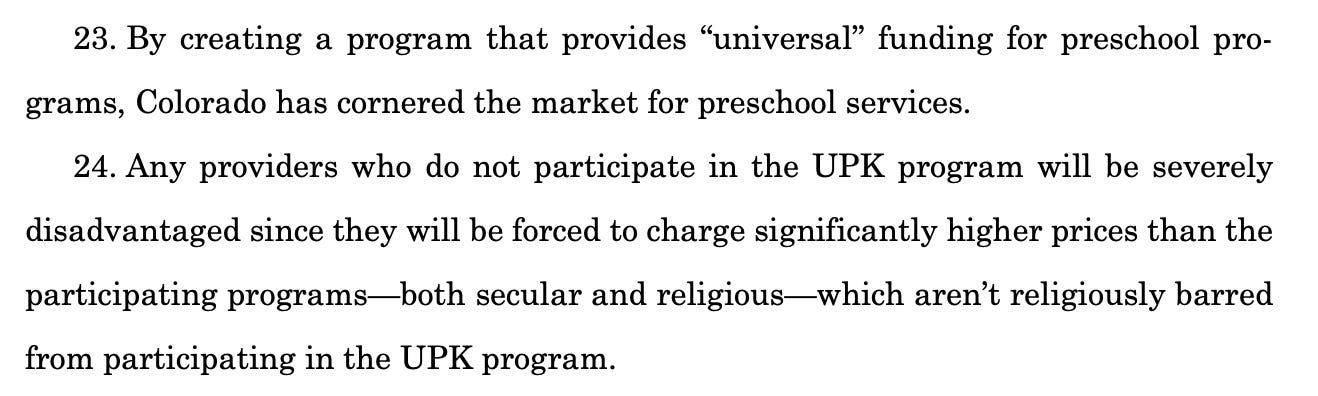
By creating a program that provides “universal” funding for preschool programs, Colorado has cornered the market for preschool services.
Any providers who do not participate in the UPK program will be severely disadvantaged since they will be forced to charge significantly higher prices than the participating programs—both secular and religious—which aren’t religiously barred from participating in the UPK program.
A press release from the conservative legal group Becket added:
This ban forces parents to choose between paying out of pocket for the cost of faith-based preschool or receiving a free preschool education at any other private school in Colorado. It also hurts the ability of schools like St. Mary’s and St. Bernadette’s to compete with other preschools that can offer free preschool education.
In the marketplace of ideas, the Catholics were admitting they were losers—and that the neutral rules were so unfair to them, it was literally illegal. Therefore, the rules needed to change, not their beliefs. (Never their beliefs.)
That’s the epitome of broken brain religion for you: A program that would lift up families that can’t afford early childhood education, and which could help students get a leg up on their formal schooling, was a problem for these Catholics because they prioritized their own bigotry and ignorance over the needs of children.
It’s not that the Archdiocese wanted to end the program. They just wanted to have their cake and eat it too. They wanted to be able to discriminate against LGBTQ staffers and kids and families while still being eligible for government funding.
It was also revealing that there was nothing in the Archdiocese’s lawsuit about their right to reject divorced parents or anyone who’s had an abortion. Because even though those things also violate Catholic doctrine, the Church has never really had a problem looking the other way on those “sins.” (They have their own made-up sin hierarchy.)
In any case, the lawsuit began its journey through the federal court system. (You can read more details here.) After the state won in district court, that victory was upheld in an appellate court. The 10th Circuit correctly said the Catholic schools had no case because Colorado’s non-discrimination rules were neutral and applied to everyone. In other words, a previous Supreme Court ruling from 1990, Employment Division v. Smith, was still in effect.
But lawyers for the Catholics asked the Supreme Court to weigh in. They now want the Court to decide what kind of “proof” is needed to show that a law isn’t actually neutral and generally applicable—because they believe they were discriminated against even if the law was said to be neutral—and whether a more recent SCOTUS decision that’s friendly to faith-based schools, Carson v. Makin, can override Employment Division v. Smith even in situations where a government doesn’t explicitly exclude religious people or institutions.
Even though that all sounds very niche, the worst-case scenario here is that SCOTUS could say states are required to let religious groups apply for taxpayer dollars to provide certain services… but the state can’t impose the same kind of rules on them if those rules burden their religious beliefs. Churches could be eligible for taxpayer dollars while being allowed to play by a different set of rules. It would be a disaster.
Last week, a number of atheist and church/state separation groups urged the Supreme Court to affirm what lower courts have already said.
In their amicus brief, American Atheists offered numerous examples of non-religious families who have been victims of religious discrimination to make the point that if faith-based schools are allowed to discriminate with taxpayer dollars, it will only make the problem worse.
… Secular preschool deserts (ie., communities in which there are no practical secular preschool options for nonreligious parents) exist in communities around the United States. Multiple participants in the U.S. Secular Survey reported having no choice but to enroll their child in a religious preschool or daycare because secular options simply were not available.
…
… Were this Court to side with the Petitioners in this case, it would be enabling preschools providing a government-funded service to engage in all the discriminatory conduct described by these nonreligious Americans.
The schools could turn the family away because of their (lack of) religious beliefs, requiring them to pay more or travel further to receive the same benefits. Or, if they enroll the kids, the children could be required to participate in religious rituals despite the family’s atheism… all with the help of taxpayer funding.
AA Legal Director Geoffrey T. Blackwell added in a press release: “Colorado, rightly, imposes its nondiscrimination requirement in order to avoid exactly this kind of damaging behavior. It must be allowed to continue protecting its residents.”
The Freedom From Religion Foundation also filed an amicus brief focusing on another aspect of the case. Colorado allowed some preschools to prioritize students in Head Start or who have Individualized Education Programs (IEPs). In other words, they allowed certain exemptions to their non-discrimination rules for secular reasons. But the Tenth Circuit didn’t believe that was hypocritical at all. Instead, they said giving preferences to low-income students or those with disabilities was meant to keep the program inclusive while the religious exemptions were all about exclusivity.
FFRF says the Tenth Circuit had the right idea, and the Supreme Court shouldn’t overturn it on account of that.
FFRF’s brief points out that mandating religious exemptions whenever any secular exemption is allowed would create a chaotic system and would require lawmaking to a degree that legislatures are not prepared to handle. The First Amendment’s Free Exercise Clause does not give an individual the ability to avoid compliance with a “valid and neutral law of general applicability.” The fact that Colorado allows preschools to prioritize serving low-income preschoolers and preschoolers with disabilities does not undermine Colorado’s interests in nondiscrimination.
“Americans with disabilities have fought long and hard to be able to participate as full members of society,” FFRF’s brief asserts. “Petitioners’ argument threatens to callously use those efforts towards inclusion to instead nullify anti-discrimination laws across the country.”
Americans United for Separation of Church and State, in coalition with a number of other civil rights groups, made the broader argument that “religion-neutral” requirements are perfectly constitutional, and public-benefit conditions (like helping low-income students or those with disabilities) don’t give faith-based groups carte blanche to challenge the law.
“Religious liberty is not a license to discriminate and deny children access to a taxpayer-funded educational program,” said Americans United President and CEO Rachel Laser. “We urge the U.S. Supreme Court to protect the religious freedom of Colorado taxpayers and LGBTQ+ children and families by ensuring public programs are not funding discrimination.
“This is another case spearheaded by religious extremists who have made Colorado a target in their quest to impose their beliefs on everyone and turn religious freedom into a license to harm vulnerable communities. We need a national recommitment to the separation of church and state. It is the shield that protects everyone’s religious freedom, regardless of their identity — so long as we don’t harm others.”
These briefs have it right because the churches aren’t asking for religious freedom. They already have that. They want something far more radical: the ability to discriminate using tax dollars. They want all the benefits of participating in a public program with none of the obligations.
The best-case scenario here is that SCOTUS does nothing with this case, allowing the earlier rulings to stand. Colorado never targeted Catholics or excluded religious schools. Dozens of faith-based providers are already participating in the program. If these Catholic schools can’t play by the rules, they shouldn’t be in the game.
The oral arguments in this case are scheduled for November 3. A final decision will be issued sometime next year.
(Portions of this article were published earlier)
Catholics think their rights to be bigots are somehow being violated and demand protection to be bigots? Seriously?
No private school religious or otherwise, should ever get a cent of public money for any reason.