
This newsletter is free and goes out to over 25,000 subscribers, but it’s only able to sustain itself due to the support I receive from a small percentage of regular readers. Would you please consider becoming one of those supporters? You can subscribe via Patreon or the Subscribe button below! You can also make one-time donations through Venmo, CashApp, or PayPal.
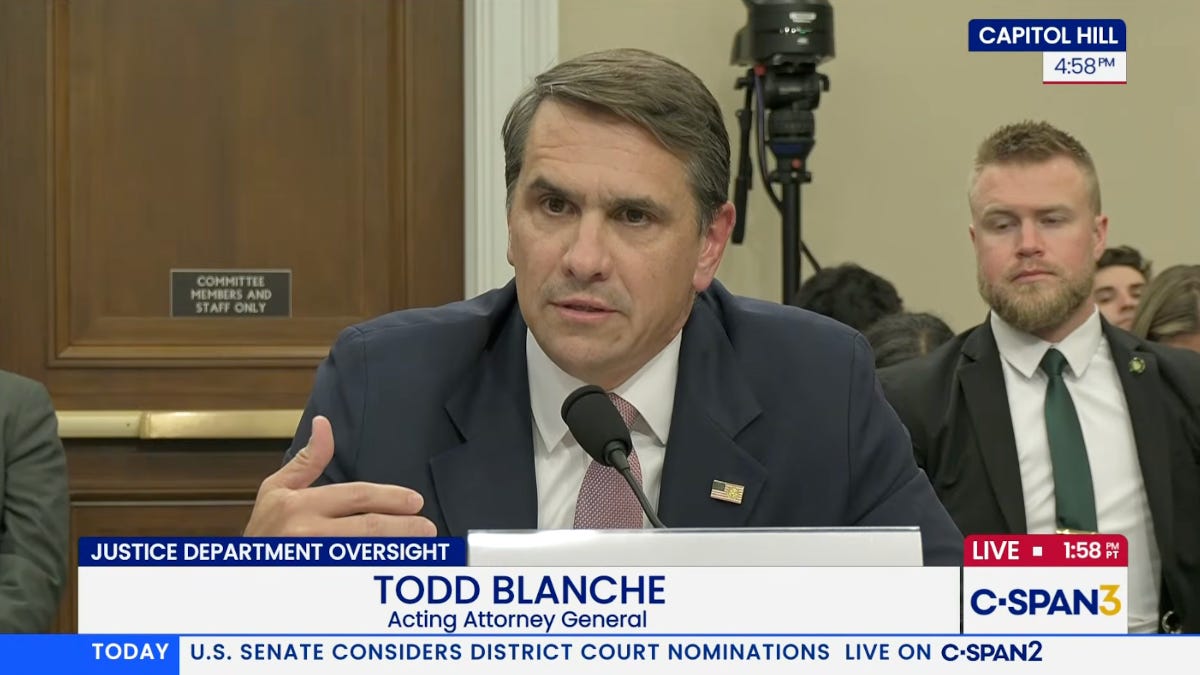
On Thursday, Acting Attorney General Todd Blanche announced updates for how the Department of Justice would tackle matters involving “religious liberty.” These were guidelines they’d use when deciding which cases to pursue. The last time the list had been updated was 2017—under Donald Trump’s former Attorney General Jeff Sessions—and Blanche insisted it needed to be revisited in “light of significant U.S. Supreme Court decisions issued over the past nine years.”
Rather than state bluntly that the government must remain neutral on matters of faith and defend separation of church and state, the updated list shows how this administration plans to allow Christians to receive accommodations, exemptions, and tax dollars—even when those desires clash with someone else’s civil rights and religious freedom.
First, let’s go back to 2017. The 25-page memo that Sessions promoted made news for saying that religious groups and businesses had the same freedom as religious people (in other words, they could discriminate and refuse to adhere to various laws that violated their beliefs). None of that could be held against them if they wanted federal contracts from the government. The same was true of grant money; if a state handed out dollars to repave playgrounds, private religious schools were eligible to receive that money.
We’ve lived under those rules for the past decade or so, so they’ve basically been normalized. But let’s not pretend there was anything normal about that guidance, as Courthouse News pointed out at the time:
The guidelines touch on a number of high-profile religious liberty disputes, including the Hobby Lobby case that challenged the requirement that employers provide health insurance coverage that includes contraception. It also says the government cannot enforce the so-called Johnson Amendment, which threatens to strip tax-exempt status from religious groups that engaged in political advocacy.
…
… Under the new policy, a claim of a violation of religious freedom would be enough to override many anti-discrimination protections for LGBT people, women and others.
“This is putting the world on notice: You better take these claims seriously,” said Robin Fretwell Wilson, a law professor at the University of Illinois at Urbana-Champaign. “This is a signal to the rest of these agencies to rethink the protections they have put in place on sexual orientation and gender identity.”
Somehow, Blanche looked at those rules and said the problem with them was that they didn’t go far enough. So wherever he could go further, he did.
The 2017 memo said the Establishment Clause was in effect and that the government was prohibited from “officially favoring or disfavoring particular religious groups.”
The 2026 memo says the Establishment Clause must be interpreted in reference to “historical practices and understandings.” Which is coded language that benefits Christianity since other religions weren’t as pervasive in the early years of our country. It also says the government doesn’t have to “purge from public life” anything that critics (i.e. atheists) claim endorses religion… like a giant cross on public property or a public school football coach wanting to pray at midfield after a game.
The 2017 memo protected federal employees’ religious expression (as long as it didn’t cross into harassment or workplace disruption).
The 2026 memo gives far more leeway to annoying religious employees, saying they can’t be punished if what they’re doing is part of their faith. It also allows federal employees to participate in religious activities—like a Pete Hegseth-led military prayer gathering—as long as no one’s forced to join. Even if those activities are arguably coercive in nature with people pressured to join in.
The 2017 memo said religious groups were eligible for public funding, assuming the money wasn’t being used to proselytize or for religious worship.
The 2026 memo gets rid of those safeguards entirely, saying religious groups can’t be excluded from public funding because of their beliefs. While it doesn’t directly authorize federal funding of worship, it gets rid of the caveats from 2017.
While the 2017 memo didn’t say much about parental rights, the 2026 memo says the government can’t interfere with a parents’ desire to raise kids with their religious beliefs. That means if public schools teach anything (e.g. sex education, books with LGBTQ characters, non-whitewashed American history) that goes against a parent’s faith, that parent can have their kid pulled from class without any consequences.
The 2017 memo required employers to provide reasonable accommodations for someone’s religious beliefs unless it created an “undue hardship” (a purposely vague term).
The 2026 memo defines that hardship as “substantial increased costs in the overall context of the business.” This makes it a lot harder to deny requests for religious accommodations.
The 2017 memo required federal agencies to respect the Religious Freedom Restoration Act of 1993 but implied that individual employees couldn’t be sued for any purported violations of that law.
The 2026 memo says agency officials “may be sued in their individual capacities if they violate RFRA” and may have to pay any associated fines. This creates a massive incentive for officials to approve any religious requests, no matter how ridiculous, than risk a personal lawsuit.
Overall, the updated memo doesn’t really focus on protecting people from the harms of religion. It’s all about giving religious zealots leeway to go even further with their desires; as long as they can claim what they’re doing is an extension of their faith, the government is generally on their side. Even if that means discriminating against people or pressuring them to join your faith.
Donald Trump appointed right-wing Supreme Court justices to rewrite the rules regarding church/state separation, and the Justice Department is now using their decisions to rewrite how they’ll uphold the law.
For those reasons, the Freedom From Religion Foundation condemned the 2026 memo:
“This so-called religious liberty guidance is really a roadmap for privileging conservative Christianity at the expense of the constitutional rights of everyone else,” says FFRF Legal Director Patrick Elliott. “Rather than reminding federal agencies that the First Amendment protects both the free exercise of religion and the prohibition against government establishment of religion, the Justice Department has produced a one-sided manifesto that treats religious belief as a trump card over neutral laws, civil rights protections and government accountability.”
…
“The Department of Justice should be defending the First Amendment in its entirety, not transforming it into a tool for advancing Christian nationalist priorities,” [FFRF Co-President Annie Laurie] Gaylor adds. “True religious freedom flourishes only when the government remains neutral on matters of religion.”
This memo tells the Justice Department they can weaponize conservative Christianity in order to use it against LGBTQ people, women, religious minorities, atheists, etc. An agency that’s supposed to defend the constitutional rights of all Americans is now manufacturing legal arguments for Christian privilege. It acts like damn near every conservative Christian grievance is a potential civil rights emergency.
If and when we ever get a different administration, this memo needs to be rescinded immediately—not that the 2017 guidance was any better. We need a Justice Department that affirms religious freedom for everyone, understanding the sensible limits to that in a pluralistic society. That also means appointing judges who understand that church-state separation protects religious freedom rather than threatens it.
I never want to hear Christians whine about being persecuted in this country ever again.
Every imaginable horror has been perpetrated in the name of deeply held religious beliefs, and they happen every day. Some people keep insisting this is a virtue. This isn’t about religious liberty, it’s about institutionalizing Christian privilege in this country. The churches know they’re losing the long game, and they’re desperate to have government backstop their religion and keep them in business. Make no mistake, they are businesses.