
This newsletter is free and goes out to over 24,000 subscribers, but it’s only able to sustain itself due to the support I receive from a small percentage of regular readers. Would you please consider becoming one of those supporters? You can subscribe via Patreon or the Subscribe button below! You can also make one-time donations through Venmo or PayPal.
A proposed rule from the Trump administration meant to harm liberals and public education in general could backfire on conservative Christian colleges whose students rely on federal government loans.
On April 17, the Department of Education announced a forthcoming rule that, in theory, would create a “hard reset in higher education.” When Republicans passed the badly misnamed “One Big Beautiful Bill” in 2025, they said there needed to be an “earnings test” to determine loan eligibility, and this rule is meant to satisfy that requirement. The new rule will go into effect on Wednesday barring any changes.
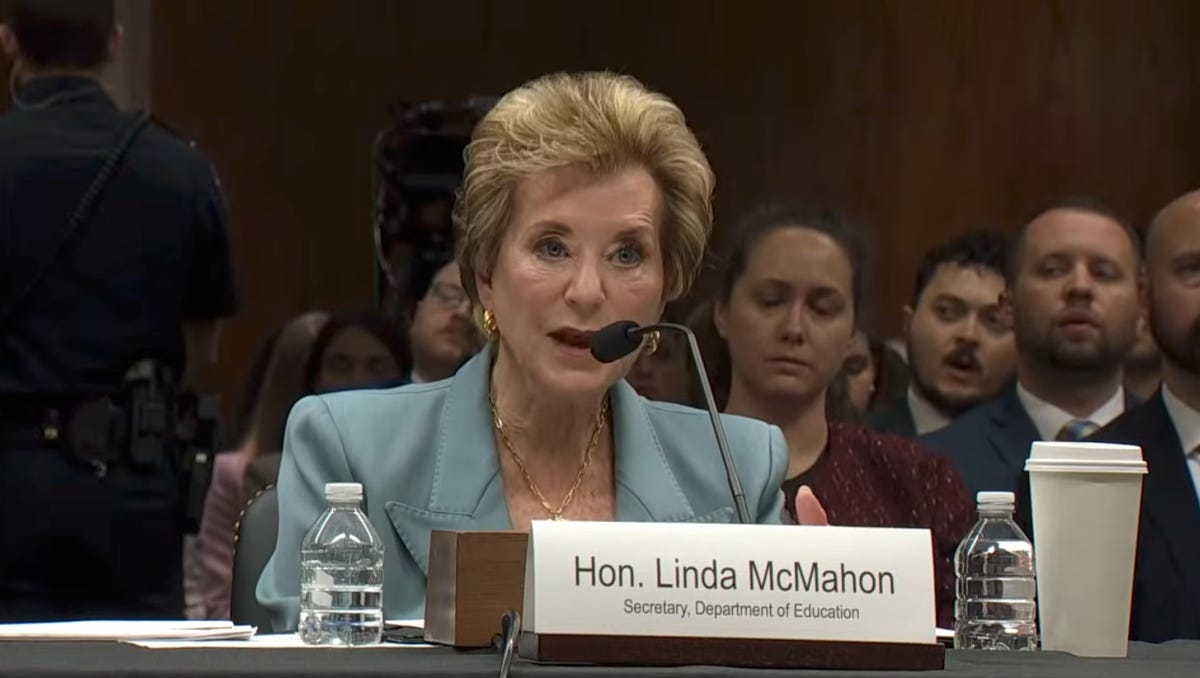
The thinking is that too many students take out college loans but can’t pay them back because they either go into low-paying careers or they’re unemployed/underemployed. (The economy is also on fire right now, but the administration doesn’t want to admit that.) This rule would prohibit those students from taking out loans for college if “the typical graduate of an undergraduate program does not earn as much as a high school graduate.” By extension, that prohibition would harm schools that offer those programs.
Put more simply, if students who are English majors aren’t earning more money than people without that degree, their colleges would be punished for it.
Programs that routinely fail to provide students with a reliable return on investment would lose access to federal student loans, and in certain cases, Pell Grants.
“The Trump Administration’s proposed accountability framework is grounded in common sense: if postsecondary education programs do not leave graduates better off, taxpayers should not subsidize them,” said Under Secretary of Education Nicholas Kent.
That might make sense on the surface. But it’s a horrible way to decide whether a course of education is worthwhile.
It’s one of those rules that conservatives love because it sounds like it punishes “liberal” schools where students major in music, or theater, or Philosophy, or Feminist Studies, or African American History, or English, or anything else they deem frivolous. To them, the only worthwhile reason to go to college is to learn a particular skill that makes you immediately employable in a high-paying job.
There are plenty of problems with that theory, though.
You could major in computer science, only to watch AI render your skills obsolete. You could major in education but work in a rural district that pays very little. You could get a degree in a subject you don’t love and realize later that you’re stuck in a career you hate. And even if you’re majoring in an area that doesn’t have high-paying prospects, you’re still learning skills that will help you no matter what career path you choose. What matters more is your ability to specialize in a subject, learning how to adapt and apply your knowledge to new areas (including jobs that may not yet exist), and having interests that go beyond simply making money. You’re just a more interesting person when you do that. Also, contributing to our culture, rather than our GDP, has plenty of value that doesn’t fit neatly into some made-up formula.
How would this rule actually work?
To evaluate earnings, the federal government would use US Census and International Revenue Service data to compare the median salary of those with undergraduate degrees four years after their graduation to the median salary of those with high school degrees ages 25 to 34.
That’s very simplified, but it’s the general idea. That’s another problem, though, because college-educated people in low-paying careers might be earning far less than those with no degrees who have years of work experience. The rule doesn’t take that into account.
If the goal is to punish schools that offer the kinds of programs liberals stereotypically enjoy, though, it may create harm far beyond that.
Because it turns out theology and ministry aren’t exactly lucrative careers for most people, either, and a hell of a lot of Christian schools rely on federal loans to stay afloat.
This rule could uniquely harm Christian colleges.
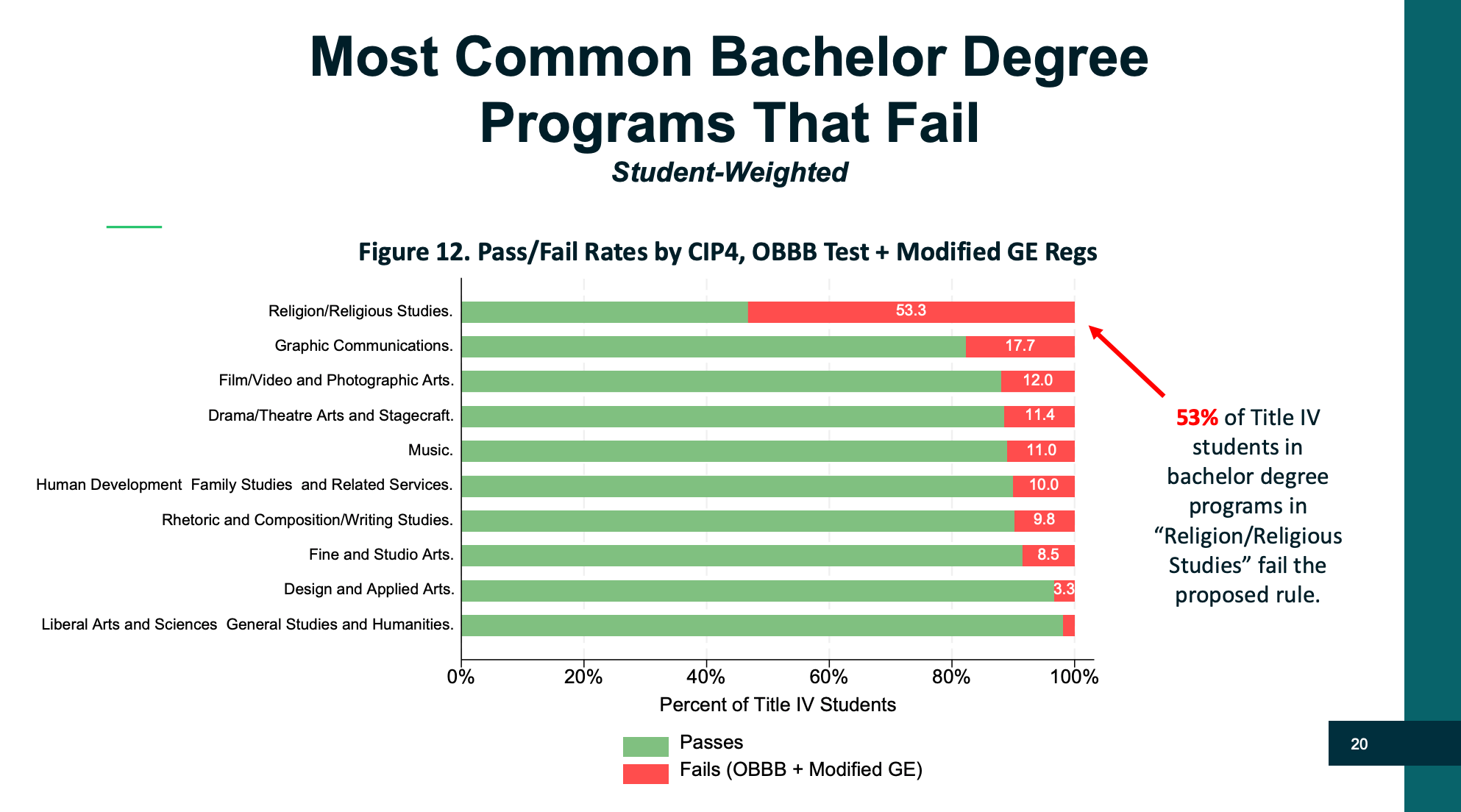
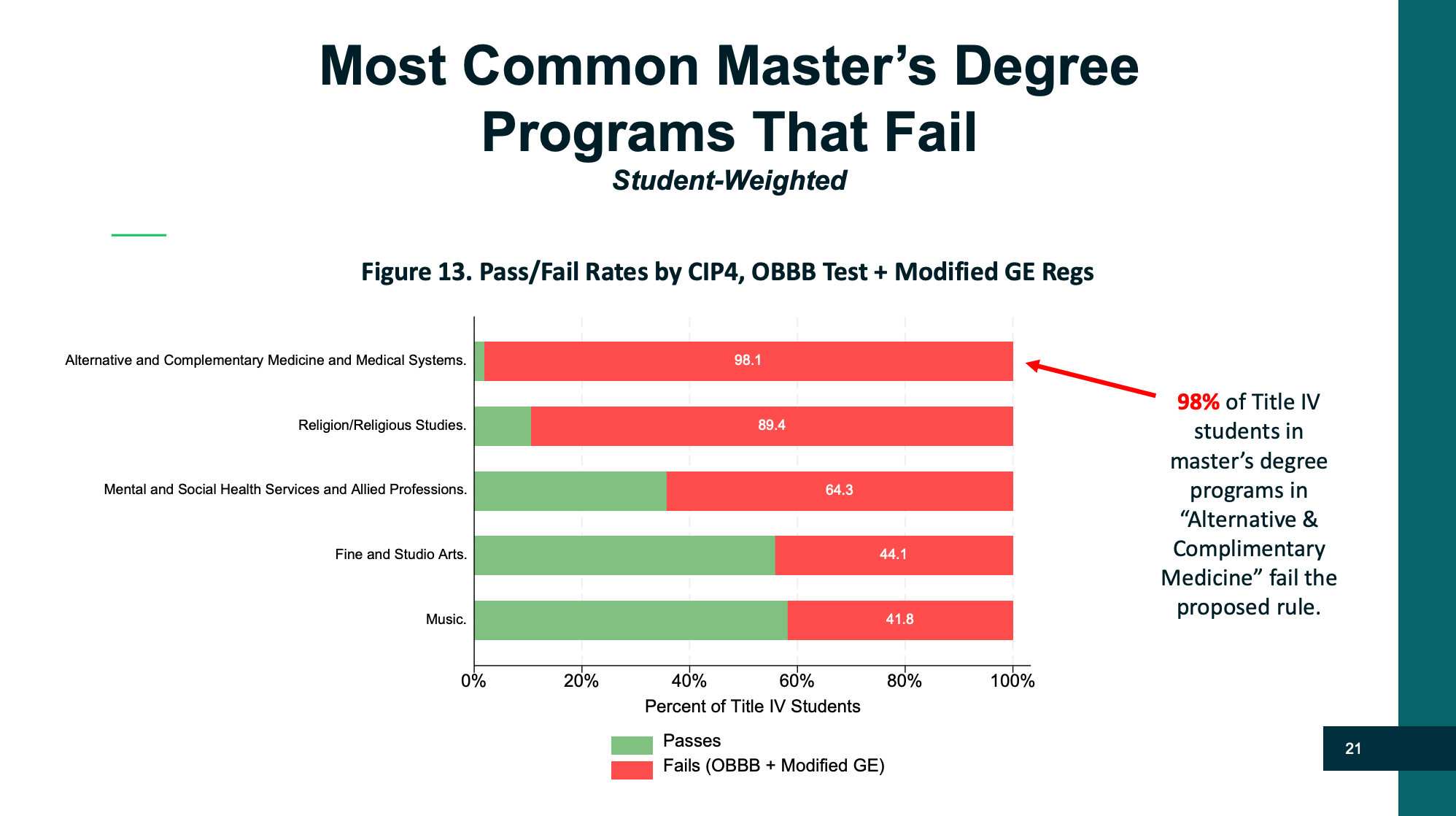
Consider this: According to the government, 53% of undergraduates who go into “Religion/Religious Studies” fail the “You Gotta Make Money” rule. And so do 89% of students who pursue graduate degrees in the same subject.
Philip Dearborn, the head of the Association for Biblical Higher Education, told Christianity Today that this is a massive concern for religious schools that focus in these areas:
“It’s an existential threat to the future of religious higher education in the US—I don’t think that’s an overstatement,” Dearborn told CT. “It came out of left field.”
…
“An accountability framework that reduces a faith-based school’s value to the future earning potential of graduates will minimize or alter its self-understanding and effectively punish those institutions for advancing a service ethos driven by their religious convictions,” wrote Asbury University president Kevin Brown in a Deseret op-ed in June 2025, before the bill was signed into law.
…
If a college program, such as a biblical studies major, flunks the earnings test two years in a row, the government would label it as failing. Biblical studies majors at that school would no longer be eligible for Title IV federal loans, and the college would have to disclose that the program was considered “failing.”
…
“Financial outcomes matter, but they don’t totally measure whether an education is worthwhile,” said David Hoag, president of the Council for Christian Colleges & Universities (CCCU).
One person pointed out that some schools offer programs that are only taken by a literal handful of students. If a few of them earn very little money year after graduation, it could mathematically screw over the entire school:
One commenter, Linda Adler-Kassner, noted that comparing the median income of an entire demographic to a small college program that may have only a few students didn’t make any sense mathematically. One graduate with low earnings could drag down the whole program.
(The rule requires a program to have at least 30 graduates before any earnings metrics can be calculated, even if that takes a few years to achieve.)
The irony here is that many of the Christian schools that pump out armies of conservative voters may be screwed over by an administration that loves the poorly educated. Republicans want to hurt liberals so badly, they don’t seem to care if Christian colleges become collateral damage.
Ultimately, this rules ties your ability to pursue a higher education with how much you make. The Republican-led government says college is only worthwhile if you make more money as a result. They’re ignoring the purpose of education more broadly, and they’re hurting the very people who pursue careers that make all of our lives better even if those vocations don’t make them personally wealthy.
As if we need more hedge-fund managers and fewer social workers.
As one pastor wrote in a piece for Fox News:
If your calling doesn’t come with a big salary, if you’re a teacher, a pastor, a social worker, your degree is deemed less valuable. And the school that prepared you? Financially penalized.
That’s not reform. That’s economic discrimination against purpose-driven education.
We should want as many students pursuing higher education as possible. Not because it’s necessary for everyone but because it broadens our options for the future and creates a better society in general. We should want to live in a nation where we have informed citizens, curious thinkers, ethical leaders, artists, teachers, and researchers. We should want people who can understand the world outside their own narrow experiences.
But America—and white evangelicals specifically—rejected an administration that wanted to forgive student loans in favor of one that punishes students who take out loans at schools that dare to teach them anything that’s not directly helping the economy. All that matters to Republicans is maximizing shareholder value.
It’s hard to have much empathy for the Christians who voted for this. So many of them spent decades building the modern Republican coalition. They promoted the culture war narratives that fueled Trumpism. They encouraged distrust of liberal institutions even as they relied on the same federal programs to make their own institutions viable. Now many of those schools are discovering that once you reduce education to pure market value, Bible Studies suddenly look just as “useless” as gender studies. Republicans created a movement built on resentment and anti-intellectualism and it’s coming back to bite their own scholars in the ass. That’s what they get for supporting the Leopards Eating People's Faces Party.
They wanted to hurt their enemies so badly, they failed to realize the Trump administration didn’t give a shit about them either.
𝑇ℎ𝑒 𝑖𝑟𝑜𝑛𝑦 ℎ𝑒𝑟𝑒 𝑖𝑠 𝑡ℎ𝑎𝑡 𝑚𝑎𝑛𝑦 𝑜𝑓 𝑡ℎ𝑒 𝐶ℎ𝑟𝑖𝑠𝑡𝑖𝑎𝑛 𝑠𝑐ℎ𝑜𝑜𝑙𝑠 𝑡ℎ𝑎𝑡 𝑝𝑢𝑚𝑝 𝑜𝑢𝑡 𝑎𝑟𝑚𝑖𝑒𝑠 𝑜𝑓 𝑐𝑜𝑛𝑠𝑒𝑟𝑣𝑎𝑡𝑖𝑣𝑒 𝑣𝑜𝑡𝑒𝑟𝑠 𝑚𝑎𝑦 𝑏𝑒 𝑠𝑐𝑟𝑒𝑤𝑒𝑑 𝑜𝑣𝑒𝑟 𝑏𝑦 𝑎𝑛 𝑎𝑑𝑚𝑖𝑛𝑖𝑠𝑡𝑟𝑎𝑡𝑖𝑜𝑛 𝑡ℎ𝑎𝑡 𝑙𝑜𝑣𝑒𝑠 𝑡ℎ𝑒 𝑝𝑜𝑜𝑟𝑙𝑦 𝑒𝑑𝑢𝑐𝑎𝑡𝑒𝑑. 𝑅𝑒𝑝𝑢𝑏𝑙𝑖𝑐𝑎𝑛𝑠 𝑤𝑎𝑛𝑡 𝑡𝑜 ℎ𝑢𝑟𝑡 𝑙𝑖𝑏𝑒𝑟𝑎𝑙𝑠 𝑠𝑜 𝑏𝑎𝑑𝑙𝑦, 𝑡ℎ𝑒𝑦 𝑑𝑜𝑛’𝑡 𝑠𝑒𝑒𝑚 𝑡𝑜 𝑐𝑎𝑟𝑒 𝑖𝑓 𝐶ℎ𝑟𝑖𝑠𝑡𝑖𝑎𝑛 𝑐𝑜𝑙𝑙𝑒𝑔𝑒𝑠 𝑏𝑒𝑐𝑜𝑚𝑒 𝑐𝑜𝑙𝑙𝑎𝑡𝑒𝑟𝑎𝑙 𝑑𝑎𝑚𝑎𝑔𝑒.
Their greed has them unable to look past the next fiscal quarter, and they really don't care if right wing Christian colleges are punished by this. Those colleges will still pump out NSGOP voters, and even fewer people will get an education.
Their ultimate goal is not to prioritize earning potential, but to eliminate education for everyone but the wealthy.
Anyone really surprised? This is far and away the most anti-public education administration ever.
Just look who's running the show.