
This newsletter is free and goes out to over 24,000 subscribers, but it’s only able to sustain itself due to the support I receive from a small percentage of regular readers. Would you please consider becoming one of those supporters? You can subscribe via Patreon or the Subscribe button below! You can also make one-time donations through Venmo or PayPal.
A lawyer who was punished for alerting a Catholic school that they had an alleged predator on staff is now asking the U.S. Supreme Court to overturn that decision. New details show that other people, not just him, were aware of the predator’s history and alerted the school about it.
It’s a complicated story but one that will rightly infuriate you.
In December of 2021, attorney Richard Trahant discovered that a chaplain at a private Catholic school—Brother Martin High School in New Orleans, Louisiana—had previously been accused of sexual misconduct.
Trahant contacted the school and informed them of what he had just learned. Within days, that chaplain, Paul Hart, announced his “retirement.” He and the archdiocese both announced that he was stepping down because of cancer.
And then that lawyer was fined $400,000 for warning people about the predator priest.
I repeat: The attorney—not the priest and not the school and not the Catholic Church—was fined $400,000 for alerting people about Hart’s past actions.
Earlier this year, a federal appeals court upheld that decision to punish the whistleblower.
The allegations against Rev. Paul Hart
Paul Hart began working for the Archdiocese of New Orleans in 1989. At some point during his tenure there, when he was in his late 30s, he met a 17-year-old girl who attended Mount Carmel Academy and was a member of a youth group at his church. Things took a disturbing turn after that:
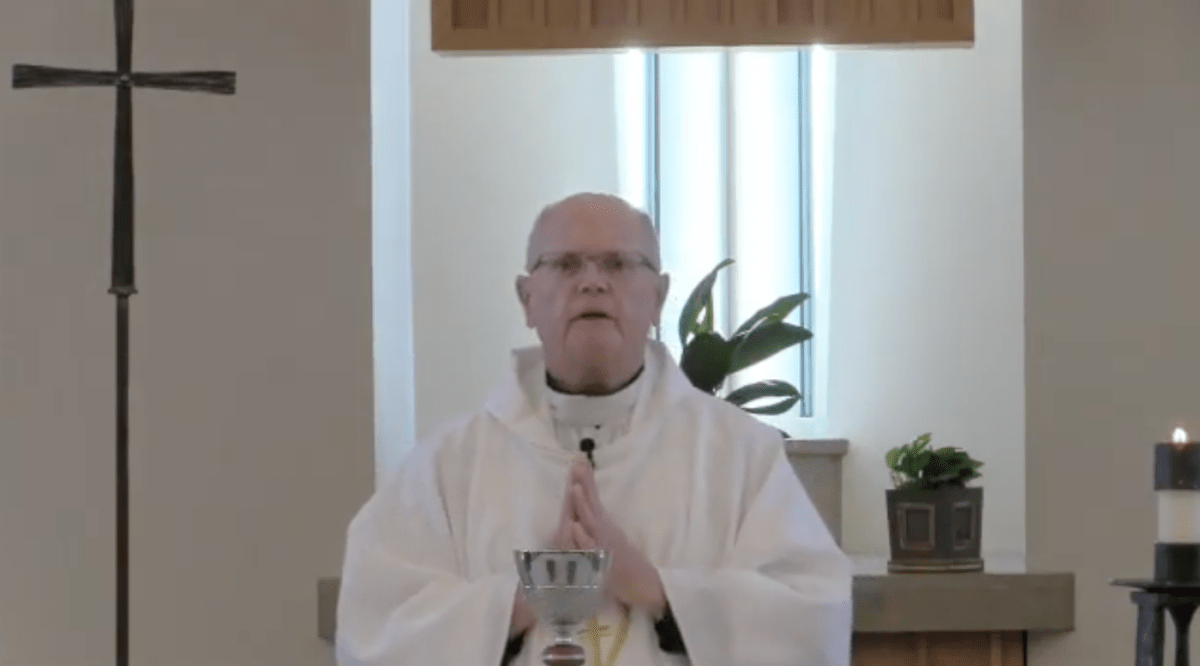
By 1990, he was allegedly spending his personal time with the student, and began kissing her, groping her chest, and at least once engaging in what church investigators described a “dry sex”—which involves people simulating intercourse with their clothes on—while in the rectory, the sources said.
As criminal as that was, the girl didn’t tell anyone what happened at that time. She later said she didn’t understand just how inappropriate his actions were.
By 2012, however, that same girl had grown up and had children of her own. She even sent them to a Catholic school in the same archdiocese. But she soon found out that Paul Hart, who had moved around quite a bit during his career, was now back at their church and in close proximity to her kids. Knowing now how egregious Hart’s behavior had been, she told the archdiocese what happened to her years earlier.
The woman filed a complaint with the archdiocese, accusing Hart of grooming her before pursuing sexual contact she now realized was inappropriate. In a church investigation, Hart denied initiating what happened but admitted contact, which he could not say did not cause him to ejaculate.
The Church’s investigation didn’t go anywhere. They said Hart broke the Catholic Church’s rules about celibacy, as if that was the real issue, but didn’t commit child sexual abuse because canon law at the time said the age of adulthood was 16. (That was raised to 18 in 2002, but investigators were going by Church rules that were in place in the 1990s.)
The end result was that Hart remained a priest within the diocese. He wasn’t fired. He wasn’t even seriously in trouble. Because he had not abused a “minor,” his name never appeared on any list of priests accused of such behavior.
The Archdiocese of New Orleans filed for bankruptcy
In May of 2020, the Archdiocese of New Orleans filed for Chapter 11 bankruptcy. Faced with the high costs of child sex abuse lawsuits and the huge financial hit from the pandemic, there was no other choice. The filing put a temporary stop to the lawsuits and began a process to figure out the archdiocese’s assets and liabilities. That process, however, involved sharing details about internal investigations.
That’s when attorney Richard Trahant (pronounced TRAY-hant) entered the story.
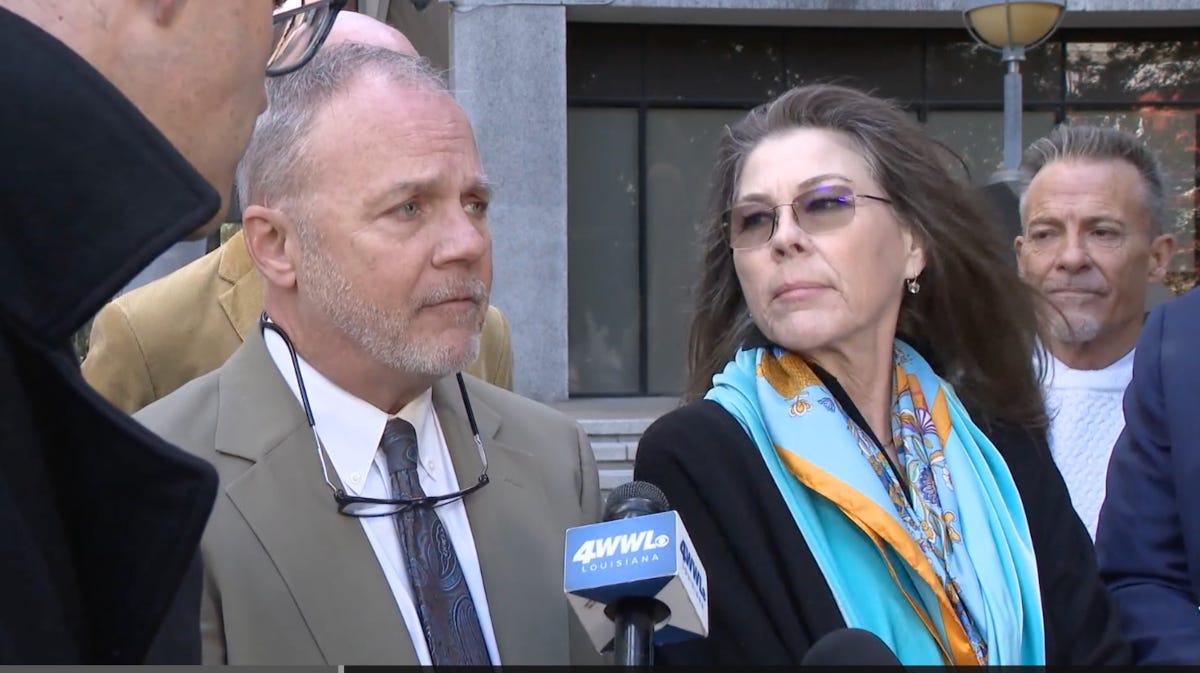
He represented some of the victims of sexual abuse and was part of a committee investigating the archdiocese. In that position, he saw the paperwork documenting the allegations against Hart. He also knew that Hart was currently working at Brother Martin High School. While that’s an all-boys school, girls are in the building for some extracurricular activities, so Trahant felt obligated to let the school know they had an alleged predator in their midst.
Trahant’s cousin also happened to be the principal of that school, which led to this exchange over text:
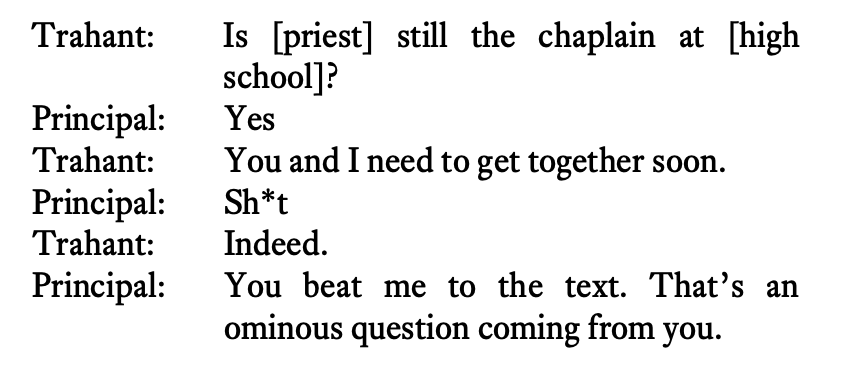
Trahant: Is [priest] still the chaplain at [high school]?
Principal: Yes
Trahant: You and I need to get together soon.
Principal: Sh*t
Trahant: Indeed.
Principal: You beat me to the text. That’s an ominous question coming from you.
Within days after the school learned about Hart, they released a statement announcing his sudden retirement. Both sides claimed Hart was stepping down “due to his ongoing battle with brain cancer.” Obviously the goal was to keep the allegations quiet.
But when the Times-Picayune wrote about Hart’s departure, reporter Ramon Antonio Vargas had the real scoop: Hart’s retirement was announced right after the school discovered the allegations of abuse against him.
The chaplain at Brother Martin High School abruptly left his post earlier this month, just days after the school was notified of allegations that he kissed and fondled a Mount Carmel Academy senior in 1990 while serving at another local Catholic institution, according to multiple sources with direct knowledge of the situation.
How was Vargas able to connect those dots?! The archdiocese clearly didn’t want anyone to know the real reason Hart was being let go, but Vargas seemed to have inside information.
Why the lawyer was fined for reporting the priest
It wasn’t until several months later when we finally learned the backstory. In a piece for the Guardian, written by none other than Ramon Antonio Vargas, he explained how he got a major tip from… attorney Richard Trahant.
It turned out that when Trahant alerted Brother Martin High School about Hart, he also emailed Vargas “advising him to ‘keep’ Hart on his ‘radar’, without saying why.”
Vargas began digging and it soon led to the scoop mentioned earlier, connecting Hart’s retirement with what seemed to be the actual reason for his departure.
When that story came out in late 2022, the judge in charge of the archdiocese’s bankruptcy proceedings, Meredith Grabill, realized that the only way a reporter could have learned any of those details was if someone working on the case leaked the information. That would have been a problem since all the documents were classified.
Grabill called for an investigation. While Vargas says he didn’t rat out his source(s), and openly told the investigators “Trahant did not provide any information in the piece,” Grabill said Trahant’s warning to the high school and his email telling Vargas to keep tabs on Hart violated the confidentiality agreement. So she punished him:
Grabill immediately removed from the clergy abuse claimants committee Trahant, two attorneys with whom he frequently collaborates and a number of clients. On Tuesday, she added the $400,000 fine against Trahant, saying the amount was derived from the cost of the leak investigation.
A $400,000 fine for warning a school about an alleged sex predator on their payroll.
Trahant said at the time he was appealing the decision. He also said in a publicly available deposition during the leak investigation that he acted like any mandated reporter: When he learned about wrongdoing, he reported it to relevant parties in order to protect potential victims.
“I don’t believe I violated the [confidentiality] order” by alerting a school about a cleric who had previously engaged in misconduct with a teen, the attorney said.
“I’m going to do something about it 10 out of 10 times.”
The bottom line is that Trahant did exactly what the Church should’ve done a long time ago. He took action when he realized there was a problem. But because his actions supposedly violated the letter of the law when it came to these bankruptcy hearings, he now faced this staggering fine.
The archdiocese practically gloated about all this:
“The wisdom of the judge’s ruling speaks for itself.”
The wisdom! You could practically feel the condescension in that statement.
Whatever the legal situation here, Trahant deserved a medal for what he did, not a fine. When the morally correct option stands in direct opposition to the law, you have to respect those who choose the former path. It may be a messed up situation, but everyone was better off because Trahant spoke up.
If the Catholic Church actually gave a damn about any of these victims, it would be first in line offering to pay Trahant’s fine on his behalf. He did them a favor by giving them information that led to the dismissal of a child sex predator.
Just because the law may have been on the Church’s side didn’t mean the Church should bask in victory. Their response showed how little they cared about the people they hurt.
That fine was later upheld
In January, Trahant’s attempt to overturn that decision failed. The Fifth Circuit Court of Appeals upheld the decision to fine him $400,000.
Trahant tried to argue he wasn’t given due process, that the bankruptcy court lacked jurisdiction over the matter, and that they abused their discretion by punishing him. The Appeals Court, for legal reasons irrelevant here, dismissed all of those arguments, finding that Trahant violated his confidentiality agreement.
Despite that, Trahant still maintained he would do it all over again to protect kids, telling reporters, “I did what I had to do to keep a child predator away from children,”
The aftermath
That brings us to where we’re at right now. Earlier this month, Trahant asked the U.S. Supreme Court to overturn the decision using the same basic arguments he made to the Fifth Circuit.
But there’s another twist, and it comes from none other than reporter Ramon Antonio Vargas. When Trahant was fined $400,000, the judge who issued it, Meredith Grabill, placed nearly all the information about the fine under seal, meaning it couldn’t be accessed by the public.
Vargas was able to get his hands on all of it.
But the Guardian has now obtained the entire case file, thousands of pages long, through a public records request made with New Orleans state prosecutors who collected it while securing the guilty plea of another priest charged with rape and kidnapping.
A review of the record provides the case’s clearest view yet – and establishes that Hart’s history was more stained than previously known.
…
Trahant, meanwhile, has long argued that the information which ended Hart’s Brother Martin tenure was actually disclosed by New Orleans’ then archbishop, Gregory Aymond – since retired – and associates, all subject to the same confidentiality order Grabill says that Trahant violated.
In short, the archdiocese knew that Hart was a predator and admitted as much to various school officials, violating the same agreement that Trahant—and only Trahant—was punished for.
When the Archdiocese stationed Hart inside the Catholic school, it was only after a “board advising Aymond on clergy abuse cases recommended that the archbishop remove Hart from ministry.” But after the school’s principal got the head’s up from Trahant via text message, he and other administration members began asking archdiocese officials if they knew anything about Hart that might be problematic.
Of course they knew. More importantly, they openly admitted things that Trahant merely hinted at.
The Brother Martin officials would say in depositions that Aymond and a lay volunteer adviser, Lee Eagan, shared specifics of the 2012 complaint against Hart. One suggested the archbishop disclosed the name of the complainant, which was confidential, though the official couldn’t remember it, according to a deposition.
Another Brother Martin official described learning from Aymond of “a boundary violation … that involved a 17-year-old female. The … behavior was not appropriate in that it was something that Father Paul, as a priest, should not have done. But the archbishop made it clear to me that it was not anything that was ever criminal.”
Nonetheless, had Brother Martin known that about Hart beforehand, it would not have accepted him as chaplain, multiple school officials said while being deposed.
The school forced out Hart only because of confidential details they learned from the archdiocese. They didn’t get rid of Hart because Trahant expressed his concern. Yet only Trahant was punished for violating a confidentiality agreement.
Former Archbishop Aymond said in a deposition that he never shared confidential information with school officials. That, it turns out, was a lie.
That’s why Trahant believes he shouldn’t be punished:
[Trahant] contends, among other things, that Aymond effectively waived confidentiality about Hart when he spoke extensively to Brother Martin officials. Trahant has also said he was within his rights to tell a reporter to keep a priest on his radar without sharing anything else.
Trahant’s 6 May request for a chance to appeal to the US supreme court says he deserves to defend his “good name, reputation, honor and integrity” from “judicial action taken without notice and an opportunity to be heard”.
While all that’s happening, the archdiocese is in chaos. Aymond retired earlier this year shortly after “the archdiocese and its insurers agreed to pay about $305m to roughly 600 abuse survivors ensnared in the bankruptcy.” Dozens of those survivors are clients of Trahant.
The entire case has just been a huge series of systemic failures. The Catholic Church chose self-protection over accountability and the well-being of minors. The bankruptcy proceedings just became another tool for the Church to bury the truth and punish someone who took the moral high ground.
If there’s anything we can take away from this situation, it’s that we need more people like Richard Trahant. He did what the Church repeatedly fights against: He treated credible allegations as an urgent danger, not just some administrative inconvenience. He warned a school. He indirectly tipped off a journalist. But what we now know is that the archdiocese itself confirmed the very things Trahant alluded to. There’s no logic that says he should be punished for violating a confidentiality agreement when the Catholic Church went even further. Trahant’s moral clarity and personal courage stands in contrast to the values that the Church likes to think it instills in people but never actually does.
All of this sends a chilling message to whistleblowers: When it comes to legal priorities, a policy of secrecy always overrides the idea of child safety. The Church and the courts have made it clear that speaking up to protect kids could ruin you financially, but silence will always be rewarded.
(Portions of this article were published earlier)
I do not know why membership in the Catholic Church isn’t down to zero. Then again, I’m assuming people are rational and will act in their self interests. The Catholic Church brain washes children from birth and they are masters at using guilt to shape behavior. Unfortunately far too many are left shackled with behavior patterns they cannot break.
𝑇ℎ𝑒 𝑏𝑜𝑡𝑡𝑜𝑚 𝑙𝑖𝑛𝑒 𝑖𝑠 𝑡ℎ𝑎𝑡 𝑇𝑟𝑎ℎ𝑎𝑛𝑡 𝑑𝑖𝑑 𝑒𝑥𝑎𝑐𝑡𝑙𝑦 𝑤ℎ𝑎𝑡 𝑡ℎ𝑒 𝐶ℎ𝑢𝑟𝑐ℎ 𝑠ℎ𝑜𝑢𝑙𝑑’𝑣𝑒 𝑑𝑜𝑛𝑒 𝑎 𝑙𝑜𝑛𝑔 𝑡𝑖𝑚𝑒 𝑎𝑔𝑜. 𝐻𝑒 𝑡𝑜𝑜𝑘 𝑎𝑐𝑡𝑖𝑜𝑛 𝑤ℎ𝑒𝑛 ℎ𝑒 𝑟𝑒𝑎𝑙𝑖𝑧𝑒𝑑 𝑡ℎ𝑒𝑟𝑒 𝑤𝑎𝑠 𝑎 𝑝𝑟𝑜𝑏𝑙𝑒𝑚. 𝐵𝑢𝑡 𝑏𝑒𝑐𝑎𝑢𝑠𝑒 ℎ𝑖𝑠 𝑎𝑐𝑡𝑖𝑜𝑛𝑠 𝑠𝑢𝑝𝑝𝑜𝑠𝑒𝑑𝑙𝑦 𝑣𝑖𝑜𝑙𝑎𝑡𝑒𝑑 𝑡ℎ𝑒 𝑙𝑒𝑡𝑡𝑒𝑟 𝑜𝑓 𝑡ℎ𝑒 𝑙𝑎𝑤 𝑤ℎ𝑒𝑛 𝑖𝑡 𝑐𝑎𝑚𝑒 𝑡𝑜 𝑡ℎ𝑒𝑠𝑒 𝑏𝑎𝑛𝑘𝑟𝑢𝑝𝑡𝑐𝑦 ℎ𝑒𝑎𝑟𝑖𝑛𝑔𝑠, ℎ𝑒 𝑛𝑜𝑤 𝑓𝑎𝑐𝑒𝑑 𝑡ℎ𝑖𝑠 𝑠𝑡𝑎𝑔𝑔𝑒𝑟𝑖𝑛𝑔 𝑓𝑖𝑛𝑒.
The Church should have been doing what Trahant did starting 20 centuries ago. If SCOTUS upholds the fine, and I suspect they will given the number of justices connected to the RCC, is there a gofundme set up so we can help Trahant clear the unjust debt?