
This newsletter is free and goes out to over 24,000 subscribers, but it’s only able to sustain itself due to the support I receive from a small percentage of regular readers. Would you please consider becoming one of those supporters? You can subscribe via Patreon or the Subscribe button below! You can also make one-time donations through Venmo or PayPal.
In a predictable but utterly awful ruling, the Fifth Circuit Court of Appeals has just ruled that Texas can force public schools to put up posters of the Ten Commandments, giving Christian Nationalists a new way to impose their religious beliefs onto children.
This will undoubtedly be appealed to the Supreme Court, but that risks exposing the rest of the country to Christian indoctrination in schools.
First, let’s remember how we got here.

Last year, Texas lawmakers passed a bill, appropriately titled SB 10, to shove the Commandments into schools despite widespread opposition. (Democrat James Talarico, now a U.S. Senate candidate, did his best to highlight the hypocrisy of the people voting for the bill as well as the possible backlash it might receive.)
Like so many other iterations of these bills, this one said every classroom would have to display a durable or framed 16” x 20” poster of the Ten Commandments—King James’ Version only. They could be privately donated or bought “using district funds.” All of the posters would have to read as follows:
The Ten Commandments
I AM the LORD thy God.
Thou shalt have no other gods before me.
Thou shalt not make to thyself any graven images.
Thou shalt not take the Name of the Lord thy God in vain.
Remember the Sabbath day, to keep it holy.
Honor thy father and thy mother, that thy days may be long upon the land which the Lord thy God giveth thee.
Thou shalt not kill.
Thou shalt not commit adultery.
Thou shalt not steal.
Thou shalt not bear false witness against thy neighbor.
Thou shalt not covet thy neighbor’s house.
Thou shalt not covet thy neighbor’s wife, nor his manservant, nor his maidservant, nor his cattle, nor anything that is thy neighbor’s.
The law also included a provision requiring the attorney general of the state to defend districts that got sued over this. If they were to lose the case, the state would then be “liable for the expenses, costs, judgments, or settlements of the claims arising out of the representation.” Which is to say if this ended up backfiring on Christian Nationalists, don’t worry, because taxpayers would foot the bill for their ignorance.
The Republicans (and a handful of Democrats) ignored all the opposition to this bill, including a letter signed by over 150 Christian and Jewish leaders who said it “undermines the faith and freedom we cherish.”
You can read more details about the lawsuit and the Plaintiffs here.
In short, though, the lawsuit noted that a SCOTUS decision from a case nearly five decades ago, Stone v. Graham, declared a virtually identical law in Kentucky unconstitutional. The lawsuit also said that in the Stone case, and more recently in Louisiana, the Ten Commandments were required to have a “context statement”—a disclaimer of sorts—alongside the posters, explaining the supposed historical relevance of the Decalogue. They didn’t even bother with that in Texas. So if those previous laws were declared illegal, this one was even more egregious.
In August, a federal judge sided with the church/state separation crowd, putting a temporary hold on the ridiculous law… but only in a handful of districts. An amended lawsuit was successful in preventing the law from going into effect in other districts too. It became a huge game of Whac-A-Mole where schools districts had to decide whether to put up posters they knew were illegal and risk getting sued by church/state separation groups… or risk getting sued by a scandal-plagued and highly litigious Republican attorney general (Ken Paxton) breathing down their necks.
Before long, Paxton just asked the full Fifth Circuit to decide the issue in both Texas and Louisiana:
Texas Attorney General Ken Paxton asked the 5th Circuit Court to overturn Biery’s ruling and allow all 17 active judges on the court to hear both the Texas and Louisiana cases together.
A federal judge blocked Louisiana’s Ten Commandments law from taking effect in 2024, a decision unanimously upheld last year by a panel of three judges on the 5th Circuit Court. With all active judges on the court now hearing the cases, Texas and Louisiana officials hope for a more favorable ruling.
Twelve of the appeals court’s 17 active judges were appointed by Republican presidents. The court is considered one of the most conservative in the nation.
And now his demand has been rewarded.
Today, a majority of the Fifth Circuit judges said the Texas law could be implemented as written. It was a 9-8 decision.
The families who sued said the imposition of the Commandments violated the First Amendment’s Establishment Clause and coerced their children into accepting the Christian faith. The judges rejected both arguments.
They said the Stone precedent was no longer in effect because the justification for that decision—the “Lemon test,” which offered a method to determine if a law violated church/state separation—had been killed off by the U.S. Supreme Court.
“With Lemon extracted,” they wrote, “there is nothing left of Stone.”
What about the Establishment Clause claim? Didn’t the posters suggest government promotion of Christianity?
The judges said no because no one was forcing Christian views on anyone:
S.B. 10 looks nothing like a historical religious establishment. It does not tell churches or synagogues or mosques what to believe or how to worship or whom to employ as priests, rabbis, or imams. It punishes no one who rejects the Ten Commandments, no matter the reason. It levies no taxes to support any clergy. It does not co-opt churches to perform civic functions. These are the kinds of things “establishments of religion” did at the founding. S.B. 10 does none of them.
Plaintiffs counter that, like historical establishments, S.B. 10 is “coercive” because it pressures children to honor the Ten Commandments. Not so. S.B. 10 requires no religious exercise or observance. Students are neither catechized on the Commandments nor taught to adopt them. Nor are teachers commanded to proselytize students who ask about the displays or contradict students who disagree with them.
They’re essentially saying there’s nothing Christian about the Christian commandments. It’s just a list devoid of any context. By the same logic, Texas could pass a law to put up The Satanic Temple’s Seven Fundamental Tenets and that would be fine, but they happened to choose this list, so what’s the big deal?
Similarly, they said that because kids don’t have to do anything in response to the posters, it’s not really coercive either.
To Plaintiffs, merely exposing children to religious language is enough to make the displays engines of coercive indoctrination. We disagree.
Another argument the Plaintiffs made was that there was “no longstanding tradition” of displaying the Ten Commandments in public spaces and no legal precedent to back up that notion. That mattered because, with the Lemon Test gone, the Supreme Court has relied on the fickle idea of tradition. If a Christian cross, for example, has been up on city property for decades and decades without complaint, then that’s justification enough for it to be allowed to remain there. This lawsuit, however, said that argument couldn’t work here because a tradition of putting Ten Commandments posters up in schools didn’t exist.
The judges just dismissed that whole argument. They said that tradition might be fine to invoke when it comes to invocation prayers at governments meetings, but the “opposite” logic—that a lack of pushing the Ten Commandments in schools means we shouldn’t do it now—is a “bizarre view” that can’t be justified. Apparently, the only way the tradition argument can be used is to allow something that used to happen, not prohibit something that never happened.
By saying that, they also dismissed all the expert testimony that said this practice of shoving Christianity in the classroom was a modern creation—a very simple way to ignore the facts.
The idea that the posters would pressure kids into accepting Christianity was also rejected by these judges. They compared it to the Pledge of Allegiance—which is also religious, with its “one Nation, under God” line—to argue that students aren’t forced to say it. Therefore, they conclude, the Commandments don’t burden anyone’s religious exercise.
The dissenting judges in this case were apoplectic about what their colleagues just did. Writing for the group, Judge Irma Carrillo Ramirez wrote:
Because legislation requiring the permanent fixture of religious rules in public-school classrooms, with no “educational function,” violates these most basic First Amendment principles, I respectfully dissent.
The dissenters wrote that the Stone precedent is very much still in effect even if the Lemon test is no longer being used. They even cited the Kennedy case—the one about the showboating football coach who demanded the right to perform his prayers at midfield after games—to say that the Supreme Court still prohibits religious coercion. Kennedy was allowed to continue his prayers because students weren’t theoretically involved; the Ten Commandments law, however, directly impacts kids.
To argue otherwise ignores the unique context of placing religious scripture in public-school classrooms where, “given the impressionability of the young, government must exercise particular care in separating church and state”… It also ignores the self-evident nature of the Ten Commandments: they “command” the reader to follow certain directives. Those directives are largely religious in nature.
As one dissenting judge pointed out, there’s no way to interpret these Commandments other than as a call to adopt a specific version of Christianity:
Texas children will naturally examine these posters and be left to reflect on the fact that one religion—different from the one they observe in their home, their synagogue, their mosque, or other place of worship—was selected to be in their school as a representation of what? An expectation of a model student? A good citizen? A properly devout person? The majority insists that students will not be “catechized,” but forgets their curiosity. Surrounded by the Ten Commandments displays, students will wonder about “the LORD”; they will wonder about “other gods”; they will wonder about “graven images”; they will wonder about “kill[ing]”; they will wonder about “adultery”; they will wonder about “covet[ing]” a neighbor’s wife... Teachers inevitably will be asked to answer these questions, but Texas parents did not entrust public-school teachers with the spiritual education of their children. It is a parent’s right to have these conversations—not inside the classroom, absent their input, but with their children, present at home.
They also pointed out that there’s no way to opt out of this situation. Students may not have to say the Pledge, but they can’t escape looking at these posters.
Stated simply, “the right of parents ‘to direct the religious upbringing of their’ children would be an empty promise if it did not follow those children into the public school classroom”… If schools across Texas must display this scripture, then today our court ordains that empty promise.
The church/state separation groups that filed this lawsuit expressed their disappointment in the decision and announced that they have every intention of fighting this even more:
"We are extremely disappointed in today’s decision. The Court’s ruling goes against fundamental First Amendment principles and binding U.S. Supreme Court authority. The First Amendment safeguards the separation of church and state, and the freedom of families to choose how, when and if to provide their children with religious instruction. This decision tramples those rights. We anticipate asking the Supreme Court to reverse this decision and uphold the religious-freedom rights of children and parents.”
So what happens now, other than the possible appeal?
It’s not clear. The Texas law is back in effect, and districts that receive donations of the posters will be required to put them up. But there’s nothing preventing malicious compliance or other posters (with better moral teachings) from going up alongside them.
Hell, a couple of months ago, a website went up offering well-designed Ten Commandments posters that meet all the requirements of the Texas bill (and ones in other states) that might make Republicans rethink their own law.
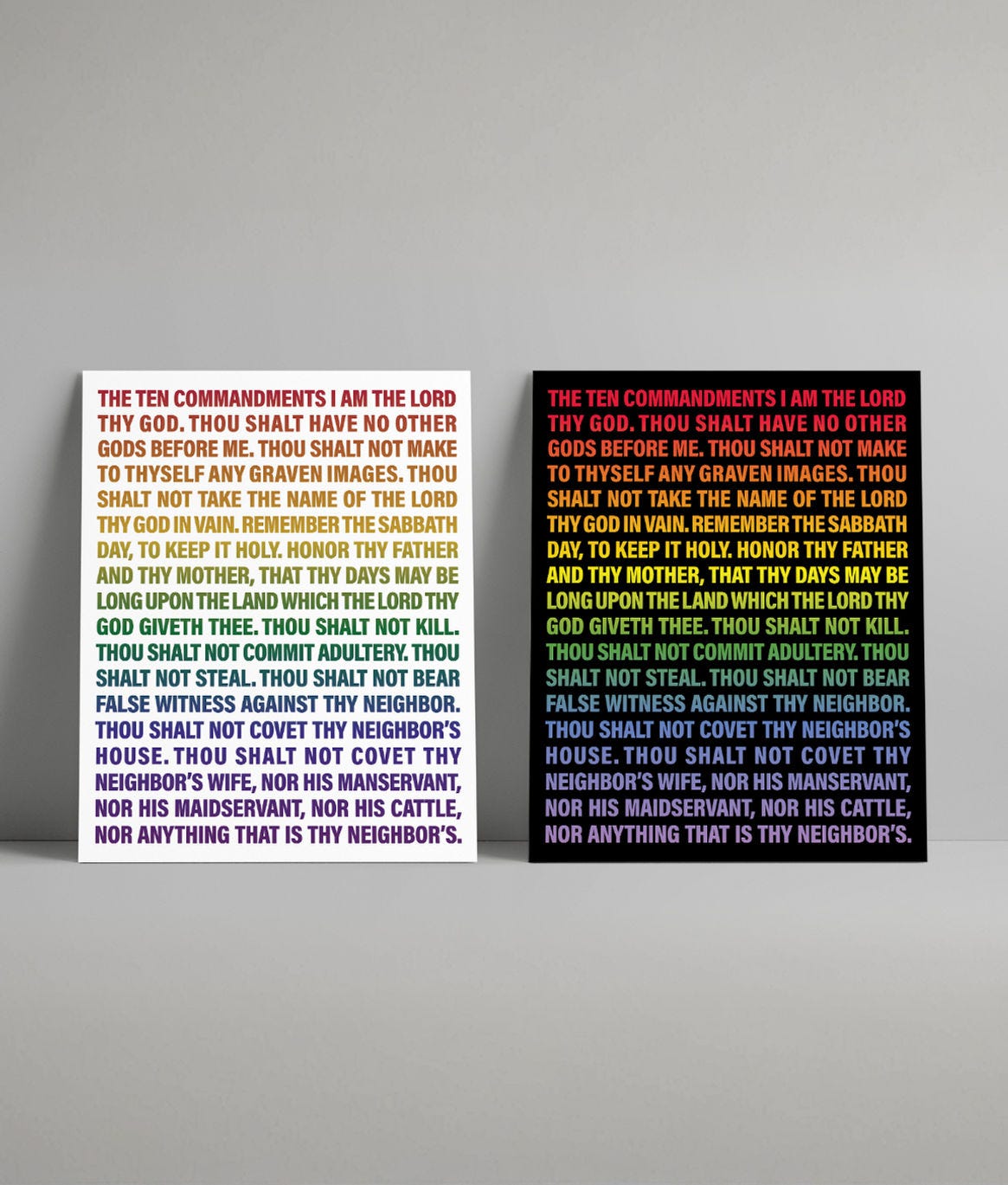
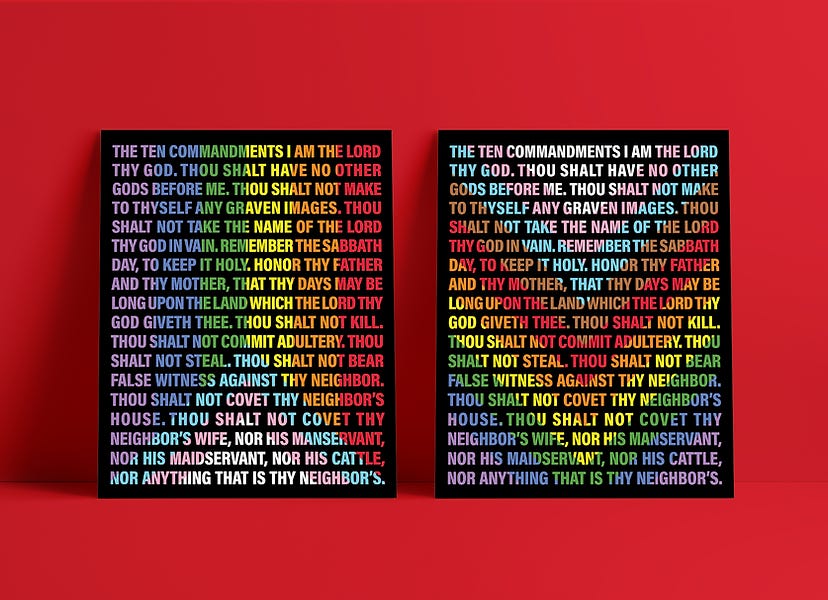
But the bottom line is that Texas conservatives have used the courts to tell kids which religion counts—and which ones don’t. They’re sending a message that kids from non-Christian families (or the “wrong” kind of Christian ones) are second-class citizens.
Texas passed an illegal law, made up details about American history to defend their position, practically bragged about their true intentions along the way, and the Fifth Circuit gave them the victory they wanted anyway. It’s a disaster for anyone who believes in church/state separation and a classroom free of religious coercion.
The Christians who are celebrating today’s ruling would be furious if schools put up lists of Islamic or humanistic moral lessons, even though that would be legal using the same logic that the Fifth Circuit is using today, but because they believe their religion is superior to all others, they’re not going to complain at all.
(This is a breaking story and may change as new information comes in. Portions of this article were published earlier)
Oh, goodie! I was 𝘫𝘶𝘴𝘵 wondering when the Fifth Circuit was going to take another giant steaming dump on the Constitution. Now I don't have to wonder anymore!
If you have to force the religion you think is so great and wonderful on others, then maybe you should consider the fact that your religion is pretty shitty.