
This newsletter is free and goes out to over 24,000 subscribers, but it’s only able to sustain itself due to the support I receive from a small percentage of regular readers. Would you please consider becoming one of those supporters? You can subscribe via Patreon or the Subscribe button below! You can also make one-time donations through Venmo or PayPal.
In dozens of countries worldwide, more people are ditching Catholicism than entering into it, including countries where Catholicism is the default religion for many citizens. It suggests a perilous future for the Church if it can’t find new ways to bring people into the fold.
There’s a phrase for this: Religious switching. It’s when you were raised in one religious tradition but have since gone on to a different one. It’s been happening a lot in recent years and it threatens to upend one of the most basic beliefs about belief: That if you raise your children in your faith, it’ll stay with them in the future.
Think about that for a moment. One of the reasons religion has historically had so much power is because parents could safely assume that if they indoctrinated their kids from a young age, those beliefs and traditions will live on indefinitely. It’s the very idea at the core of the Quiverfull movement, famously exemplified by the Duggars: If you have lots of children, the religion will eventually spread to their own families, and within a few generations, your religion will mathematically outgrow all the other ones.
But the vertical continuation of religion isn’t a safe assumption.
People make friends outside their religious bubble when they go to school. They date and marry people who don’t share their faith (though their values likely overlap). They live in diverse communities where there’s no “default” faith, making the spread of different ideas a little easier. There’s also less stigma today in saying you’re not religious (or not Christian). That means the pressure to remain in the fold has largely evaporated. And, of course, there’s the internet, which allows people to see what life is like outside their particular bubbles.
When it comes to religion in general, the switching is intense. It’s especially bad news for the Catholic Church because far more people are leaving than entering.
Just take in this incredible chart from the Pew Research Center showing the percentages of people who have “switched” into or out of Catholicism in various countries. The blue bars represent people who left Catholicism despite being raised in the faith. The yellow bars show people who decided to convert to Catholicism.
In nearly every case, the blue bars dwarf the yellow ones. And in the few cases where Catholic converts outnumber those who’ve escaped, it’s only by a small amount.
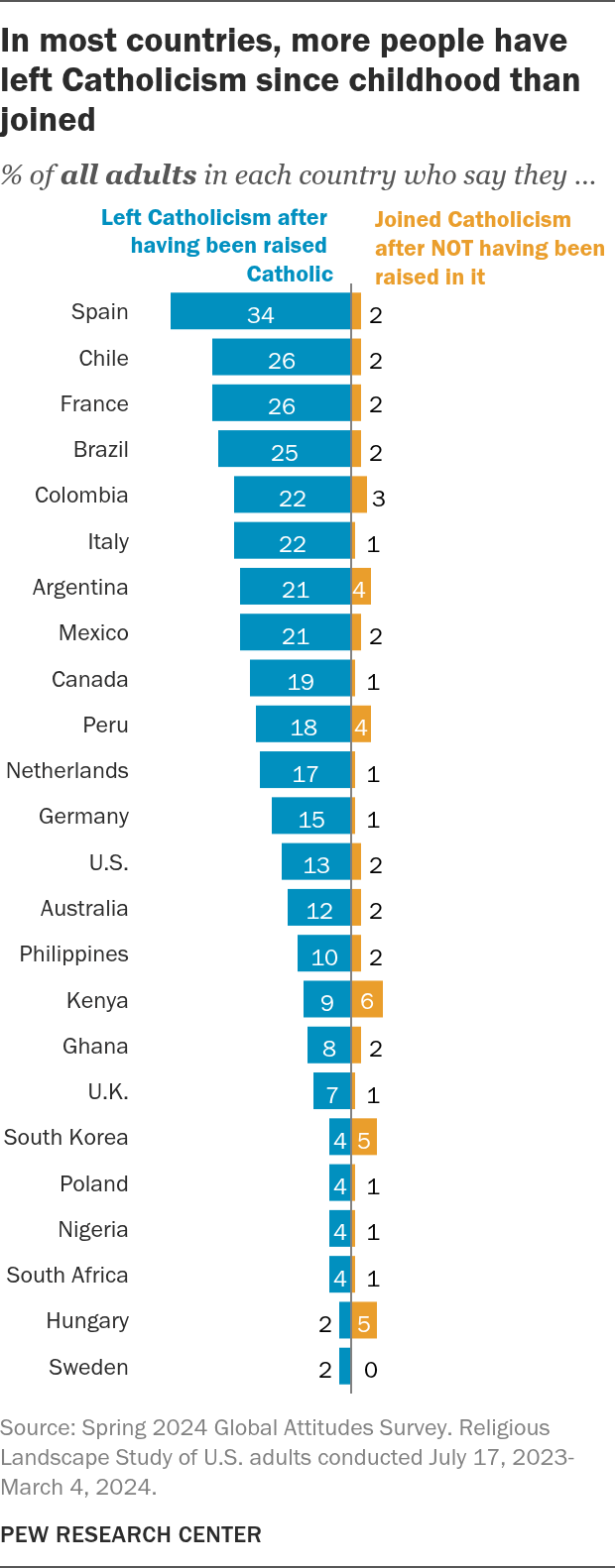
Overall, more people left Catholicism than joined it in 21 of the 24 countries we analyzed. Hungary is the only country surveyed where more people joined (5%) than left the church (2%). In the remaining two countries – Kenya and South Korea – similar shares entered and exited Catholicism through switching.
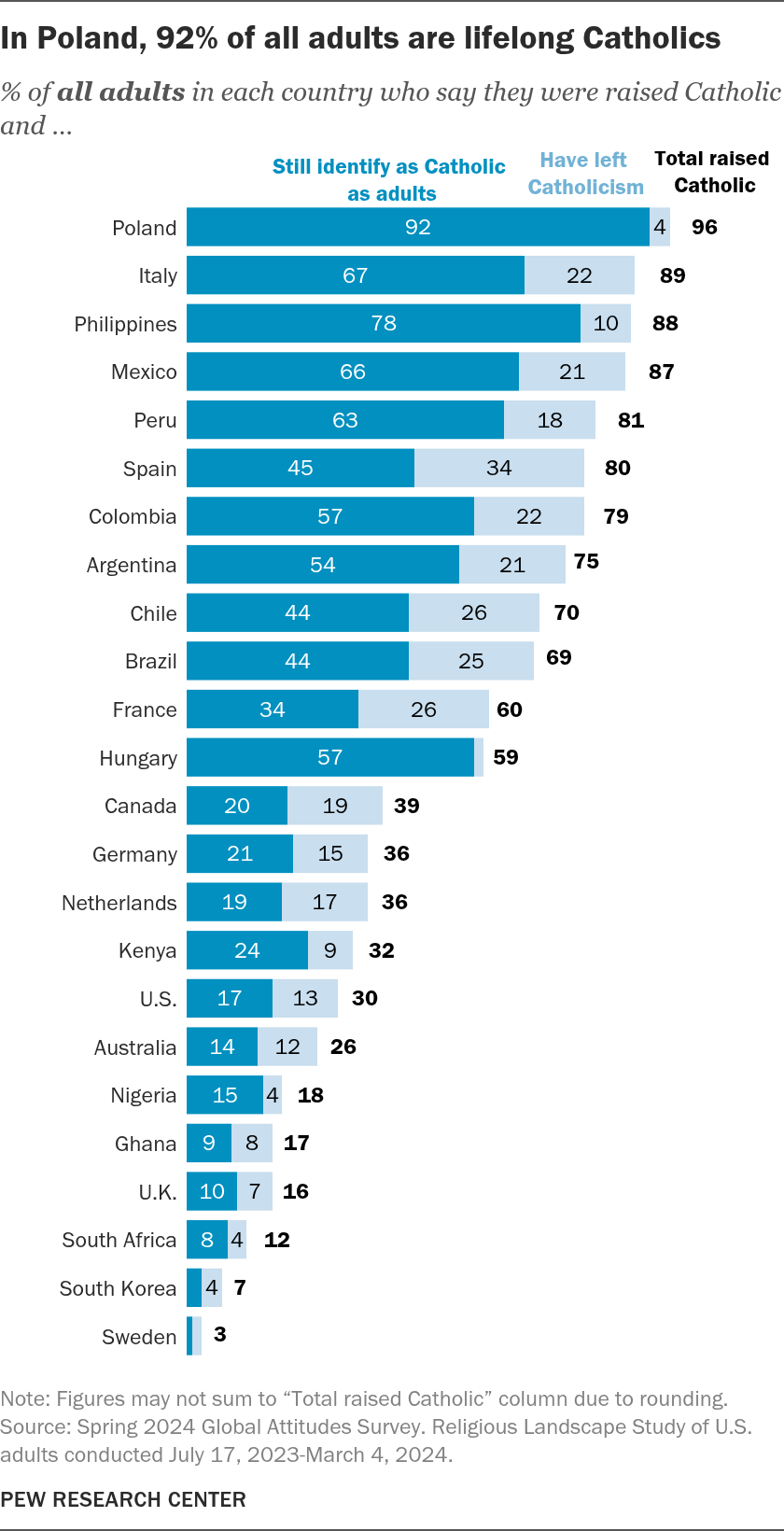
It also helps to know how Catholic these nations were to begin with to better understand how porous they now are. Poland, for example, is almost entirely Catholic with a low leak rate. But Italy, which is also heavily Catholic, is on track to lose quite a few believers over the next few generations. (And who knows what might happen to religion in Hungary now that the autocrat Viktor Orbán has been ousted.)
The big question is: Why is this happening? The analysis doesn’t go into all that, but I would argue a lot of this is simply the Catholic Church shooting itself in the foot. Blame the sex scandals, the blatant hypocrisy, the desperate attempts by some conservative Catholics to worship Donald Trump while abandoning Jesus, the easy access to material for people questioning their faith, etc. Or maybe JD Vance’s relatively recent conversion scared them away.
It’s tempting to say these trends may reverse with Pope Leo at the helm, but so far, he’s really no different from his predecessor in terms of his PR savvy and positions on issues. And while some American dioceses are celebrating a rise in new converts—and receiving fawning media coverage for their self-reported numbers—the overall trend is still not good news for them.
Before you celebrate the global demise of religion, though, it’s important to recognize these trends aren’t the same for Protestantism. If you do the same kind of analysis in the same countries, you find that the shifts aren’t quite as drastic. In fact, Pew says, “Protestantism has seen a net gain from switching in nearly as many places as it has seen a net loss.” Those gains are especially noticeable in Latin America:
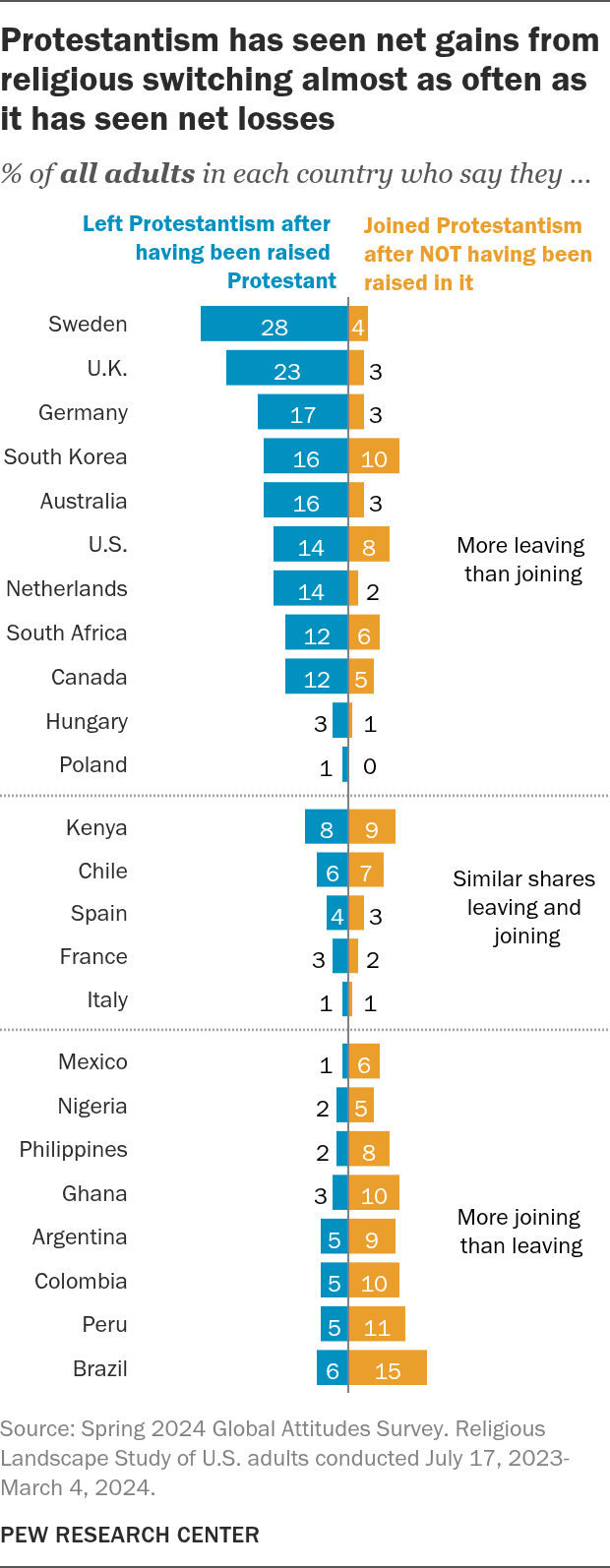
The question in places like Brazil and Ghana is whether those gains will remain in place in years to come. Or will people who switch to Protestantism eventually leave that religion for the same reason so many people are leaving Catholicism? It’s too early to tell.
If there’s a broader takeaway here, it’s that religious institutions no longer get to assume permanence. People around the world are willing to reconsider their religious upbringing and that sort of thinking is contagious. When you realize you don’t have to be trapped in a faith you no longer believe in and whose beliefs in certain areas are indefensible, it’s much easier to walk away when you see others doing it. Right now, the Catholic Church is hemorrhaging credibility faster than it can replace it.
(Portions of this article were published earlier)
The Catholic Church and I went our separate ways over half a century ago, and I never regretted that decision. I did not, however, simply trade old nonsense for new and left religion all together. Maybe if the church could bring back burning heretics and witches alive after having tortured confessions out of them they could turn this around. I have contended for a long time the staggering number of Christian tribes should be a far bigger problem for believers than it is. It speaks to a divine being who supposedly willed the universe into existence, but when it came to the most important message imaginable, . . . couldn’t make himself understood. It also speaks to the complete lack of objective evidence to support the church’s claims.
It would be interesting to see the statistics for Islam around the world, too. Muslim communities are surely more close-knit than Catholic ones with more pressure to stay at least nominally within the faith.