
This newsletter is free and goes out to over 25,000 subscribers, but it’s only able to sustain itself due to the support I receive from a small percentage of regular readers. Would you please consider becoming one of those supporters? You can subscribe via Patreon or the Subscribe button below! You can also make one-time donations through Venmo, CashApp, or PayPal.
PERSONAL NOTE: Tonight, I’ll be interviewing Congressman Jared Huffman, the only openly Humanist member of Congress, about his new book No Prophets: The Fight to Save Democracy from Christian Nationalism (affiliate link). It’s a fascinating exploration of the impact religion has on our government.
If you’d like to tune in, you can do so here!
Australia’s Bureau of Statistics conducts its census every five years, and it’s a valuable tool to understand the shifting religious demographics in the country. Unfortunately, because of the way the religion question is worded, the results will once again severely undercount the percentage of non-religious people.
That’s not speculation either. We can now say that with evidence thanks to a new survey sponsored by the “Census – Not Religious? Mark No Religion” campaign.
We’ll get to their results in a moment, but it helps to understand the dilemma.
All of this is a topic of conversation because the percentage of Australians with no religious affiliation has jumped from 22.2% in 2011, to 30.1% in 2016, to an astonishing 38.9% in 2021, marking a rapid shift away from organized religion.

While Christianity was still the most popular religion in Australia in 2021, that year marked the first time the majority of Australians said they were not Christian. There was even reason to believe that, by 2026, non-religious people could outnumber Christians given that 46% of Millennial Australians had no religion, compared to 30% of Baby Boomers.
But all of that really depends on how the religion question is worded… and that question has been the subject of all kinds of controversies over the years.
Here’s how the question looked in 2011:
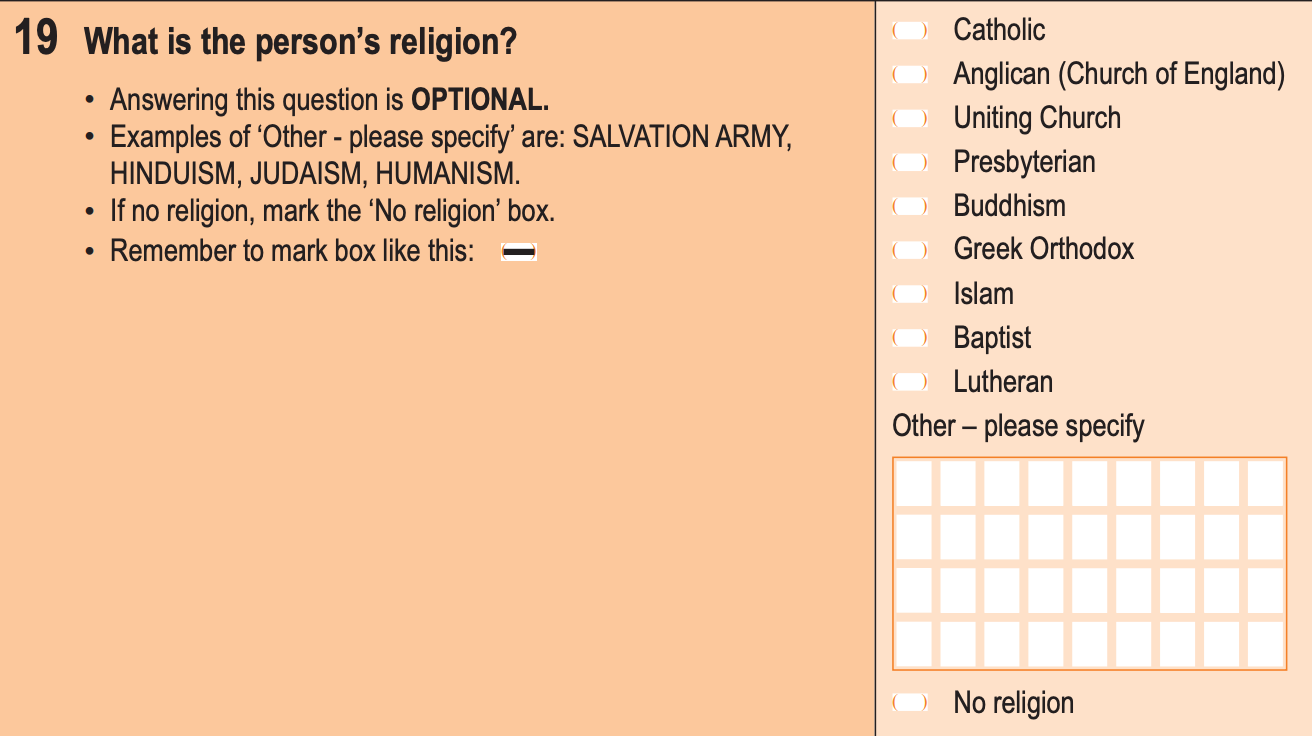
You can see that “No religion” was placed in No Man’s Land at the bottom of a long list of options… including Other! It was so confusing! How many people saw the first options on the list and just filled in the bubble for whatever religion they were raised in regardless of what they actually believed? It was a horrible way to get accurate information.
In 2016, the question got a little better. “No religion” was placed at the top of the list, making it much more likely that people who left organized religion would see it and mark it.
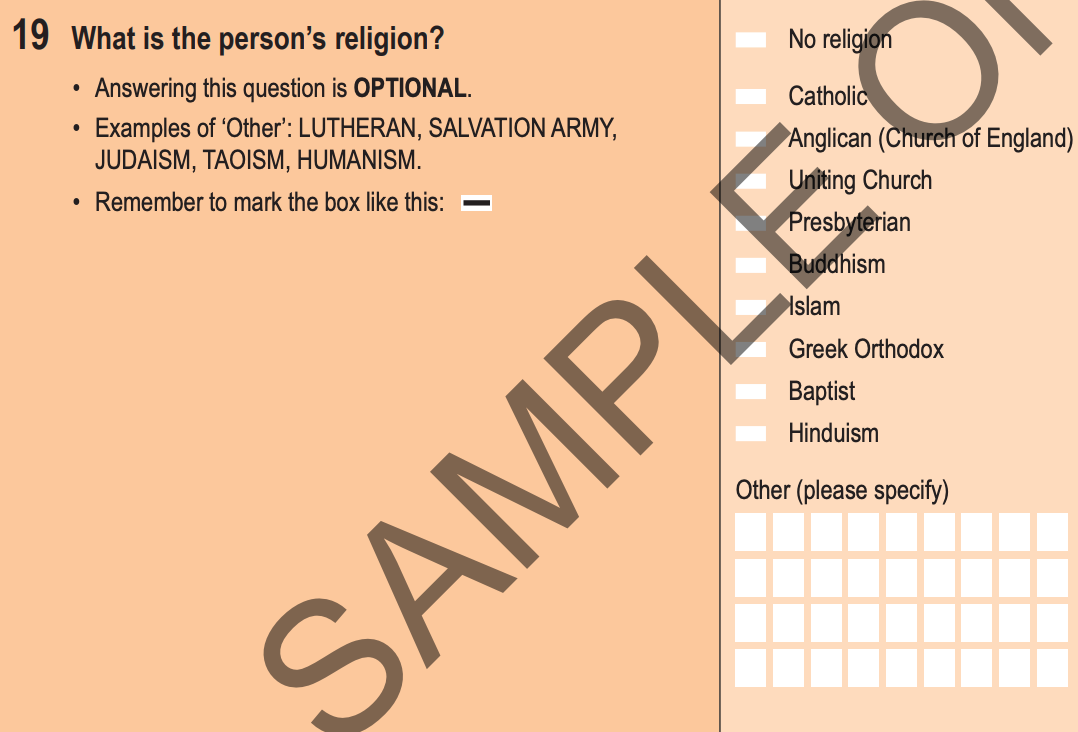
But even then, it wasn’t perfect.
People without religion usually don’t use that language; they might use a specific label (e.g. atheist, agnostic, Humanist, etc). Plus, the way the question was laid out, it wasn’t clear whether a Humanist should fill in “No religion” or write in “Humanist” under “Other” like the instructions literally told them to do! (While the data collectors would eventually group those together, it was still confusing!)
There was another problem as well: The question itself—”What is the person’s religion?”—was biased because it assumed people were religious. It was coercive, in a way, because it implied you should have a religion and that not having one put you in a separate category.
Despite those legitimate complaints, the 2021 census posed the religion question the same way. (It was arguably worse than before because “Atheism” was explicitly listed as an example of “Other” as opposed to “No religion.”)
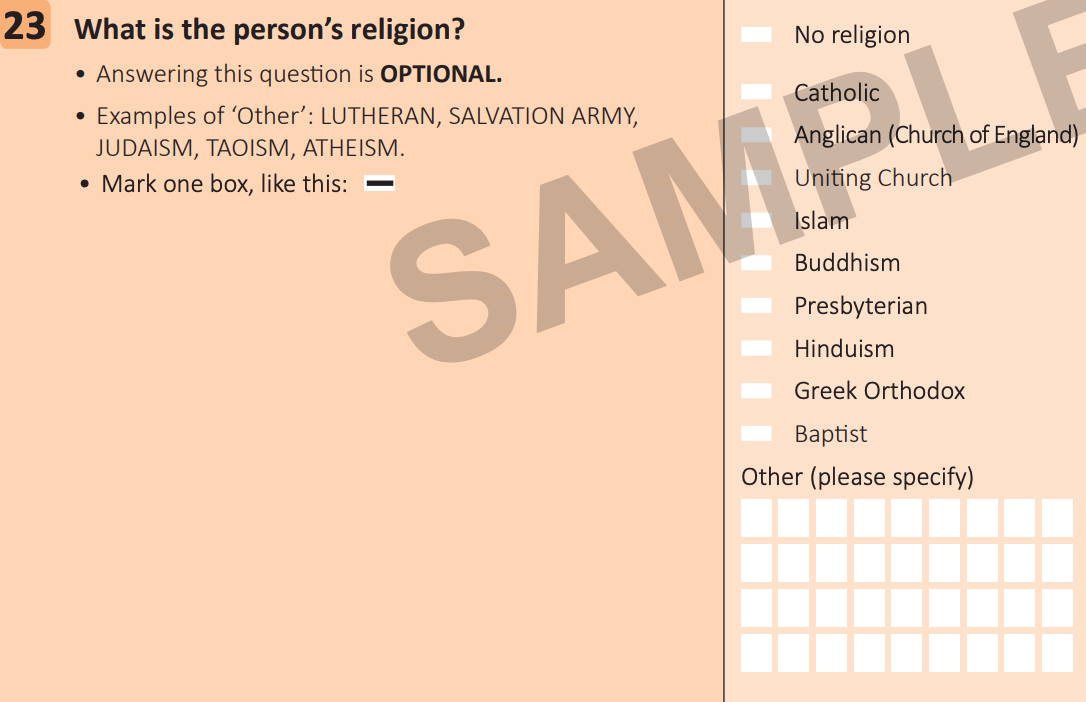
The bottom line is that the number of non-religious Australians—a number that has been on the rise for decades now—may be even larger than the census results show in part because of the misleading nature of the question itself.
Then consider all the other reasons people may have walked away from organized religion in the past decade. Since the 2016 census, marriage equality got legalized. When subjects like euthanasia and abortion became political battles, conservative religious views lost the argument over and over again. More Australians have come to realize that their sense of moral decency is incompatible with the bigoted views of the most powerful religious groups in the country. And on top of that, there have been plenty of scandals involving the most prominent Christian preachers in the country, including Brian Houston of Hillsong.
We’ve also seen campaigns by non-theistic groups urging people to mark “No religion” on the census as opposed to the more frivolous “Jedi.” They even put up billboards telling people to be honest if they’re not religious rather than filling in the religion in which they were raised or one that they only call themselves for cultural reasons.
That’s why there’s been such a jump in the “No religion” numbers. Australia is witnessing a massive shift in religious identity, and that’s true no matter how poorly the question is worded on the census.
But accurate information is important.
When Australia was gearing up for its 2026 census, atheists once again urged officials to ask the religion question in a way designed to obtain more honest results. In fact, in 2023, a coalition of non-theistic organizations in Australia called on the Bureau of Statistics to change the question by simply asking it in two parts:
“Does the person have a religion?”
(If yes) “What is the person’s religion?”
By asking it that way, not only would the assumption that everyone has a religion disappear, it would allow people to offer their own religious labels rather than picking from a pre-selected list of popular ones.
Indeed, the Bureau of Statistics tested that very model to see if it could work.
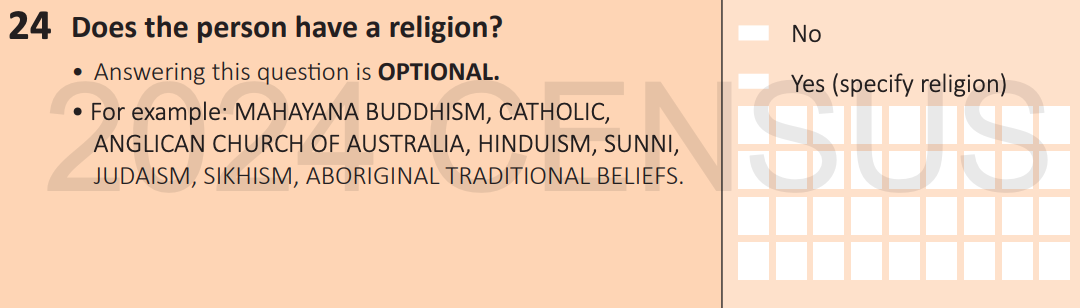
Unfortunately, last year, the Bureau announced it would not be making any changes to the religion question in 2026, mostly so it would be easier to compare future results with previous iterations of the question. They added that they also didn’t have enough time to test different variations of the question and analyze the potential consequences, which they would need to do before implementing it.
The feedback from consultation highlighted that it is not possible to design a question(s) that will meet the range of needs identified. In addition, understanding the impact that a question change would have on response patterns and comparability between Censuses requires a more extensive testing program than was possible within the 2026 Census timeframes.
Following the extended consultation, the ABS has decided to retain the question design used in the 2021 Census. This includes the question wording ‘What is the person’s religion?’, the 10 response categories, and a write-in box for other religions.
That said, the religion section will include additional instructions to “encourage respondents to use the write-in box if their religion… is not one of the response categories.” They will also remove “Atheism” as an example of “Other” so that there’s less confusion about which box atheists should mark.
There may be another reason they didn’t change the question, though: direct lobbying from powerful religious groups. The Rationalist Society of Australia’s Si Gladman published evidence that the Australian Catholic Bishops Conference literally asked the government not to change the question in 2026 because it would lead to “unwarranted complication for people who wish to record their religion.” Which is a fancy way of saying the Catholic Church doesn't want the public to realize it's rapidly losing its grip on society. The government didn’t mention the lobbying when explaining their reason for not changing the wording.
For that reason, the “Census – Not Religious? Mark No Religion” campaign decided to run its own version of the census with the question properly worded. They commissioned an outside group, Essential Media, to ask respondents two versions of the religion question to 2,000 people each: the official version… and the proposed revision.
For the first group (the official version), 43% of respondents marked “No religion,” which would be a small but predictable increase from 2021 if it actually played out that way.
But. The revised version of the question led to completely different results.
… when given a “yes/no” option first (“do you have a religion?”), followed by a text box to fill in if “yes” was selected, 54% of respondents picked “no”. That translates to about 2 million more adults without religion.
As predicted, the more accurate version of the question suggests an even less religious population.
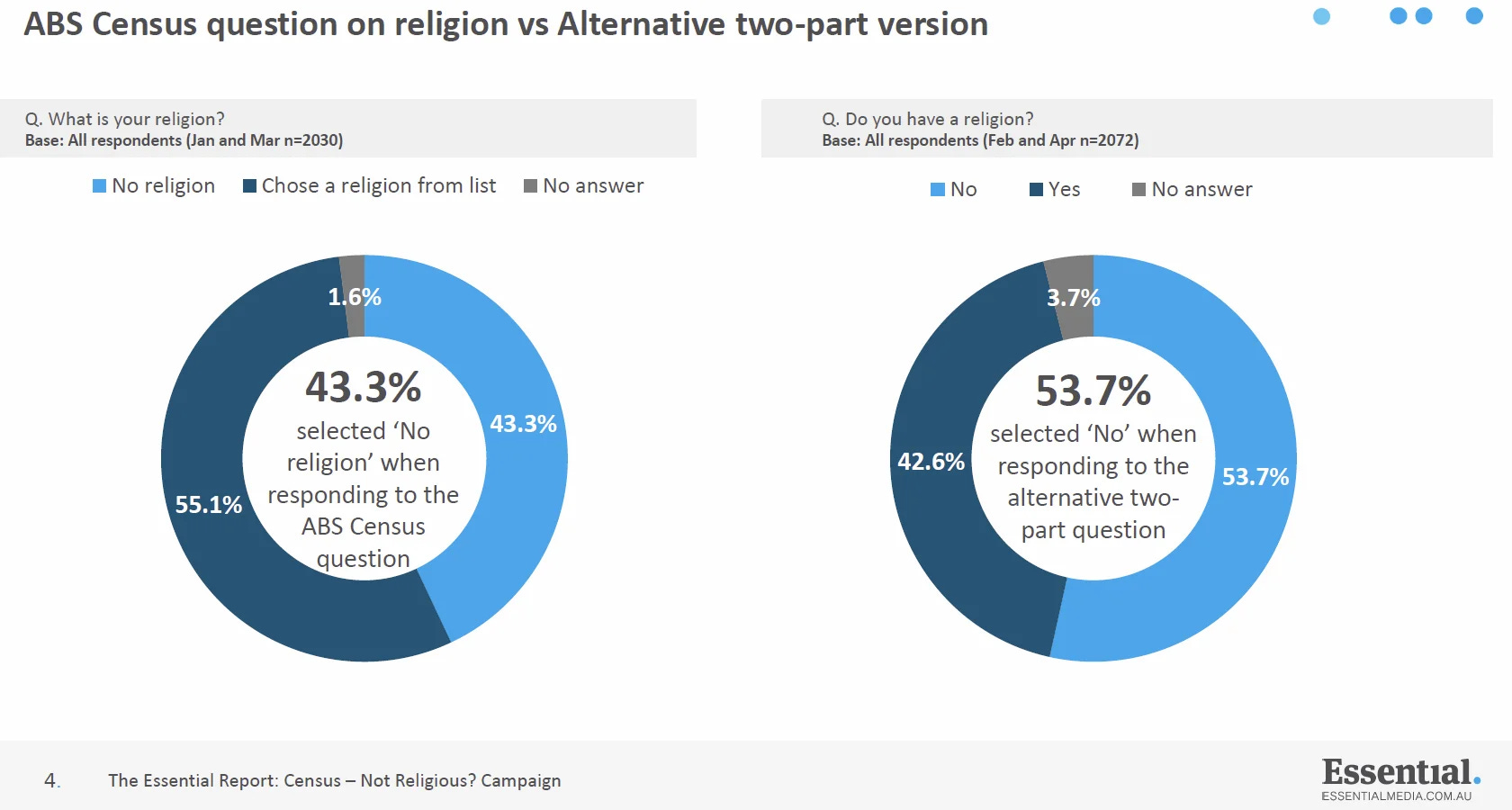
Michael Dove, spokesperson for the Census – Not Religious? campaign, said the new polling provided the clearest insight into the extent of the impact of the leading question.
“We’ve long known that the leading nature of the Census religion question significantly inflates the data in favour of religion and undercounts the non-religious population,” he said.
“The Essential Research poll is the first to test the actual question that the ABS had proposed using versus the flawed question design that it decided to re-use. So it provides the best insight yet into the impact of the bias in the question being used in the 2026 Census.”
He said the ABS needed to fix the question for future Censuses.
He’s not kidding about fixing it, adding, “We’ve already got our eyes on 2031.”

While the census question they plan to use is disappointing because it won’t be as accurate as it could be, the silver lining is that the campaign to get more Australians to mark “No religion” will likely be larger than ever. That means there will be even more opportunities for Australians to realize this is a simple way to declare their freedom from religion once and for all.
Hell, there’s even a theme song (though this one is being released by a different organization working toward the same goal):
Despite undercounting the number of non-religious Australians, there’s still reason to believe Christians will finally be outnumbered when the results are finally released in 2027. Whatever the difference turns out to be, though, keep in mind the actual gap is likely much larger.
(Portions of this article were published earlier)
OT:
Lol
New York sculptor spent $100,000 to make a Charlie Kirk statue no one wants to buy
https://www.theguardian.com/us-news/2026/jul/20/sculptor-charlie-kirk-statue-new-york
“𝑊𝑒’𝑣𝑒 𝑙𝑜𝑛𝑔 𝑘𝑛𝑜𝑤𝑛 𝑡ℎ𝑎𝑡 𝑡ℎ𝑒 𝑙𝑒𝑎𝑑𝑖𝑛𝑔 𝑛𝑎𝑡𝑢𝑟𝑒 𝑜𝑓 𝑡ℎ𝑒 𝐶𝑒𝑛𝑠𝑢𝑠 𝑟𝑒𝑙𝑖𝑔𝑖𝑜𝑛 𝑞𝑢𝑒𝑠𝑡𝑖𝑜𝑛 𝑠𝑖𝑔𝑛𝑖𝑓𝑖𝑐𝑎𝑛𝑡𝑙𝑦 𝑖𝑛𝑓𝑙𝑎𝑡𝑒𝑠 𝑡ℎ𝑒 𝑑𝑎𝑡𝑎 𝑖𝑛 𝑓𝑎𝑣𝑜𝑢𝑟 𝑜𝑓 𝑟𝑒𝑙𝑖𝑔𝑖𝑜𝑛 𝑎𝑛𝑑 𝑢𝑛𝑑𝑒𝑟𝑐𝑜𝑢𝑛𝑡𝑠 𝑡ℎ𝑒 𝑛𝑜𝑛-𝑟𝑒𝑙𝑖𝑔𝑖𝑜𝑢𝑠 𝑝𝑜𝑝𝑢𝑙𝑎𝑡𝑖𝑜𝑛."
No surprises here. Of course the religious people in charge of writing the official question are going to make sure it's misleading enough to overstate their numbers. Lying for Jesus is baked into the whole thing.