
This newsletter is free and goes out to over 23,000 subscribers, but it’s only able to sustain itself due to the support I receive from a small percentage of regular readers. Would you please consider becoming one of those supporters? You can use the button below to subscribe or use my usual Patreon page!
New Hampshire Republicans have proposed a constitutional amendment that would elevate Christianity over all other religions and allow local communities to elect public school teachers… who presumably share their Christian faith.
The goal is to turn the state into a full-blown Christian theocracy.
As it currently stands, Part 1, Article 6 of the New Hampshire Constitution, which concerns “morality and piety,” reads as follows:
As morality and piety, rightly grounded on high principles, will give the best and greatest security to government, and will lay, in the hearts of men, the strongest obligations to due subjection; and as the knowledge of these is most likely to be propagated through a society, therefore, the several parishes, bodies, corporate, or religious societies shall at all times have the right of electing their own teachers, and of contracting with them for their support or maintenance, or both. But no person shall ever be compelled to pay towards the support of the schools of any sect or denomination. And every person, denomination or sect shall be equally under the protection of the law; and no subordination of any one sect, denomination or persuasion to another shall ever be established.
There’s nothing too problematic with that. It basically says churches can elect their own leaders and taxpayers can’t fund religious schools. It also says religious discrimination is prohibited; everyone’s equal under the law.
All of that is in line with what the U.S. Constitution and subsequent court decisions have all said.
But that section of the constitution was adopted in 1968. It had to be changed because the original version, adopted in 1784, was much more direct about the importance of religion—specifically Christianity— in public life.
That archaic version said local jurisdictions could use public dollars to support Christian preachers.
It said public school teachers could be elected.
And while it had a clause banning religious discrimination under the law, that rule only applied to Christians; it said no one in a particular Christian sect would be obligated to pay for another Christian sect’s beliefs.
I suppose that made some sense in a place where non-Christians were essentially non-existent.
In any case, most of Article 6 didn’t age well, which is why the correction was needed. We now consider it illegal to prop up Christianity over other religions, or even faith over non-faith. We don’t elect teachers— we allow public school districts to do their own (non-discriminatory) hiring based on qualifications and need. And religious discrimination is wrong, regardless of your beliefs.
That’s what Republicans now hope to change.
Led by State Rep. Julius Soti with the help of co-sponsors Reps. Matt Sabourin dit Choinière, John Sellers, and Kelley Potenza, Republicans have put forth a constitutional amendment—CACR 28—that would revert Article 6 back to its original wording.
This is what those Republicans now want Article 6 to say. (I’ve boldfaced the most important changes.)
As morality and piety, rightly grounded on evangelical principles, will give the best and greatest security to government, and will lay in the hearts of men the strongest obligations to due subjection; and as the knowledge of these, is most likely to be propagated through a society by the institution of the public worship of the Deity, and of public instruction in morality and religion; therefore, to promote those important purposes, the people of this state have a right to impower, and do hereby fully impower the legislature to authorize from time to time, the several towns, parishes, bodies corporate, or religious societies within this state, to make adequate provision at their own expense, for the support and maintenance of public protestant teachers of piety, religion and morality:
Provided notwithstanding, That the several towns, parishes, bodies corporate, or religious societies, shall at all times have the exclusive right of electing their own public teachers, and of contracting with them for their support and maintenance. And no person of any one particular religious sect or denomination, shall ever be compelled to pay towards the support of the teacher or teachers of another persuasion, sect or denomination.
And every denomination of Christians demeaning themselves quietly, and as good subjects of the state, shall be equally under the protection of the law: and no subordination of any one sect or denomination to another, shall ever be established by law.
And nothing herein shall be understood to affect any former contracts made for the support of the ministry; but all such contracts shall remain, and be in the same state as if this constitution had not been made.
What are the big changes here?
It grounds morality on “evangelical principles.”
It calls for public worship of God (“the Deity”).
It requires public instruction on morality, which means taxpayer-funded support for Christianity.
It allows the legislature to force towns to support Christian preachers.
It permits towns to elect teachers, usurping that authority from elected school boards and creating an environment when non-Christian educators could be blocked from the profession (depending on the community).
It only protects Christians under the law, not non-Christians.
It only protects Christians who are “good subjects of the state” and who carry themselves “quietly"—so not protesters or agitators.
This version of Article 6 basically says Christianity is better than other religions and evangelicals are better than other Christians, therefore tax dollars can and must be used to prop up that faith and protect those believers.
It’s so blatantly illegal, it’s a wonder anyone would even consider reverting back to this version of the Amendment. But “reverting back” is the right phrase because this is precisely what Article 6 said before 1968’s corrections.
The legislation also says that voters must be told the following to explain the need for this change… and it makes extremely clear that the goal is to elevate Christianity. It even whines about how Christianity has to play by the same rules as everyone else, as if that’s a problem.
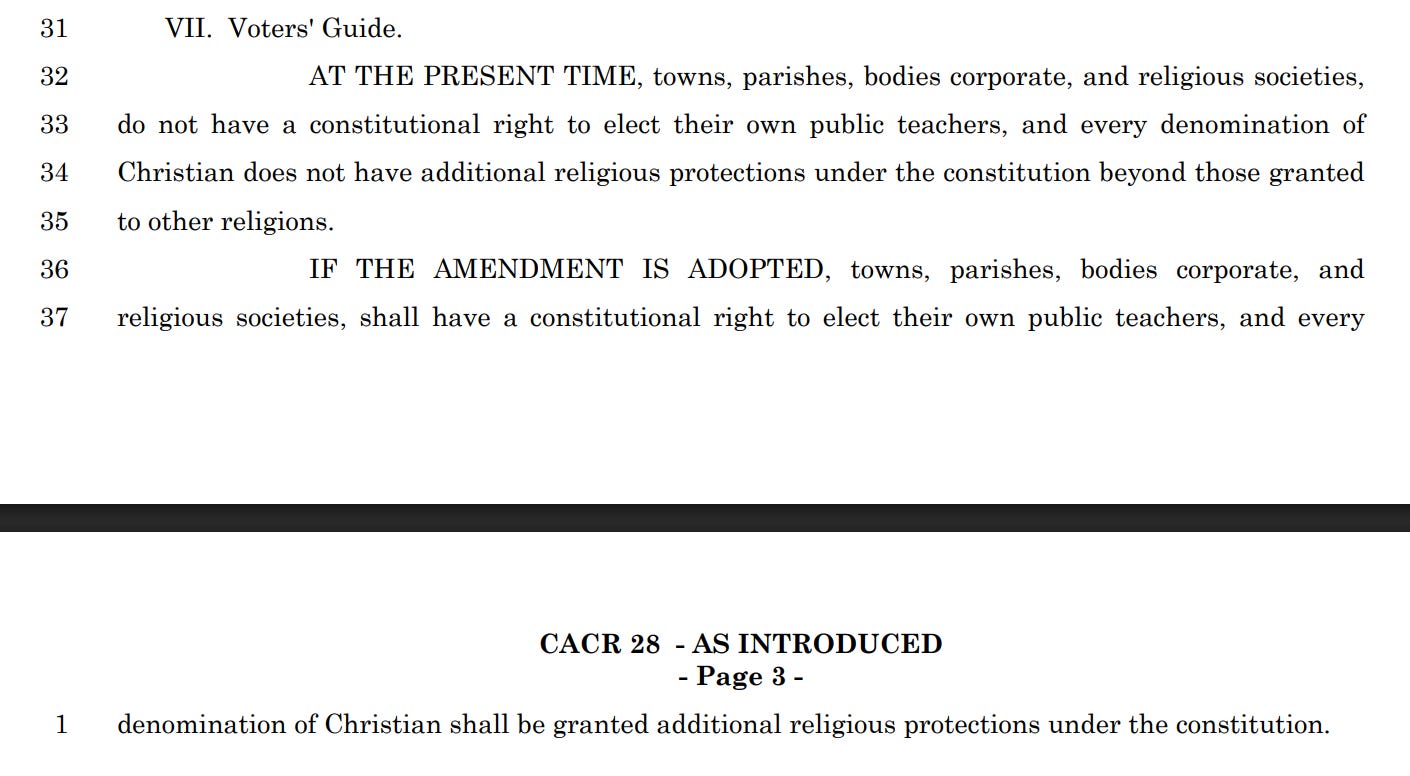
AT THE PRESENT TIME, towns, parishes, bodies corporate, and religious societies, do not have a constitutional right to elect their own public teachers, and every denomination of Christian does not have additional religious protections under the constitution beyond those granted to other religions.
IF THE AMENDMENT IS ADOPTED, towns, parishes, bodies corporate, and religious societies, shall have a constitutional right to elect their own public teachers, and every denomination of Christian shall be granted additional religious protections under the constitution.
One Democratic state representative, Peter Petrigno, posted about the dangers of this bill, calling it an effort to “transform New Hampshire into an evangelical Christian theocracy,” which is absolutely true. But he also said it was unlikely this bill would go anywhere. The messaging is the point.
I doubt seriously this will have any traction just as past Republican legislation calling for New Hampshire to secede from the country failed. Nonetheless, this kind of extremism is out there and very dangerous. Their ultimate objective is to have everyone fall in line with their narrowly focused religious perspective.
A public hearing on the matter is scheduled for Wednesday afternoon and there are already people planning to speak out against the move.
When those critics speak out, I hope they make it clear this is not a proposal to protect religious freedom. It’s a declaration that equality is no longer enough for New Hampshire Republicans; they want preferential treatment for Christians.
The proposed amendment sends a clear message that non-Christians, dissenting Christians, and the non-religious are second-class participants in public life. It tells Jewish, Muslim, Hindu, and atheist families that their tax dollars may be diverted to fund beliefs they don’t share—and that their children’s public school teachers could be excluded through a religious litmus test imposed by a future Republican majority. It tells those educators that their professional qualifications are meaningless compared to their religious conformity. It also tells citizens that constitutional protections will apply only if they’re “quiet,” compliant, and ideologically acceptable.
None of this is religious freedom. All of this violates the state’s “Live free or die” motto.
Even if the sponsors know this proposal will fail, they’re still trying to normalize the idea that the state should enforce religious dominance over democracy.
That’s why this bill should be rejected forcefully.
We’re already seeing what happens when political ideology is allowed to trample over everyone’s civil rights, and these Republicans think the solution is eradicating even more of them. New Hampshire corrected this mistake once before, though, and it’s not too late to prevent another error from getting adopted. Because if everyone isn’t protected under the law, no one is.
Any religion that seeks to impose its will on all is a bad religion.
Once again, we see that the Christian faith is so allegedly wonderful it feels it has to use force to insure compliance.
Every spring, we seed a slew of politically theatric "fanservice" bills, where conservatives submit creationism etc. bills just to be able to tell their constituents they did it, with no real hope of passing.
I was expecting this was one such. It. Is. Not.
The GOP in NH controls every elected branch of government - both legislatures, Governor, and AG. So this could very well make it in front of voters and if they approve it, there will likely be no pushback from the Governor or AG's office.
Very alarming. The only thing going for it - if this is a plus at all - is that that voter's guide lays it out pretty clearly. So maybe the voters reject it? Fingers crossed.