
This newsletter is free and goes out to over 26,000 subscribers, but it’s only able to sustain itself due to the support I receive from a small percentage of regular readers. Would you please consider becoming one of those supporters? You can subscribe via Patreon or the Subscribe button below! You can also make one-time donations through Venmo, CashApp, or PayPal.
Christianity is on track to lose its status as the world’s most popular religion around 2035. And by 2070, the number of Muslims (an estimated 3.6 billion people) will dwarf the number of Christians (just under 3 billion).
Meanwhile, because of the rapid growth rates from those religions, by 2070, religiously unaffiliated people are expected to drop as a share of the global population—from 24.2% of people worldwide to about 17%. In raw numbers, we’ll go from roughly 1.9 billion people in 2020 to about 1.7 billion five decades later—a 10% decline. This is primarily due to a major population decline expected to occur in China, where two-thirds of the world’s “Nones” live.

That’s according to a new report from the Pew Research Center, which attempts to project what the future will look like in terms of religious belief based on demographic information available today.
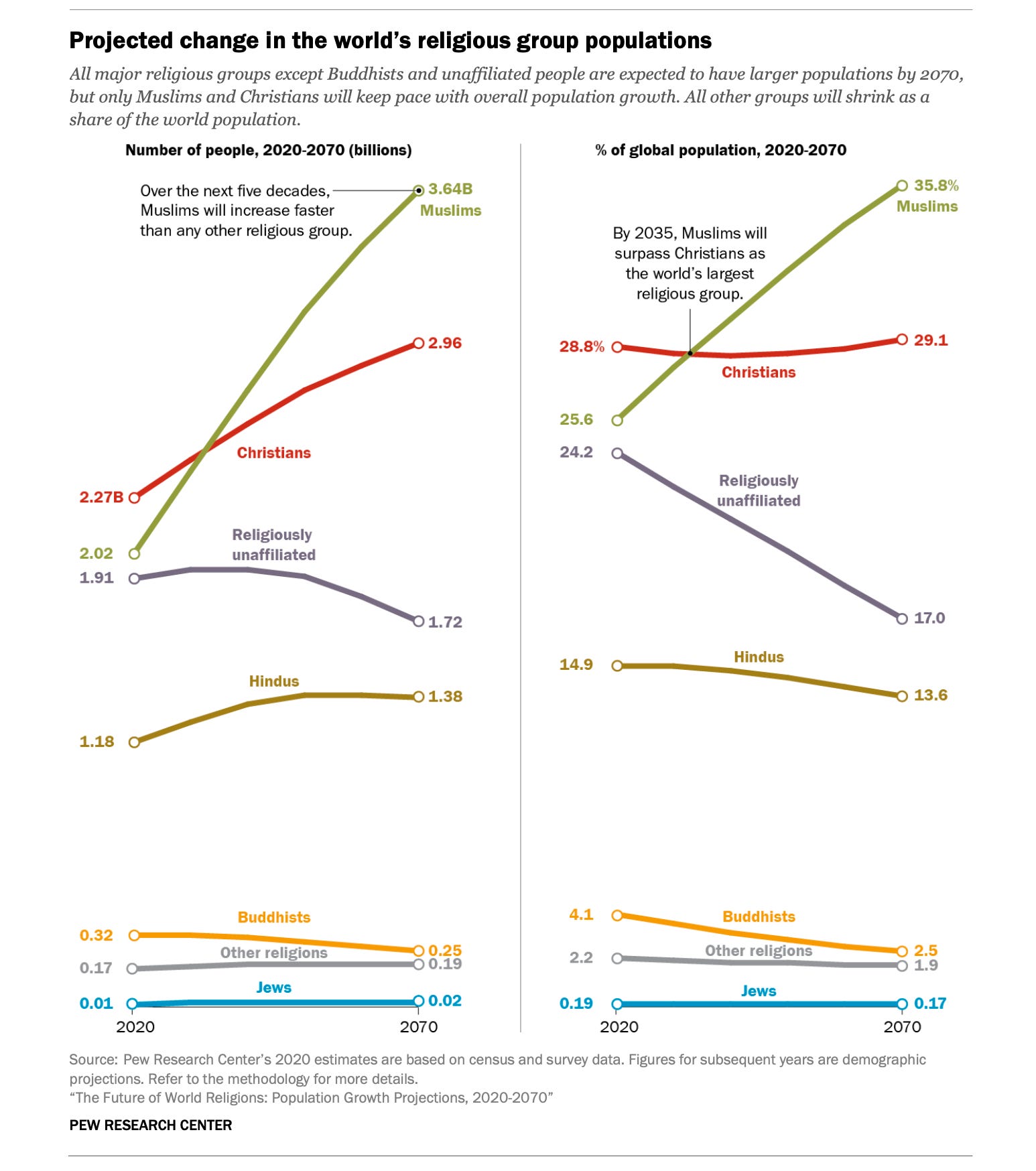
The biggest reason for the massive shift is the expectation of growth in sub-Saharan Africa. By 2070, the analysis says, “more than half of the world’s Christians” will live there:
Since the vast majority of people who currently live there are either Christians or Muslims, the region’s high fertility and rising life expectancy will boost the global numbers of both faiths.
…
Fertility differences have big effects on populations. Globally, Muslims tend to have more children than other major religious groups. During the 2020-2025 period, the total fertility rate for Muslims was 3.1 children per woman. By comparison, the rate for non-Muslims was 2.0 children per woman.
As for the United States, we’ll no longer have a Christian majority (even if Christianity as a whole remains the biggest religious group in the country).
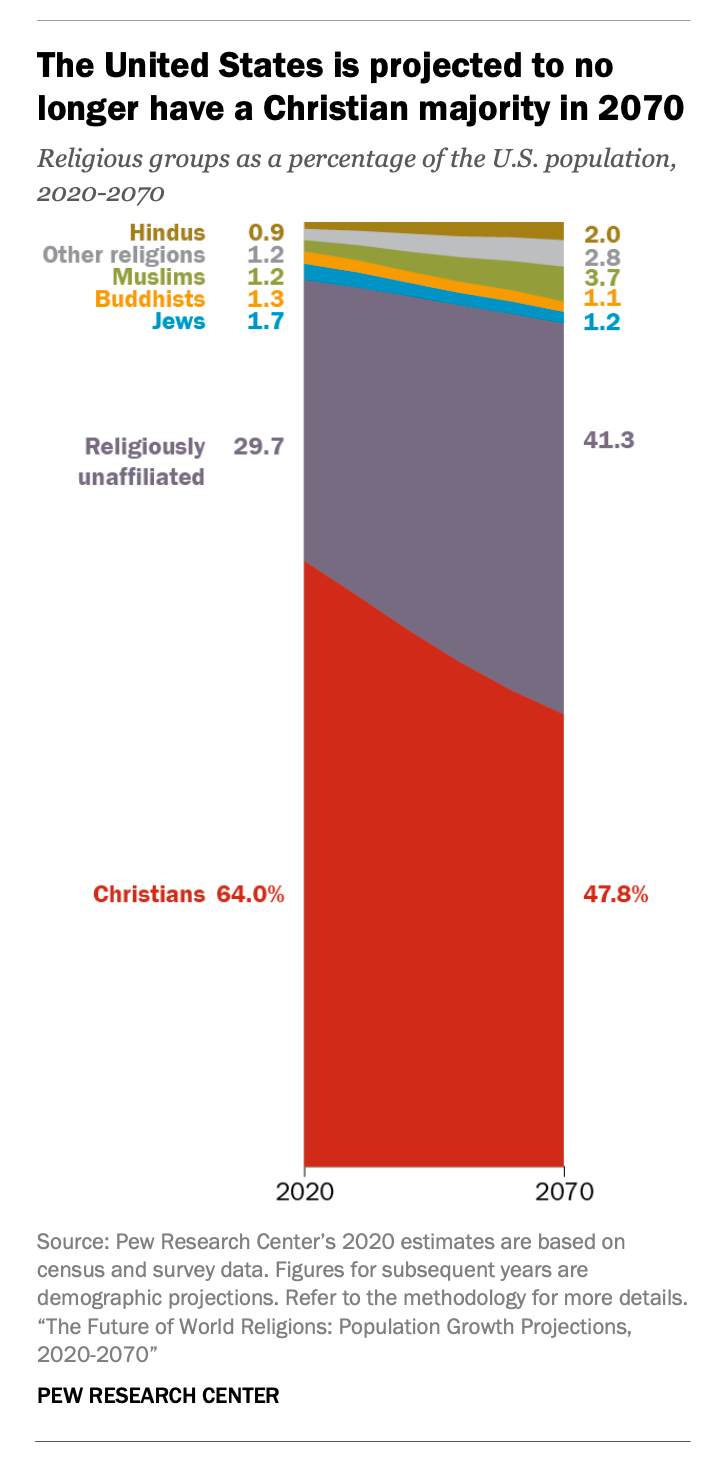
The irony is that religiously unaffiliated people are expected to grow as a share of the population in more countries and territories—37 compared to 31 for Muslims—yet our overall numbers and shares are projected to shrink.
Why the discrepancy? Because the expected population increase in sub-Saharan Africa—and the presumed religious identities that go with it—offsets our growth in those other places. The “Nones” tend to be older and have fewer children than people who are religious. (Religiously unaffiliated women, globally, have an average of 1.3 children each compared to 2.5 for religious women.)
That’s even true when you consider that many people raised in religious homes may eventually become non-religious. “Religious switching,” as it’s known, is projected to impact two groups in particular: The religiously unaffiliated… and Christians.
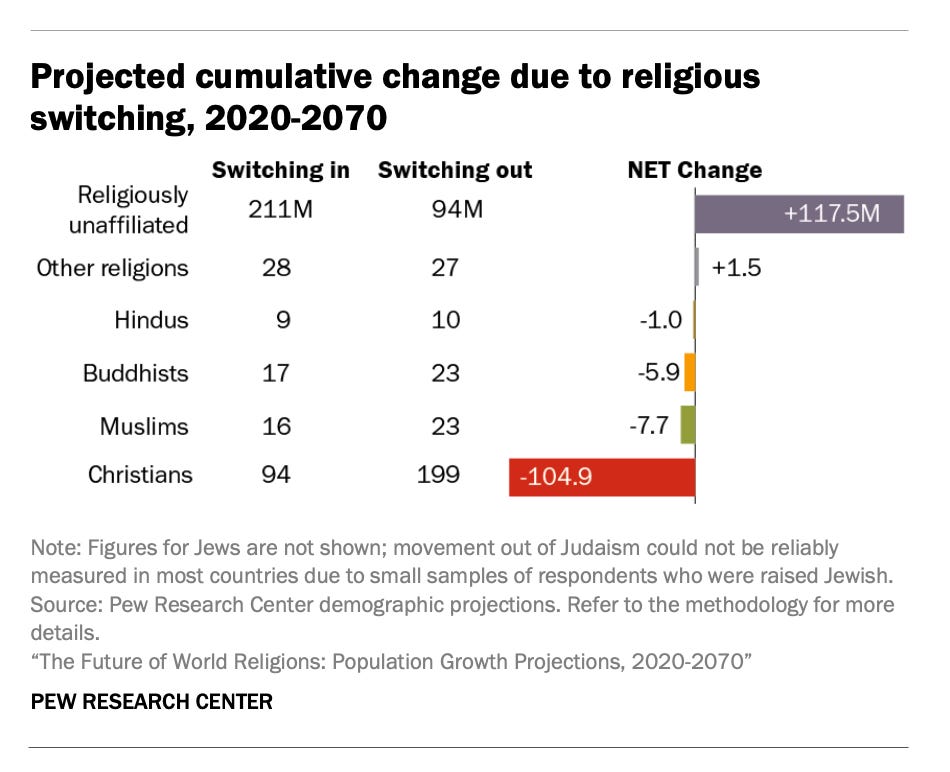
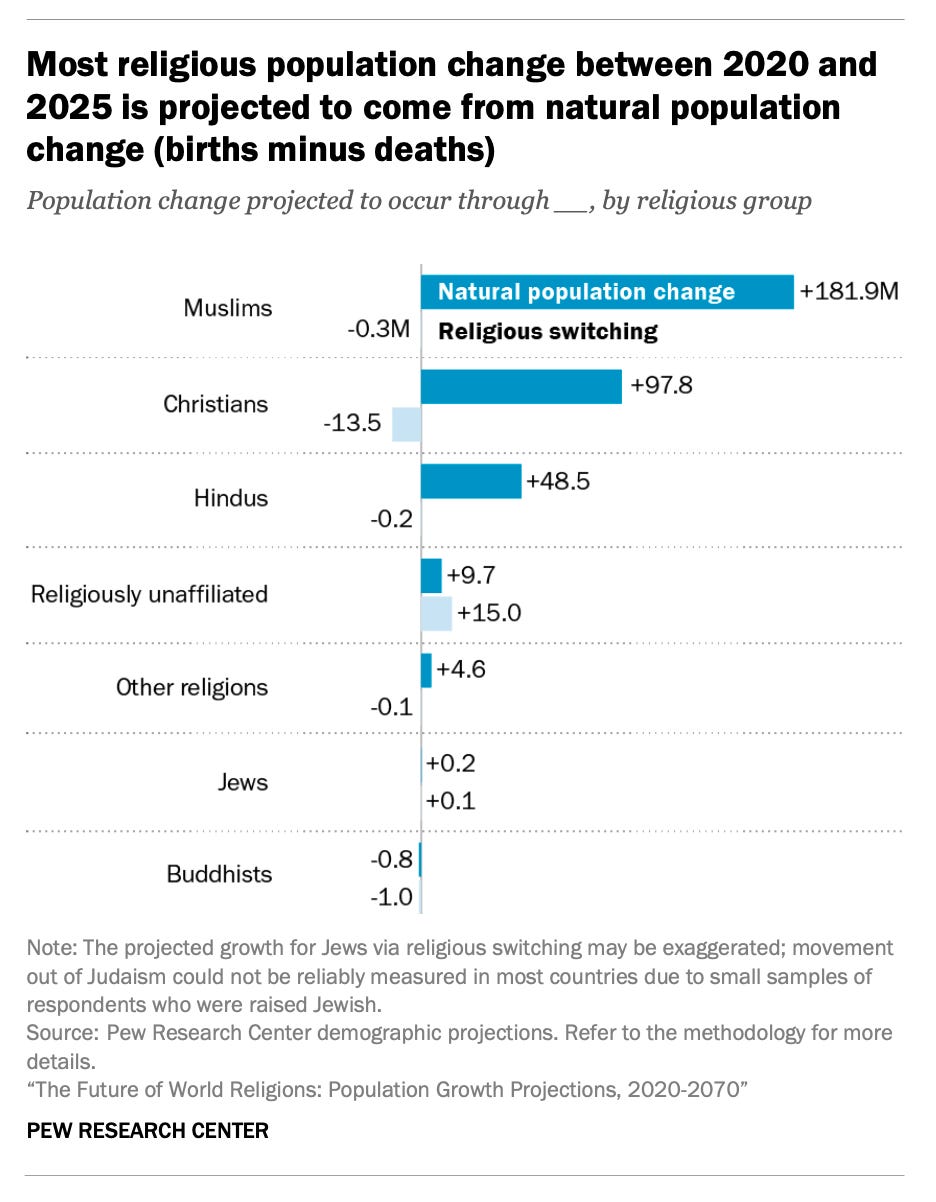
But because the population changes are affected by birth rates and death rates, those “switches” don’t have as great an impact as the circumstances of where you’re born. Just consider the change between 2020 and 2025: The “Nones” around the world rose by 15 million through religious switching, with an additional 10 million people simply raised in those families. But that’s nothing compared to the natural changes seen among Muslims and Christians.
Sociologist Phil Zuckerman told me fertility rates are important—secular democracies see lower birth rates—but he also added that religion can bring comfort to people at a time when everything else seems broken. That could be important in a future that doesn’t always look like it’s going to improve:
… religion has a proven track records of being the “go-to” comforter for people during hard times, hunger, strife, famine, violence, etc. Thus, as the world heats up due to global warming, and as AI takes over more and more of our lives, I expect more and more people to turn to religion for a sense of comfort and security in an increasingly precarious world.
Fellow sociologist Ryan Cragun echoed those ideas, though he said there was one key factor that couldn’t be accounted for: how quickly sub-Saharan Africa will develop:
If societal development picks up in sub-Saharan African countries, we could see: (a) birth rates decline faster than is projected, AND (b) higher rates of religious exiting. If that happens, that would change things pretty substantially.
It’s interesting to see all this when you consider that Pew released a similar type of analysis about the future—through the year 2050—about a decade ago. Back then, the big headlines were all about how Muslims were expected to match the Christian population around 2050. The new report, which uses updated demographic numbers, says the two groups will equal each other in 2035 instead.
There’s also an update to the numbers Pew found a decade ago for the religiously unaffiliated:
… the religiously unaffiliated population grew faster than anticipated. We projected that unaffiliated people would rise in absolute numbers but begin to decline as a percentage of the world’s total population between 2010 and 2020. We now estimate—based on our latest analysis of recent census and survey data—that “nones” actually grew both in absolute numbers and in percentage terms, rising from 23% of all people around the world in 2010 to 24% a decade later.
But because they can’t anticipate future trends about when and why people walk away from religion, it’s harder to know what the future of the Nones might look like:
Our new projections for 2020-2070 may be conservative about the degree to which the ranks of the religiously unaffiliated will grow, especially if social scientists are correct that many countries are at different stages in a “secular transition.” Their hypothesis suggests that religious disaffiliation could become more widespread.
On the other hand, it’s also possible that there could be a turn toward religion among “nones” in the future, a process of re-affiliation or religious revival among people who often hold some spiritual beliefs even if they don’t identify with any religious group.
If there’s a silver lining in all of this, it’s that the United States will see a steady rise in the percentage of people who are non-religious. Even if Christians as a whole outnumber us, the share of Christians who represent the politically powerful conservatives is likely on the decline. And even if the “Nones” are not all in lockstep in terms of how we see the world, we tend to support a more secular society that supports religious freedom for everyone.
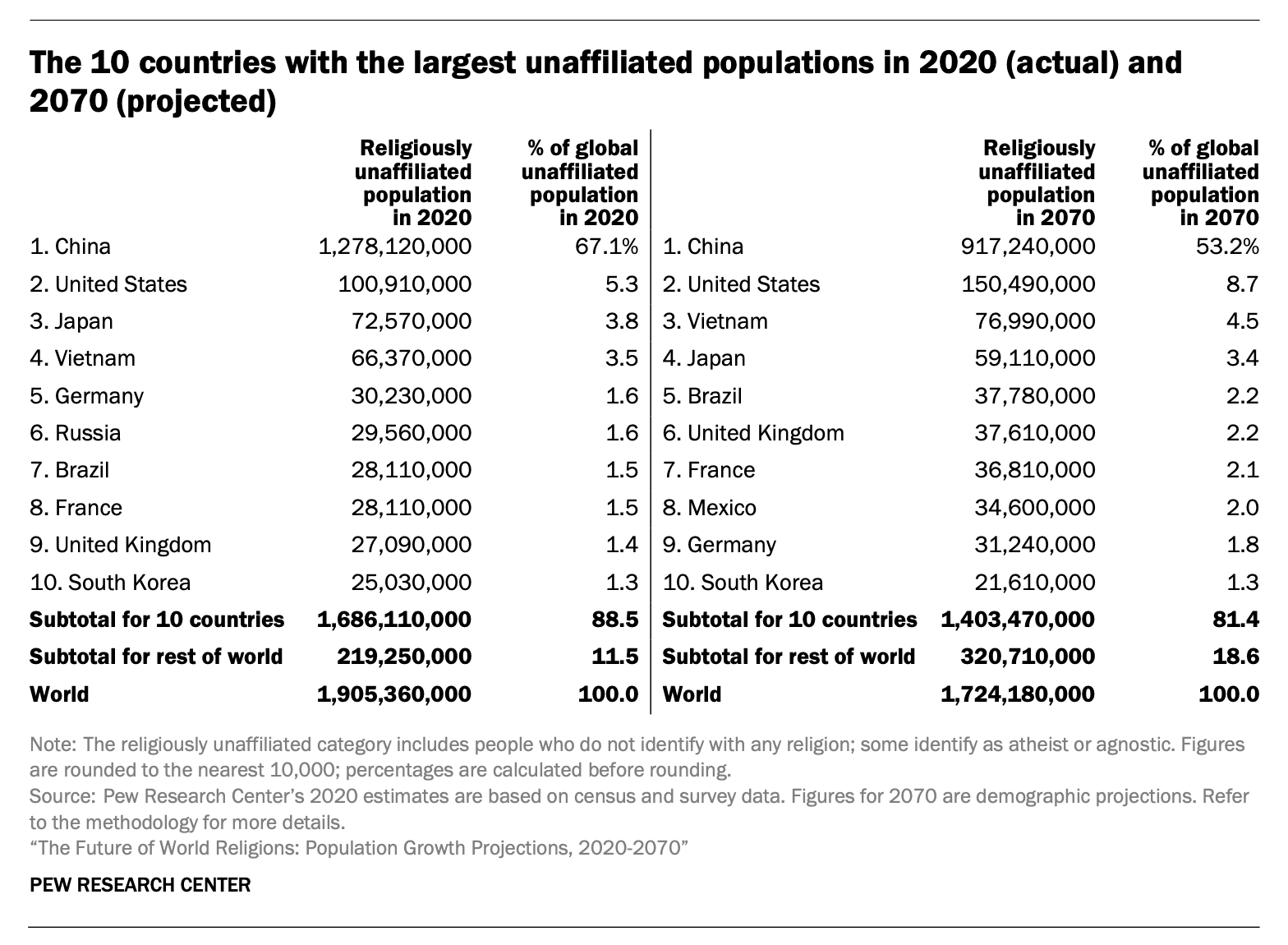
Interesting note: By 2070, religious unaffiliated people are expected to be the majority group in South Korea (60%), France (53%), and the United Kingdom (52%).
In so many ways, this analysis offers hope and despair for everyone. The “unaffiliated” population is projected to shrink worldwide, even as it grows substantially as a share of the population in 37 countries/territories. Christianity is expected to grow in total numbers and remain roughly the same share of the global population, even as its share falls in many countries. Globally, Muslims may be “winning” but that’s more about birth rates than anything ideological. In other words, there’s plenty of room to change minds. We may know people’s religious identities, but we can’t predict their thoughts and behaviors, much less how they plan to vote.
All the more reason to fight for a world where religious freedom thrives so that a single group can’t force their beliefs on everyone else.
Can we just rid ourselves of religion altogether?! Why do people feel they need a higher power to do good in the world and to be happy? Can’t we just be good to one another naturally?
Xtians react to the news
tenor.com/view/panic-oh-noes-gif.10637171