
This newsletter is free and goes out to over 25,000 subscribers, but it’s only able to sustain itself due to the support I receive from a small percentage of regular readers. Would you please consider becoming one of those supporters? You can subscribe via Patreon or the Subscribe button below! You can also make one-time donations through Venmo, CashApp, or PayPal.
The Maine Supreme Court has just ruled that a father can have veto power over where his daughter can attend church—after the mother took her to one that was objectively dangerous for the child in many ways. The mother had said this was a violation of her religious rights.
The case involves Matthew Bradeen, Emily Bickford, and their 12-year-old daughter Ava. When the parents separated over a decade ago—they were never married—they agreed to “share parental rights and responsibilities regarding religious education and upbringing.” And none of that appeared to be a problem until 2021, when Bickford began taking Ava to Calvary Chapel, a church in Portland.

Bradeen soon noticed some major changes in Ava—harmful ones—and asked a judge to modify their parenting agreement so that he could have control over Ava’s religious upbringing.
That’s a big ask, obviously, and he needed some damn good reasons for a judge to sign off on his wishes.
In 2024, that’s precisely what a Maine District Court judge did. In an 18-page ruling, Judge Jennifer Nofsinger laid out all the reasons Bradeen’s argument was compelling—and why he deserved to have control of Ava’s religious upbringing.
The justification boiled down to a few major issues.
The church’s teachings were frightening and psychologically harmful
The pastor routinely delivered fire-and-brimstone sermons vividly describing Hell, full of “burning and torment.” He also focused on the Book of Revelation, talking about the reign of the Antichrist. All of this scared the shit out of Ava. She started having panic attacks, tried to convert him, and asked her dad why he wasn’t going to Heaven with her. All of this, Bradeen said, led to Ava experiencing “fear and anxiety” with the church’s teachings.
It didn’t help that Ava went to the church a lot. There were services on weekdays and multiple services on Sunday, all of which Bickford and Ava attended. On some of those Sundays, Ava had to listen as people testified about how Jesus saved them from “sexual and physical trauma, gay and lesbian relationships, and infidelity.”
Despite all that, Bradeen never let Ava think her mother was wrong or brainwashed. He just told Ava that different people believed different things, and that he simply didn’t agree with what that church taught.
Bickford hid from Bradeen how much she was indoctrinating her daughter
Bickford once told Bradeen she was taking Ava out of school to visit the state capitol, but that was a lie. She and Ava attended an anti-abortion protest.
She also sent Ava to a church-sponsored overnight retreat without telling him. Bradeen wasn’t told the location, and Ava wasn’t allowed to have a phone there, so he couldn’t communicate with her as it happened.
At another point, Bickford was on the verge of baptizing Ava without telling Bradeen. (He only found out through a third party.)
When your custody agreement says both parents have shared control over the daughter’s religious upbringing, those are all things they should have discussed together. But even when Bradeen was on his own, Bickford forced her religion into the picture anyway. She sent Ava to his house with “more religious paraphernalia than typical.” She also demanded that they homeschool Ava in order to avoid public schools that she believed posed a “danger” to kids. (The judge said of Bickford: “Ironically, her explanation is that she ‘wants to be able to review what her child is learning,’ but she has not given Mr. Bradeen the option to weigh in on events that Ava attends.”)
An expert testified that the church was cult-like
At one point, the judge heard from Dr. Janja Lalich, an expert on cults. (Bickford and her lawyer did not object to Lalich when she delivered testimony, though they tried to have it all tossed out afterwards.) Lalich explained that “closed social systems” like this church had certain elements in common: A charismatic and authoritarian leader who could not be questioned, the promise of salvation, a demand for loyalty, etc. They also promoted “hateful rhetoric,” opposing science, public schools, and homosexuality.
That sort of indoctrination, Lalich explained, could have a serious impact on a developing child, filling her with inferiority and doubt. It was also problematic that Ava didn’t appear to have a choice in the matter; she was pressured to “comply and conform.”
Importantly, Lalich never said the church was a “cult.” She just said it shared some characteristics with them.
Bickford’s new medical views were harming her daughter
There was a time when Ava was up to date on her vaccinations. She had an inhaler for her allergies and asthma. But since joining this church, Bickford had become an anti-vaxxer—rejecting shots for COVID and the flu—and fought Bradeen when he wanted Ava to get the HPV vaccine.
The anti-science mentality also extended to antibiotics. When Ava got pneumonia, Bickford refused to let her take the proper medicine to treat it. (Ava’s doctor was eventually able to prescribe an alternative medication that Bickford allowed.)
When Ava was dealing with anxiety, Bickford never even considered taking her to see a professional. She dismissed the very idea of anxiety, saying that prayers alone would solve the problem. She also argued that mental health care was a “hoax.”
In short, Bradeen’s decision-making when it came to medicine and health was seen by the judge as “more rational” and in Ava’s best interests while Bickford’s decision-making was not.
The church started a war against Bradeen
Shortly after their custody trial began, in August of 2024, Bickford took Ava to church where Pastor Travis Carey delivered a diatribe about the situation. Carey implied that Bradeen’s issue was with Christianity (and not the extremism inherent in this particular church), that Dr. Lalich was paid a lot of money to “find dirt” on them, and that the judge’s ruling would ultimately depend on whether or not she believed in God.
Ava was forced to listen to all of it.
… Let’s begin by prayer. There is a dear sister in the church. You guys know Emily Bickford. And for months in preparation for what really is a… I guess a custody battle—there’s been 50/50 with dear Ava—eleven-year-old Ava who’s been with the church family. She’s had teen camp with the teenagers this past weekend and Ava’s grown in the lord. And Emily’s made a priority that when she has the custody over her daughter, that they’re here. And they’re here all the time. But Ava’s father has had a difficult time with that. We’ve been praying for Matt and his salvation for a long time…
…
… It’s a unique situation because you guys probably are aware that justice is so much now in the hands of a judge, and no matter what area of civilization, culture, politics, you’re looking at, that can go one way or the other depending on who appointed that judge…
…
… Matt’s side—Ava’s father—has hired what they call an “expert witness” and this expert witness out of California was hired for a large sum of money to find any dirt they can on Calvary Chapel, on Pastor Ken Graves, and on… myself and on… Ava’s faith and Emily’s faith...
…
… depending on where this judge stands with god and his word will depend on how the decision goes forth…
…
… It’s hard to imagine that when you’re 11 years old and… you’re dealing with a level of persecution that young Ava is dealing with…
The judge was so appalled by that sermon that she transcribed the entire excerpt from that sermon—more than six minutes of preaching—and concluded that it was completely inappropriate:
Sadly, Mr. Carey went far beyond simply referencing the litigation. The court is further influenced by the fact that at no point did Ms. Bickford remove Ava from the congregation once it became clear that Mr. Carey was not going to offer a simple prayer. Instead, Ms. Bickford allowed Ava to receive the message that her father was the enemy and was persecuting her. The court finds that, more likely than not, Ava’s receipt of this message, delivered with the blessing of her mother, was psychologically detrimental.
After considering all of this, the judge came to some straightforward conclusions. For example, when it came to Ava’s health, Bradeen could make all final decisions, since the mother clearly wasn’t interested in following the advice of medical experts.
When it came to Ava’s religious upbringing, the legal reasoning was more complicated, but the evidence was clear that Ava’s psychological health was in danger and that Bradeen should be allowed to make those decisions as well:
The court finds that Ms. Bickford’s unquestioning loyalty to the church and abdication of independent decision making has placed Ava in situations where she receives messages that pose an immediate risk of significant psychological harm. Further, the court finds that due to Ms. Bickford’s level of commitment to Calvary Chapel, there is little to no room for the parties to co-parent on religious decision making.
…
Because the parties cannot effectively co-parent on this issue, one of the parties must be vested with the right and responsibility to make decisions. Ms. Bickford has handed over that right and responsibility to the church and is no longer exercising independent decision making regarding the messaging that her daughter receives.
…
Accordingly, the court concludes that a narrowly tailored restriction of Ms. Bickford’s rights is as follows: Mr. Bradeen is allocated the right and responsibility to make decisions regarding whether Ava attends any services, gatherings, or events associated with Calvary Chapel; whether and what material, literature, video, or other messaging associated with, or created or published by, Calvary Chapel she reviews; and whether she associates or communicates with any member of Calvary Chapel other than Ms. Bickford.
That wasn’t some rash anti-Christian decision. That was a tough analysis of a complicated issue. But after weighing the extremism of this church’s beliefs and how it was quite literally harming Ava, the court came to a thoughtful decision. It’s not like Bickford wouldn’t have contact with Ava; Bradeen just had veto power in a few key areas.
How the Christian Right distorted the facts of the case
When that decision was handed down in December of 2024, it didn’t make much news because it was just a private conflict. But it created a firestorm in the conservative Christian universe after right-wing legal group Liberty Counsel (no longer able to fundraise off of Kim Davis) decided to make it its next culture war battle.
For months, they fought to overturn the judge’s decision, and they eventually got the Maine Supreme Court to consider their appeal.
That also led to countless fundraising emails claiming Dr. Lalich was a “Marxist,” that a liberal judge decided Christianity was a “cult,” and that the judge was anti-religious because she “purposefully refused to capitalize the word ‘God’” throughout her ruling.
Liberty Counsel also claimed that Bradeen, whom they portrayed as horrible father, didn’t want Ava to “hang out with her friends from church,” that Ava was banned from reading the Bible or even talking about religion with her mom, and that Pastor Carey just wanted to “pray over [Bickford] and Ava.”
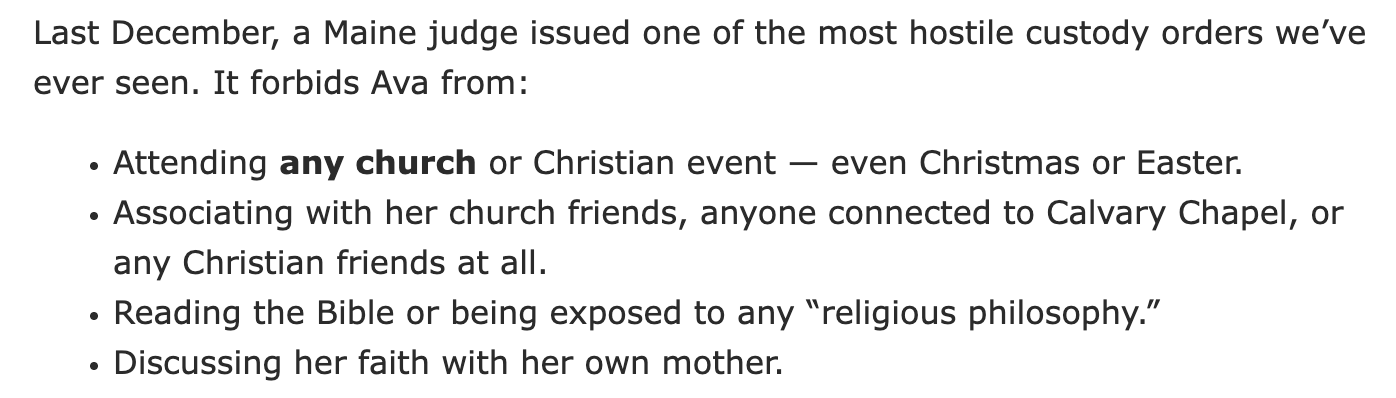
They twisted the ruling to say Bradeen thought the Bible itself was “psychologically harmful” (which is not what anyone said) and that he had some kind of vendetta against religion and not just the way this particular church was harmful to his child. One fundraising email even pretended the judge said Bickford was a fit parent “EXCEPT for the fact that she is a Christian.” (That’s not even close to accurate.)

In fact, every article written about this case in conservative publications appeared to distort the facts more and more. The Christian Post allowed Liberty Counsel’s leader to get away with several lies in a single sentence without noting that they were indeed lies:
“Calvary Chapel is not a cult. This custody order banning Emily Bickford from taking her child to a Christian church because of its biblical teachings violates the First Amendment,” Liberty Counsel founder and Chairman Mat Staver said in a statement shared with The Christian Post.
No one called it a cult. The custody order didn’t ban Bickford from taking Ava to a Christian church. And the “biblical teachings” weren’t the issue. (It’s not like the judge said Bradeen deserved custody because this church focused way too much on the Sermon on the Mount.)
But this is how groups like Liberty Counsel operate. When the facts aren’t in their favor, they make things up because they know their donors are too stupid to realize they’re being scammed. And Christian media outlets are happy to act as stenographers for them. Just look at this headline from an opinion piece on a website run by Focus on the Family, suggesting an extremist judge blocked a Christian mother from taking her daughter to church:

But fundraising letters and propaganda aside, the ball was eventually in the hands of the Maine Supreme Court. Bickford’s lawyers from Liberty Counsel asked them to take up this case and overturn Nofsinger’s ruling giving Bradeen power over Ava’s religious upbringing. They said the entire case boiled down to a “simple” question: “Does a district court have the authority to prohibit a parent from taking her child to Church?” What the lower court did, Liberty Counsel said, was a violation of Bickford’s First Amendment rights.
They said in the brief that the judge’s repeated use of “god” instead of “God” revealed “some disdain and hostility for Bickford’s monotheistic religious beliefs.” They said giving Bradeen final say over Ava attending that church amounted to handing him a “heckler’s veto over a fit parent’s right to direct the religious upbringing of their minor child.” And they insisted that what this church told Ava amounted to “mainstream and conventional religious beliefs, based on the Bible,” therefore the ruling was a form of religious persecution.
Legally, their argument was that religious beliefs didn’t need to be “logical” to warrant protection. (It was downright hilarious to watch Liberty Counsel freely admit this church’s beliefs were illogical.) But even that argument failed because the issue at hand wasn’t that the church’s beliefs were wrong or ridiculous. If that were the issue, then every religion would fall under that category. The problem was how the church was psychologically harming Ava, and Liberty Counsel refused to address the substance there. Instead, they talked about how, for example, it wasn’t psychologically harmful to denounce homosexuality,
It was as if Liberty Counsel never read the lower court’s decision. Instead, they just looked for a handful of buzzwords, then blew them entirely out of proportion. They believed that any insane belief, as long as it was cloaked in a religious shield, had to be respected.
The Maine Supreme Court justices were skeptical of the Christian side’s arguments
The Maine Supreme Court heard oral arguments last November:
A lot of the discussion was rehashing what had already been said in writing, but one of the justices asked Liberty Counsel’s Mat Staver what an acceptable line was regarding when a church caused harm. Staver seemed to want no limitations whatsoever, but was there a line that even he agreed a parent could not cross?
His response: If the church sexually abused the child, that would be a bridge too far. (The judges seemed shocked by that response, with multiple people asking him, “Anything short of that?” Staver didn’t answer that one. Instead, he pointed out that, in other cases involving a snake-handling church and one in which children were groomed to become underage brides, judges still allowed kids to attend those places of worship… which was not the flex he thought it was.)
The judges didn’t seem to buy what Staver was saying. They noted that the lower court’s ruling documented actual harm to Ava—with anxiety and panic attacks—not just theoretical harm. So did none of that matter to him? Nope, he said, adding “That is not sufficient.”
The judges also pointed out that the issue wasn’t whether one religion was unacceptable to the courts, but that the case “centered on the inability to co-parent and the denigration of the other parent.” (Staver said: “Well, she didn’t denigrate the other parent!” The chief justice responded: “But she allowed others to.”)
Bradeen’s lawyer Michelle King simply reacted to all this by telling the judges that all that mattered here was “preventing further harm to the child” and “maintaining the child’s best interests and well-being.” She noted the lies, too: First, no one was saying prayer was inappropriate, only that Carey’s diatribe was inappropriate. Second, it was wrong to dismiss what Dr. Lalich said because she was an expert in her field, and both sides agreed on that point. Finally, when there were religious differences between co-parents, it made sense to draw the line whenever harm came upon a child, and this was a case where there was documented harm against Ava.
The judges asked whether the lower court’s ruling exhibited any hostility toward religion and whether it was truly neutral with regards to religion. The response? All that mattered was the harm to the child, and Ava was harmed by what was said. In other words, no one was judging the church’s beliefs, only the impact they had on Ava.
Staver’s rebuttal to all of this? The lowercase “G” is hostility against faith: “That’s an assault to both Christianity and Judaism and Islam. And that’s what this order does. And that order reeks with that kind of hostility by intentionally doing that.”
How the Maine Supreme Court ruled
On Tuesday night, the Maine Supreme Court finally ruled on this case. And it was a unanimous decision in favor of Bradeen, affirming the earlier decision (thank goodness).
When it came to allowing Bradeen to have veto power over religion, Bickford had said the court violated her rights under the First and Fourteenth Amendments to the U.S. Constitution. Chief Justice Valerie Stanfill didn’t buy that at all, and her colleagues didn’t see any evidence of religious bias or hostility:
The court found that the child was harmed by Bickford’s decisions to expose the child to messages that characterized Bradeen as an “enemy” who seeks to “persecute” the child and her faith, and by Bickford’s unwillingness to prevent the child from receiving those messages or to take any other steps to reduce the risk of alienating her from Bradeen. Thus, far from “declar[ing] that the Christian religion is psychologically harmful,” the court’s finding reflected simply that it is harmful for a child to hear negative and frightening messages about one parent from the other parent or the other parent’s authority figures.
They also didn’t care about the use of the word “cult,” which they rightly explained Lalich used as shorthand for “closed social systems” like that church.
In short? There was no evidence of anti-Christian bias and no evidence the lower court judge abused her authority in making that decision.
So naturally, Liberty Counsel is already trying to claim persecution, promising to appeal to the Supreme Court.
After the Supreme Judicial Court’s decision was published, Liberty Counsel announced that it will ask the U.S. Supreme Court to hear the case.
“This opinion rejects the First Amendment right of a fit parent to raise her child consistent with her Christian faith,” Staver said in a statement. “This opinion goes against other state court decisions involving custody in the context of religious free exercise rights and ignores precedent from the U.S. Supreme Court. We will ask the High Court to take this case and overrule the decision.”
Staver argued the implications of the Maine Supreme Judicial Court’s decision pose a serious threat to religious freedom.
There’s no threat to anyone’s religious freedom. This is a custody battle where one parent was dragging her daughter to a church that actively harmed the kid and disparaged her father in front of her, so a judge put a stop to it. If the mother attended a “normal” Christian church where the pastor didn’t butt into everyone’s personal life and take sides in a custody battle and traumatize children, there wouldn’t be a controversy.
Liberty Counsel often threatens to appeal cases to the Supreme Court. It doesn’t mean SCOTUS will take up their cases, but it’s great for fundraising. They don’t give a damn if this is bad for Ava. As long as it’s good for Mat Staver’s bottom line.
That strategy is very familiar to Bradeen’s lawyer:
Bradeen’s attorney Michelle King said in an email that the court’s decision “was well-reasoned and affirmed the lower court’s authority to make decisions based on the best interests and well-being of the child, even in cases involving religion.”
She was not surprised by Bickford’s plans to involve the U.S. Supreme Court.
“It has been anticipated all along,” she said. “That’s why the church hired Liberty Counsel for Ms. Bickford.”
Hopefully, though, this is the end of the line. There’s no reason for the Supreme Court to take up this case. It’s a waste of their time.
Ultimately, this case cut to the heart of a serious problem: Are courts allowed to admit the truth when religion is causing harm to a child? Or is religion immune simply because it’s… religion? When faith crosses a line into fear, coercion, medical neglect, and psychological terror, the damage is real regardless of how many Bible verses are used to justify it all. Bickford didn’t just practice her faith; she allowed a religious institution to make parenting judgments on her behalf, letting them act like Ava’s father was a spiritual enemy.
That wasn’t good co-parenting. That wasn’t good parenting. That wasn’t good adulting. That was just abdication of responsibility.
What Bradeen argued in court wasn’t radical or anti-religious in any meaningful way. He just wanted to protect his child. I’m sure the mother wants to do that too. The difference is his side has evidence backing it up. She has conspiracy theories. His side is objectively better for Ava, which is why the lower court was right to give him power over religious and medical decision-making.
If the courts rejected that logic, the consequences would have extended far beyond this case. It would have meant that fear-based indoctrination, medical neglect, emotional coercion, and psychological abuse could have become legally untouchable as long as a pastor blesses them. It would have meant that the state had to look away even when children suffered—not because the harm was disputed but because it was faith-based.
Thankfully, that’s not what happened. The judges all acknowledged that Ava should not be treated like a symbol in a culture war fundraising campaign. She is a real child who suffered real panic attacks, real anxiety, and real distress. Giving Bradeen veto power over the source of that harm wasn’t irrational.
They made the right call. The only people trying to drag this case out even longer are the ones who are willing to ignore Ava’s well-being in favor of their own selfishness.
(Portions of this article were published earlier)
Three words: Religion. Is. Poison.
𝐴 𝑐ℎ𝑎𝑟𝑖𝑠𝑚𝑎𝑡𝑖𝑐 𝑎𝑛𝑑 𝑎𝑢𝑡ℎ𝑜𝑟𝑖𝑡𝑎𝑟𝑖𝑎𝑛 𝑙𝑒𝑎𝑑𝑒𝑟 𝑤ℎ𝑜 𝑐𝑜𝑢𝑙𝑑 𝑛𝑜𝑡 𝑏𝑒 𝑞𝑢𝑒𝑠𝑡𝑖𝑜𝑛𝑒𝑑, 𝑡ℎ𝑒 𝑝𝑟𝑜𝑚𝑖𝑠𝑒 𝑜𝑓 𝑠𝑎𝑙𝑣𝑎𝑡𝑖𝑜𝑛, 𝑎 𝑑𝑒𝑚𝑎𝑛𝑑 𝑓𝑜𝑟 𝑙𝑜𝑦𝑎𝑙𝑡𝑦, 𝑒𝑡𝑐.
Gee, what could go wrong ... or should I say, what COULDN'T? Not certain which is worse, the indoctrination that Ava was subjected to or the predatory behavior Pastor Carey indulged in, once Matthew Bradeen rightfully asserted his authority in attempting to separate Ava from that abuse. What genuinely floors me is that this church, such as it is, could not at all see the harm they were causing, mostly because its members are likely utterly sold out to Carey.
Now, the question becomes: will this business actually go to SCOTUS or not.