
This newsletter is free and goes out to over 25,000 subscribers, but it’s only able to sustain itself due to the support I receive from a small percentage of regular readers. Would you please consider becoming one of those supporters? You can subscribe via Patreon or the Subscribe button below! You can also make one-time donations through Venmo, CashApp, or PayPal.
For the second time this year, the Jehovah’s Witnesses have (thankfully) weakened one of their most dangerous doctrines: the ban on blood transfusions.

Members can now make their own decisions about accepting donated red blood cells, white blood cells, platelets, and plasma. They can also donate blood if it will be separated into components. Only transfusions of whole blood remain categorically prohibited.
That last sentence sounds like a major exception—until you realize how modern transfusions work. Most patients aren’t given whole blood. They receive whichever component they need. In effect, then, the Jehovah’s Witnesses just lifted their prohibition on nearly every form of transfusion patients typically receive.
That will almost certainly prevent deaths. But it also raises an important question: How many people suffered or died because the same men previously insisted that accepting those components violated God’s law?
Before getting into the change, though, let’s talk about how we got here.
The Bad Blood rule has always been one of the most pernicious beliefs of a religion filled with them. The rule says members must refuse blood transfusions, even if they’re necessary to save their lives, because it’s considered a violation of biblical law.
The policy was introduced in 1945 and has undoubtedly contributed to preventable deaths. The Alliance for Jehovah’s Witness Research and Bioethics, an advocacy group, estimates that the cumulative toll may be in the tens of thousands.
The Associated Press explained the religious basis of this belief:
Jehovah’s Witnesses’ historic teachings on blood transfusions stem from biblical passages requiring believers to “abstain ... from blood,” which they interpret as applying not just to food but to transfusions. While they teach that many detailed dietary laws in the Old Testament portion of the Bible no longer apply, they say this prohibition on partaking of blood is upheld as a universal principle for believers in other Bible passages.
That religious belief has had real-world consequences—often to children who never truly had a say in their faith. Those kids were forbidden by their JW parents from accepting a necessary transfusion—or conditioned and pressured into saying they didn’t want one. After all, if you’re a Witness who dares to go through with a transfusion, you pay the price for it. Until this change, a Witness who knowingly accepted a prohibited transfusion and remained unrepentant could be treated as having disassociated themselves from the religion—a technical distinction that could still result in being shunned by family and the wider JW community.
It’s led to extraordinary situations where hospitals have sought court authorization to transfuse minors over the religious objections of their parents—and sometimes of the minors themselves. (In some cases, doctors have created clever scientific workarounds to save JW lives even when their religion would otherwise prohibit it.)
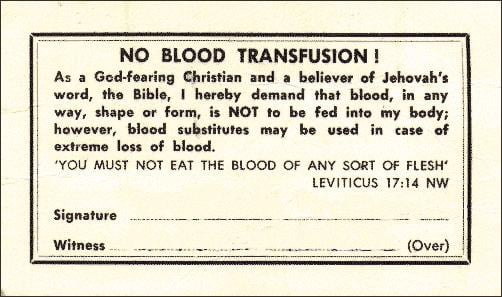
The policy is so ingrained in members that some Witnesses carry physical cards to let doctors know they don’t want a transfusion even if their life is on the line.
On October 15, 2000, in their official publication The Watchtower, the Governing Body explicitly ruled out both blood donation and the advance collection and storage of a patient’s own blood for a later transfusion.
… Jehovah’s Witnesses respect the principles God included in it, and they are determined to ‘abstain from blood.’ Hence, we do not donate blood, nor do we store for transfusion our blood that should be ‘poured out.’ That practice conflicts with God’s law.
It’s about as clear-cut a rule as you’ll ever find in a religion.
So, naturally, JW leaders have been changing it all year long.
Earlier this year, Governing Body member Gerrit Lösch announced that storing your own blood for a future transfusion would now be a matter of personal conscience. He even cited the very same article that doubled down on the blood transfusion ban in 2000, reminding people that it also said, “A Christian must decide for himself how his own blood will be handled in the course of a surgical procedure, medical test, or current therapy” (emphasis theirs).
The Bible does not comment on the use of a person’s own blood in medical and surgical care.
Regarding the use of one’s own blood, our position has been, as is stated in the October 15, 2000 issue of The Watchtower. There, it says, “A Christian must decide for himself how his own blood will… be handled in the course of a surgical procedure, medical test, or current therapy.”
For that reason, many Christians accept simple procedures such as blood tests, as well as more complicated procedures involving their own blood, such as the use of heart-lung machines, cell salvage devices, and kidney dialysis treatments. However, the list of treatment options continues to grow.
Therefore, after much prayer and consideration of the scriptures, the Governing Body has decided to clarify our position on the use of a patient’s own blood in medical and surgical care.
The clarification is this: Each Christian must decide for himself how his own blood will be used in all medical and surgical care. This includes whether to allow his own blood to be removed, stored, and then given back to him.
Lösch made it sound like this was merely a clarification on something the religion has always taught, but it was very much a reversal of their past policy.
It also didn’t go far enough. A lot of critics said the Bible doesn’t comment on blood transfusions at all, so what’s with the parsing that says it doesn’t comment on “the use of a person’s own blood in medical and surgical care”?
Also, who benefited from this? In an emergency involving sudden blood loss, you probably won’t have your own blood sitting on a shelf, waiting to be given back to you. And for patients who needed blood donated by someone else, the change offered no help at all. The “clarification,” in other words, benefited a much narrower group: people who knew in advance that they might need a transfusion and had access to facilities capable of collecting and storing their blood. Many countries lack those facilities entirely.
Why were they making this change now? The Governing Body didn’t say. It just came out of nowhere.
But there were stories in a subreddit for ex-JWs sharing how they could have saved themselves a lot of pain and trauma if this “clarification” came earlier, like one woman who said she didn’t store her own blood in advance when she had a C-section precisely because of the ban despite her doctors’ advice.
And now JW leaders are changing the rules again.
This time, they’re saying that Witnesses can finally receive products derived from blood—they can receive platelets, plasma, red blood cells, or white blood cells—but transfusions of “whole” blood from other people are still prohibited.
The JWs will also leave it up to individual Witnesses to decide if they want to donate blood (assuming it’s for the purpose of donating those blood-derived products).
Here’s why this is still a big deal, according to the Associated Press:
Plasma, the liquid component of blood, is often used for those suffering from trauma or certain diseases, according to the American Red Cross. Red cells can be used to treat conditions such as anemia and white cells to treat certain infections. Platelets are used in some cancer and other treatments.
For decades, Witnesses have been unable to receive those blood components, even in cases of anemia or disease or cancer, because it would have violated the religious rules. That’s not the case anymore.
In most hospitals today, patients who need transfusions usually don’t receive whole blood. They receive the particular component they need—most commonly red blood cells, but sometimes platelets, plasma, or another blood product. Whole blood is an uncommon transfusion product used mainly when patients need large amounts of several components simultaneously, like after a major accident or during certain heart surgeries.
Because the new policy allows Jehovah’s Witnesses to make their own decisions about receiving donated blood components, it effectively ends the organization’s categorical ban on nearly all transfusions used in regular medical practice—even though whole-blood transfusions remain prohibited.
This is how it was announced by Governing Body member Geoffrey W. Jackson on the official JW website:
After further prayerful consideration, the Governing Body has decided that this same principle applies to the four primary components of whole blood—that’s red cells, white cells, plasma, and platelets—that are derived from another person’s blood. Therefore, each Christian must make his own personal decision about the use of these four primary components in all medical and surgical care. Likewise, each Christian must decide whether to donate components or fractions derived from his own blood.
To be clear, JW leaders are not endorsing these transfusions. They still say the matter is spiritually serious and encourage members to pray before deciding whether or not to go through with it. But they now say the congregation will not intervene or judge a Witness for accepting one. The threat of punishment for accepting these components is finally gone.
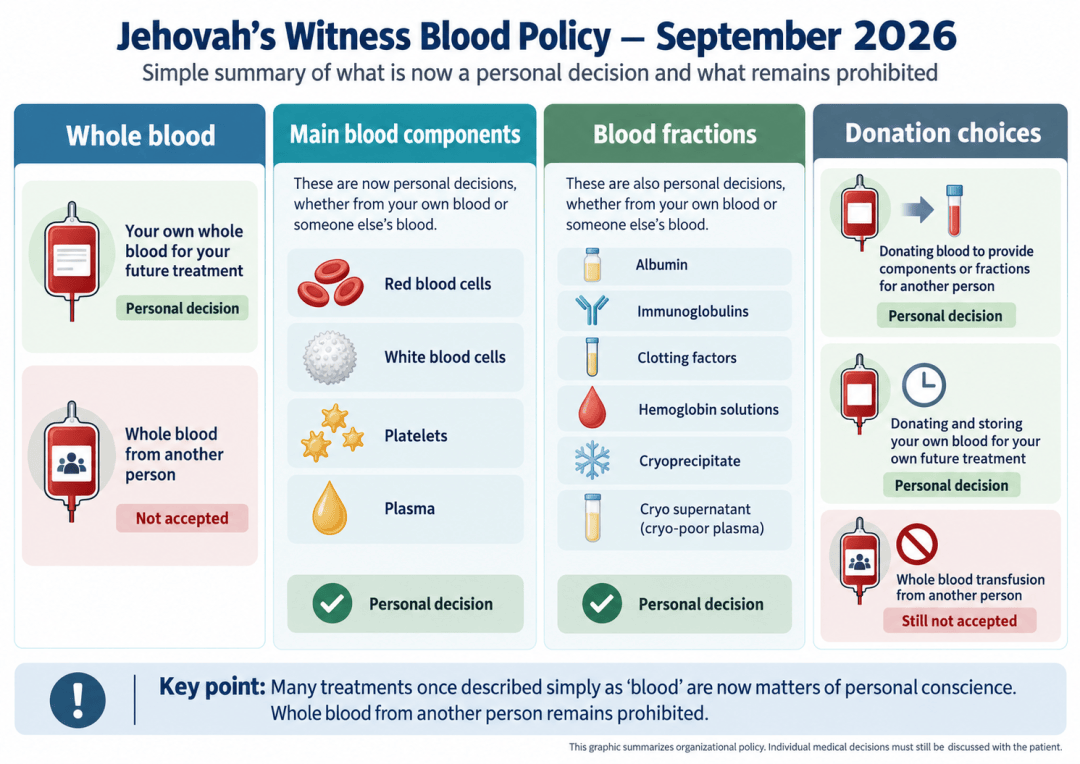
Since all of this is so chaotic and confusing, the group Alliance for Jehovah’s Witness Research and Bioethics (AJWRB) put together this useful chart to explain what’s currently allowed and prohibited under the revised rules:
When this was first announced on the ex-JW subreddit, the top comment came from someone who said they were thrilled that fewer people will die now but sad because “just a few months ago a person I know died because of refusing red blood cells.” Over the past 24 hours, the subreddit has been swamped with infuriated ex-JWs who know people (often family members) who could have lived had this rule been in place earlier.
For former Witnesses, the timing only adds to their outrage. However long the Governing Body considered the change internally, members continued making life-or-death decisions under the old rule until the announcement became official.
It also raises another question: If people were treated as having disassociated themselves—and subsequently shunned—because they accepted a prohibited transfusion, will those decisions now be reversed? Will they be allowed to reunite with their families? (Will they even want to?)
Whatever prompted this change, though, it wasn’t a clarification of God’s Word. It was a decision made by a small group of men—a decision they could have made decades ago.
That’s why their refusal to acknowledge the damage they’ve caused is so infuriating. An unknown number of Witnesses suffered because their leaders insisted there was no moral ambiguity when it came to the blood ban. Some lost their lives rather than disobey. Others faced the prospect of being cut off from everyone they knew. Now, however, the same blood components have quietly become a matter of personal conscience.
The Governing Body can say that’s a clarification, but it sure as hell looks like an admission that their earlier certainty was manufactured all along.
This is why you never obey first and question later.
(Portions of this article were published earlier)
About 25 years ago, the Catholic Church decided that limbo was no longer a thing. They invented it, then for whatever reason, DE-INVENTED it. In a similar fashion, the Jehovah's Witnesses have now determined that elements of blood if not whole blood may be used to save the lives of JWs. Check me on this, but hasn't the whole business of blood transfusion been a major foundational point of the Witnesses since Hector was a pup? I have to ask: WHO DIED??? Who among them who was so critical to the existence of their sect lost their life to some form of disease? I want to know what event or series of events catalyzed this change of heart.
Because stuff like this doesn't come out of a vacuum.
𝐼𝑡’𝑠 𝑎𝑏𝑜𝑢𝑡 𝑎𝑠 𝑐𝑙𝑒𝑎𝑟-𝑐𝑢𝑡 𝑎 𝑟𝑢𝑙𝑒 𝑎𝑠 𝑦𝑜𝑢’𝑙𝑙 𝑒𝑣𝑒𝑟 𝑓𝑖𝑛𝑑 𝑖𝑛 𝑎 𝑟𝑒𝑙𝑖𝑔𝑖𝑜𝑛.
𝑆𝑜, 𝑛𝑎𝑡𝑢𝑟𝑎𝑙𝑙𝑦, 𝐽𝑊 𝑙𝑒𝑎𝑑𝑒𝑟𝑠 ℎ𝑎𝑣𝑒 𝑏𝑒𝑒𝑛 𝑐ℎ𝑎𝑛𝑔𝑖𝑛𝑔 𝑖𝑡 𝑎𝑙𝑙 𝑦𝑒𝑎𝑟 𝑙𝑜𝑛𝑔.
Of course the eternal and unchanging god almighty has changed his mind. It has always been a stretch to claim that a blood transfusion is the same as making a meal out of blood.
I think I know why the big rule change. The JWs have been hemorrhaging (pun intended) members for a while now, keeping the ones who still want to stay from dying of blood loss is practical. This may backfire on them, though, as many will jump ship when they realize that a relative who bled to death yesterday could have survived today.