
This newsletter is free and goes out to over 23,000 subscribers, but it’s only able to sustain itself due to the support I receive from a small percentage of regular readers. Would you please consider becoming one of those supporters? You can use the button below to subscribe or use my usual Patreon page!
In a stunning decision out of Indiana, a judge has blocked the Republican-led state’s near-total abortion ban saying that it violates the religious freedom of those whose beliefs require them to get an abortion when they believe it’s necessary.
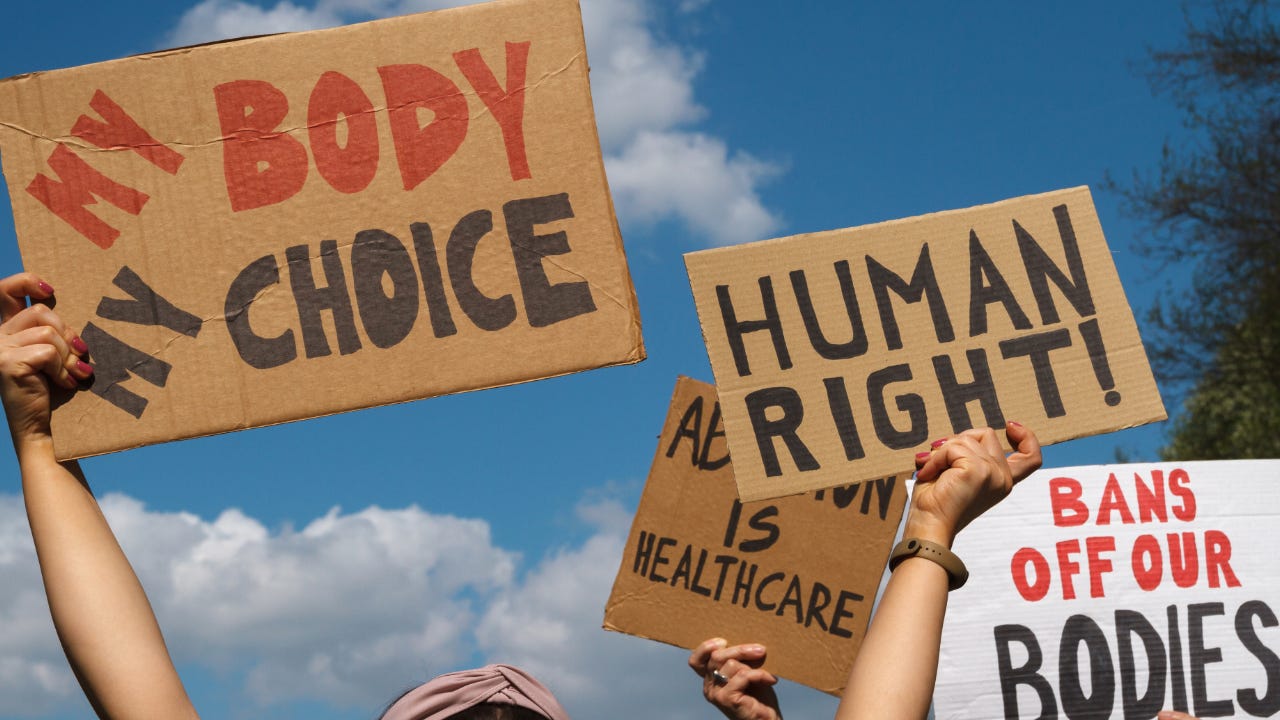
The lawsuit itself dates back to 2022, when Republicans passed a law effectively banning all abortions with exceptions only in the case of rape, incest, or lethal fetal anomalies—and even then, only within certain time limits. Furthermore, surgical abortions could only be performed in hospitals or surgical centers owned by a hospital—something that happened fewer than 2% of the time in Indiana in 2021, according to one report—further limiting access for women who met the already narrow requirements to have the procedure done.
It was a law designed to punish women who didn’t want to be pregnant. It was cruel. It was unnecessary. It forced women to give birth against their will. The consequences were predictable—and I suppose it worked as intended: at least one woman died because she couldn’t access medical care, which was the logical conclusion to the Republicans’ wishes.
That’s why the ACLU sued various state officials who were in charge of enforcing the new law as well as the Medical Licensing Board of Indiana. They did it on behalf of Hoosier Jews for Choice and a group of five anonymous Plaintiffs who held a variety of religious beliefs.
The Jewish clients, for example, believed that fetuses were considered “living” only after birth, not at conception. That view—that life doesn’t begin at conception—was also true for Muslims, Unitarian Universalists, Episcopalians, and more.
The ACLU said their Plaintiffs all had “sincere religious beliefs that direct them to obtain an abortion under circumstances prohibited by [the anti-abortion bill] S.E.A. 1 and who are at risk of needing an abortion in the future consistent with these beliefs even though the abortion would otherwise be prohibited by S.E.A. 1.”
They added that Indiana also had its own version of the “Religious Freedom Restoration Act” prohibiting the government from substantially burdening anyone’s religious exercise without a really good reason. This anti-abortion law violated their clients’ ability to practice their faith if they needed to obtain an abortion.
It wasn’t the only challenge to the new law. Another one was initially successful, leading the new law to be put on hold… but the state’s Supreme Court, in 2023, ended that temporary ban, allowing the anti-abortion law to go into effect.
But the ACLU’s challenge has now thankfully achieved its goal.
Last week, Marion County Superior Court Judge Christina R. Klineman ruled that the religious freedom of the Plaintiffs outweighed the draconian measures in the anti-abortion law.
“The court finds that there is significant public interest in ensuring the religious freedom of all citizens and the state’s position that religious freedom is somehow less important than other exceptions in the abortion law puts the court in an untenable position and finds a permanent injunction the only proper relief,” Klineman wrote.
…
“The abortion law would allow a plaintiff to seek an abortion if her pregnancy were the result of rape, but not if it were mandated by her religious beliefs. The state has not justified this differential treatment by establishing that its interest in the same prenatal life changes based upon the reason for terminating a pregnancy,” Klineman wrote.
In a way, Klineman turned the argument often used by Christian Nationalists against them. She said the state had an obligation to prove that the abortion exceptions they granted in certain situations were more important than abortions that women simply wanted to have as a result of their religious beliefs. Because the state couldn’t do it, the only solution to protect the Plaintiffs’ religious beliefs was to throw out the anti-abortion ban entirely when it affected them.
It’s an argument that several groups made in an amicus brief on behalf of the Plaintiffs, saying that there was ample evidence of “sincerely held religious beliefs” that permitted abortions—both before and after Roe v. Wade.
The State had argued that result would be unfair because the women in question weren’t targets of the law; only providers were. But obviously that’s not how reality works. Pregnant people were going to suffer the consequences of the law either way even if they didn’t risk a prison sentence:
Penalizing providers to avoid the violation of RFRA is an untenable endrun around the conflict in these laws. The “substantial burden” is the inability to receive an abortion in an exercise of religion which necessarily effects the person who is challenging it. The fact that a third party is likewise burdened (by serious disciplinary action) does not alleviate the burden to the individual seeking the abortion for religious purposes.
The ACLU of Indiana celebrated the decision as a victory for freedom:
“Today’s ruling is a recognition that religious freedom protects people of many faiths and beliefs, not just those favored by the state,” [ACLU attorney Stevie] Pactor said. “For more than three years, our clients have challenged a law that forces them to choose between their faith and their autonomy. This decision makes it clear that Indiana cannot enforce its abortion ban in ways that violate their religious freedom.”
To be clear, there is a huge limitation with this decision.
Because it was filed as a class action, the ruling only applies to people whose religious beliefs direct them to obtain abortions. People who simply want to get one for personal reasons would still be unable to do so. The judge simply said the state could apply the same accommodations they did when it came to rape/incest cases to people whose sincerely held religious beliefs required them to get an abortion.
And even that carve-out may not be permanent.
Indiana Republicans will challenge this ruling, and it’ll eventually get in the hands of their allies. If that plan succeeds, though, those judges will still have to explain why the religious beliefs of some people deserve to be violated in order to enforce an abortion ban (which, let’s be honest, is nothing more than a religious request by a more powerful religious bloc).
That may be the most significant aspect of this ruling. While conservatives want to pretend they’re protecting life, what they’re actually doing is privileging certain religious beliefs over others. They believe the law should fall on the side of whatever the hell white evangelicals and conservative Catholics want— everyone else just needs to deal with it.
(Incidentally, The Satanic Temple had also sued to overturn Indiana’s law, but they were unsuccessful. They said the law prevented them from providing telemedicine abortion care, but an appellate court ruled that the Satanists failed to point to any concrete injury, including their claim that they were being persecuted for their beliefs.)
By using Indiana’s RFRA as their guiding light, the Plaintiffs in the ACLU’s case were able to upend the law, at least temporarily, by saying their faith gave their control over their bodies, and the state had no argument compelling enough to toss aside that claim.
The Law, Rights & Religion Project based out of Union Theological Seminary said in an email that this strategy could be useful in other states:
Similar cases are ongoing, including a challenge to Kentucky’s fetal personhood law. We expect that the holding in Indiana may inspire other suits in states with RFRAs on the books. This legal strategy could ensure some access to abortion care in states where abortion is otherwise banned. In a federal case, religiously motivated abortion providers in South Carolina have asserted their own rights to provide abortions to patients relying on the First Amendment’s protection for free exercise of religion.
On the other side, Indiana Right to Life whined about the fact that some religious people now have rights that their group hoped to take away:
Indiana Right to Life issued a statement in response to the ruling, President and Chief Executive Officer Mike Fichter called the decision “distressing—and a perversion of the law’s intent”.
“Indiana’s Religious Freedom Restoration Act was never intended to equate taking the life of an unborn child with religious expression in our state. While this current injunction is limited to the plaintiffs in the case only, if it withstands challenge, it will be exploited so anyone claiming a spiritual belief, even if personal and non-theistic, can justify taking a child’s life,” Fichter’s statement read.
Yes, it’s deeply ironic for a religious zealot to complain about people citing their religion to overturn a law they don’t like because—gasp—that argument could be exploited by anyone with an axe to grind.
Republicans in Indiana could always respond by repealing the state’s RFRA law, but they probably aren’t going to do that, knowing it would anger their rabid conservative Christian base. I would guess they’re just hoping courts handle this matter for them so they don’t have to make abortion another election-year controversy.
Still, at a time when victories regarding abortion rights are few and far between, this one is worth cheering for. For years, architects of anti-abortion bans cloaked their agenda in the language of neutrality and “protecting life,” pretending the law reflected some universal moral consensus. This ruling makes clear that the ban was never neutral. It was a theological mandate by a small-but-powerful religious faction.
When confronted with the reality that other religious traditions draw radically different conclusions about when life begins, or what moral obligations pregnancy entails, the state had no legitimate response. Their bubble had been pierced.
We’ve been living in an era where religious freedom has been weaponized by conservatives as a tool to carve out exemptions from civil rights protections, public health rules, and anti-discrimination laws. It’s about damn time that tool was used against them, all in support of protecting people instead of harming them. There’s an underlying truth to that strategy we can’t forget: Once you elevate religious liberty, you don’t get to dictate whose religion counts.
Indiana’s RFRA law was meant to shield conservative Christians from a pluralistic society. Now it’s become a way to protect reproductive freedom. Beautiful. Much like we’ve seen with gerrymandering, a strategy meant to protect the power of conservatives has backfired.
But the victory isn’t complete. A lot of Hoosiers will still be left to fend for themselves—unless, of course, they want to pretend their desire to have an abortion stems purely from their religious beliefs rather than their dignity, health, or freedom. As if philosophical justifications for freedom don’t count as much as religious ones. By allowing the state to continue banning abortions for secular reasons, the decision inadvertently reinforces the idea that someone’s personal liberty is less legitimate than someone else’s religious convictions. That’s a troubling precedent.
The so-called pro-life crowd does not care about the health and well being of women, and they quit caring about the child the moment it’s born. They are pro-death penalty, anti-gun control, anti-universal health care, and never met a war they didn’t love. These measures are all about the subjugation of women. Period.
I did not get enough sleep last night, or the last three nights. So coffee is my religion.
When I first started to read this article, I thought that the religious conclusion reached by the judge would not hold up. And then Hemant ddressed the problem: “That may be the most significant aspect of this ruling. While conservatives want to pretend they’re protecting life, what they’re actually doing is privileging certain religious beliefs over others. They believe the law should fall on the side of whatever the hell white evangelicals and conservative Catholics want— everyone else just needs to deal with it.”
And that is the real problem. It is privileging one group groups religious beliefs over the religious beliefs of other people or the non-beliefs of other people. The same argument applies to gay marriage, sodomy laws, blue laws, or laws guaranteeing that your church can take over a public street on Sunday morning because your parishioners need a place to park: your religious beliefs should not hold sway over my beliefs and my life. Believe whatever you want, but keep your goddamn and goddamning religious beliefs out of my life. Purely theological concerns have absolutely no place in the laws governing a free society that guarantees freedom of religion.
No religion requires anybody to get an abortion. That’s the problem I had with the judge's ruling. But if their religion does not forbid them, someone else’s religion should not be able to forbid them either. The whole Kim Davis fiasco was privileging her religious beliefs over the belief of people who were simply seeking a legal marriage license from the state. And the hypocrisy of saying that it was fine for her to violate the clear Commandments— GOD HATES DIVORCE— of her religion while claiming that someone else’s marriage which she does not participate in is also a violation of her religious beliefs…
That is the crux of the issue.