
This newsletter is free and goes out to over 25,000 subscribers, but it’s only able to sustain itself due to the support I receive from a small percentage of regular readers. Would you please consider becoming one of those supporters? You can subscribe via Patreon or the Subscribe button below! You can also make one-time donations through Venmo, CashApp, or PayPal.
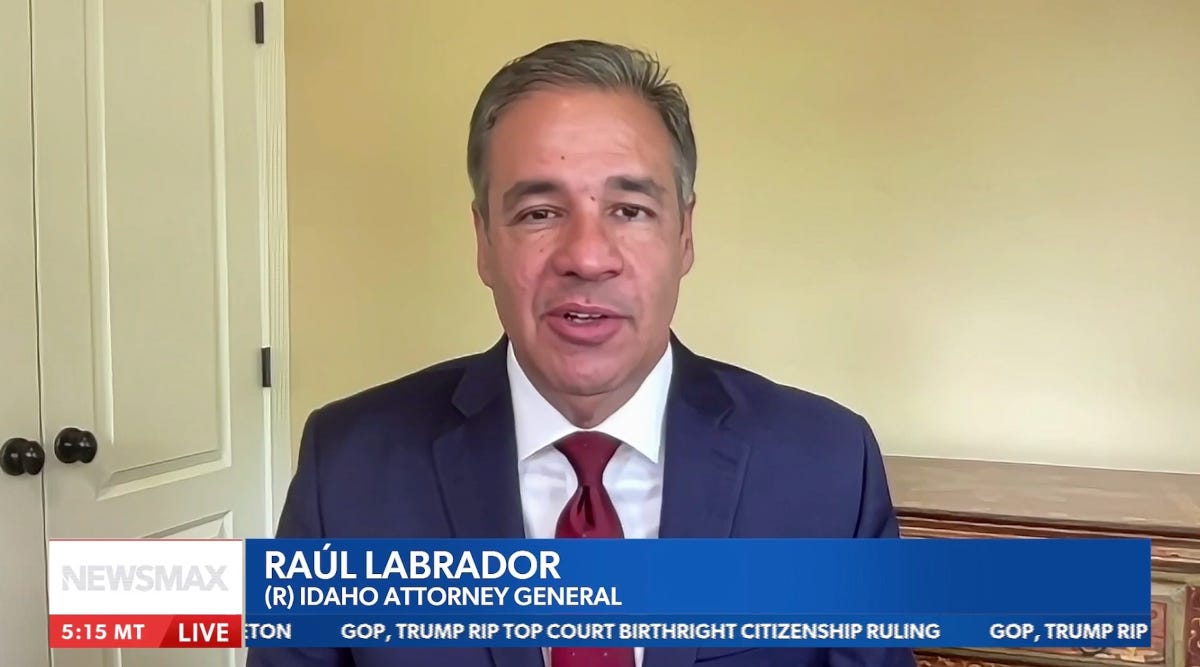
Idaho Attorney General Raul Labrador, a Republican, says it’s perfectly legal for churches to spend their general funds on political campaigns while shielding the names of the individual donors who contributed to the funds. If applied, the move would create a dark money funnel, helping conservatives prop up their preferred candidates and ballot measures. The churches and their spending would still be disclosed but not the donors themselves.
The result is a dark-money loophole especially useful to right-wing religious organizations.
The deeply red state is currently considering a citizen-led ballot measure known as Proposition 1, the Reproductive Freedom and Privacy Act. Generally speaking, if it gets enough “Yes” votes, Idahoans could restore some of their reproductive freedom and privacy rights. They could access abortion, at least until the point of fetal viability. The state (generally speaking) couldn’t interfere with decisions about contraception or fertility treatments unless a restriction was narrowly tailored to protect the patient’s health. If the “No” side wins, Idaho’s near-total abortion ban would remain in place, though a recent federal injunction currently limits its enforcement in certain serious-health situations.
It’s really a question of who should control a woman’s body: Women and their doctors… or Republicans.
As the election draws near, Idaho Secretary of State Phil McGrane asked Labrador for a formal assessment of whether churches could spend money supporting or opposing ballot initiatives like this one without having to reveal the names of the individuals who gave them money.
Labrador responded by saying not only could churches donate, they could keep their individual donors secret. But only if they did it a certain way.
As it stands, Idaho’s (pro-transparency) Sunshine Law says a non-business entity— including a church—that spends over $1,000 in a calendar year for a candidate or ballot measure must report that to the secretary of state. That report must include the names of people who gave the group over $500 during either of the previous two calendar years, or who promised more than $500 this calendar year. If the groups don’t do this, they could receive a fine and possible criminal penalties.
The concern for some conservative churches is that they want to give money to oppose Prop 1, but they don’t want to reveal the names of their donors. Isn’t forcing them to do that a violation of the state’s Free Exercise of Religion Protected Act (FERPA)? In other words, they say it violates their religious freedom to make them disclose their donors. What should take precedence: Their religious freedom or campaign finance laws?
Labrador tries to reconcile the difference by saying churches have to play by the rules if they’re raising money specifically for a ballot measure.
But if they simply use money from their “general funds” to support those campaigns… then they don’t have to say anything about their individual donors. To put that another way, if church leaders use money from a Giant Pool of Tithes to oppose Prop 1, then Labrador says they don’t need to disclose anything about who contributed or how much they gave. It would be the church donating to the cause, not individuals.
One University of Idaho law professor said this “advice” effectively creates a loophole for churches that want to hide their donors’ names: A donor could give a large bag of money to a church as an unrestricted tithe, even while expecting the church will spend part of its general fund on the donor’s preferred campaign(s). Unless the state can prove the donation was intended for a specific campaign, the donor’s identity could remain hidden.
"You can imagine a church saying, 'Well, we're worried about disclosing who gives money through regular donations, tithes, what have you, because if we disclose, people may stop giving us money.' They don't want to be outed or publicized," [University of Idaho law professor Richard] Seamon said. "They are a church, and they are exercising their religion when they undertake to oppose or support these measures," he said.
Seamon also said some people worry the opinion could create a path around campaign finance disclosure rules.
"People may try to get around the limits on disclosing donations directly to support measure, by almost laundering them through churches—giving them to churches with the expectation that the churches will use that money in turn for these electioneering purposes," Seamon said.
This is not technically a Johnson Amendment issue. That federal restriction concerns intervention in candidate elections; advocacy for ballot measures is generally treated as lobbying. The scandal here is narrower but still serious. Labrador wants churches to spend their general funds influencing ballot measures while concealing the identities of donors who supplied those funds.
The Roman Catholic Diocese of Boise has already given $2,000 to the anti-Prop 1 campaign, and when a reporter reached out to them for comment about this advice, the response from Church lobbyist Christian Welp was straight out of the MAGA playbook: Dodge the question entirely, attack the messenger, and complain about the other side:
"I would love to see a story from you guys about the nearly $2 million Idahoans for Women and Family took in just yesterday. $250,000 from billionaire Michael Bloomberg. $650,000 from some big PAC out of DC. I think that is far more news worthy than the Catholic Church in Idaho wanting to weigh in on abortion in Idaho."
The Catholic Church in Idaho is, of course, free to oppose abortion rights. That’s not the issue here. Welp avoided the question of whether the Catholic Church should be allowed to spend money on a political campaign while covering up the donors who made it possible.
(In case you’re wondering, the side supporting reproductive freedom has raised twice as much money as the anti-choice zealots on the other side—$5 million to $2.5 million, roughly, as of September 29.)
As Boise Public Radio explained, lawmakers considered a bill that would have exempted religious organizations from donor-disclosure requirements as long as their ballot-measure spending remained below 10% of their total receipts from the previous year. That bill died in committee. But if it passed, it would have allowed the Catholic Church in Boise to donate up to $2.3 million for campaigns like Prop 1 due to its $23.2 million in revenue in 2025—and they wouldn’t have had to disclose anything about their donors.
Labrador’s opinion doesn’t even have a comparable 10% ceiling.
Former Idaho attorney general and longtime justice of the Idaho Supreme Court Jim Jones wrote an opinion piece for the Idaho Statesman denouncing Labrador’s insane advice:
The opinion does not provide any criteria for determining how central abortion is to the church’s religious beliefs or even how to categorize Prop 1 as a religious issue rather than a secular issue. The opinion would allow out-of-state interest groups to funnel tons of money through those churches into the campaign against Prop 1, without voters learning of their identity.
Jones points out that Labrador has only issued seven opinions like this one over the past four years, and three of them involved abortion, implying that Labrador is more interested in pushing a pet right-wing cause rather than clarifying confusing laws.
He also called out the ridiculous idea that transparency laws would burden churches:
The Sunshine Law requires all recipients of political donations to disclose the identity of their donors so as to prevent dark money contributors from corrupting Idaho elections. The reporting requirement applies to all entities that use donor money to influence the vote on political candidates or ballot measures. The requirement is neutral and universally applicable. It does not target religious groups. It does not substantially burden churches that choose to funnel money to political causes. It is the least restrictive means for identifying who is trying to influence elections.
…
We are now faced with the prospect of having a dark money group anonymously dump a ton of money into the coffers of some sort of church and use it to publicly hammer the Prop 1 initiative.
This is what Labrador and his religious allies want: the freedom to spend money influencing elections without letting voters see who funded them. They’ll go out of their way to circumvent any laws that might allow the public to realize how they’re being screwed over.
This may be the bigger scandal: Idaho lawmakers considered a similar religious exemption and rejected it. Labrador’s office is now trying to produce the same result through a shady legal interpretation.
Labrador insists this isn’t a dark money funnel because earmarked political donations would still have to be disclosed and churches still have to identify themselves (if not their individual donors). But that supposed safeguard depends entirely on the state proving what a donor intended when the check was written. A wealthy activist could give a church an ostensibly unrestricted donation, the church could spend its general funds attacking Proposition 1, and voters would see only the church’s name—not the person who supplied the money.
Labrador wants to transform that statutory disclosure obligation into a special privilege for religious organizations, one that conservative churches opposing Prop 1 are already well-positioned to exploit.
... 𝑏𝑒𝑐𝑎𝑢𝑠𝑒 𝑖𝑓 𝑤𝑒 𝑑𝑖𝑠𝑐𝑙𝑜𝑠𝑒, 𝑝𝑒𝑜𝑝𝑙𝑒 𝑚𝑎𝑦 𝑠𝑡𝑜𝑝 𝑔𝑖𝑣𝑖𝑛𝑔 𝑢𝑠 𝑚𝑜𝑛𝑒𝑦.
That makes you wonder just what, exactly, these churches are trying to conceal.
I'd call Labrador a dirty dog, but that would be an insult to real dogs.
Why are xtian Rethuglikkkans so damned deceitful? It's not like they have to hide what they do, given who's holding power in the US these days.