
The following is a guest post by Libby Bliss, the Camp Director for Camp Quest Chesapeake.
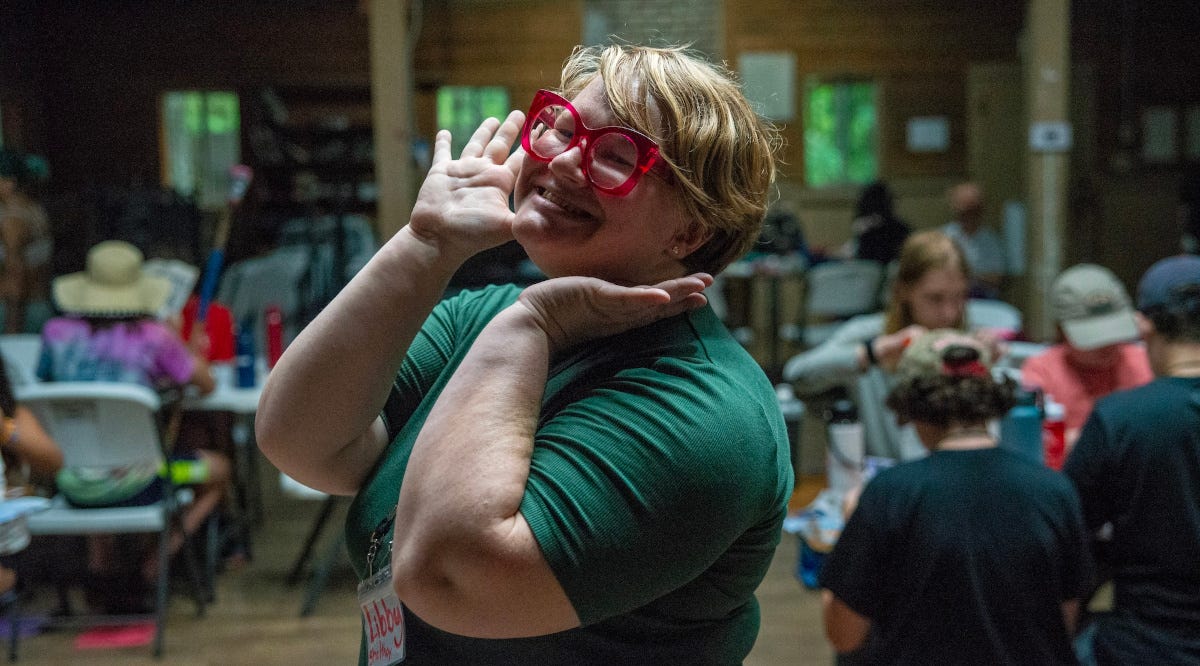
I’ve been an atheist since I was a kid. In my decades of non-believing, I’ve never really felt like I was missing anything. But when upsetting things in the world are happening, sometimes I do wish I could pray and feel like it would do something.
I may not have prayer, but I do have concrete action. When I was 16, I attended my first sleepaway summer camp, part of the nationwide Camp Quest network. (You’re reading this post on the Friendly Atheist because I found out about CQ from a post Hemant made 15 years ago. Thanks for changing my life, Hemant!)
Since the 90s, Camp Quest locations have been working toward a vision of the world where children grow up exploring, thinking for themselves, connecting with their communities, and acting to make the most of life for themselves and others.
Attending Camp Quest Chesapeake in 2011 gave me, for the first time, what a lot of people find in church: a community of people who share my beliefs and values. It also gave me confidence to develop as a leader—when my cabin counselor requested that I be her counselor-in-training again the following year, I felt so honored. I was also extremely grateful that CQC made the experience available to me at no cost. I was valued as a human being, as part of the community, regardless of my ability to contribute monetarily.
Camp Quest serves children aged 8 to 17, so I only had two years as a camper. Those two years were meaningful and shaped me in ways I can only begin to describe, but I think the years that I’ve spent as a volunteer that have been even more important to me. It hasn’t always been easy. My first role was leading the counselor-in-training program from which I’d just graduated—probably not the best choice. A few years later, when camp leadership decided to entirely re-envision that position, it left me gutted. But the harder things came later, when I took on the role of Camp Director and helped rebuild the board after COVID-19 burnt out the existing leadership, disrupted operations, and paused camp for two years.
In my years leading the counselor-in-training (now Peer Leader) program, one of the things I told teens was that being a counselor isn’t for everyone. The focus is no longer on you: you’re there to be the guardrails for campers’ safety, to encourage them to be curious and kind to others, and to set an example of what it means to be a leader. That’s not everyone’s cup of tea. The days are long, often hot, sometimes wet, and— critically—unpaid. If you’re a working adult, you’ll probably have to use your hard-earned vacation time to come to camp. And at the end of the day, when you just want to be around adults only and hang out with your friends, you’re going to be so tired most of the time that you only manage it once or twice. (Am I selling you on camp yet?)
It is also the most rewarding thing I’ve ever done in my life.
Being a part of raising the next generation gives me hope. The kids I meet at camp are some of the smartest, kindest, curious, funny, and yes, mischievous people I’ve ever met. Getting to nurture those tendencies, push them to think more critically and compassionately, and learn from them, is the highlight of my year. The same is true for many of our volunteers, and for the campers themselves! Camp gives me hope in times where hopelessness tries to drag me down.
When January 2026 kept pummeling me with depressing headline after depressing headline, I turned my focus to camp. At Camp Quest Chesapeake, our theme this year is The Future of America. It’s partially timely—our session will start on July 5 this year and 2026 marks America’s semiquincentennial (say that five times fast) or 250th birthday. But it’s also because these kids are the future of America.
But so am I! I get to help shape the questions that guide their growth and development. I get to encourage them to think critically, to be curious and compassionate, to make good trouble, to be brave and share their thoughts and opinions with the world.
So if you’re feeling a need for concrete action, consider camp. There are nine Camp Quest locations across the country running a total of eleven sessions. All sessions will need campers and volunteers, and both Camp Quest national and affiliates need board members. There are opportunities to get involved that don’t require actually going to camp, whether that’s volunteering or donating.
Stay curious out there!
It wasn't long after I came out as an atheist that I first heard about Camp Quest and learned what it was about. That a group of atheists would put together a learning environment that encouraged critical thinking and emphasized HOW to think rather than WHAT to think would have been a radical idea when I was growing up, six-plus decades ago. That Libby not only had a chance to experience it both as a camper AND as a counselor and reports herself as to the enormous benefit she gained from that time tells me that CQ is not just doing something right. They're doing something of incalculable value.
Thank you, Libby, for your story, and THANK YOU, CAMP QUEST!
I wish I could have gone to a camp like this instead of two weeks of bible camp.