
This newsletter is free and goes out to over 26,000 subscribers, but it’s only able to sustain itself due to the support I receive from a small percentage of regular readers. Would you please consider becoming one of those supporters? You can subscribe via Patreon or the Subscribe button below! You can also make one-time donations through Venmo, CashApp, or PayPal.
The Florida Department of Education, in an attempt to update science standards for public school students that were last revised in 2008, have issued a draft proposal that all but eliminates mentions of evolution and climate change. The standards allude to the ideas behind them, but they don’t connect the dots to show where the evidence leads.
For now, these standards are just a proposal. The public can read them now and the State Board of Education will likely vote on a final version in December.
But the current version is all a far cry from 2008, when evolution was explicitly described as “the fundamental concept underlying all of biology” and “supported by multiple forms of scientific evidence.” (That only occurred after a lengthy battle during which Creationists argued their mythology should be taught alongside evolution.)
The new version still includes mentions of natural selection, inherited variation, and populations changing over time. But students are not guaranteed to learn that evolution unifies all those concepts.
In middle school, for example, students will be taught about natural selection and the fossil evidence for change over time… without being told this is all evidence for evolution. In high school, the word “evolution” is omitted entirely. It’s a huge loss of clarity. Students shouldn’t have to connect these dots on their own—or hope they have a teacher who can do that for then. It should be a state requirement. For now, students are given individual pieces of a jigsaw puzzle without being told they should assemble to form a clear picture.
Bertha Vazquez, a longtime middle school science teacher and the director of the Teacher Institute for Evolutionary Science, put it simply:
The biggest thing I noticed is that all the underlying science is still there, but the scientific vocabulary that organizes that science has disappeared.
The situation isn just as dire for climate change. Both that phrase and “global warming” are nowhere to be found in these proposed standards. Students might learn about greenhouse gases, fossil fuels, and how humans influence Earth’s ecosystems. But the standards never connect the dots to their logical conclusion: Climate change is real, it’s happening, and human activity contributes to it.
That would be bad enough on its own. It’s even worse when it’s happening in Florida, a state that’s already dealing with climate-related disasters. Students deserve to understand how all the evidence fits together.
That’s not exactly a new battle in the state, though. As the Orlando Sentinel notes, in 2024, Republican Gov. Ron DeSantis banned the use of the phrase “climate change” in state laws. As if closing your eyes to reality might make it all go away.
A few months later, the education department told some science textbook publishers that they must remove the term from their books if they wanted to sell to Florida public schools.
Columnist Pat Beall asked a more pressing question: If not in school, when would Florida students ever learn about climate change?
Let’s not spring the news on the kids until they are older and able to handle it. Let’s wait until they are grown, living in a beachfront home without insurance (because Florida). Let’s put it off until they are watching a beautiful full moon lighting up the Cat 6 heading for landfall on their new sofa.
Let it be a surprise.
Or it could be another kind of surprise at Thanksgiving dinner, when Uncle Joe lets slip why humans don’t have feathers, or when the SAT scores arrive and the kids finally find out that even though Florida told them they were getting all the stuff, they were only getting a slice of the stuff, and they, not Florida, will pay the price for not enough stuff.
This isn’t a battle over terminology. If the state standards don’t explicitly tell teachers which topics they need to cover, that makes it much easier for lazy teachers, lower-performing districts, and well-intentioned-but-ignorant teachers to skip those areas altogether. Or at least minimize them.
Those aren’t the only problem with the proposed standards. Glenn Branch, deputy director of the National Center for Science Education, said the standards were “a mile wide and an inch deep” with close to 1,000 benchmarks—many of which were focused on definitions or isolated facts, not a coherent framework.
Branch also points out that the proposed standards aren’t even based on the National Research Council's 2012 A Framework for K-12 Science Education, a set of guidelines that most states use.
It doesn’t help that the people who wrote the proposed standards have an agenda that’s hardly a secret.
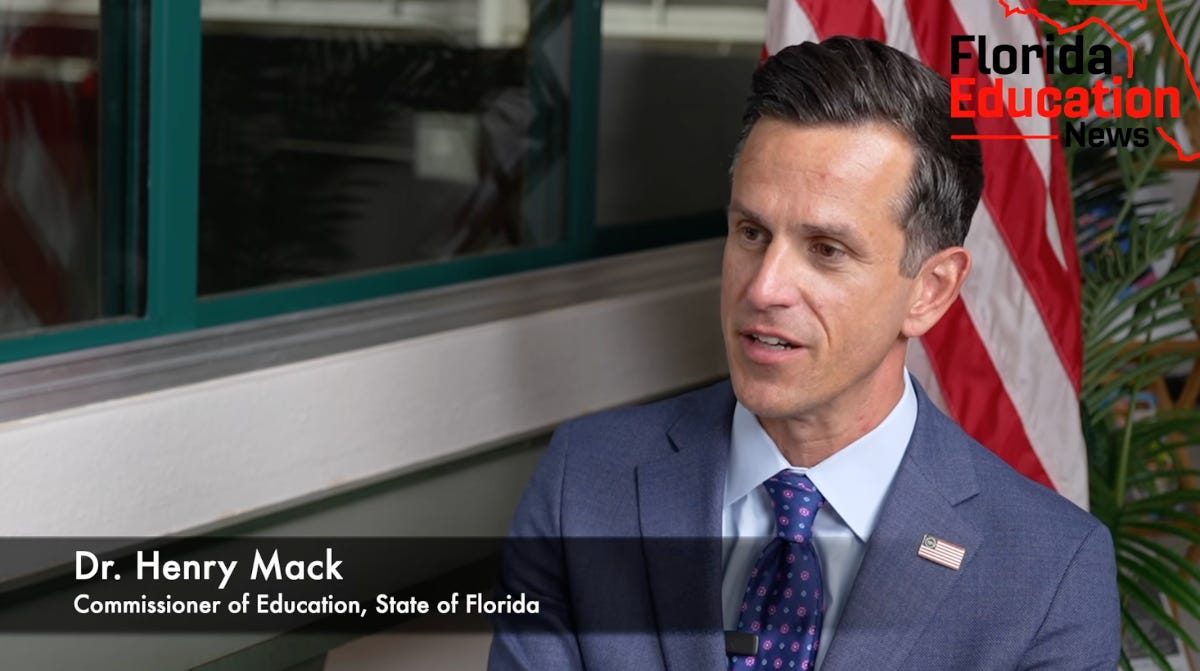
“Science begins in wonder, not in ideology. The classical tradition taught that nature is intelligible because it is ordered—that the book of creation can be read by reason,” said Commissioner Henry Mack. “Florida’s new science standards will form students who observe carefully, reason rigorously, and treat the natural world as something given to be known, not invented.”
“Ideology.” “Intelligible.” “Book of creation.”
These are standards written by Christians who, unable to find a way to inject their religion into the state standards, are trying to downplay science instead.
Elsewhere, the press release notes that the state is not interested in pursuing “trendy themes,” denounces science based in “speculation, advocacy, and political fashion,” and highlights a focus on “the dignity of life.” All of those are right-wing concepts that have been used to dismiss evolution and climate change.
Mack pretended to deny all of this on X/Twitter, where he insisted he was “not smuggling a Sunday-school lesson into Biology”… before proceeding to dismiss areas of science that he deems “a prop for adult ideology” that’s advanced by “leftist zealots.”

This is what you get when you appoint someone who graduated with degrees in “philosophy and theology from the Catholic University of America” to a position that has sway over public education.
One Christian parent who attended a feedback meeting on the new standards didn’t get the memo that he wasn’t supposed to promote religion, accidentally giving away the game:
Chris Vercelli, a parent in Sarasota County who regularly attends government meetings to preach Christianity, suggested at Wednesday’s meeting that he read the commissioner’s statement as an endorsement of his views and said he was in “full support” of the new standards.
It was “refreshing” to hear the state was “entertaining the idea of teaching creation and intelligent design in schools,” he said, referring to the argument that an “intelligent cause” better explains living things than evolution by natural selection.
“The way that evolution is taught really is like a bait and switch … that means that everything originated from primordial soup, and there is no God. That’s just ridiculous. That is like total non-science,” Vercelli said.
He understands what Republicans are doing. But Republicans are pretending they don’t understand what Republicans are doing.
It’s also why the people who understand science education the best are warning the public against these standards:
“It’s disappointing to see Florida politicize something that shouldn’t be political or remotely controversial. No science standards can be complete without evolution,” said David Griffith, national research director for the Fordham Institute, which reviews states academic standards.
If these standards are adopted, there’s another consequence beyond just raising a generation of students who don’t fully understand science. It puts Florida students at a disadvantage when applying to college. Admissions officers who see applications from students who graduated from a Florida public school may rightly wonder if those students have the science background they need to succeed in higher education. It could make it harder for those seniors to gain admission.
Like I said, though, these standards are not final. For the rest of the month, Florida is accepting public comment online. But the entire process is cumbersome for good reason: Republicans want to make it as hard as possible for the public to weigh in, allowing them to say later that there was minimal opposition to the standards. Commenters are expected to work through each section of the standards individually and reach the final “Submit” button for their comments to count. At first, the Sentinel points out, they posted “each standard on a separate page, requiring clicking through hundreds of pages to view all the standards.” They eventually combined those into three documents. But reviewing them still requires readers to click through “hundreds of pages.”
Vasquz explained:
In each section, there are about 100 standards, sometimes over 150. If you want to comment on standard #54 in a given section, for example, you have to start at standard #1, click one-by-one to #54, choose “modify” and comment, and then click one-by-one all the way to the last standard to submit your comments, and there are always more than 100 standards in each section.
It’s ridiculous for a reason.
Maybe the upcoming elections will have an impact here. Floridians seem to be getting sick of the way Republicans have screwed them over, but whether it’ll be enough for candidates like David Jolly and Angie Nixon to win their races for governor and senator, respectively, remains to be seen. If enough voters don’t give a damn about their own children’s education, then Republicans may hold on to power. If people are fed up, then a seismic change could impact if the State Board of Education goes through with these changes.
Still, the message here is damning: Florida’s leaders can deny that they’re promoting Creationism all they want. Their proposed standards still give cover to Creationist arguments regarding evolution and obscure the impact of human activity on climate change.
That said, anyone can comment on the standards.
When they do, they should make clear that “evolution” must be restored to the standards whenever we’re talking about biological change across generations. And that topics like greenhouse gases and human activity on the environment should be connected to “climate change.” (Vasquez has created a really helpful guide for anyone who wants to know exactly what to write in that space.)
The goal is to make sure these draft standards are revised before the December vote.
Ban the term climate change, and the problem goes away? Creationists have been flailing away at Darwin for over a century and a half and have yet to land a punch. Attacking Darwin does nothing to prove their point. If the Bible is true, then everything we think we know about the life sciences, cosmology and geology are wrong, while some Bronze age goat herders, who didn't know where the sun went at night, got things just exactly right.
"Science begins in wonder, not in ideology."
That statement should be tattooed on the foreheads of every person who wants to back this misbegotten alteration in the science curriculum for Florida. I feel particularly bad for any student wishing to pursue a career in the medical sciences. This proposal would hamper if not utterly hamstring those educational institutions which would support such an effort.
I would hope this proposal would be rejected outright, but we are talking about Florida here.