
This newsletter is free and goes out to over 23,000 subscribers, but it’s only able to sustain itself due to the support I receive from a small percentage of regular readers. Would you please consider becoming one of those supporters? You can use the button below to subscribe or use my usual Patreon page!
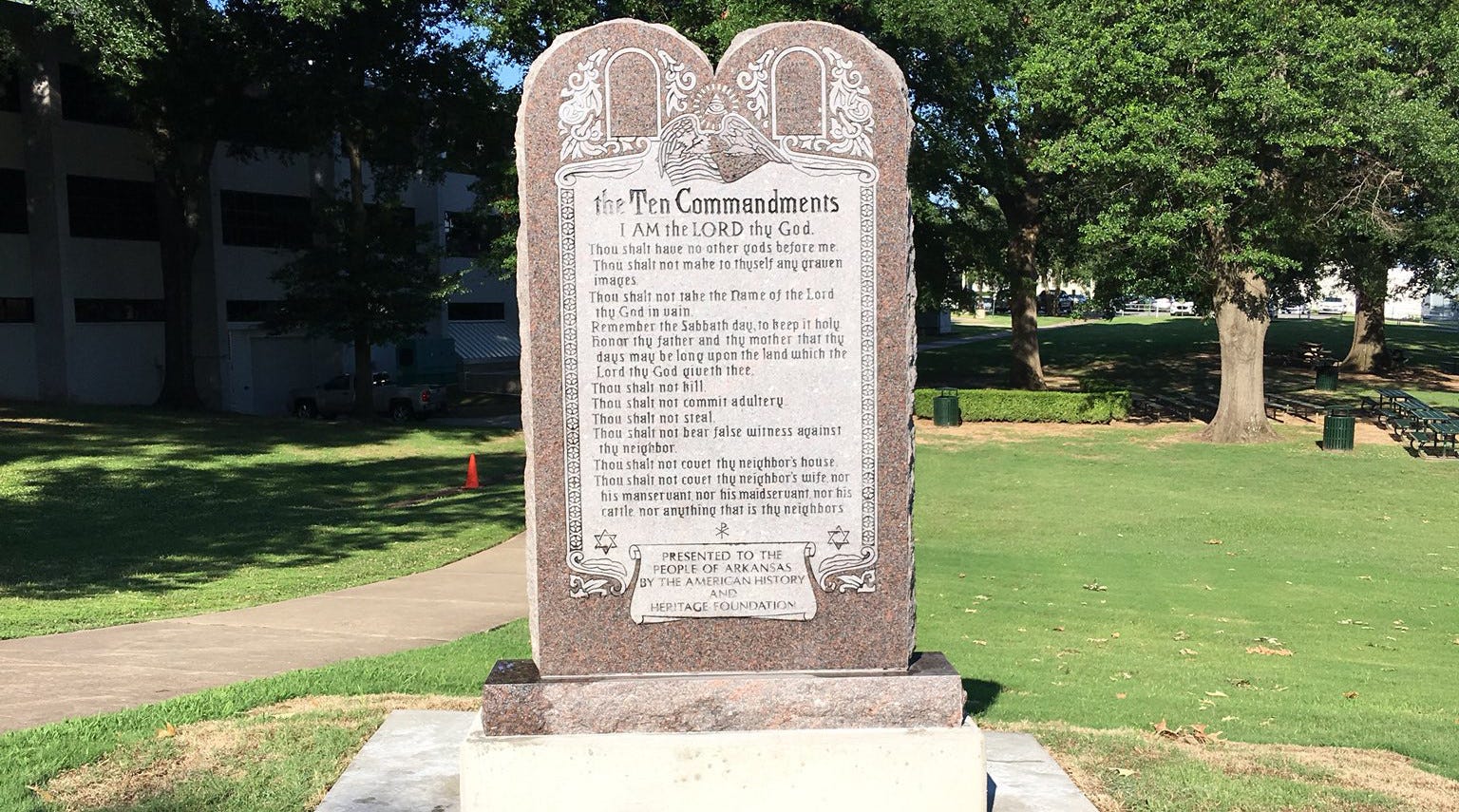
After nearly a decade, a federal judge has just ordered the Ten Commandments monument outside the Arkansas State Capitol to come down because the law that ordered it to go up is unconstitutional. Just like atheists and Satanists said.
Some background for those who have forgotten about this saga: In 2015, Arkansas passed a law allowing the state to erect a Ten Commandments monument outside the Capitol. It would be privately funded but the same privilege didn’t extend to any non-Christian groups. This was the work of former lawmaker and Christian Nationalist State Sen. Jason Rapert, who wrote the bill making it a reality.
A number of non-Christian groups—including Satanists, Hindus, and atheists—also wanted to put up monuments representing their beliefs, but state officials always found reasons to reject their requests.
The possibility that a non-Christian group might occupy that space, however, grew strong enough that, in 2017, lawmakers passed another bill giving themselves (and not the Capitol Arts and Grounds Commission) the power to veto additional monuments.
Eventually, though, the Christian monument (and only the Christian one) went up in July of 2017.

And then literally one day later, the monument was destroyed by a Christian vandal.
In April of 2018, a replacement monument went up. Once it was officially on the Capitol grounds, that’s when the lawsuits began.
One of the lawsuits was filed by a coalition of non-theistic groups, including the Freedom From Religion Foundation, the American Humanist Association, the Arkansas Society of Freethinkers, and seven individuals (both religious and nonreligious) who lived in the state.
The other lawsuit was filed by the ACLU of Arkansas on behalf of four atheist and agnostic women.
Those cases were quickly consolidated by U.S. District Judge Kristine Baker.
As those cases were being considered, it was unusual that neither of them involved The Satanic Temple, since that group really fueled the controversy. They had applied to put up their own statue of Baphomet via the same process used to approve the Christian display… but they were rejected.
That July, they filed a motion to act as “intervenors” in this legal battle. In short, that meant they were asking the courts to let them join in the litigation because they would directly be affected by how a judge ruled on this matter in the other lawsuits. It was a way to piggyback on the other cases. The judge approved that motion.
And then the pandemic happened and the trial got postponed. But eventually, all sides were in court pleading their case in front of Judge Baker.
FFRF argued that the Christian monument violated the Constitution:
The Ten Commandments are undeniably religious in nature, FFRF’s brief notes, and its placement has created precisely the kind of religious divisiveness the Establishment Clause was intended to prevent. The religious message “is an archetypical violation of the First Amendment’s Establishment Clause,” charges FFRF’s brief. The use of our secular government for the advancement of one religion’s beliefs above all others is, to put it plainly, un-American.
“Of course, there’s no reference to the bible or God, much less to the Ten Commandments, in our secular Constitution, which is the foundational document that governs our nation,” says FFRF Co-President Dan Barker. “The First Commandment alone — dictating which deity alone must be worshiped — is in clear and direct contravention of our First Amendment.”
The ACLU made the point that Arkansas officials falsely claimed the monument was “historical” because it was the Ten Commandments, when the Supreme Court has used “historical” to mean a Christian monument can stay up on government property because it’s been there for a really long time.
They also noted that Rapert made it very clear that his goal was to shove God into government—and his intentions as a public official mattered. (Rapert later claimed these comments from the lawyers were intended to “drag me personally through the mud.” That’s a lie. They were just quoting him verbatim.)
The Satanic Temple’s argument took a different approach. Their lawyers said the Satanists were denied equal access because of their faith. This was religious discrimination, in other words. It wasn’t just Rapert who was guilty of it either.

The Satanists said they either wanted their monument to go up in the same place as the Ten Commandments monument—and for the same length of time—or that their Baphomet statue should be placed outside the Capitol at a location determined by both parties.
The lawyers representing Arkansas didn’t seem to know what they were doing, according to an account of the proceedings offered by The Satanic Temple. They argued the plaintiffs didn’t have standing because they weren’t really harmed by the monument, though they were unable to come up with anyone who would have standing. They argued anyone offended by the monument could just ignore it (which is hard to do for anyone who has business at the Capitol and never seems to be an acceptable solution whenever Christians don’t like something).
They also cited the Supreme Court’s Van Orden decision from 2005, which allowed a Ten Commandments monument outside the Texas Capitol to stay up, ignoring the very relevant fact that the Texas monument was one of several illustrating a broadly secular theme. Arkansas’ situation more closely mirrored a different 2005 case, McCreary County, which involved a stand-alone Christian monument; the Supreme Court declared that one illegal.
The bottom line was that the state needed to allow non-Christian groups to erect their own donated monuments on Capitol grounds… or the Christian monument needed to come down. If the Ten Commandments monument was allowed to stay up—by itself—it would send a clear message that Christianity is the official religion of Arkansas. Non-Christians aren’t welcome there.
Rapert didn’t seem confident at the time of the trial, writing on Facebook, “Regardless of the decision of the district judge in this case, I predict the Arkansas Ten Commandments Monument will ultimately be upheld, especially if the case goes all the way to the U.S. Supreme Court.”

He seemed to be implying that he was going to lose at the district level and possibly the appellate level. But it’s hard to tell how these things will play out.
But late Tuesday night, Judge Baker handed down her 148-page decision. And my goodness, this was worth waiting for.
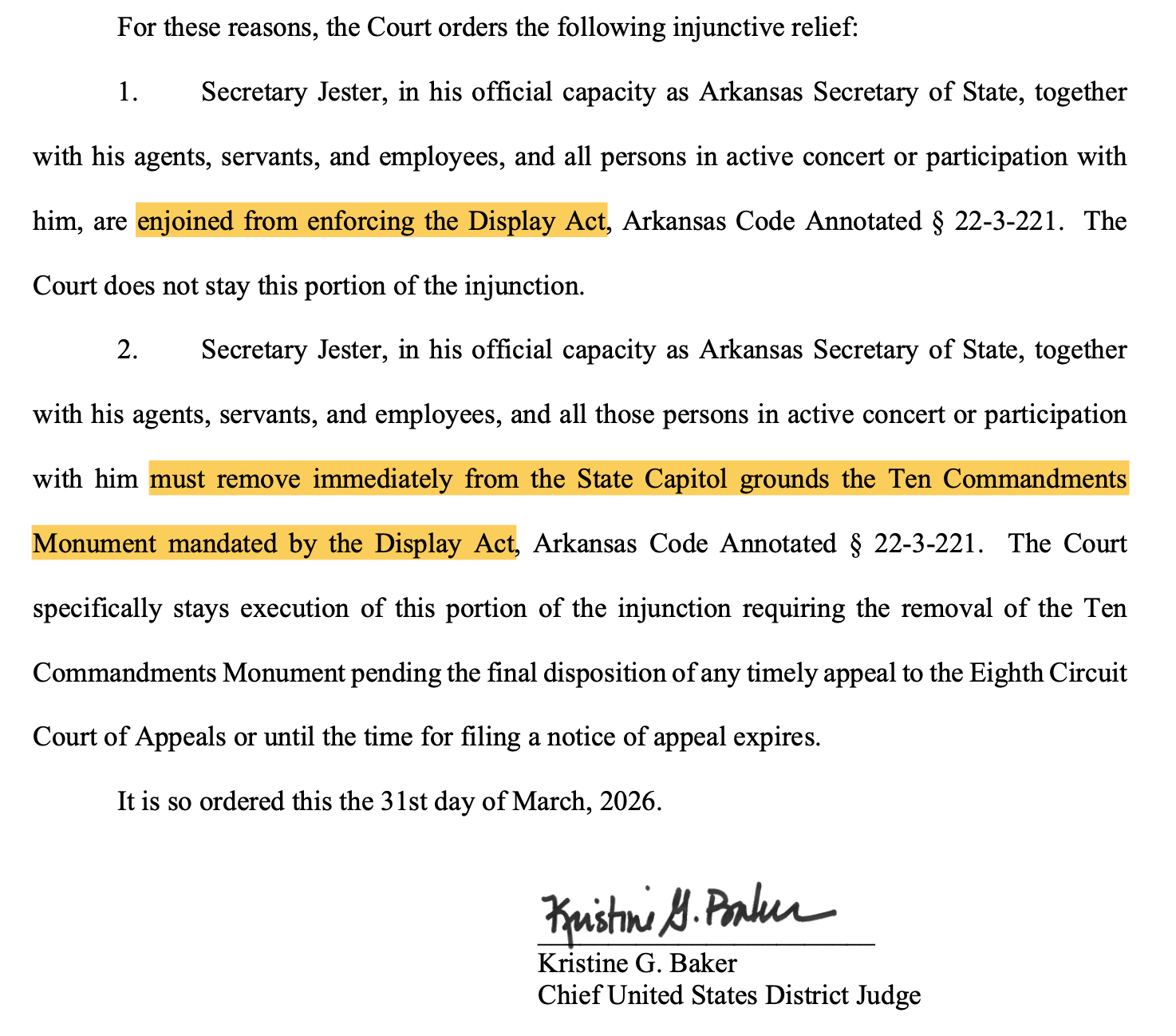
Before I get into the details, the end result is that Baker said state officials cannot enforce the law putting the Ten Commandments monument outside the Capitol and therefore, as a result, they “must remove immediately from the State Capitol grounds the Ten Commandments Monument mandated by the Display Act.”
That takedown, however, is on hold until the appeals process plays out.
How did the judge arrive at that conclusion? In many cases, she quoted Rapert directly, with his open desire to promote Christianity through the government and his reassurances to donors that Satanists would never be allowed the same access. Turns out his own big mouth was one of the best weapons for his opponents.
It all led to this conclusion on page 115 regarding the Establishment Clause element of the case:
… Based on the undisputed record evidence before it and for the reasons explained in this Opinion and Order, the Court concludes that the Orsi, Cave, and Intervenor plaintiffs have sufficiently established that the Display Act and the Ten Commandments Monument violate the Establishment Clause. The placing of the Ten Commandments Monument as required by the Display Act failed to avoid excessive government entanglement with religion, and the Display Act and the Ten Commandments Monument violate the Establishment Clause…
…
… the placement of a Ten Commandments Monument on State Capitol grounds does not fit within and is not consistent with a broader tradition in place at the time of the founding. Moreover, even if there were a broader tradition at play, the Display Act and the Ten Commandments Monument that the Act mandates would be inconsistent with that tradition because the Display Act and the Ten Commandments Monument are discriminatory and coercive, as demonstrated through undisputed record evidence.
On the final pages, she offers her overall assessment: Because the law itself violates the Establishment Clause, and because The Satanic Temple was “prevented from competing with Christianity on an equal footing for placement of its Baphomet monument on State Capitol grounds,” the Christian monument cannot remain in place.
It’s exactly what the church/state separation crowd has been demanding for years.
I wanted to reach out to Rapert for comment, but the last time I did that, he threatened me, so ¯\_(ツ)_/¯.
Lucien Greaves of The Satanic Temple told me this just before I published this piece:
After eight years of intense litigation, we have finally prevailed in our flagship battle against Christian Nationalist efforts to claim exclusive religious viewpoint domination of public spaces.
The Separation of Church and State is still alive, pluralism is still enshrined in our constitution, and government viewpoint neutrality is still the law. But we must always fight to preserve these values, always object loudly and confidently as theocrats attack the fundamental underpinnings of democracy.
We will fight them every step of the way. Eight years later, our work has only just begun.
What makes this ruling so satisfying isn’t just that this Christian display is coming down (barring an appeal). It’s that this years-long con finally collapsed largely because the Christians involved couldn’t stop bragging about what they were doing.
We always knew this was never about “history” or “heritage.” It was about Christian Nationalism and using government to elevate one religion while shutting everyone else out of the picture. Lawmakers didn’t even bother to hide it! That’s why we always knew this was about religious favoritism.
Thank goodness groups like the The Satanic Temple forced the issue. If they hadn’t, Arkansas would have gotten away with it because that’s part of the Christian Nationalism playbook: Violate the law to your liking, then dare everyone else to spend time and money fighting it. They want to exhaust their enemies into submission. But atheists and Satanists are nothing if not stubborn, especially when fighting for a righteous cause.
That’s why this victory feels so damn good. It reaffirms our interpretation of the Constitution, not their distortion of it. Religious freedom means nothing if only one religion is able to reap the benefits. But no matter how loudly Christian Nationalists insist otherwise, this country doesn’t belong to them and their beliefs alone.
I don't believe it – another one just as I'm about to have dinner. Still it's good news, though I don't see why the decision should take 148 pages – that's half a tree. I'm not American but it does seem obvious even to me and I could do it in about half a page or less.
I propose that this day, the First of April- April Fools' Day- be henceforth dedicated to the rank stupidity and gullibility of MAGAts. I can think of no better use for this holiday. All of its entertainment value is lost- so let it be a monument to the Fools. Let it stand forever as a reminder that yes, humans 𝘤𝘢𝘯 be this stupid; yes, we 𝘤𝘢𝘯 be this self-destructive; yes, we 𝘤𝘢𝘯 be this evil. This is a holiday for the fools. Let them have it. Let them 𝘳𝘰𝘵 in it.