
This newsletter is free and goes out to over 25,000 subscribers, but it’s only able to sustain itself due to the support I receive from a small percentage of regular readers. Would you please consider becoming one of those supporters? You can subscribe via Patreon or the Subscribe button below! You can also make one-time donations through Venmo, CashApp, or PayPal.
A Christian metal band called Demon Hunter is suing Netflix for trademark infringement following the popularity of the movie K-Pop Demon Hunters and the announcement of an upcoming musical tour.
Is this the most important story ever? Not at all. But we all deserve some fun.
According to the federal lawsuit, the company behind the band, Hyde Lane, has been using the name “Demon Hunter” for nearly 25 years, and the band has “become one of the most successful and enduring bands in Christian heavy metal music... Blending metalcore, groove metal, melodic death metal, and alternative metal.”
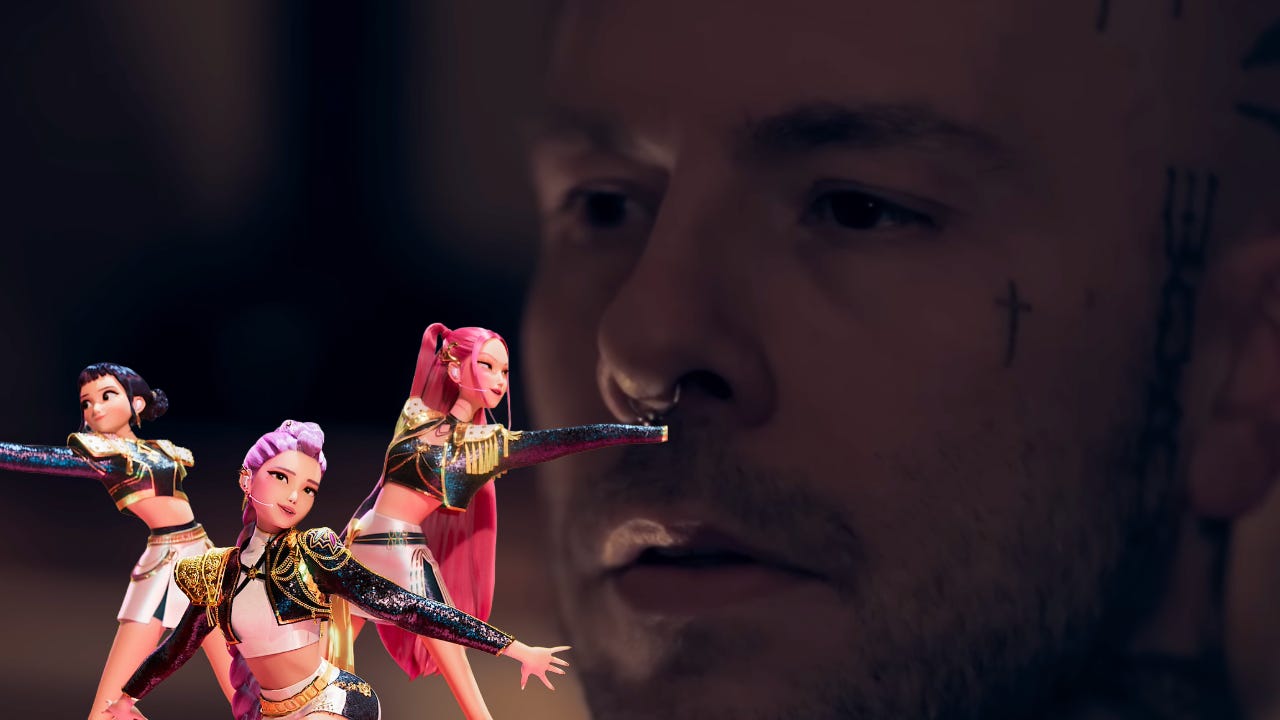
But Netflix, “despite almost certainly being aware of Demon Hunter”—really?—released their movie anyway.
In short, in just a year’s time, Defendants have taken step after step to move into almost complete overlap with the goods and services offered by Hyde Lane under the DEMON HUNTER mark.
Hyde Lane says that the slight differences between their names doesn’t excuse what Netflix is doing. After all,
Netflix is no more entitled to use the mark KPOP DEMON HUNTERS than it would be to launch a recording artist, live touring show and merchandise under the marks KPOP METALLICA, KPOP U2 or KPOP BLACK SABBATH.
Except those bands are infinitely more popular than a genre-specific Christian artist that has had success within that bubble but is virtually unknown outside of it. (Admit it: This lawsuit is arguably the most attention the band has ever had.)
To be clear, the band isn’t going after the movie. They’re suing only after Netflix announced a global concert tour; the band says Netflix is now stepping into their lane, which is why they have to file the lawsuit.
But is there any actual proof that people are confused by the two? Did anyone hope to see the “Golden” singers only to realize they bought tickets to a Christian metal band? Apparently yes. In an email included in the lawsuit, someone messaged the band requesting a refund because she thought she was going to see the singers from the movie only to realize that’s not what she had paid for:
Hi Demon Hunter, I just purchased tickets to your show in Albany NY for May 2, 2026 and after I accepted the tickets I realized that you guys are not "K Pop demon hunters" and that my 5 and 6yr old girls will probably not fit in well at your concert. I thought I was purchasing tickets to a child friendly concet [sic]. I was way to [sic] excited and didn't pay attention. I spent almost $500 on the tickets because I wanted my girls to have a great view their very first concert and I really messed up. Is their [sic] anyway to refund me or get me a credit or something. If I dont get it refunded I will not be able to purchase tickets to the actual "K pop demon hunters show". Please help! Thanks for your time
That sounds more like a mother who didn’t do any research into what she was buying, no different from someone who buys tickets to a cover band thinking they’re about to see the real thing. Other pieces of evidence include an email from a TV producer hoping to speak to a songwriter from the movie, and people using the hashtag #DemonHunter to tag content about the film. (Hilariously, the lawsuit includes a screenshot of this, and it’s clear the person who posted it used a dozen hashtags covering anything and everything close to the film’s title, including #demonhunters and #demonhuntersgolden. In other words, the person wasn’t thinking about the Christian band at all.)

The band is also furious that when you search their name on Ticketmaster, the results prioritize movie-related events… since that’s what people actually want to see. Ditto with Google and Spotify. (It takes a certain level of Christian privilege to assume you should be ranked higher on those sites because you’ve been around longer.)
None of this, however, proves that Netflix is passing off its singers as members of a Christian metal band. It just shows that people make careless purchases, send misdirected emails, and use a variety of hashtags trying to cover their bases.
The lawsuit demands that Netflix stop using the name “KPop Demon Hunters” for anything music-related (like tours), along with payments for damages.
Netflix, not surprisingly, isn’t losing any sleep over this:
In a response statement Wednesday, Netflix said the lawsuit’s allegations were “without merit” and that the company would “look forward to vigorously defending this matter.”
While the band’s frustration is understandable, the question is whether this lawsuit has any merit. It’s worth noting that the lawsuit says the name “Demon Hunter” wasn’t trademarked by Hyde Lane until 2022… and yet Sony announced the film in 2021 (when Netflix bought it from them). Was there no evidence of confusion until the global tour was announced?
Obviously, I’m not a lawyer, much less a trademark expert. I’ll just say that commenters on the r/law subreddit argue that “demon hunter” is far too vague a name to win a case in this situation. There are also other technicalities with registering the trademarks that could make this a difficult case for the band to win.
It’s also not like “demon hunter” is a unique phrase. Hell, Wikipedia has a disambiguation page for the phrase because there are so many examples of it in use. The words come from centuries of religious mythology and decades of fantasy, horror, and popular culture. A Christian band chose a name built from those supernatural concepts, enjoyed some success within their Christian-metal ecosystem, and is now arguing that everyone else in the world of music and entertainment should have known to stay away.
The band is obviously entitled to protect its brand. Whether they can prove the Netflix movie is causing deliberate confusion, though, is going to be tough to prove in court.
Christians can never seem to pass up an opportunity to play the poor persecuted victim. This is in keeping with my long-held theory that, at least up to a point, religion thrives on persecution. If you want to keep people in the pews and the money flowing, make them think they're being threatened.
𝑁𝑒𝑡𝑓𝑙𝑖𝑥 𝑠𝑎𝑖𝑑 𝑡ℎ𝑒 𝑙𝑎𝑤𝑠𝑢𝑖𝑡’𝑠 𝑎𝑙𝑙𝑒𝑔𝑎𝑡𝑖𝑜𝑛𝑠 𝑤𝑒𝑟𝑒 “𝑤𝑖𝑡ℎ𝑜𝑢𝑡 𝑚𝑒𝑟𝑖𝑡” 𝑎𝑛𝑑 𝑡ℎ𝑎𝑡 𝑡ℎ𝑒 𝑐𝑜𝑚𝑝𝑎𝑛𝑦 𝑤𝑜𝑢𝑙𝑑 “𝑙𝑜𝑜𝑘 𝑓𝑜𝑟𝑤𝑎𝑟𝑑 𝑡𝑜 𝑣𝑖𝑔𝑜𝑟𝑜𝑢𝑠𝑙𝑦 𝑑𝑒𝑓𝑒𝑛𝑑𝑖𝑛𝑔 𝑡ℎ𝑖𝑠 𝑚𝑎𝑡𝑡𝑒𝑟.”
Netflix lawyers should be able to handle this for a quick $1000 worth of billable hours. The real intent of the Christian band is to milk this for all the "persecution" donation money they can grab. Or am I being too cynical?