
This newsletter is free and goes out to over 26,000 subscribers, but it’s only able to sustain itself due to the support I receive from a small percentage of regular readers. Would you please consider becoming one of those supporters? You can subscribe via Patreon or the Subscribe button below! You can also make one-time donations through Venmo, CashApp, or PayPal.
Canada’s Supreme Court has largely upheld a Quebec law banning certain government workers from wearing religious symbols at work. It was a ruling on a technicality more than the merits, but it means religious oppression of this kind can continue.
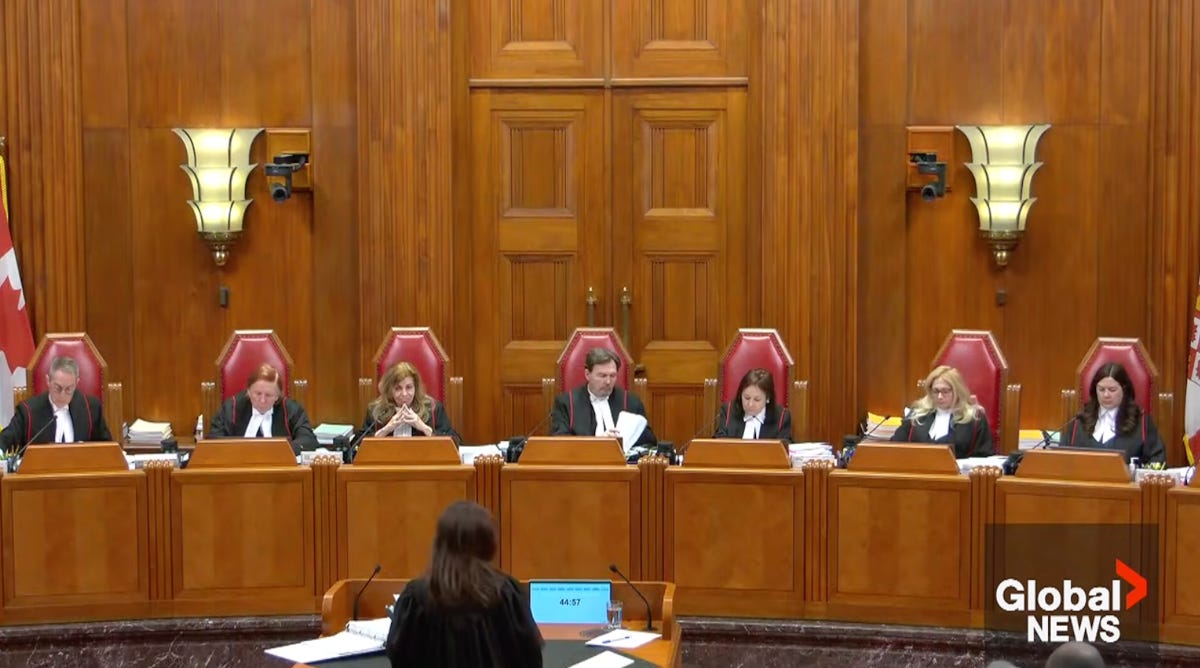
While, on the surface, this might seem like a victory for secular government, it’s more like a ban on religious freedom. That’s why the original law united several religious groups as well as civil rights and church/state activists who said this would be an obvious case of religious oppression, not to mention a violation of human rights that are supposed to be protected under Canadian law.
Quebec has been pushing mandatory public secularism for some time now. In 2019, they passed Bill 21, which said Quebec was a secular state, thereby banning religious symbols worn by certain government employees, including police officers, government lawyers, and teachers. It was (and continues to be) widely seen as an attack on religious minorities, like Muslims and Sikhs who can’t just not wear their hijabs or turbans the same way a Christian employee can tuck away a cross necklace. Yet while a majority of Canadians opposed the law, a 2019 poll found that 64% of people who live in Quebec supported it.
The question in front of the Court was whether Quebec could override some protections guaranteed by Canada’s Charter of Rights and Freedoms using what’s known as the “notwithstanding clause,” as long as they have a legitimate reason for it.
The Charter protects freedom of religion and expression, but Quebec argued Bill 21 was necessary to protect a secular democracy.
Quebec’s nationalist, right-leaning government argued that the law was crucial to protecting secularism in Quebec. The Roman Catholic Church once held enormous political influence and control in the province, including over public education. Religious symbols worn by some public employees, the government said, would undermine the neutrality of the state, as well as the separation of state and religions.
In its ruling Friday, the Supreme Court said that Quebec’s 2019 law “is rooted in Quebec’s legitimate and historical commitment to ensuring the laicity of the state in a free and democratic society.”
To be clear, the Supreme Court didn’t actually rule on whether Bill 21 was helpful or harmful, only that Quebec had the right to override those civil rights protections for the reasons they gave. That decision wasn’t unanimous, though. Some of the Supreme Court justices said the notwithstanding clause “cannot be used to authorize laws that are incompatible with the fundamental character of Canada as a free and democratic country.” To an extent, the majority agreed and said that power was not unlimited, adding that judges still have the ability to say certain provincial laws violate Canada’s Charter, even if that wasn’t invoked here.
There was one major exception, though: As lower court judges ruled, the bill went too far in requiring members of Quebec’s National Assembly to keep their faces uncovered—something that would effectively prohibit Muslim women from serving in office. That clause was struck down and the Supreme Court affirmed that aspect of the case.
But most everything else was upheld.
Stephen Brown, CEO of the National Council of Canadian Muslims, called the law “discriminatory” and criticised the court’s decision.
“Entire categories of people are now barred from entire sectors of employment, not because of what they have done, but because of who they are,” he said.
The BC Humanist Association said it was “frustrated and disappointed” by the ruling because it opens the door to right-wing extremists using the same rules to push their faith on others:
“We’re disappointed that Quebec’s attack on religious minorities will stand for those not in the National Assembly,” said Ian Bushfield, BCHA Executive Director. “This decision puts the rights of all Canadians at risk. Any populist politician who wins a majority of the seats with 39% of the vote can run roughshod over [Canadians’] fundamental rights and freedoms. If the notwithstanding clause can be used to oppress religious minorities, it can just as easily be turned around to establish a theocracy.”
“We’re hopeful that the ability for courts to make declarations will provide a path forward for those targeted by populists. The notwithstanding clause was never meant to be a shield for bigotry and hatred.”
If there’s any consolation here, it’s that this ruling may prevent some right-wing outrage. Quebec’s conservatives—who have repeatedly talked about seceding—still have power and no national government is taking it away from them. Judges also retain the ability to declare laws unconstitutional even if the “notwithstanding clause” is invoked.
In the meantime, Quebec’s leader is already planning to go further with the idea of Bill 21:
Quebec’s new premier, Paul St-Pierre Plamondon, has focused his first weeks in power on asserting the province’s authority against the federal government. Mr. St-Pierre Plamondon has pledged to push Quebec secularism further, for example by barring students at public primary schools from wearing religious clothing or symbols.
All of this feels, in many ways, like a Bizarro World version of what’s happening in the United States. Christian Nationalists here have taken over the government and made it their mission to eradicate the persecution of Christians (which isn’t a real thing). One way they’ve done that is by spreading lies about Muslims, leading to things like a Muslim Ban and calls for Muslims to be banned from holding office or taking an oath on the Qur’an. There were all kinds of religious smears against New York City Mayor Zohran Mamdani and Rep. Ilhan Omar.
In Quebec, officials are using the goal of a secular government to push the same baseless attacks on primarily the same religious minority.
In a better world, we would judge people by their actions, not their beliefs. That’s what a respectful secular society ought to look like. What’s happening in Quebec is not secularism. It’s a perversion of it.
When we talk about the importance of church/state separation, it means everyone is protected under the law and no single belief system promoted by the government dominates the public square. It doesn’t mean that all faith must be driven out of it. This just feeds into the exaggerations we hear from Christian Nationalists in the U.S. about what happens when secular people control the government.
Bill 21 was never a neutral rule about how government behaves. It tells people who wear visible religious symbols—especially Muslim women and Sikhs—that they can serve the public only if they hide an important part of who they are. They have to choose between their faith and their career.
By giving Quebec’s government broad room to use the notwithstanding clause to keep that policy in force, the Supreme Court is both recognizing the harm it causes while giving Quebec a green light to make everything worse. That’s not what a secular government should be doing. It shouldn’t be policing the religious identities of workers and students.
(Portions of this article were published earlier)
As a gay man, I have very mixed feelings about this.
On the one hand, this sounds an awful lot like don’t ask. Don’t tell in the US military 15 years ago. You can be gay, but you just can’t tell anybody you’re gay. And telling could simply mean someone could find out or even guess. It was wrong then and it’s wrong now.
On the other hand, and I may be speaking strictly from an American perspective, goddamn religion has brought this goddamn thing on their goddamn selves. taxpayer support for religions. Special privileges for religions. Enacting religious discrimination into law. Religions accruing hundreds of millions or even billions of dollars while preaching the virtues of poverty.Religion behind laws that penalize people for being gay, for wanting to plan their own families, marrying whom they want to marry, for taking medical conditions and turning them into crimes in laws, demanding exceptions to laws of generalized applicability, insisting that purely theological concerns, go into the ciVil laws theyat govern of us, insisting that they have a God given right to spread diseases, which could kill lots of people, and did….
The list just goes on and on and on and on.
I don’t have an answer for it. I think the Quebec law has a merit to it, but when I hear that it is sponsored by “conservatives”, I immediately suspect that there’s a great deal more behind it, and that’s what Hemant says. True conservatives would support religious expression, and protect it. Principled conservatives would figure out. Way to do that.
Fascists would figure out a way to target the people they don’t like and pretend they are not.
Not sure how to feel about this, but banning people representing the government from wearing religious symbols seems reasonable to me. Some people could easily interpret that as governmental endorsement of a particular faith. Knowing the United States isn't the only country who has to deal with the far-right isn't exactly comforting. The far-right, in any culture, will always represent the lowest common denominator, and the path of least resistance. Ever so much easier than critical thinking.