
This newsletter is free and goes out to over 25,000 subscribers, but it’s only able to sustain itself due to the support I receive from a small percentage of regular readers. Would you please consider becoming one of those supporters? You can subscribe via Patreon or the Subscribe button below! You can also make one-time donations through Venmo, CashApp, or PayPal.
When you spend as much time as I do tracking the intersection of politics and religion, it’s hard not to notice an obvious reality: Many of the problems we currently face stem from the scourge of right-wing Christianity. It’s not that all white evangelicals think alike; it’s that our government is controlled by a hell of a lot of white evangelicals who do think alike and they’re supported by an army of white evangelical voters who won’t waver no matter how bad things get.
We know there are religious zealots in the White House, the Cabinet, and Congress who make political decisions based on what conservative Christians want instead of what’s good for the country, or what experts say, or what the facts show. White evangelical voters have been led to believe it’s a moral imperative to vote for Republicans no matter how corrupt or blatantly evil they are, even if it goes against their own interests. And many of the most powerful conservative Christian leaders in the country refuse to speak out against any of this. Whether it’s due to ideological conviction, partisan loyalty, cowardice, or simple careerism, supporting Republicans remains good for business—and the people harmed by that alliance remain an afterthought.
So when someone like Bonnie Kristian, the deputy editor of Christianity Today, is out promoting her new book In Defense of Evangelicalism (affiliate link), you might think it’s a perfect opportunity for someone with her credibility in that world to point out how conservative Christians have done untold damage to the country… while still making some kind of argument for why believers shouldn’t abandon the faith. (I’m not saying that would be a good argument, only that it would be an argument.)
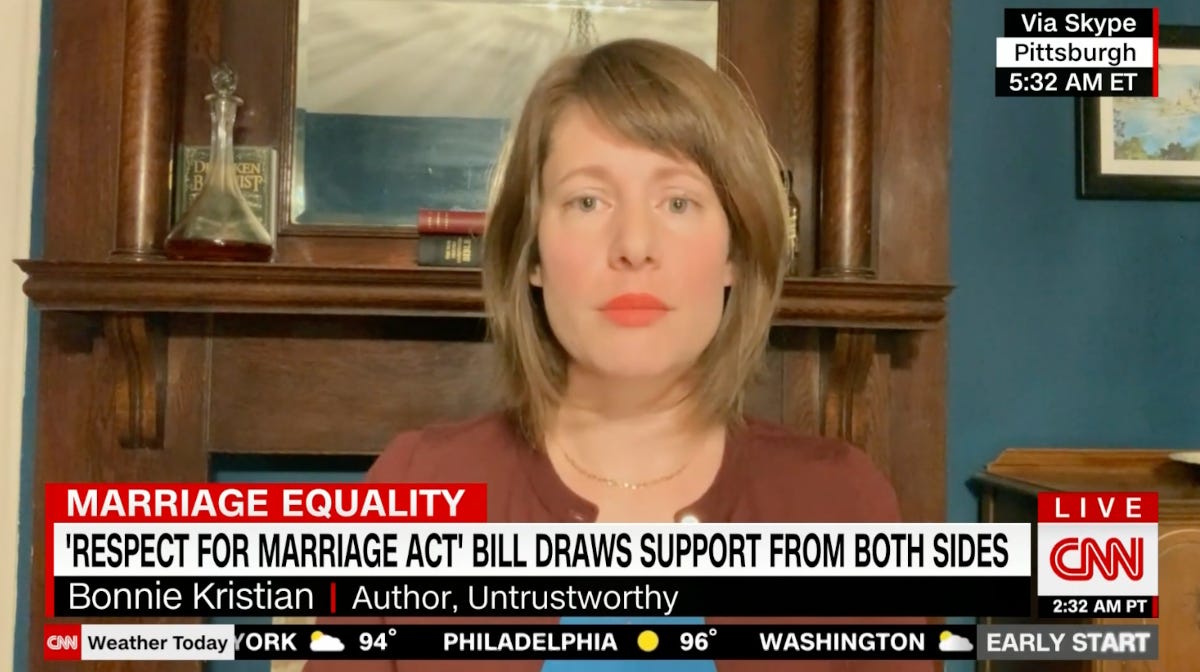
That’s not what she does. Instead, she argues we are unfairly criticizing white evangelicals as a whole for the actions of some.
And she opens a recent essay with the most inflammatory example she can find.
The target in this case is an episode of the “I’ve Had It” podcast. Earlier this year, progressive podcaster Jennifer Welch and her co-host were discussing the brutal treatment of children at the hands of ICE. Welch pointed out that this was happening in part because Republicans in power didn’t have the “courage to confront the cult nature of evangelical Christianity.” She went on to talk about how Erika Kirk (the widow of Charlie) was speaking at an event called “Make Heaven Crowded”—suggesting that conservatives like her and the attendees there were going to be rewarded in the afterlife for the cruelty they’re inflicting right now. The leaders of that movement were all about getting rich while “hoodwinking their flock into thinking they're super moral.”
And then she said this:
This is a cancer. White evangelical Christianity is a cancer. These are the worst of our country. These are the worst people in our country because they use their religion in two ways: as a weapon and as a shield.
They weaponize it whenever they want to and say, “We’re on the moral high ground. You’re a lesbian—you deserve to die. You’re a lesbian—the cops shouldn’t have revived you. Oh, your parents are Mexicans and they brought you over here? Yeah, you should go to jail and eat worm food.”
And then when you call them out on it, “Oh my god, they’re after the Christians. How dare they?! How dare they? We’re so oppressed. White Christians are so oppressed in this country!”
And they want it both ways, because in the religion, that duplicity is taught. You can be morally duplicitous. You thrive in cognitive dissonance. And so this is just a massive, massive problem.
And it should come as no surprise to anyone that, of this cult that I’m talking about—white evangelicals—I think over 80% went and voted [triple-Trump].
Kristian had made the same case against Welch earlier this year in The Free Press, citing several other clips in which Welch called evangelicals racist, judgmental, and abusive.
To be fair, Welch’s words are sweeping. Saying white evangelicals are “the worst people in our country” sure sounds like a condemnation of “every individual evangelical,” including those who oppose Trump and reject the cruelty committed in the name of their faith. Kristian has every right to object to that.
But Welch’s larger argument is about white evangelical Christianity as a political and cultural force—and on that point, Kristian offers almost no rebuttal. She focuses on whether individual evangelicals are capable of kindness (of course they are!) while largely avoiding how the movement has empowered the worst kinds of people who do the worst kinds of things. No doubt evangelicals bring casseroles to sick neighbors. But private kindness doesn’t erase the fact that the vast majority of white evangelical voters have repeatedly supported politicians who bully vulnerable people—and that many of those voters portray themselves as victims when anyone holds them responsible for the consequences.
That “cancer” clip went viral in certain right-wing corners of social media. Christian Nationalist musician Sean Feucht posted it, only quoting this part: “White Evangelical Christianity is a cancer… These are the worst people in our country.”
And that’s the quotation Bonnie Kristian now uses as evidence of growing contempt toward evangelicals. In an essay for the Washington Post (naturally), Kristian objects to this language in a piece with the headline: “I’m an evangelical. My faith isn’t ‘a cancer.’”
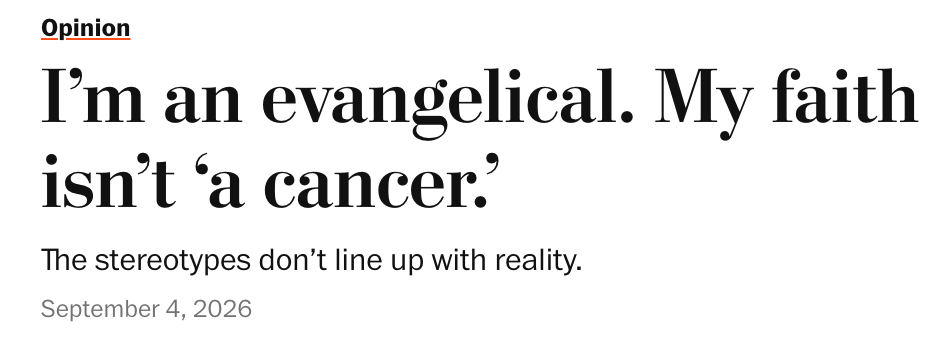
I’m an evangelical woman and a frequent critic of President Donald Trump. I don’t believe evangelicals are above reproach. But legitimate criticism of their political choices has shaded into something darker: contempt for an entire group of Americans.
Kristian is careful to say in the piece that evangelicals are not being persecuted. But she still steers the conversation away from those suffering under white evangelical political power and toward the hurt feelings of the very people who helped create that suffering.
To that end, she lists several examples of Christianity’s critics in an effort to show how these criticisms have “unleashed an outpouring of anti-evangelical sentiment.” She points to books that portray evangelicals as “dangers to democracy” and dismisses those characterizations as “sweeping” and “inaccurate.”
For example, she insists white evangelicals are treated as hypocrites for opposing candidates like James Talarico in Texas but notes how that outrage is muted if, say, “a pro-choice Episcopalian won’t vote for a pro-life Republican who’s also a Christian.”
But there’s a reason for that: They are hypocrites.
Kristian is right that no one owes a candidate a vote merely because that candidate shares her faith. The hypocrisy isn’t that white evangelicals refuse to vote for Talarico. It’s that many of the same people who spent decades demanding public displays of Christian faith from politicians now declare Talarico’s Christianity to be fake because it leads him toward compassion instead of conservative policies.
The same people tolerate Donald Trump’s corruption, look the other way when it comes to Ken Paxton’s scandals, and aren’t troubled enough by endless Republican cruelty, but they somehow rediscovered the theological high ground the moment a devout Christian Democrat appeared on the scene.
Kristian herself has called Talarico’s Christianity “undeniably heterodox, if not outright heretical.” Other conservative voices have labeled him a “fake Christian,” distorted his comments about God and falsely claimed he is gay and vegan. Talarico’s Christianity isn’t being questioned because he lacks faith; it’s because his faith leads him to conclusions conservative evangelicals reject.
That is the hypocrisy Kristian’s Episcopalian analogy misses. The objection isn’t that evangelicals must vote for every fellow Christian. It’s that many of them tolerate nearly non-stop personal corruption from Republicans but impose impossibly high religious standards on Democrats whose faith inspires them to help marginalized people.
That’s not all Kristian gets wrong.
At one point, she offers statistics meant to show how practicing evangelicals behave better than people who have left evangelical churches.
But the broad-brushed dismissal of evangelicals by figures such as [California Gov. Gavin] Newsom and Welch overlooks the reality of evangelicalism in churches across America. Research shows that practicing evangelicals are markedly more likely than those who leave the church to “avoid discrimination based on race,” to provide “financially and/or practically for the poor and oppressed” and to avoid lying, stealing and greed. Evangelicals donate twelve times as much to disaster relief and missions as they spend on politics.
The first problem is Kristian’s category switch: Jennifer Welch and many of the political critics Kristian cites are specifically talking about white evangelicals, while Kristian responds with favorable data about evangelicals as a whole.
The second problem is that her evidence doesn’t establish what she claims it does.
Consider the research she points to. It doesn’t measure whether practicing evangelicals actually avoid racial discrimination or help oppressed people. The link she provides—to a book written by two conservative Christians—asks which standards respondents say they “seek to follow in good faith.” In other words, the authors are measuring aspiration, not conduct. Kristian quietly converts “I want to be this kind of person” into “research shows I behave this way.”
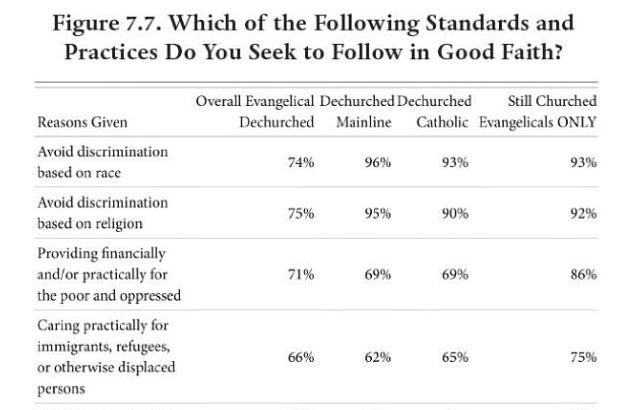
We shouldn’t be surprised that people who go to church want to be better people. But that doesn’t mean they consistently live out those stated values—and their collective voting habits give us plenty of reason to doubt their self-reported intentions.
So she’s misinterpreting what that survey says. Not a good sign.
By the way, in a book written by PRRI president Robert P. Jones, who does plenty of polling himself, he came to a very different conclusion with regards to evangelicals and race. And he brought receipts.
For example, surveys conducted by PRRI in 2018 found that white Christians — including evangelical Protestants, mainline Protestants and Catholics — are nearly twice as likely as religiously unaffiliated whites to say the killings of Black men by police are isolated incidents rather than part of a pattern of how police treat African Americans.
And white Christians are about 30 percentage points more likely to say monuments to Confederate soldiers are symbols of Southern pride rather than symbols of racism. White Christians are also about 20 percentage points more likely to disagree with this statement: “Generations of slavery and discrimination have created conditions that make it difficult for Blacks to work their way out of the lower class.” And these trends generally persist even in the wake of the recent protests for racial justice.
These findings don’t directly contradict the first survey. That first survey measured the standards evangelicals say they aspire to follow; Jones examined their positions on concrete racial issues. And as soon as the questions moved from abstract opposition to racism to things like policing, Confederate monuments, and the lasting effects of slavery, the flattering portrait of evangelical Christianity fell apart.
There’s a saying on the left: Judge them by what they do, not what they say. Similarly, we shouldn’t judge a political movement by the values its members claim to hold. We should judge them by the attitudes, leaders, and policies they repeatedly support.
What about Kristian’s claim that evangelicals spend “twelve times as much” on disaster relief and missions as they spend on politics? Her citation leads to a Ross Douthat book, which in turn relies on a claim published in 1998. Even if the figure was accurate then, it’s nearly three decades old. And spending on “foreign missions” cannot automatically be equated with humanitarian charity, since that category may include evangelism and institutional support like churches.
Kristian also cites a more recent American Bible Society study, conducted with the National Opinion Research Center, which found that evangelicals led the religious groups surveyed in charitable participation and average giving, including donations to nonreligious organizations. Fine. I won’t dispute that. Generosity is good.
But it isn’t a rebuttal to the political indictment. People can donate generously to disaster relief while empowering politicians who deny health care, civil rights, and basic dignity to vulnerable people.
Private charity doesn’t cancel out public harm.
Elsewhere in her piece, Kristian cites a steep decline in how Democrats view Christian fundamentalists. In 2008, according to one study, 52.8% of Democrats “had a positive view of Christian fundamentalists.” By 2024, that number had dropped to 32.2%.
But declining approval isn’t proof of irrational bigotry, especially when that decline coincides with white evangelicals’ overwhelming support for Trump, and an aggressive campaign to weaponize the government against LGBTQ people, immigrants, religious minorities, people who need abortions, and public schools.
When you do unpopular things, don’t be surprised when your popularity fades.
Kristian concludes by asking critics to distinguish legitimate condemnation from broad contempt:
Like other religious bigotries, animus toward evangelicals harms the civic friendship on which democracy depends. Like their Muslim, Jewish and secular neighbors, evangelicals don’t deserve broad-brush dismissals. They’re people with whom you may have grave disagreements, but they’re also people capable of extending grace — and receiving it in turn. Evangelicals are people you can have a country with, people not deserving of scorn.
She’s absolutely right to say no one deserves broad-brush dismissals, but come on. Powerful white evangelical leaders and institutions have repeatedly treated Muslims and atheists—not just individuals but entire communities—with contempt. Hell, as I recently wrote, conservative Christian activists in Texas are attempting to drive Muslims out of public life. (The New York Times’ headline about that? “Islamophobia’s Rise in Texas: ‘I Won’t Rest Until Every Muslim Is Gone’.”) One Republican is promising to rewrite a law to make it easier to restrict the civil rights of Muslims.
We can’t have “civic friendship” with people who don’t think Muslims, LGBTQ people, immigrants, atheists, and women should have the same rights they do.
Who’s to blame for that? It’s not Christianity as a whole or every individual evangelical. It’s the white evangelical political bloc—the constituency that has supplied votes, money, theological cover, and institutional support for authoritarianism and Christian nationalism.
So if “cancer” is too inflammatory, choose another word. Call it a decades-long moral failure. Whatever the label, the movement has spread through our government, made life worse for vulnerable Americans, and prioritized loyalty to the Republican Party over every principle its members claim to hold sacred.
Objecting to the “cancer” metaphor does nothing to treat the underlying disease.
In a different interview, Kristian complained that attention-seeking blowhards like Pastor Greg Locke are constantly presented as representative of white evangelical pastors. It’s true that Locke doesn’t represent every pastor. But that raises a more important question: Who does represent white evangelical power?
Franklin Graham has influence. Pete Hegseth has power. Paula White-Cain advises Trump. Mike Johnson is Speaker of the House. Kristian can’t dismiss every destructive leader as an unrepresentative anomaly while defining evangelicalism by the kindest and least powerful people in the pews. A movement should have to answer for the people it elevates, follows, funds, and repeatedly places in power.
Remember: MAGA allegiance remains perfectly acceptable in most white evangelical spaces. It rarely costs anyone their church membership, leadership positions, Christian media platforms, or the respect of their fellow Christians. That tolerance is a choice. If authoritarian cruelty isn’t a deal-breaker, what the hell is?
Kristian is right to say individual white evangelicals shouldn’t be reduced to a stereotype. There are white evangelicals who oppose Trump, defend LGBTQ people, welcome refugees, protect church-state separation, and reject their faith being used as a political weapon. They deserve to be recognized. We can work with them.
But that minority can’t absolve the larger movement.
For three consecutive presidential elections, roughly 80% of white evangelical voters have backed Donald Trump. Their churches, institutions, media outlets, and celebrities have turned the GOP into a vehicle for Christian Nationalism. As a result, Americans are losing their rights, health care, safety, education, and freedom.
Kristian may want critics like me to see evangelicals as kind neighbors who stop by when you’re sick rather than as caricatures like Locke. Fine. But white evangelical leaders should also be willing to see the immigrant taken from her family, the transgender child terrorized by right-wing lawmakers, the Muslim treated as an enemy by evangelists, the pregnant woman denied medical care, and the students forced to go to class under the shadow of a Ten Commandments poster. Those people aren’t caricatures either.
Kristian has publicly said Trump is a terrible president and shouldn’t hold the office. That matters, and it separates her from many of the evangelical figures I’m criticizing here. But her essay spends far more energy policing Jennifer Welch’s language than confronting why roughly 80% of white evangelical voters supported Trump in three consecutive elections. Personal opposition to Trump doesn’t answer the institutional question her defense of evangelicalism keeps avoiding.
She does try to explain the 80% number, though. Kristian says that normie white evangelicals felt obligated to vote, limited themselves to viable major-party candidates, and prioritized abortion. See? They didn’t necessarily love Trump! They voted for the Republican candidate for other reasons! That may explain their votes, but it doesn’t exonerate them of the consequences.
White evangelicals are not unfairly criticized because we’ve failed to notice their private kindness. We’re looking at their public cruelty—or at least their tacit support of it. They’re facing a credibility crisis because their collective political behavior has unleashed harm that will last for decades.
Until influential evangelicals demand meaningful change from their own institutions, leaders, and voters, complaining about the tone of their critics isn’t a defense of evangelicalism. It’s just another way to avoid accountability.
𝐼'𝑚 𝑎𝑛 𝑒𝑣𝑎𝑛𝑔𝑒𝑙𝑖𝑐𝑎𝑙. 𝑀𝑦 𝑓𝑎𝑖𝑡ℎ 𝑖𝑠𝑛'𝑡 𝑎 𝑐𝑎𝑛𝑐𝑒𝑟.
Agree to disagree on that one. Your faith IS a cancer, in its impact on people who don't believe as you do, but whose lives are being impacted by the restrictive mean-spiritedness of YOUR beliefs. You named a number of them, from castigating the LGBTQ+ community to immigrants coming to the US, whether to escape REAL persecution to trying to find a better life for themselves. You've decided that empathy is anathema to Christianity, when Jesus clearly thought of it as a necessity (at least part of the time).
Essentially, you and those like you have turned Christianity into a weapon to attack anyone who isn't you, who doesn't agree with you, who has the temerity to live a life different from you. I would heartily suggest that you deal with the lumber in your own eye before you attempt to handle the speck in someone else's.
The evangelical excesses may be the work of a few, but I don’t see the many doing anything to rein them in. At the end of the day the thing I detest most about the evangelicals is their conviction they have the right to force their religion on others. They have no such right, and they have little to no respect for the religious right of others. Once people become convinced they’re operating under divine sanction, they’re capable of justifying just about any behavior.