
This newsletter is free and goes out to over 23,000 subscribers, but it’s only able to sustain itself due to the support I receive from a small percentage of regular readers. Would you please consider becoming one of those supporters? You can use the button below to subscribe or use my usual Patreon page!
Tennessee Republicans are advancing a bill that would require public schools to teach the Bible as objective history while also forcing them to set aside time during the day for students to pray.
The sponsor claims this is about restoring religious freedom to schools. In fact, it forces his religion upon students who want nothing to do with it while violating the Establishment Clause.

HB 1491 was filed earlier this year by State Rep. Gino Bulso. (An identical bill, SB 1714, was sponsored in the other chamber by State Sen. Joey Hensley.)
The deliberately misleading “Protecting Religious Liberty and Expression in Public Schools Act” begins by offering up a string of lies about the history of church/state separation, saying that the “Nativists” who promoted the “so-called separation of church and state” did so because they were “deeply prejudiced against ecclesiastical organizations and especially the Catholic Church.” It also says the law is wrongly applied to states when they ought to be exempt from the principle.
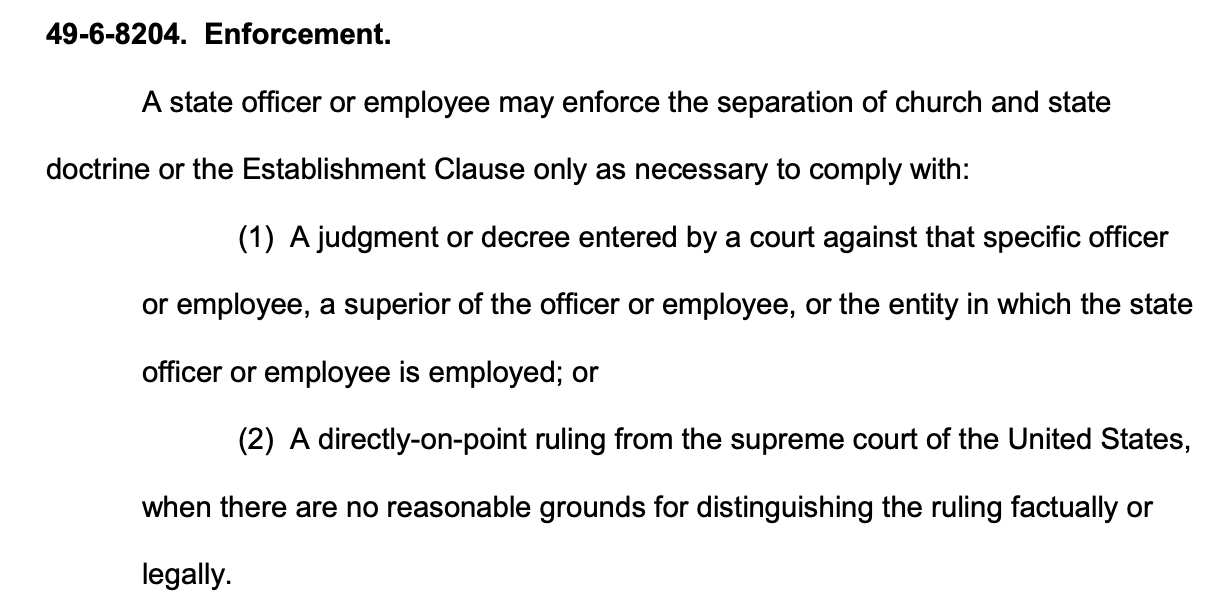
It then says public schools cannot enforce church/state separation unless they’ve specifically been commanded to by a court order or a “directly-on-point ruling” from the Supreme Court.
That means a principal who learns that the school’s football team has a chaplain or coach who leads prayers in the locker room before games couldn’t take any action to stop it out of fear that she’s worried about violating the law because a court didn’t require it. It would tie the hands of school officials who simply want to comply with the law as everyone knows it.
This provision would be handing a blank check to Christians who treat children as targets for religious conversion.
The bill then attacks the Supreme Court’s ruling in Everson v. Board of Education (1947). In that case, a 5-4 Court ruled that a New Jersey law that reimbursed parents for sending their kids to school on buses was legal even if those kids attended private Catholic schools. Writing for the majority, however, Justice Hugo Black advanced the idea that the Establishment Clause was intended to erect “a wall of separation between Church and State.”
This bill cites that decision—written by “a former Klansman”—as one that’s been overruled by Supreme Court decisions ever since.
Then, finally, on page 7, we get into the meat of the bill.
It says all public schools must teach the Bible as literature and offer “Age-appropriate instruction on the history of Israel, the stories and the moral and ethical teachings of the Old and New Testaments, the life of Jesus, the history of the early Christian church, and the Bible's influence on western civilization.”
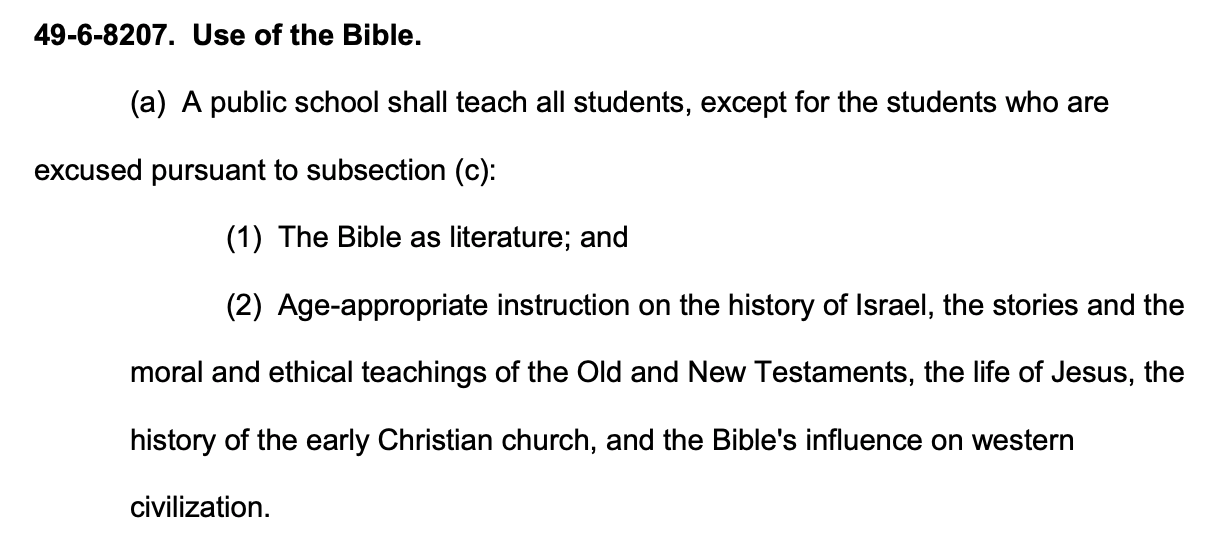
So… Sunday school. He wants to force public schools to teach Christian mythology as if it were fact, even though the material that might relevant to all students’ understanding of history is already taught in school. Seriously, many school districts already offer “Bible as literature” classes as electives—42 districts in Tennessee offer them—and those are legal as long as they’re taught objectively. There’s no need to force it upon everyone.
Why teach morality and ethics through the lens of the Bible, anyway? It’s not like the Bible originated those concepts. And why only teach Christianity this way when other religions have plenty of influence throughout the world?
The bill includes caveats that the Bible must not be taught as “religious dogma,” there cannot be any proselytizing, the classes cannot violate the Establishment Clause, and that students who have a written note from their parents can be excused. But when you’ve already declared that the “life of Jesus” is simply factual, you’re already advancing religion under the banner of secularism. (Also, if these classes are required, it raises a question of what the excused kids are supposed to do during that time.)
The bill goes on to say every school must set aside a “designated period of prayer and reading of the Bible or other religious text” every day.
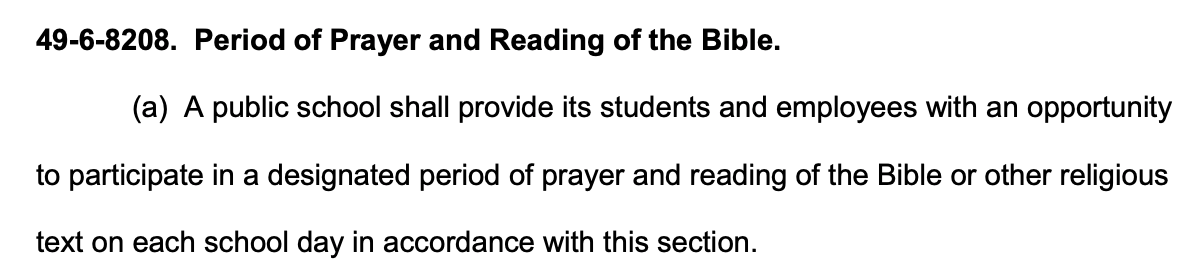
Parents would have to sign a form saying they understand this is optional and that they won’t sue over it. We’re also told this time could be offered “before regular school hours.” But even if it’s voluntary, you can already envision the social pressure that would be placed on kids to participate even if they don’t want to.
By the way, Tennessee already requires schools to have a one-minute moment of silence every day. Apparently that’s not good enough and the Christian God doesn’t listen to your prayers if they’re too short. Who knew.
It’s also completely unnecessary since students can already read the Bible during their free time. They can also pray whenever they want. No one was ever stopping them.
And yet the consent form parents would have to sign says they wouldn’t be allowed to sue even if they later withdrew their children from participating because they felt the school was crossing the line into promoting Christianity.
If someone is demanding you waive your constitutional rights in order to participate in a supposedly voluntary program, you know there’s a problem.
What’s also disturbing about this bill is that it includes a provision about lawsuits involving church/state separation that could prevent people from suing even if they believe their civil rights are being violated.
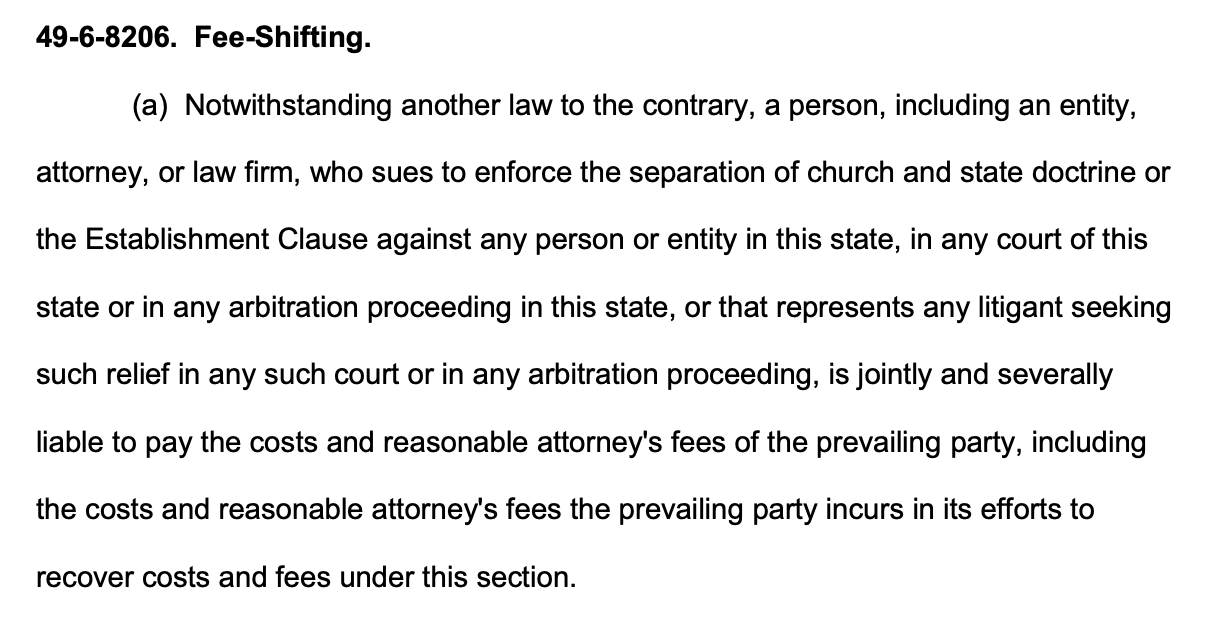
The provision would make someone “jointly and severally liable to pay the costs and reasonable attorney's fees of the prevailing party,” which basically means that if you sue a school district because you believe they’re forcing Christianity on your child, and your case is dismissed—or you voluntarily withdraw it—you or your lawyer may have to pay the other side’s legal fees.
Even if the state, for example, wasn’t asking you to pay those legal fees, they would also have three years to sue you to recover those costs.
The only reason to include this provision is to deter everyday people from suing over a new law that would inevitably infringe upon their rights.
And finally, the bill includes a section that says students can sue their schools for not complying with this law, creating an environment where schools would be pressured to offer more religious programming to make sure they’re not running afoul of the law.
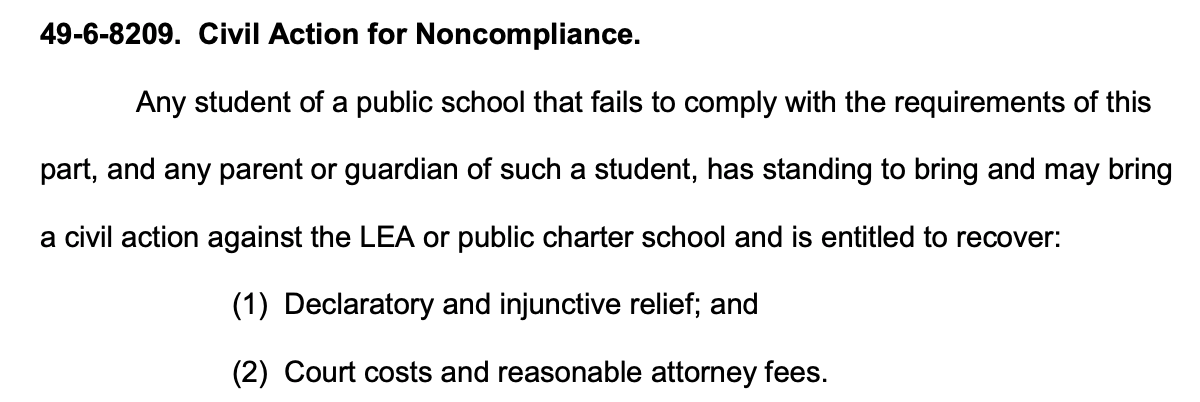
So, to summarize, this bill challenges the legitimacy of church/state separation, makes it harder for school officials to enforce the law, requires schools to promote Christianity during the day, makes people waive their legal rights before participating in school prayer, discourages lawsuits that are meant to protect church/state separation, and encourages lawsuits against schools that aren’t promoting religion enough.
It’s exactly the kind of bill you’d expect from a lawmaker most famous for defending marriage between first-cousins. (#Tennessee.)
At least one group is sounding the alarm against this bill:
The advocacy group United Volunteers of Tennessee raised questions about the bill, saying, “All of these requirements would infringe on parents’ and families’ long-settled constitutional rights to guide their children’s religious development. The irony is that both prayer and Bible reading are already allowed — a student may read the Bible during free reading times or pray at any time — without the need to be codified in law.”
Aleta Ledendecker of the East Tennessee chapter of the Freedom From Religion Foundation was more blunt in her assessment:
"This is a religious move. This is in order to get that sense of Christianity, Christian practices into the school," Ledendecker said. "This is not even a veiled attempt at trying to force Christianity onto all the students in Tennessee — this is just an overt attempt."
Not that any of that matters to the cousin-marriage guy. In an opinion piece defending his bill, Bulso wrote that shoving prayer into public schools has always been part of our history:
Prayer and religious study in American schools have deep historical roots, dating back to before the nation’s founding. From Massachusetts’ first public education law in 1642, which required boys and girls to receive instruction in religious principles, to the widespread use of the New England Primer beginning in 1690 as a foundational elementary textbook, early American education incorporated religious teaching.
In 1781, printer Robert Aitken petitioned Congress for permission to print “a neat edition of the Holy Scriptures for the use of schools.” Congress approved his request and, on Sept. 12, 1782, authorized what became known as the Bible of the American Revolution.
The reference to Aitken is misleading, as I’ve written about before. (Congress didn’t authorize much of anything in his case.) The New England Primer was used almost exclusively in religious schools long before the rise of public education. And if you have to go back 150 years before the nation began—before we had any kind of real religious diversity, before there were toilets, before civil rights were a thing—then you’ve already lost the argument.
Even the headline of that article is a lie. Bulso says he’s “restoring voluntary prayer in schools.”
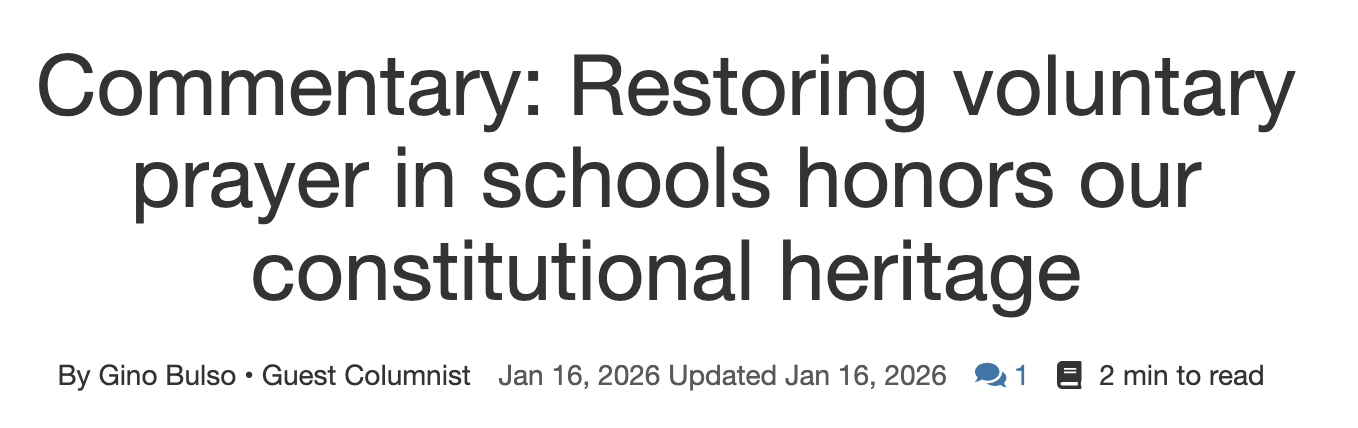
But there’s nothing to restore since voluntary prayer has always been permitted.
He also says “Our founders never intended to prohibit voluntary prayer in public schools.” But those were never prohibited! What the Supreme Court has said is that coercive prayers, even if voluntary in theory, are indeed unconstitutional.
In a separate news report, Bulso defended his bill with the usual lies we hear from religious extremists who blame the removal of mandatory Christian prayers in school for everything bad that’s ever happened ever since.
“We had prayer in schools from the founding of the country all the way up until 1962, and we built a beautiful, wonderful country,” Bulso said. “Since prayers have been removed from schools, I think you can see the social decline that we’ve had.”
Bulso cited the abortion rate, a falling marriage rate and an increased divorce rate, saying such social ills did not exist when children were permitted to pray in school.
Abortions occurred before 1962. They weren’t always safe. Women were forced to stay in unhappy, unhealthy marriages before no-fault divorces were legal nationwide. But Bulso thinks giving them the option to leave those relationships is apparently a problem.
These types of bills, though, are gaining some traction. A nearly identical one was passed in Texas last year, leading over 160 faith leaders to sign an open letter last month saying the new law “threatens to drive a wedge into public school communities and create unnecessary administrative burdens.”
For now, the Tennessee bill has been advanced by the House Civil Justice Subcommittee and will now go to the House Judiciary Committee.
What makes this bill especially dangerous isn’t just everything I’ve said above. It also reveals this willingness among conservatives to work around the Constitution when it gets in the way of their religious agenda. We know that because the bill tries to redefine church/state separation in a way to make it obsolete—or at least toothless.
You also have to wonder who’s asking for this. If students were clamoring for more Bible instruction, they could take elective classes or go to church. If families wanted more time to pray, they could do it before school, or after school, or anytime they want because that’s how prayer works. None of this requires legislation.
The fact that lawmakers are trying to mandate it—while also threatening anyone who challenges it—shows that they don’t actually have the law on their side, much less broad support for what they’re doing. This isn’t about protecting religious freedom. This is about using the power of government to pressure children into religious participation, then shielding that effort from legal scrutiny.
The Establishment Clause already protects everyone, including Christians. As soon as we allow one state to amplify one particular set of religious teachings, others will be marginalized. And if a Republican lawmaker can mandate Christianity in schools today, there’s nothing stopping a future legislature from mandating atheism tomorrow. Neutrality is the best way to protect everyone’s rights.
This bill offers solutions to problems that don’t exist. It only serves to make everything worse.
Incidentally, Bulso has also made headlines recently for a bill that would allow private companies and people—including hospitals, banks, and restaurants—to deny the legitimacy of same-sex marriages, allowing them to discriminate against gay people. The logic behind the bill, critics say, would allow Republicans to eventually discriminate on the basis of race and sex, too. But when you’re a Christian like Bulso, that’s the goal.
[“We had prayer in schools from the founding of the country all the way up until 1962, and we built a beautiful, wonderful country,” Bulso said. ]
Dead slaves, Native Americans, LGBTQ people, women, and Black people might disagree.
[“Since prayers have been removed from schools, I think you can see the social decline that we’ve had.”]
No. I really can't. I see more people enjoying the freedom to pursue happiness even if it makes shits like you angry and that's the real thing that sticks in your craw.
[Bulso cited the abortion rate, a falling marriage rate and an increased divorce rate, saying such social ills did not exist when children were permitted to pray in school.]
"We need more unwanted children born into poverty! We need women trapped in abusive and failing relationships!" is definitely a take.
Sounds like child grooming.
You know. That thing xtians falsely accuse drag queens and LGBTQs of doing.