
This newsletter is free and goes out to over 26,000 subscribers, but it’s only able to sustain itself due to the support I receive from a small percentage of regular readers. Would you please consider becoming one of those supporters? You can subscribe via Patreon or the Subscribe button below! You can also make one-time donations through Venmo, CashApp, or PayPal.
An essay in Christianity Today argues that Christian Nationalism isn’t really a big deal and that the “concept has been characterized in increasingly extreme terms.” But the “three myths” highlighted in the piece don’t actually rebut anything we’ve come to understand about a growing threat in the country.

Let’s get some numbers under our belts first.
According to a Pew Research Center survey from earlier this year, 61% of Americans believe teachers should be allowed to lead religious exercises in public school classrooms. That number jumps to 87% when we just look at white evangelical Christians. (While the question doesn’t specify the nature of the prayers, in practice, it would almost certainly be tailored to Christians, referring to a monotheistic higher power.)

Now, it’s worth mentioning that only 8% of people want to force kids to participate, but it’s still a huge percentage of people who support teacher-led (inevitably Christian) prayers.
It doesn’t stop there. 57% of Americans say they favor public school coaches leading their teams in prayer while 50% support posting the Ten Commandments in public school classrooms. Those numbers are 89% and 83%, respectively, for white evangelicals.

We’ve seen plenty of coach-led prayers in the past and they’re always Christian-centric. And the Ten Commandments bills we’ve seen passed in a few states require the King James Version translation.
I would assume, even in those cases, that most people don’t think students should be forced to participate in the huddles or interact with the posters, but the problem is the implied idea that Christianity is a force for good, not to mention the possible coercion and peer pressure placed on non-Christian students to worship with everyone else.
That’s also why we shouldn’t be misled by numbers that show only 10% of Americans have a favorable view of Christian Nationalism, especially when 59% had no opinion or hadn’t heard of the term, and only 17% say the government should declare Christianity the nation’s official religion. It sounds like relatively few Americans want Christianity to be our national religion in writing. But there’s far more support for implied Christianity. Which is why another 43% of Americans say they want to see Christian “moral values” promoted.
That leads to an interesting question: Why are the numbers so high when they involve examples of Christian Nationalism in action but relatively low for the generic concept itself?
In my opinion, the answer is obvious: A lot of Americans want to see Christianity imposed on the country in an unofficial way. And the people steering those conversations are the ones who are conservative Christians.
That’s part of the threat. That’s what we’re fighting against. We’re not fighting over the Sermon on the Mount. We’re fighting over Leviticus. We’re not talking about private faith. We’re talking about the ability of the government to elevate one religious tradition—and its preferred morality—over all the others.
When we talk about Christian Nationalism, there’s an academic definition we can use, but casually, it’s the idea that our nation was founded on Christianity and should therefore treat that religion (and only that religion) as a default option. That means shoving conservative Christian beliefs upon everyone in the country, whether or not the religion is cited as the reason.
A lot of white evangelicals may not use the term “Christian Nationalist” to describe themselves, but they sure as hell love seeing it in action—just look at laws targeting LGBTQ people (especially transgender people) and reproductive rights.
To put it another way, the fact that relatively few Americans say they favor “Christian Nationalism” only tells us about the label’s unpopularity; when you ask them about specific situations, the numbers rise.
With that in mind, consider this article in Christianity Today by Jesse Smith, a sociologist of religion and assistant professor at Ohio State University. (An alternative link can be found here.)

His argument is that Christian Nationalism has become a catch-all term for all things conservative and doesn’t even represent what those people want. He wants us to stop using the term as an unfair bogeyman for conservative ideas people like me just don’t like.
To make his point, he argues that “much of what we know about Christian nationalism comes from survey data.” (Which is apparently bad because those are pesky facts.) The problem with surveys, he says, is that they’ll ask people about Christian Nationalism without defining their terms… and the result is a skewed idea of how many people support it.
In the typical approach to studying this topic, public opinion researchers distribute surveys in which respondents are asked how much they agree or disagree with a variety of statements argued to reflect Christian nationalism. These statements are things like “The federal government should declare the United States a Christian nation.”
Based on their responses, survey participants are often assigned a Christian nationalism score, which is then tested for correlations with survey responses about other topics such as white identitarianism or political violence. It is from these survey response patterns in these surveys that we hear claims to the effect that between one-third and one-half of Americans support Christian nationalism in a radical, alarming, and even dangerous sense.
That’s because it’s radical and alarming.
Smith says that’s not really the case, though, because people may not understand what they’re agreeing to. If they say they want a “Christian nation,” it could mean a country where the majority of people are Christian (relatively harmless!) to a nation that forces Christianity upon people (dangerous!). Without knowing that, these surveys don’t tell you much.
… When people taking surveys check a box indicating they agree with a statement, we don’t know what that agreement means—and it might mean different things for different people. When someone encounters the term Christian nation in a survey, for instance, he or she might be thinking about anything from a majority-Christian country to a formal theocratic establishment, and researchers have no sure way to tell the difference.
If that were true, then yes, it would be a problem that we’re citing these sources.
But I’m not looking at surveys with ambiguous phrasing. I’m looking at surveys that say exactly what people would do: Do you want the Ten Commandments in classrooms? Do you want teachers leading students in prayer? etc. Smith either downplays those surveys or doesn’t know they exist.
In any case, he decided to conduct his own survey in which he asked about Christian Nationalism in general, then got more granular. He and his colleague surveyed 558 Christians recruited through CloudResearch, an AI-powered platform. 209 respondents said they agree with the statement, “The federal government should declare the United States a Christian nation.” But there were plenty of disagreements among that group about what that would entail.
Again, this is not surprising. We already knew this. But from his survey, Smith identifies “three myths” he wants to debunk.
Myth 1: Christian nationalism is a radical ideology
We know Christian Nationalism is radical. But Smith says he found more nuance:
First, different respondents emphasized different things, with some focusing on public Christianity (such as religious displays or holidays), others on moral regulations (like banning abortion), and some simply appealing to the country’s Christian heritage without suggesting any policies at all. Many of our respondents tended to treat the idea of a “Christian nation” more as a loose narrative than a coherent ideology.
Second, the policies offered in our responses are mostly the same ones that were favored by the Christian right 40 years ago. They’re not novel. Of course, that doesn’t mean they’re right, but a set of positions that has remained stable for decades cannot easily be construed as a new and radical threat.
He’s already lost me. A government-sponsored Nativity scene, anti-abortion legislation, and whitewashing American history to pretend it had some “Christian heritage” are all part of the same horrible narrative. It suggests Christianity is or should be the default religion of the country. That’s the problem. The people who “simply [appeal] to the country’s Christian heritage” are likely to support school board members who want to change the history curriculum to teach David Barton-esque bullshit. This is not innocuous.
Smith makes it sound like a Nativity scene outside City Hall is no big deal. But it is. Same with laws that give churches the ability to override public health measures in the name of Jesus.
Also, there’s a huge difference between the Christian Right of 40 years ago and now: The “radical” ideas they had in the 1980s usually placed them in the minority. They now have an entire political party that caters to their whims and who can make their faith-based fantasies come true. That’s the danger. There are no longer any checks to their power among Republicans. It’s not even the beliefs themselves we’re worried about so much as the fact that their beliefs now have sway over the federal government—and we’re all worse off as a result. I wouldn’t care as much about a pastor calling for Christian invocations at city council meetings if they didn’t have the power to make that happen. But they do. And it gets so much worse than symbolic celebrations of Christ.
Myth 2: Christian nationalism means support for religious coercion or theocracy
Smith makes it sound like the threat of Christian Nationalism is synonymous with fears of a theocracy. Calm down, he tells us. Supporters of Christian Nationalism don’t want to see a theocracy. They don’t want to force you to believe what they believe.
They just want their beliefs enacted into law.
Most of the 209 respondents did support some sort of soft establishment of religion, like having prayer in public schools or Christian symbols in public places: a Nativity in the town square at Christmas or the Ten Commandments on the courthouse wall. In many cases, respondents simply affirmed the policies and practices that already exist, though others advocated for more robust government endorsement of Christianity. It’s fair to say most “Christian nation” supporters don’t favor full government neutrality on religion or intentional public pluralism.
At the same time, we found very little support for anything like religious coercion or restriction by the government. Of 209 respondents, only 14 expressed any explicitly coercive or exclusionary sentiment toward non-Christians. These were outnumbered by 35 respondents who directly affirmed religious liberty, noncoercion, constitutional protections, or the separation of church and state.
This is a five-alarm fire and Smith doesn’t even realize it.
He uses the phrase “soft establishment” as if that’s not a big deal even when it is. I’m not worried that Doug Wilson or his allies like Pete Hegseth want me imprisoned because I don’t share their Christian faith. I’m worried that they absolutely want to see their beliefs shoved in everyone’s faces. (Recall the recent kerfuffle in which a right-wing seminary leader suggested punishments for blasphemy in his ideal Christian utopia, an idea he later recanted. Even that guy said acceptance of the myth that we’re a “Christian Nation” would be a prerequisite for potential public office holders.)
Prayer in public schools isn’t generic either; it’s inevitably Christian. And just because people want to see separation of church and state doesn’t mean they don’t want their church influencing what our government does.
Smith has no clue what the problem actually is.
Myth 3: When people say “Christian nation,” they really mean “white Christian nation”
This may be the dumbest one of them all.
Smith says it’s unfair to use “white Christian nationalism” as an identifier because the supporters of Christian Nationalism in his survey aren’t pushing for overt racism.
Out of the 209 respondents, only 12 made any substantive mention of race at all. Of these, 9 expressed support for racial equality, and only 3 indicated any form of white grievance. For the most part, race simply does not show up as an important factor in what our respondents told us.
First of all, racists don’t have to wear a hood to be racist. Even if they didn’t cite white grievance, they could still oppose affirmative action and DEI-based policies. They could still pretend that the Trump administration isn’t being racist when it decides who to hire or promote under the guise of “merit.” Not all forms of racism show up in a survey.
But more importantly, we say “white Christian Nationalism” because that’s the group that overwhelmingly wants these forms of Christian intrusion in our lives. They’re the ones with the political power to make that happen. Black Christians aren’t the problem. Latino evangelicals aren’t the problem. Catholics in general are not the problem. It’s white evangelicals, roughly 80% of whom voted for Trump in each of the last three elections, larger than any other religious demographic.
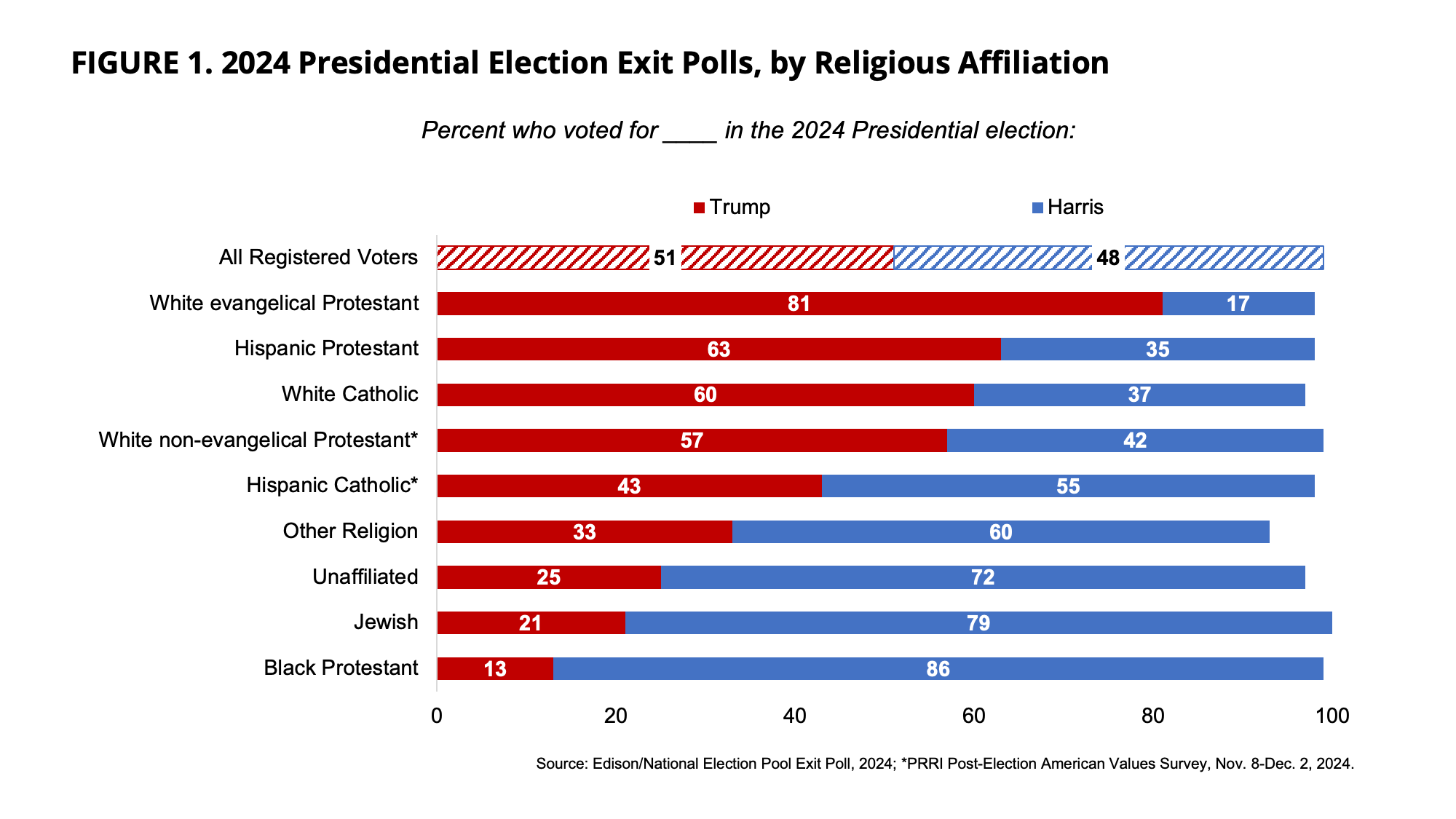
When we oppose Christian Nationalism, we’re fighting against the form of faith-based policy-making that that group specifically tends to support. It’s not because they’re racist (even though a whole bunch of them are racist) but because we’re trying to be as specific as possible when discussing where the problem stems from.
Elsewhere in his piece, Smith argues that Christian Nationalist discourse has been popularized in part because “there is a group of politicians, theologians, and right-wing influencers who really do advocate for radical ideologies” (emphasis his), but he doesn’t go the next step. He doesn’t say the concern is that is that those beliefs, no matter how radical, are now taken seriously by people in the highest levels of government. And they have the votes—and a rubber-stamping administration—to enact their wish list.
He concludes:
… our research suggests that the Christian nationalism discourse does not capture what millions of Americans who are branded with the label actually want or believe. There are very real conflicts over the appropriate role of Christianity in public life and over religious influences on social policy, and our data reflects this. But such conflicts are nothing new and should fall well within the boundaries of legitimate disagreement in a liberal democracy.
These are not differences of opinion. There are not harmless debates. We’re talking about faith-based exemptions from vaccines, a Supreme Court that has allowed abortion to be banned across the country, state lawmakers who want to impose their brand of Christianity upon students (along with the coercion and peer pressure that comes with it), and an elevation of mythology over fact.
These are genuine threats to those of us who want to live in this country.
In some cases, these are genuine threats to those of us who want to live, period.
Smith wants us to treat these conflicts as ordinary disagreements. But when government elevates one tradition’s holy book in public schools, gives official platforms to religious exercises, or uses religious doctrine to restrict people’s rights, it’s already chosen a side. Christian Nationalism doesn’t need majority support for a theocracy to be concerning. We’re already seeing it in action.
The policies might sound modest on their own, but they’re steadily teaching people whose faith counts—and whose rights are negotiable. Call that whatever you want. The consequences are real.
In a liberal democracy, you can have a debate of ideas. There’s no debate to be had with people fully convinced God is on their side and everyone else is the enemy.
That's all we need now: a Christian Nationalist apologist. Blunt Fact: THE FIRST THING I think of when I think of Christian Nationalism is January 6th, 2021. I especially think of those flags that said something to the effect of: "Jesus is my Savior; Trump is my President." I also think of that prayer that was held on the floor of the House when the rioters (yeah, that's what they were!) took over that chamber and thanked Jesus for their ability to exercise their god-given rights.
Whether this schmuck Smith wants to admit it or not, THAT is the face of Christian Nationalism, that and every bible-thumping jackass who says that Trump is the chosen one, that James Talarico is gay, and that Democrats are the real threat. Smith wants to sanitize Christian Nationalism.
We can't let him do that.
The so-called Christian Nationalists would be only too happy to turn the American Republic into a theocracy with their own narrow version of Christianity making the rules for everyone. Fortunately, for the people who want nothing to do with theocracy, rights are not matters of majority rule. It doesn't matter how many people want to force their religion into the public schools and on others, It's unconstitutional. Rights exist protect the individual from the tyranny of the majority, and groups like the Christian Nationalists.